A single small word part can completely change a word. Add un- to kind, and it becomes unkind. Add -ness to kind, and it becomes kindness. Add -ly to quick, and it becomes quickly. Readers who notice these parts have a powerful tool: they can unlock the meaning of many words they have never seen before.
When you read, you do not need to memorize every word in the world. Instead, you can learn how words are built. Many English words are made from smaller meaningful parts. If you know what those parts mean, you can often make a smart guess about the whole word. This is especially helpful with long words in stories, science books, social studies texts, and directions.
Long words can look confusing at first. But many long words are really built from pieces. A word might have a base word, a prefix at the beginning, and a suffix at the end. When readers break a word into these parts, the word becomes easier to read and understand.
For example, look at the word carelessness. You can break it into care + less + ness. Even if you have not studied this exact word before, knowing the parts helps. The base word care gives the main idea. The ending changes the meaning and shows what kind of word it is. That is how morphology, the study of word parts and meanings, helps readers.
Prefix means a word part added to the beginning of a base word.
Suffix means a word part added to the end of a base word.
Base word means the main part of a word that carries its core meaning.
Word parts also help with pronunciation. If you see a long word like disrespectful, you can chunk it into dis + respect + ful. Reading it in parts often makes it easier to say and understand.
A prefix is added to the beginning of a word and changes its meaning, as [Figure 1] shows with several common examples. Prefixes do not usually stand alone. They work together with a base word. If you know a prefix's meaning, you can use it as a clue.
Some prefixes tell you that something is the opposite. Some tell you that something happens again. Others tell you that something is apart, away, or not. In grade 4, three especially useful prefixes are un-, re-, and dis-.
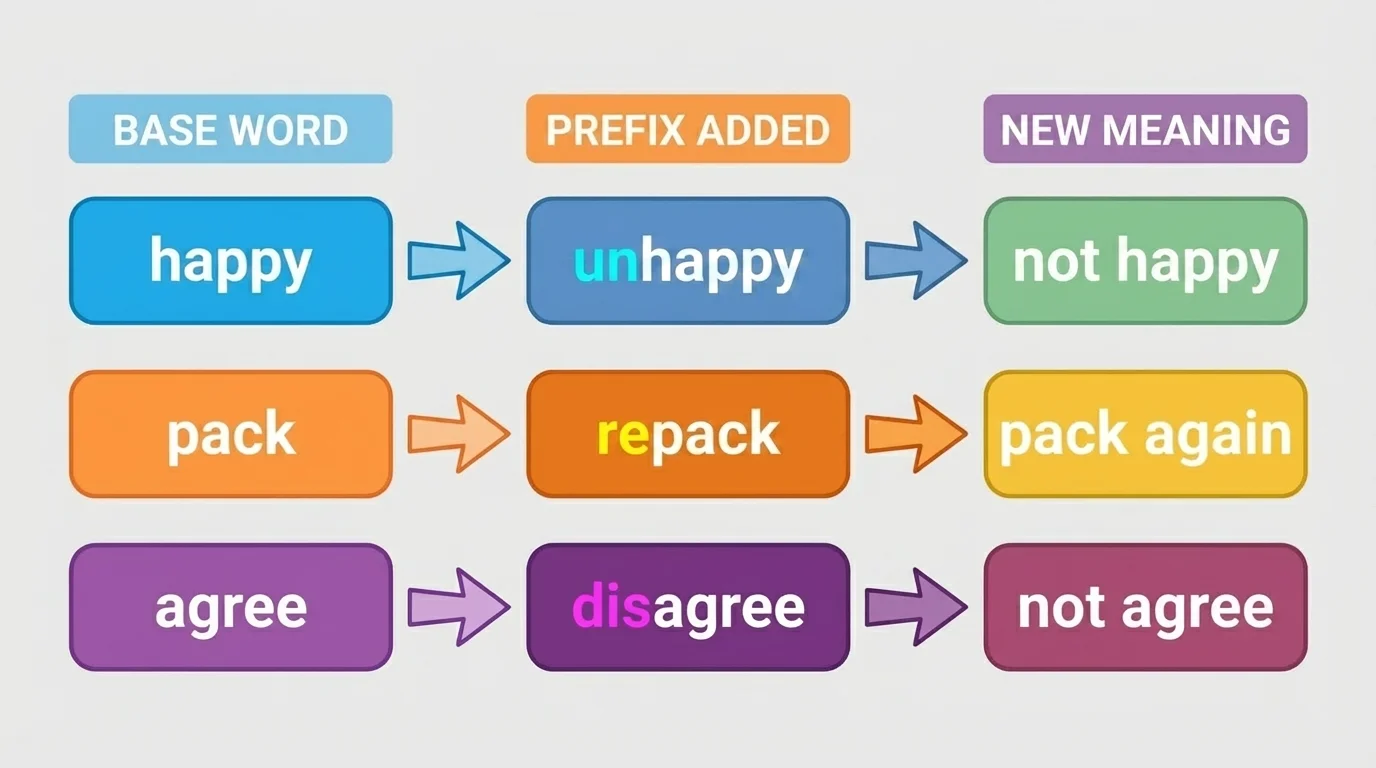
The prefix un- often means not or the opposite of. When un- is added to a base word, it changes the meaning.
Examples include unhappy meaning not happy, unsafe meaning not safe, and untie meaning to undo a tie or knot. In some words, un- creates an opposite idea. In others, it means to reverse an action.
Here are more examples:
Notice that the base word still gives an important clue. If you know fair, then unfair is easier to understand. You can think, "This must mean not fair."
The prefix re- often means again or back. This prefix is common in school directions. If a teacher says to rewrite a sentence, that means write it again. If you replay a song, you play it again.
Examples include rebuild, retell, return, and recheck. Sometimes re- means to do the action one more time. Sometimes it means to go back.
Think about these words:
If you see reread the paragraph, the prefix tells you the action happens again. This is a strong clue to the word's meaning.
The prefix dis- can mean not, opposite of, or apart. This makes it a very useful but sometimes tricky prefix. You have to pay attention to the base word and the sentence.
Examples include disagree meaning not to agree, dishonest meaning not honest, and disconnect meaning to separate a connection. In each case, the base word matters.
Here are more examples:
Later, when you meet words like disrespectful, the same idea helps. If respectful means showing respect, then disrespectful suggests not showing respect.
Many English prefixes came from older languages such as Latin. That is one reason the same prefix can appear in lots of different words.
Prefixes are powerful because they let one base word grow into many new words. A reader who knows a few common prefixes can understand many more words than a reader who only tries to memorize whole words.
A suffix is added to the end of a word and can change both its meaning and the job it does in a sentence, as [Figure 2] illustrates. Some suffixes turn adjectives into nouns. Some turn adjectives into adverbs. Some add the idea of being full of something.
Three useful suffixes are -ful, -ly, and -ness. Learning these endings helps readers understand unfamiliar words in books and conversations.
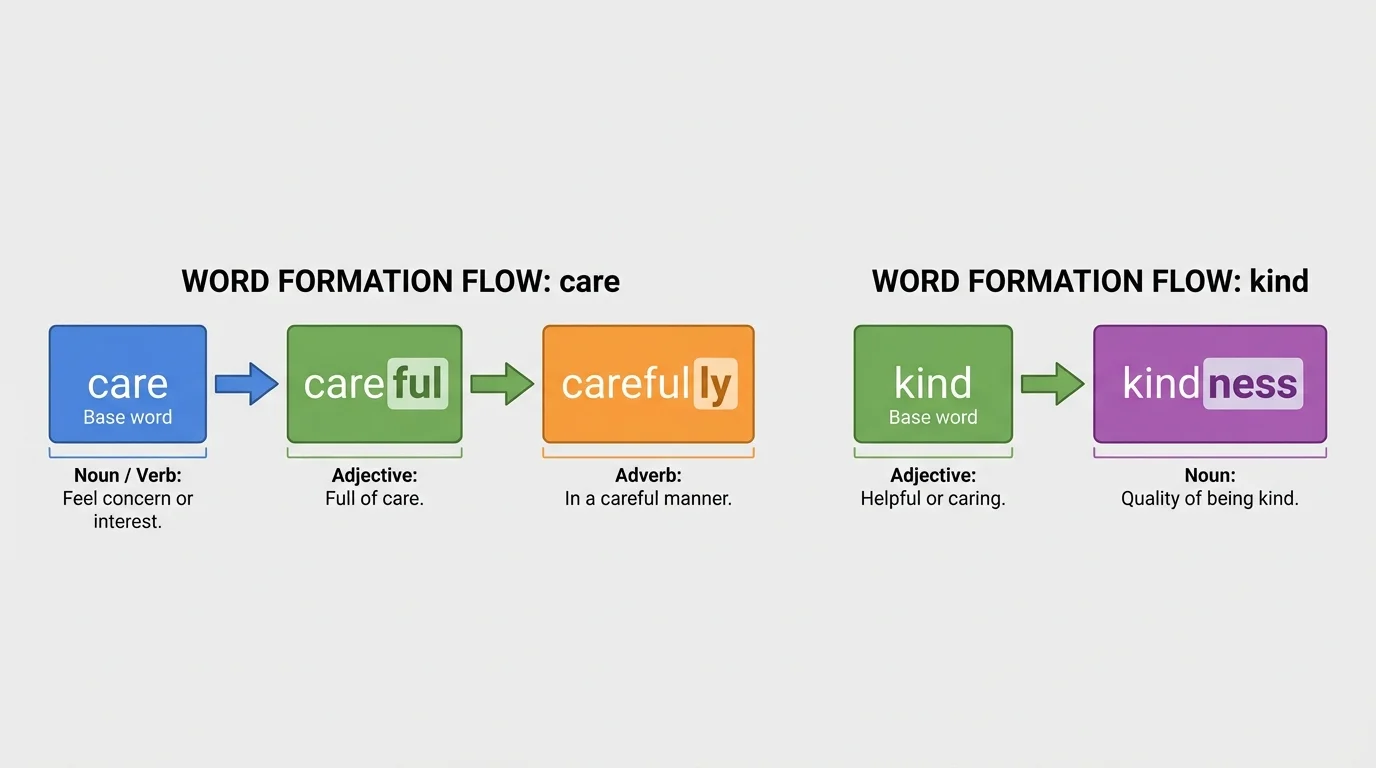
The suffix -ful often means full of or having a quality. When it is added to a base word, it usually creates an adjective, a word that describes.
Examples include helpful, thankful, joyful, and careful. If someone is helpful, that person is full of help or gives help. If someone is careful, that person shows care.
This suffix helps readers picture a quality. A colorful painting has lots of color. A hopeful character has hope.
The suffix -ly often turns an adjective into an adverb. An adverb often tells how something happens. For example, quick becomes quickly, and slow becomes slowly.
In a sentence like "The rabbit moved quickly," the word quickly tells how the rabbit moved. In "She spoke softly," the word softly tells how she spoke.
Not every word ending in -ly is an adverb, but many are. That is why readers should use both the suffix and the sentence context to decide what the word means.
The suffix -ness turns many adjectives into nouns. A noun names a person, place, thing, or idea. When you add -ness, the word often becomes the name of a quality or condition.
Examples include kindness, sadness, darkness, and illness. The word kind describes a person, but kindness names the quality of being kind.
This ending is especially helpful in reading because it often tells you that the word names an idea. In a sentence such as "Her kindness cheered the class," the word kindness is not describing. It is naming a quality.
| Word Part | Usually Means | Example | Meaning of Example |
|---|---|---|---|
| un- | not; opposite of | unfair | not fair |
| re- | again; back | replay | play again |
| dis- | not; opposite of; apart | disagree | not agree |
| -ful | full of | helpful | full of help; giving help |
| -ly | in a certain way | quietly | in a quiet way |
| -ness | state or quality of | darkness | the state of being dark |
Table 1. Common prefixes and suffixes with their usual meanings and examples.
Many words in books for older readers have more than one syllable. These are called multisyllable words. Word parts help you decode them. Instead of trying to read the entire word all at once, you can break it into chunks.
Take the word carefully. You can see care + ful + ly. That makes the word easier to read and understand. The base word care tells the main idea. The suffix -ful creates careful, and the suffix -ly creates carefully, meaning in a careful way.
Now look at unhelpful. Break it into un + help + ful. The base word is help. The suffix -ful makes helpful, and the prefix un- changes it to the opposite: not helpful.
Words can grow step by step. A word does not always get just one extra part. Sometimes a base word changes more than once. For example, care can become careful, and then careful can become carefully. Seeing this growth helps readers understand longer words without feeling overwhelmed.
When you chunk a long word, try to find a familiar base word first. Then look at the beginning and the end. Ask yourself what each part adds to the meaning.
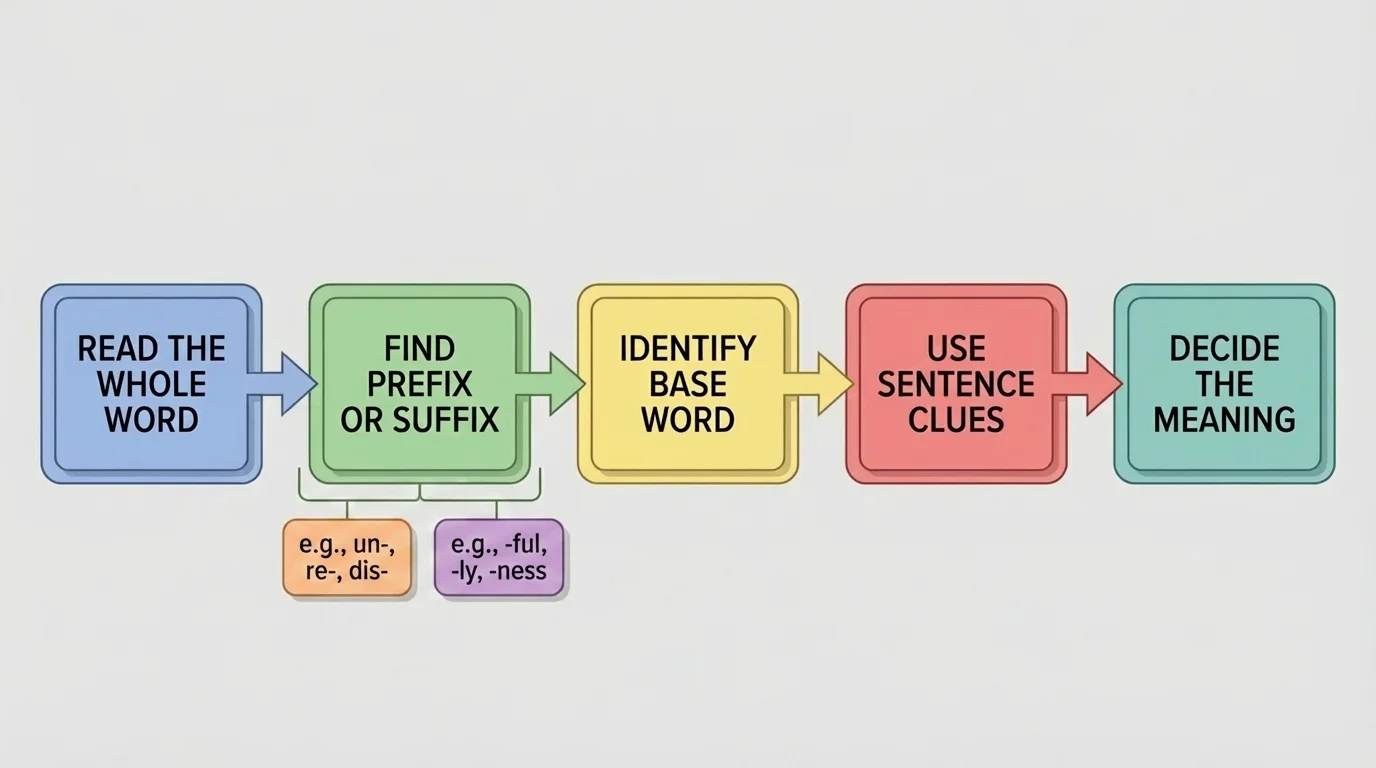
Good readers use more than one clue. When they meet an unfamiliar word, they can follow a simple process using context clues and morphology, as [Figure 3] explains. This strategy helps when a word appears in a story, an article, or a textbook.
Here is a useful method. First, read the whole sentence. Next, look for a prefix or suffix. Then find the base word. After that, combine the meanings of the parts. Finally, check whether your idea makes sense in the sentence.
Example: figuring out the word "dislike"
Sentence: "Mina dislikes loud noises during reading time."
Step 1: Find the parts.
The word has the prefix dis- and the base word like.
Step 2: Think about the meanings.
Like means to enjoy or feel pleased about something. Dis- often means not or the opposite.
Step 3: Put the meanings together.
Dislike means not like.
Step 4: Check the sentence.
"Mina dislikes loud noises" makes sense. It means Mina does not like loud noises.
The same process works for many words. Try it with reread, kindness, and careless. Even when the answer is not perfect at first, the strategy helps you make a strong guess.
Context matters too. In the sentence "Please refill your water bottle," the prefix re- suggests again. The base word fill confirms the meaning. So refill means fill again. This same kind of thinking appears in many school subjects, just as [Figure 3] shows in its step-by-step routine.
Word study is helpful, but it is not magic. Sometimes a word part has more than one meaning. For example, dis- can mean not, opposite of, or apart. Readers must use the whole word and the sentence to choose the best meaning.
Spelling can change a little when suffixes are added. For example, happy becomes happiness. The y changes to i before -ness is added. Readers do not need to memorize every spelling rule right away, but they should notice that the base word is still there.
Also, not every group of letters is truly a prefix or suffix. A word may begin with letters that look like a prefix but are simply part of the base word. That is why readers should ask, "Does this chunk really make sense here?"
You already know that sentences give clues about meaning. Word parts do not replace sentence meaning. They work together with it.
Another tricky point is that some words can have more than one meaning. The word refill can be a verb, as in "Please refill the cup," or a noun, as in "I need a refill." The prefix still gives a clue, but the sentence shows how the word is being used.
These word parts appear everywhere. In classroom directions, you may see words like rewrite, recheck, or disagree. In stories, you may meet words like unkind, hopeful, or darkness. In science reading, you might see words such as carefully in instructions or unlikely in explanations.
Knowing prefixes and suffixes also helps with writing. If you want to describe a character, you might choose helpful or fearful. If you want to explain how an action happened, you might use quietly or bravely. If you want to name a quality, you might use kindness or sadness.
Sports, games, and hobbies use these word parts too. A coach might ask players to repeat a drill. A music teacher may ask students to replay a section. A friend may act carelessly in a game, or a teammate may be especially helpful. Once you notice prefixes and suffixes, you start seeing them everywhere.
Example: using word parts and context together
Sentence: "The hikers moved carefully across the wet rocks."
Step 1: Spot the base word.
The base word is care.
Step 2: Notice the suffixes.
-ful makes careful, meaning full of care. -ly makes carefully, meaning in a careful way.
Step 3: Use the sentence.
The hikers are crossing wet rocks, so they need to move in a safe, cautious way.
Step 4: Decide the meaning.
Carefully means in a way that shows care.
As readers become more skilled, they begin to recognize patterns quickly. They no longer see every long word as a mystery. Instead, they look for the base word, notice the affixes, use context, and build meaning.
That is an important reading habit. It helps with decoding, with understanding vocabulary, and with learning across all subjects. The more often you notice common prefixes and suffixes, the more confident and accurate a reader you become.
