Some of the longest words you read are actually built from smaller word parts. A word that looks huge at first can become much easier when you notice the pieces inside it. Readers do this all the time. When you can break apart a long word, read each part, and think about what each part means, you unlock many new words without needing someone to tell you every one.
A multisyllabic word is a word with more than one syllable. Words like basket, careful, disappear, and celebration all have several syllables. Good readers do not try to read the whole word all at once. They look for parts they know.
For example, the word jumping can be read as jump + ing. The word fearless can be read as fear + less. The word teacher can be read as teach + er. When you know how the ending works, the word becomes less mysterious.
You already know that syllables are word parts you can hear when you say a word aloud. Clapping the beats in a word can help: teach-er has two beats, and cel-e-bra-tion has four.
Reading long words is not only about sounding them out. It is also about understanding what the word means. Sometimes an ending changes only the time or number of a word. Other times the ending creates a new word with a new meaning.
Many long words are easier to read when you study their parts. The main parts to know are a base word, a root, a prefix, and a suffix.
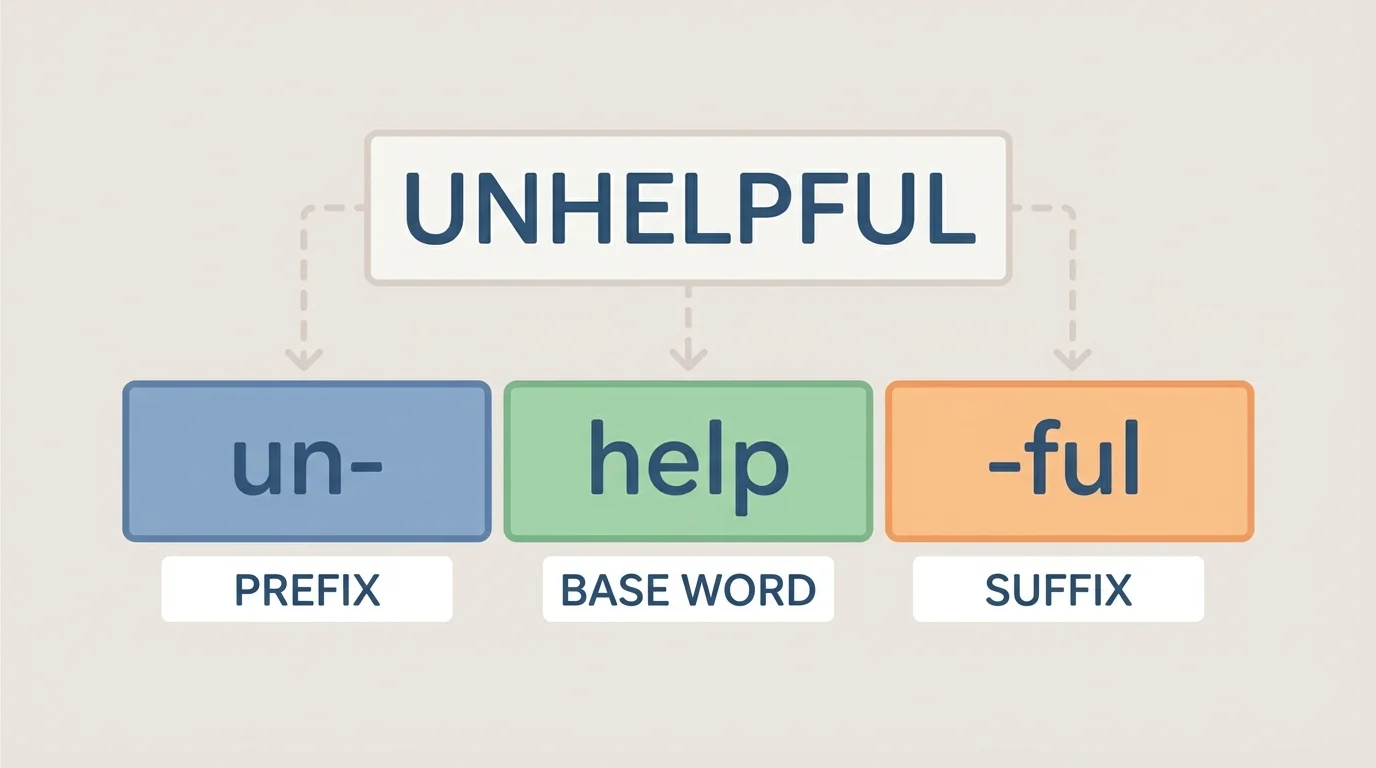
[Figure 1] A base word is a word that can stand by itself, such as play, hope, or care. A root is the main meaning part of a word. Sometimes the root can stand alone, and sometimes it cannot. A prefix comes at the beginning of a word, and a suffix comes at the end.
Look at these examples: replay is re + play. hopeless is hope + less. careless is care + less. When readers notice these chunks, they can decode more quickly and understand more deeply.
Inflectional suffixes are endings that change a word a little, such as showing number, tense, or comparison, but they do not change the word's basic meaning.
Derivational suffixes are endings that create a new word. They often change the word's meaning and sometimes change the part of speech too.
If you think back to the word parts in [Figure 1], the suffix is the ending piece. That ending might simply show that something already happened, like walked, or it might help form a new word, like happiness.
An inflectional suffix changes a word so it can fit correctly in a sentence, but it does not change the word's core meaning. The word is still about the same action, thing, or quality.
Common inflectional suffixes include -s and -es for more than one, -ed for past tense, -ing for an action happening now or over time, and -er and -est for comparisons.
Here are some examples: cat becomes cats, wish becomes wishes, jump becomes jumped, jumping keeps the same main action, and fast becomes faster and fastest. The word changes form, but the basic meaning stays connected to the original word.
Notice that some inflectional suffixes can appear on multisyllabic words too. Remember becomes remembered. Follow becomes following. gentle becomes gentler. Even when the word is longer, the suffix still works in the same way.
Reading words with inflectional suffixes
Step 1: Look for the ending.
In painted, the ending is -ed.
Step 2: Find the base word.
The base word is paint.
Step 3: Read the whole word.
Blend the parts: paint + ed = painted.
Step 4: Check the meaning.
Painted means someone already put paint on something.
This same method works with singing, boxes, and smallest. When the suffix is familiar, the word often becomes easier to decode right away.
A derivational suffix often does more than adjust a word. It can create a different word with a different role in the sentence. For example, a verb can become a noun, an adjective can become an adverb, or a noun can become an adjective.
Some common derivational suffixes are -ful, -less, -ly, -ness, -ment, -tion, -able, and -er. These endings can help you understand the meaning of an unfamiliar word.
Look at these examples. care becomes careful, meaning full of care. careless means without care. happy becomes happiness, which names the feeling. move becomes movement, which names the action or process. educate becomes education, which names the process of teaching and learning.
Derivational suffixes can also change a word's part of speech. quick is an adjective, but quickly is an adverb. teach is a verb, but teacher is a noun. enjoy is a verb, but enjoyable is an adjective.
Many big academic words in science and social studies become easier when you notice derivational suffixes. Words like pollution, darkness, kindness, and readable all carry clues in their endings.
When you meet a long unknown word, a derivational suffix can act like a meaning clue. If you see -ly, the word often tells how something happens. If you see -ness, the word often names a state or quality. If you see -able, the word often means "can be."
Readers can follow a clear strategy when a long word appears. Instead of guessing, move through the word in a careful order.
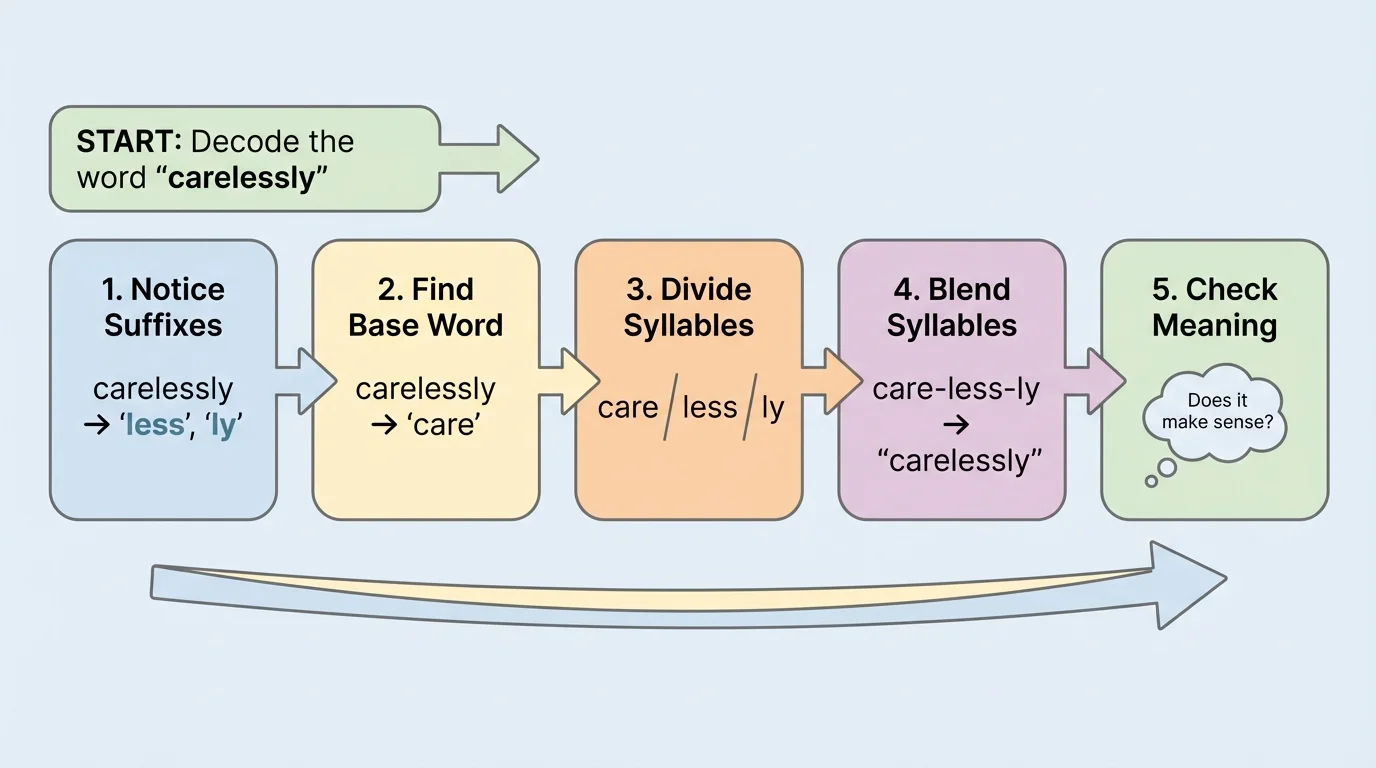
[Figure 2] First, look for an ending you know. A suffix at the end is often the easiest part to spot. Second, cover the suffix and look at the base word or root. Third, break the remaining word into syllables. Fourth, read each part and blend them together. Fifth, think about the meaning and ask whether it makes sense in the sentence.
Take the word carelessly. You may notice -ly at the end. Then you can see careless, and inside that is care + less. The syllables are care-less-ly. After blending the word, you can think about the meaning: it means in a careless way.
Try another example in your mind: disagreement. You might notice -ment at the end. Then you can spot agree in the middle, and the prefix dis- at the beginning. The word breaks into meaningful parts that support both reading and understanding.
Why this strategy works
Long words are often made from smaller, familiar parts. When you notice those parts, you reduce the amount of the word you have to solve at one time. This helps both pronunciation and meaning.
Later, when you read content-area words such as prediction, carefully, or fearlessness, the same process from [Figure 2] still helps. You notice the suffix, identify known parts, divide the word into syllables, and then confirm the meaning in context.
Sometimes the base word changes a little when a suffix is added. These spelling patterns can seem tricky, but they follow common rules.
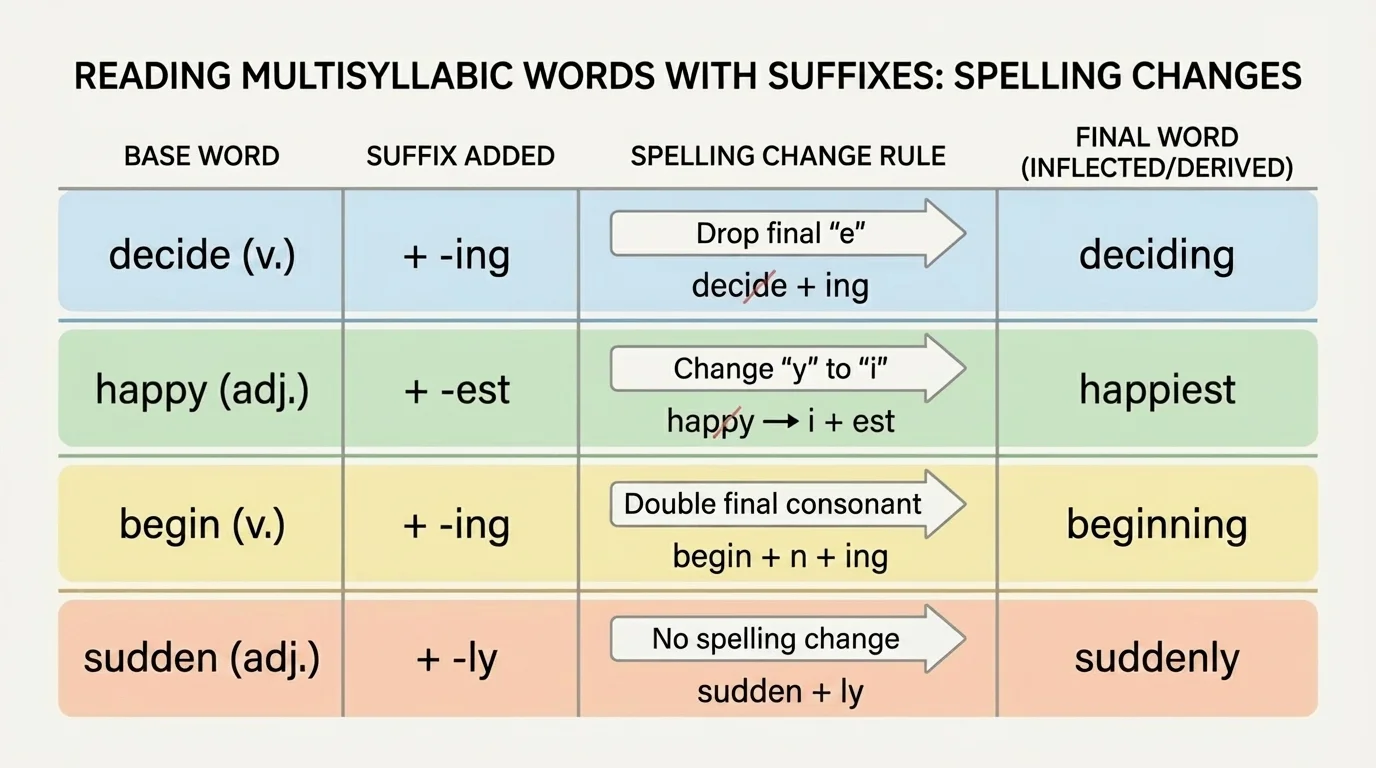
[Figure 3] One common change is dropping a silent e. The word make becomes making. The word hope becomes hoping. The final e drops before the suffix -ing or some other vowel suffixes.
Another common change is changing y to i. The word happy becomes happiest. The word easy becomes easier. The y changes to i before certain suffixes.
A third pattern is doubling the final consonant in some short words before adding a suffix. The word run becomes running. The word swim becomes swimmer. Readers should watch carefully because the base word is still there, even though the spelling changed a bit.
Sometimes there is no spelling change at all. quick becomes quickly. fear becomes fearless. teach becomes teacher.
| Base word | Suffix | New word | What changed? |
|---|---|---|---|
| make | -ing | making | Drop silent e |
| hope | -ing | hoping | Drop silent e |
| happy | -est | happiest | Change y to i |
| easy | -er | easier | Change y to i |
| run | -ing | running | Double final consonant |
| quick | -ly | quickly | No change |
Table 1. Common spelling changes that happen when suffixes are added to base words.
When you see a long word with a small spelling change, do not panic. Look for the word hiding underneath. The chart in [Figure 3] reminds you that the ending may change the spelling a little, but the base word still gives strong clues.
Decoding a word is only part of reading. You also need to understand it. Word parts help with this. If you know that -less means "without," then powerless means without power. If you know that -ful often means "full of," then hopeful means full of hope.
This is where morphology matters. Morphology is the study of word parts and how they build meaning. When readers use morphology, they do not just sound out a word. They ask, "What does this part mean?" and "How do the parts work together?"
Context also helps. Suppose you read: The careless driver forgot to check the road signs. Even if you were unsure of careless, the sentence suggests that the driver was not paying enough attention. The suffix -less supports that idea.
Using suffix meaning and context
Read the word fearless in this sentence: The fearless climber crossed the narrow bridge high above the river.
Step 1: Spot the suffix.
The ending is -less.
Step 2: Find the base word.
The base word is fear.
Step 3: Combine the meanings.
-less means "without," so fearless means "without fear."
Step 4: Check the sentence.
A person crossing a narrow bridge high above a river would need courage, so the meaning fits.
Some words can have more than one meaning, and context helps you choose the correct one. The word teacher clearly means a person who teaches. But a word like runner could mean a person who runs, a long rug in a hallway, or a plant stem that spreads. The suffix helps, but the sentence tells you which meaning makes sense.
Word families help readers notice patterns. If you know act, then you may recognize acting, acted, action, and active. If you know observe, you may decode observer and observation.
In science, you might read words like movement, carefully, or colorless. In social studies, you might see government, agreement, or peaceful. In stories, you may meet darkness, hopeful, foolishness, or beautifully. Across subjects, the same suffix knowledge keeps helping.
| Base word | New word | Suffix type | Meaning clue |
|---|---|---|---|
| play | played | Inflectional | already happened |
| play | player | Derivational | a person who plays |
| hope | hopeful | Derivational | full of hope |
| kind | kindness | Derivational | the quality of being kind |
| small | smallest | Inflectional | more small than all the others |
| move | movement | Derivational | the act or process of moving |
Table 2. Examples of base words with inflectional and derivational suffixes and the meaning clues they provide.
As you read harder texts, you will see that suffixes do not belong only to language lessons. They appear everywhere. That is why learning them is such a powerful reading tool.
One common mistake is skipping the ending and reading only the base word. A reader might see jumped and say jump. To fix this, train your eyes to sweep all the way to the end of the word.
Another mistake is guessing from the first few letters. A reader might see careless and guess careful because both start with care. The suffix matters. Read the ending carefully before deciding.
Some readers also forget to check whether the meaning makes sense. You may decode the sounds correctly but still choose the wrong meaning. Always test the word in the sentence.
"Good readers look at all the parts of a word and then ask, 'Does this make sense?'"
A smart fix is to slow down just enough to notice patterns. Find the suffix. Find the base word. Watch for spelling changes. Read the syllables. Then connect the parts to meaning. This is how readers grow stronger with every new text.
