Have you ever been reading a story or an article and suddenly hit a word that seems impossible, but then the next few words help you understand it? Strong readers notice that authors are often helpful in subtle ways. They do not always stop and say, "Here is the definition," but they often explain a hard word right inside the sentence or nearby. Learning to catch those explanations turns you into a word detective.
When you read, you will not know every word. That is normal. Good readers do not give up every time they see an unfamiliar word. Instead, they use the words and sentences around it to figure out what it probably means. This is called using context clues.
One of the most helpful kinds of context clues is an explanation clue. An author may define the word, restate it in simpler language, give examples, or add a phrase that tells what the word means. If you learn to spot these explanations, you can understand stories, science articles, social studies passages, and directions much more easily.
Context clues are hints in the words and sentences around an unfamiliar word that help a reader figure out its meaning.
Infer means to make a smart guess based on evidence.
Explanation clue is a kind of context clue in which the author explains the meaning of a word in the sentence or nearby text.
This skill matters because reading is not only about saying the words. It is about understanding them. When you infer word meanings as you read, you stay focused on the big idea instead of getting stuck on one word.
Context clues can come in different forms. Sometimes the clue is a synonym, which is a word with a similar meaning. Sometimes it is an antonym, a word with the opposite meaning. In this lesson, the main focus is on explanation clues, where the author gives enough information for you to work out the meaning.
For example, read this sentence: "The puppy was frantic, running in circles and whining because it could not find its owner." Even if you have never seen the word frantic before, the explanation "running in circles and whining" helps you infer that it means very upset, wild, or worried.
Notice that the sentence does not use a dictionary definition. Instead, it gives actions that explain the word. Readers combine those actions into a likely meaning.
You already know that sentences work together to make meaning. Instead of looking at one word alone, read the whole sentence and sometimes the sentences before and after it. The clue you need may be nearby.
Sometimes a word may still seem a little fuzzy after one sentence. That is okay. Readers often gather clues little by little. The goal is not always to find the perfect dictionary wording. The goal is to understand the word well enough to make sense of the text.
Authors explain unknown words in several common patterns. Once you know these patterns, you can spot them much faster while reading.
One pattern is a direct definition. The author gives the meaning clearly. Example: "A nocturnal animal is an animal that is active at night." The phrase "active at night" directly explains the word.
Another pattern is a restatement. The author says the word, then says it again in simpler language. Example: "The ground was parched, or very dry, after weeks without rain." The word or signals that an explanation is coming.
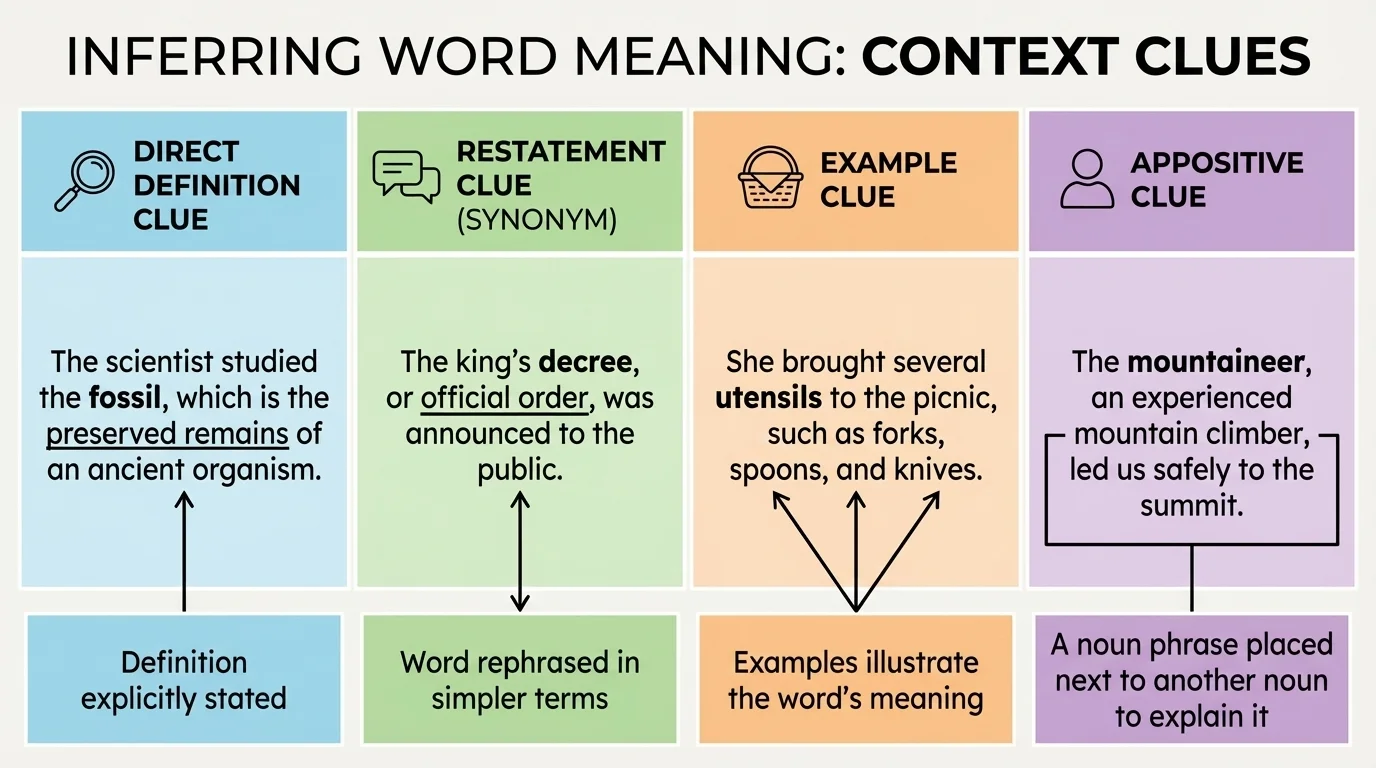
A third pattern uses examples. Example: "Many insects go through metamorphosis. For example, a caterpillar changes into a butterfly." The example helps you infer that metamorphosis means a major change in form.
A fourth pattern is an appositive, which is a word or phrase placed next to another word to explain it. Example: "My brother is a novice, a beginner at skateboarding." The phrase "a beginner at skateboarding" explains the unknown word.
Writers also use signal words and phrases such as or, that is, which means, called, for example, and such as. These do not always appear, but when they do, they often point straight to an explanation.
| Clue type | What the author does | Example signal |
|---|---|---|
| Direct definition | Tells the meaning clearly | is, means, is called |
| Restatement | Says it again in simpler words | or, that is, in other words |
| Example clue | Gives examples that show the meaning | for example, such as |
| Appositive | Adds a phrase next to the word to explain it | commas often set it off |
Table 1. Common types of explanation clues that help readers infer word meaning.
Later, when you read a science article or a chapter book, these same patterns appear again and again. As you saw earlier in [Figure 1], the explanation may look different each time, but the job is the same: it helps the reader unlock the unknown word.
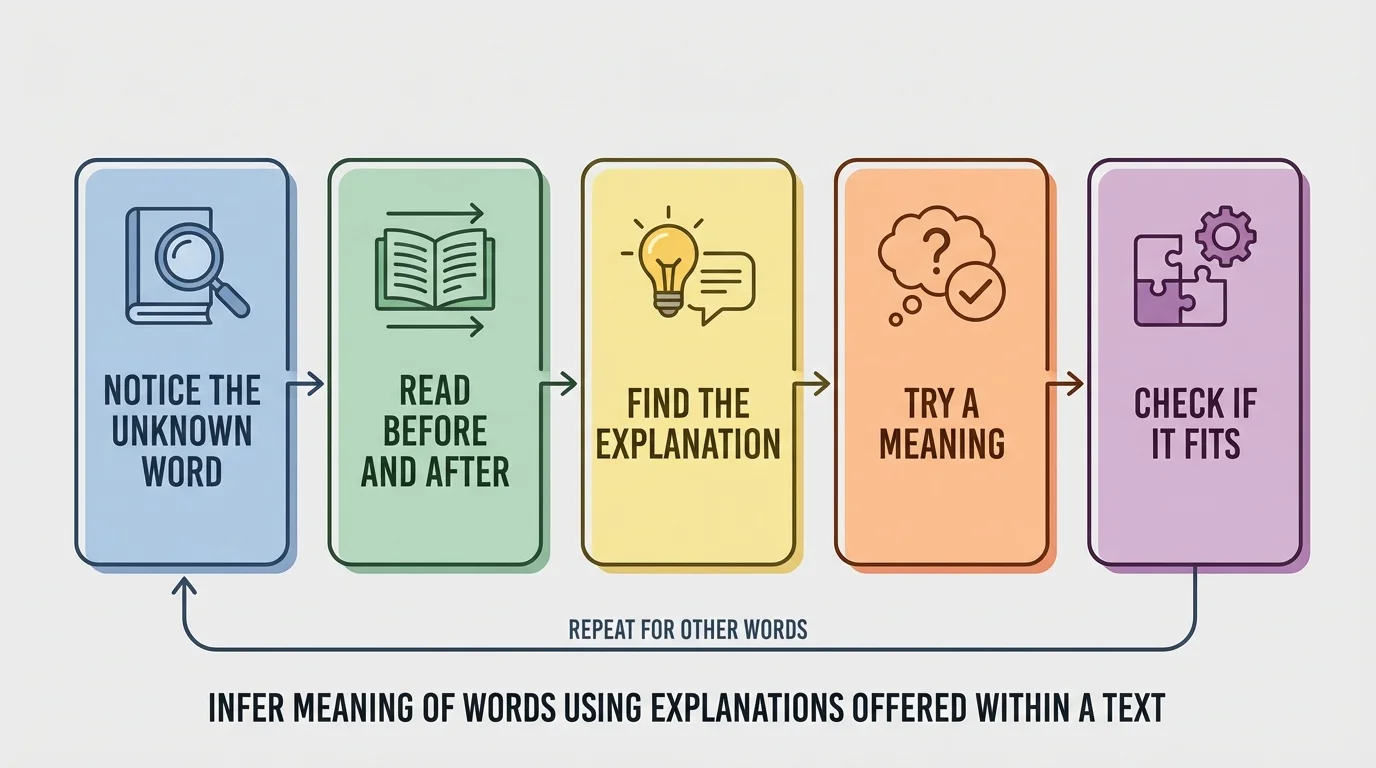
Figuring out a word from explanations works like a set of detective steps. Strong readers often do these steps quickly in their minds.
Step 1: Notice the unfamiliar word. Stop just long enough to recognize that the word is important and not fully understood.
Step 2: Read the whole sentence carefully. Do not guess too fast. The explanation may be right after the word or at the end of the sentence.
Step 3: Read the sentence before and the sentence after if needed. Sometimes the author spreads the clue across more than one sentence.
Step 4: Look for explanation patterns. Ask yourself: Does the author define it? Restate it? Give examples? Add an explaining phrase?
Step 5: Try a meaning in your own words. You do not have to sound like a dictionary. A simple meaning that fits is enough.
Step 6: Check whether your meaning makes sense in the sentence and paragraph. If it fits, keep reading. If not, look again for a better clue.
Why checking matters
Sometimes a clue leads to a rough meaning, but not the exact one. By placing your guessed meaning back into the sentence, you can test it. If the sentence sounds strange, the guess may need to be adjusted.
For example, in the sentence "The glass was fragile, so it could break easily," the explanation suggests that fragile means easy to break. If you replace the word with your guess, the sentence still makes sense. That is a good sign.
Now let us study several examples closely. Each one shows a different way an explanation can help.
Example 1
"The desert looked barren, with almost no plants or trees growing there."
Step 1: Find the unknown word.
The unknown word is barren.
Step 2: Find the explanation in the sentence.
The phrase "with almost no plants or trees growing there" explains the condition of the desert.
Step 3: Infer the meaning.
Barren probably means empty of plant life or not able to grow much.
Here, the explanation comes after a comma and gives details that help shape the meaning.
Example 2
"Luis wore protective gear, such as a helmet, knee pads, and elbow pads, before riding his bike."
Step 1: Spot the clue type.
The phrase "such as" signals examples.
Step 2: Read the examples.
Helmet, knee pads, and elbow pads are all items that keep someone safe.
Step 3: Infer the meaning.
Protective gear means equipment worn to protect the body.
Examples are powerful because they give you real items or actions that point to the meaning.
Example 3
"My grandmother is generous, always sharing her time and giving thoughtful gifts."
Step 1: Look at the actions.
She shares her time and gives thoughtful gifts.
Step 2: Connect the actions to the word.
These are signs of kindness and giving.
Step 3: Infer the meaning.
Generous means willing to give and share with others.
Action clues often explain describing words very well. Instead of defining a word directly, the author shows what the word looks like in real life.
Sometimes the clue is not sitting beside the unknown word. It may appear in the next sentence or even earlier in the paragraph. That is why careful readers do not look at only one sentence.
Read this short paragraph: "Polar bears need a suitable habitat. They live in icy areas where they can hunt seals and move across sea ice." If you do not know the word habitat, the second sentence explains it. A habitat is the place where an animal lives.
Here is another example: "Mia did not want to reveal the surprise. She kept the party plans secret all week." The second sentence explains that reveal means to tell or show something that had been hidden.
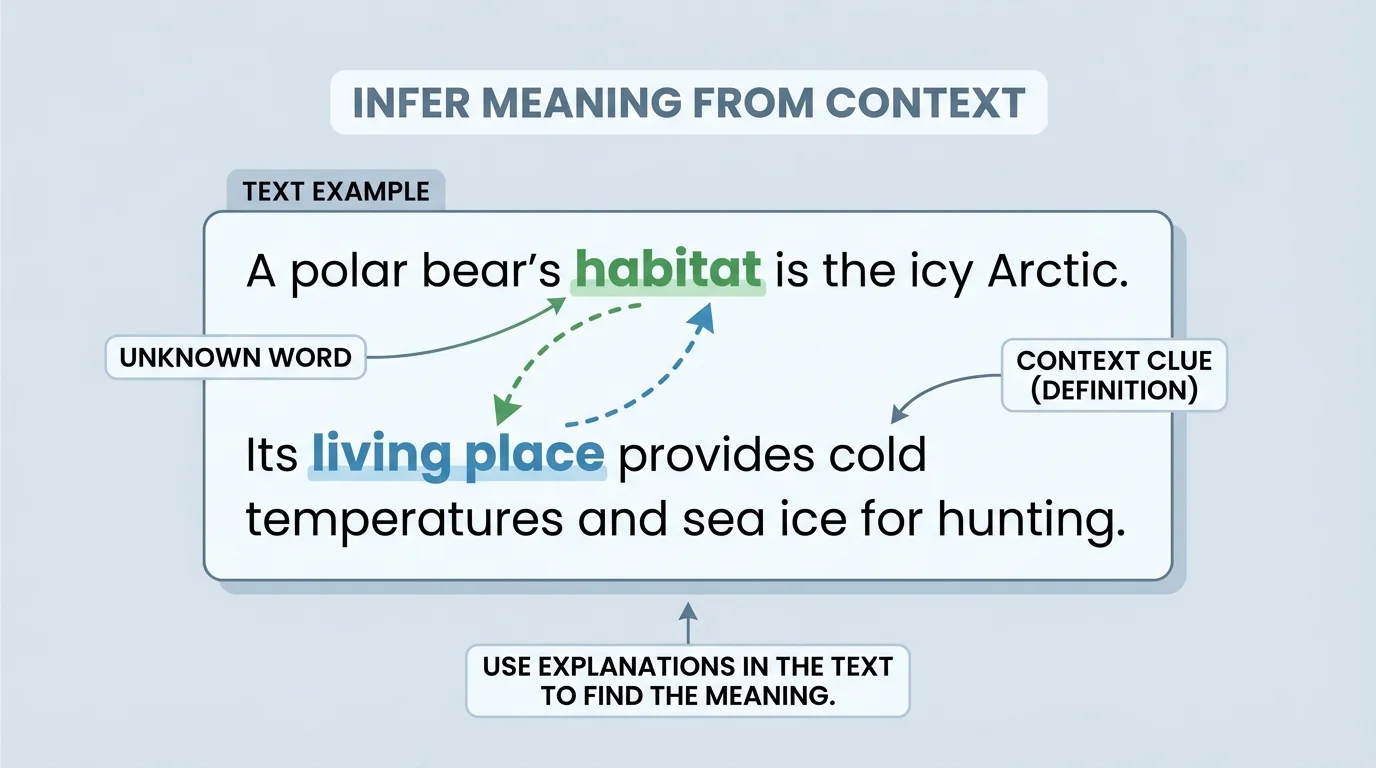
This is why rereading helps. If a word seems confusing, go back and look around it. Often, the author already gave you the answer. Sometimes the explanation may come one sentence later instead of immediately.
Some words have more than one meaning. Explanation clues help readers choose the correct one.
Take the word bat. In one text, "The bat slept upside down in the cave," nearby details tell you it means the animal. In another text, "Jalen swung the bat and hit the ball," the surrounding details tell you it means sports equipment.
Now look at the word crane. "We watched the crane lift heavy steel beams." The explanation about lifting steel beams shows that crane is a machine. But in "A tall crane stood still in the marsh," details about standing in a marsh show that it is a bird.
Many common English words have several meanings. Readers choose the right meaning by paying attention to how the word is used in the sentence and what the author explains around it.
When a word has more than one meaning, do not grab the first meaning you remember. Let the text guide you.
Sometimes explanation clues and word parts work together. This is especially helpful with long words. If you notice a familiar base word, prefix, or suffix, you can combine that clue with the explanation in the sentence.
For example: "The preview showed scenes from the movie before it was released." The prefix pre- means before. The sentence also explains that it happened before the movie was released. Together, those clues help you infer that preview means something seen ahead of time.
Try another one: "The careless spill was preventable because a lid could have stopped it." The suffix -able often means can be done. The phrase "a lid could have stopped it" explains the idea too. So preventable means able to be prevented.
Using more than one strategy
Flexible readers do not rely on only one clue. They may use explanation clues, examples, prefixes, suffixes, and familiar base words together. The more evidence they gather, the stronger their meaning guess becomes.
This is especially useful for multisyllable words. A long word can seem intimidating at first, but if you break it into parts and read the explanation around it, it becomes much easier to understand.
This skill is helpful in every subject. In science, authors often explain special words because the topic includes precise vocabulary. For example: "Evaporation occurs when liquid water changes into water vapor." Even if evaporation is new, the sentence explains it.
In social studies, you may read: "A colony is a territory controlled by another country." Again, the explanation is built into the sentence. You can understand the word without stopping the whole reading.
In stories, authors may explain feelings, actions, or traits through description. "Tasha was reluctant. She paused at the door, frowned, and said she was not sure she wanted to go in." Those details explain that reluctant means unsure or unwilling.
When you move from one subject to another, the strategy stays the same. Look for the explanation, connect it to the unknown word, and test your idea.
One mistake is guessing too quickly from only the first few words. The best clue may appear later in the sentence.
Another mistake is using only one nearby word instead of the full explanation. For instance, if you see "The cave was damp, with wet walls and cool air," the full phrase "with wet walls and cool air" explains the word better than using just one word nearby.
A third mistake is choosing a meaning that does not fit the whole paragraph. If your guess makes one sentence work but makes the rest of the paragraph confusing, check again.
Finally, do not assume that every hard word has a direct definition beside it. Sometimes the clue is an action, an example, or a sentence that comes later.
"Good readers do not just look at a hard word. They look around it."
That habit of looking around the word is what makes this strategy so powerful.
The more you read, the more often you will notice authors quietly helping you. A hard word may be followed by a simple phrase, an example, a description, or a second sentence that makes the meaning clear.
When you come to an unfamiliar word, pause, read around it, and hunt for an explanation. Use the sentence, the paragraph, and even the word parts if they help. You do not need to know every word immediately. You need to gather clues and make a smart meaning guess.
That is what skilled readers do. They stay curious, think carefully, and let the text teach them the meaning of new words.
