Have you ever tried to build something with the wrong instructions, or listened to a story that jumped around so much you got confused? Good writing works much like a good map: it helps the reader know where to go next. When writers choose the right organization, their ideas make sense. When they choose the wrong one, even strong facts can feel mixed up.
Informative writing is writing that teaches, explains, or describes. A writer may want to tell the steps for making applesauce, describe the layers of a rainforest, explain why shadows change during the day, or compare two kinds of weather. Each purpose needs a structure that matches it. That is why learning about text structure is such an important writing skill.
A text structure is the way a writer organizes ideas in a piece of writing. Structure is not just how a paragraph looks on the page. It is the pattern the writer uses to help the reader understand the information.
If a writer wants to show steps, the writing should move in order. If a writer wants to show how two things are alike and different, the writing should group similarities and differences. If a writer wants to explain why something happens, the writing should connect reasons and facts. The structure should match the writer's purpose.
Purpose is the writer's reason for writing. Text structure is the pattern the writer uses to organize ideas so the purpose is clear to the reader.
Readers also use text structure as a clue. When readers notice words like first, next, and finally, they expect steps. When they see words like similar, both, and however, they expect a comparison. Strong readers and strong writers both pay attention to these patterns.
Writers often use five common structures in informative writing, as [Figure 1] shows. Each one helps organize information in a different way, and each one fits a different purpose.
The five structures are sequence, chronology, description, explanation, and comparison-and-contrast. Some texts are very short and use only one structure. Longer texts may include more than one, but one main structure usually stands out most clearly.
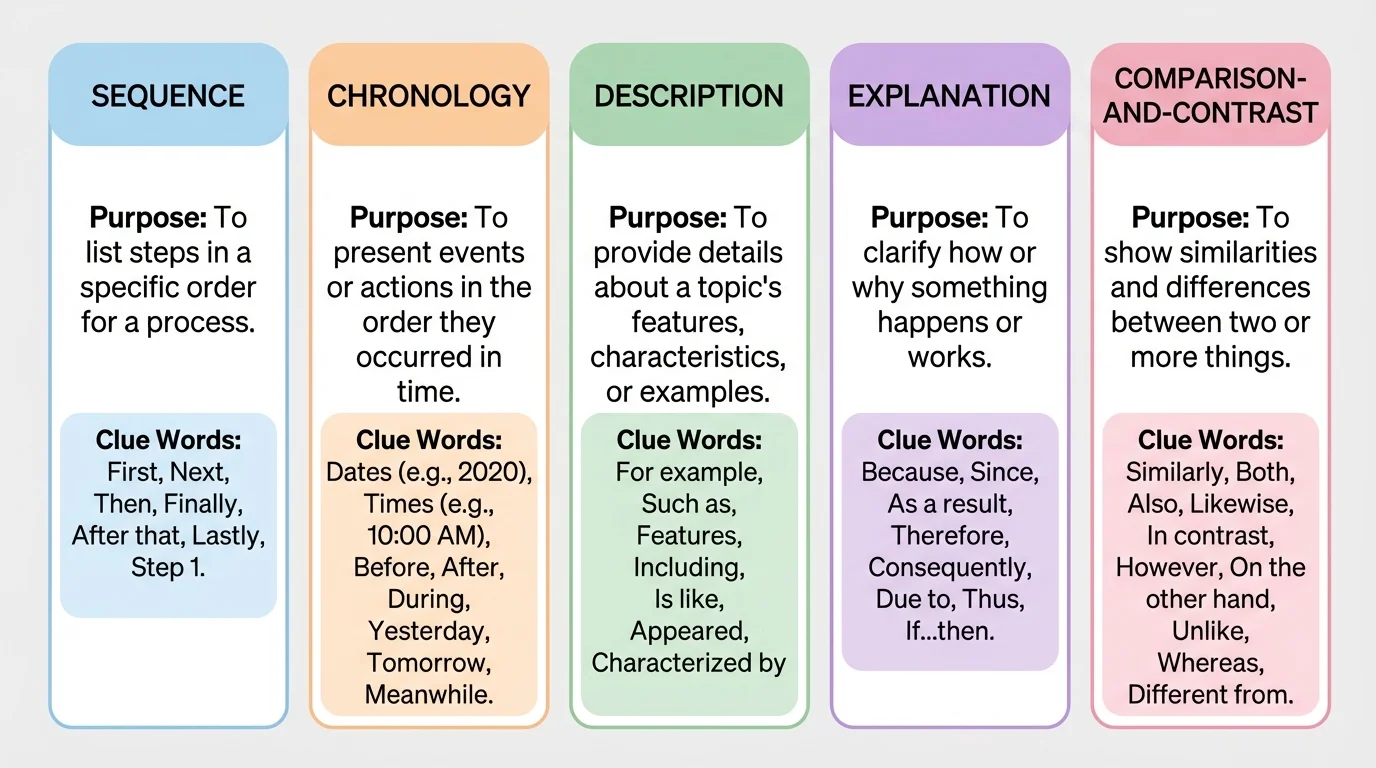
Learning to tell these structures apart is like learning to sort tools in a toolbox. A hammer, screwdriver, and wrench are all useful, but each one is best for a different job. Text structures work the same way.
| Text Structure | Main Purpose | Common Signal Words |
|---|---|---|
| Sequence | Show steps or directions | first, next, then, last |
| Chronology | Show events in time order | before, after, later, during |
| Description | Tell what something is like | for example, such as, looks like |
| Explanation | Tell how or why something happens | because, since, so, as a result |
| Comparison-and-Contrast | Show similarities and differences | both, unlike, similarly, however |
Table 1. The five main text structures, their purposes, and common signal words.
Signal words help readers notice a pattern, and in sequence writing they often point to steps. Sequence is used when a writer wants to tell how to do something in the correct order.
This structure is common in recipes, science procedures, craft instructions, game directions, and how-to articles. The order matters. If you mix up the steps, the reader may not be able to complete the task correctly.
Common signal words for sequence include first, second, next, then, after that, and finally. These words guide the reader from one action to the next, as [Figure 2] shows.
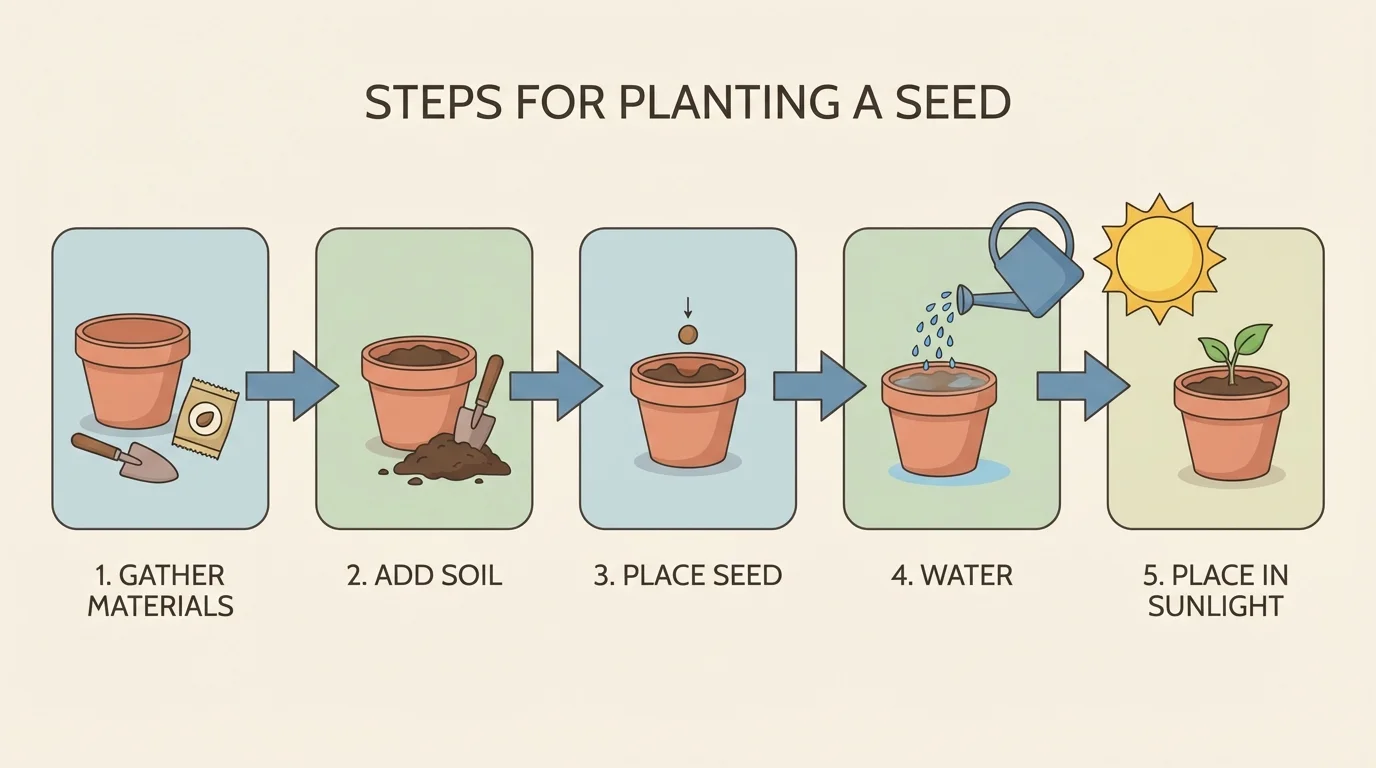
Here is a sequence example: First, wash the apple. Next, cut it into small pieces. Then, place the pieces in a pot with a little water. After that, cook the apples until they are soft. Finally, mash them into applesauce. The writing teaches a process, so sequence is the best structure.
Sequence is about order of steps. The main question it answers is, "What should happen first, next, and last?" Later, when you compare it with chronology in [Figure 1], notice that both use order, but sequence focuses on steps to do something, while chronology focuses on events in time.
Choosing sequence
A student wants to write about how to safely cross a busy street.
Step 1: Think about the purpose.
The purpose is to teach a procedure.
Step 2: Decide whether order matters.
Yes. Looking both ways should happen before walking.
Step 3: Choose the structure.
Sequence is the best choice because the writing gives steps in order.
When writing in sequence, use clear verbs and concrete details. Instead of saying Do the thing carefully, say Hold the bowl with both hands and stir slowly. Precise language helps the reader follow the procedure.
Chronology organizes events by time, as [Figure 3] shows with one event leading to another across a day. This structure tells what happened and when it happened.
Chronology is common in biographies, history writing, personal narratives, news reports, and descriptions of a day or event. A writer may begin with an earlier event and move forward in time. Sometimes the writer gives exact dates. Sometimes the writer uses words that show time order.
Common signal words for chronology include long ago, before, after, later, meanwhile, during, and at last. These words help readers track when events happen.
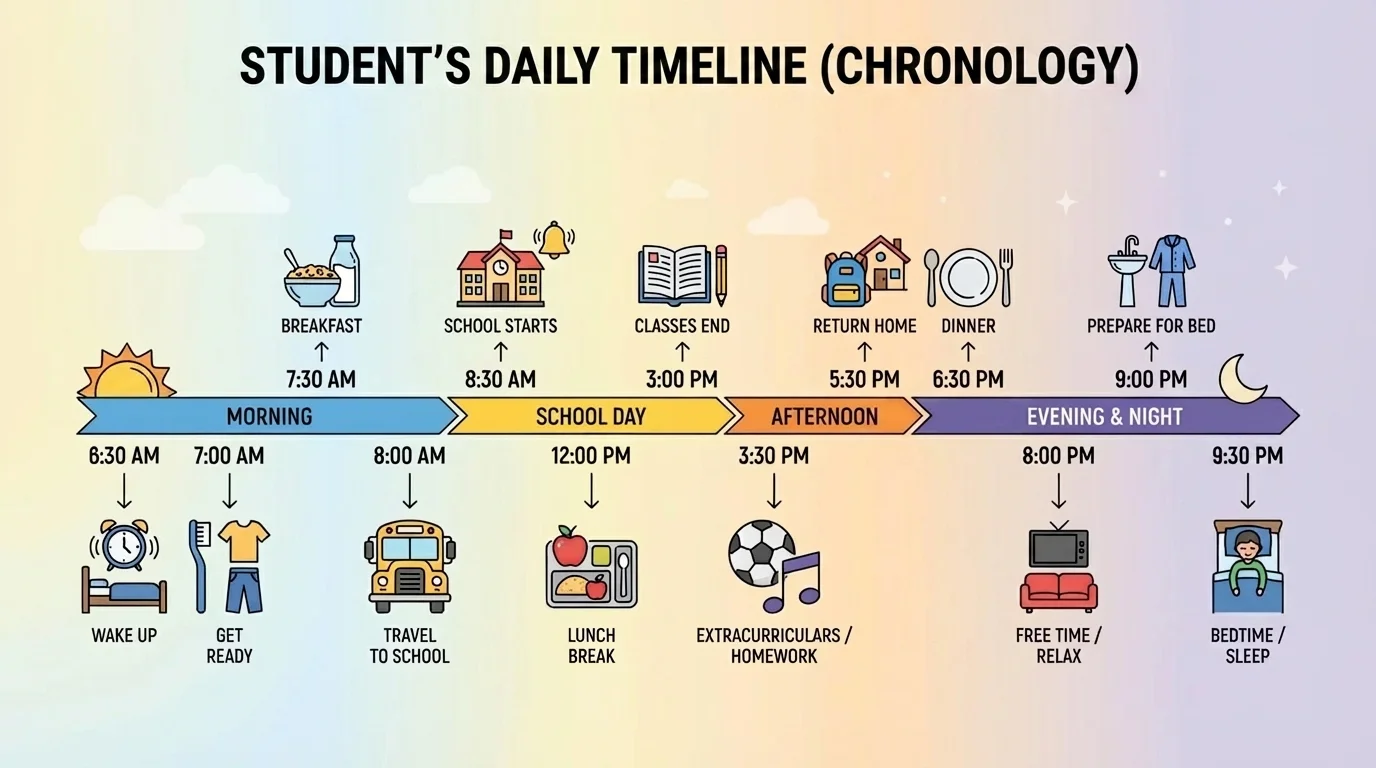
Here is a chronology example: At 7:00 in the morning, Maya woke up early for field day. After breakfast, she rode to school with her father. Later, her class ran relay races on the playground. That afternoon, Maya received a blue ribbon. By evening, she told her family all about the day. This is not giving instructions. It is telling events in time order.
Chronology and sequence can seem alike because both use order. The difference is the writer's purpose. If the writer says how to do something, use sequence. If the writer tells when events happened, use chronology. The timeline pattern in [Figure 3] makes that time-based structure easy to see.
You may already know that stories often have a beginning, middle, and end. Chronology builds on that idea, but it is often used in informative writing too, especially when explaining real events in order.
A history paragraph about the first moon landing, a report about a class trip, or a short biography of an inventor can all use chronology well. The structure helps readers follow the path of time.
Description tells what something is like. Instead of focusing on steps or time, it focuses on features, traits, and details. It answers questions such as "What does it look like?" "What parts does it have?" and "What makes it special?"
Description is useful when writing about animals, places, objects, weather, or ideas with clear characteristics. A writer might describe a desert, a violin, a volcano, or a school garden.
Writers often use facts, definitions, concrete details, and sensory language in description. For example: The snowy owl has thick white feathers, sharp yellow eyes, and wide wings that help it glide silently over fields. This sentence helps the reader picture the owl.
Description builds a picture in the reader's mind. Good descriptive writing does more than list random details. It groups details in a sensible way, such as by appearance, parts, size, color, habitat, or function. That organization keeps the writing clear.
Description does not just mean using pretty words. It means choosing the details that matter most. If you are describing a bicycle for an informational piece, the color may matter a little, but the wheels, handlebars, chain, and brakes matter much more.
A descriptive paragraph about a coral reef might explain its bright fish, branching coral, shallow warm water, and busy animal life. The purpose is not to tell steps or time order. The purpose is to help the reader understand the subject's features.
Explanation tells how something works or why something happens. It helps a reader understand causes, reasons, results, and connections.
This structure is common in science and social studies writing. A writer might explain why leaves change color, how a dam controls water, why communities make laws, or how exercise affects the body.
Explanation often uses signal words such as because, since, therefore, so, as a result, and this causes. These words connect ideas logically.
Here is an example: Rainbows appear when sunlight passes through raindrops. The raindrops bend the light and separate it into different colors. As a result, people on the ground can see a band of color in the sky. This is explanation because it tells how and why a rainbow forms.
Choosing explanation
A student wants to write about why some playground metal feels hot on sunny days.
Step 1: Find the purpose.
The purpose is to explain why something happens.
Step 2: Look for cause and effect.
Sunlight heats the metal, and the metal becomes hot to the touch.
Step 3: Choose the structure.
Explanation is the best choice because the writing gives reasons and results.
Description and explanation can work together, but they are not the same. If you describe a volcano, you tell what it looks like. If you explain a volcano, you tell how pressure and melted rock lead to an eruption. One focuses on features; the other focuses on causes or processes.
Writers often make explanation stronger by adding clear facts and domain-specific vocabulary. For instance, a science explanation might use words like energy, temperature, or erosion if they are accurate and necessary. Precise language helps the reader understand the idea clearly.
Some of the most interesting books and videos you use in science are built mostly with explanation. They answer the curious questions people ask every day, such as why ice melts or how animals survive in winter.
Comparison-and-contrast shows how two or more subjects are alike and different. This structure helps readers notice important similarities and differences.
Writers use this structure when comparing animals, places, tools, sports, characters, weather systems, or historical periods. A writer might compare city life and country life, frogs and toads, or two ways of generating electricity, as [Figure 4] shows.
Common signal words include both, also, similarly, likewise, however, on the other hand, unlike, and in contrast. These words help readers know whether the writer is discussing similarities or differences.
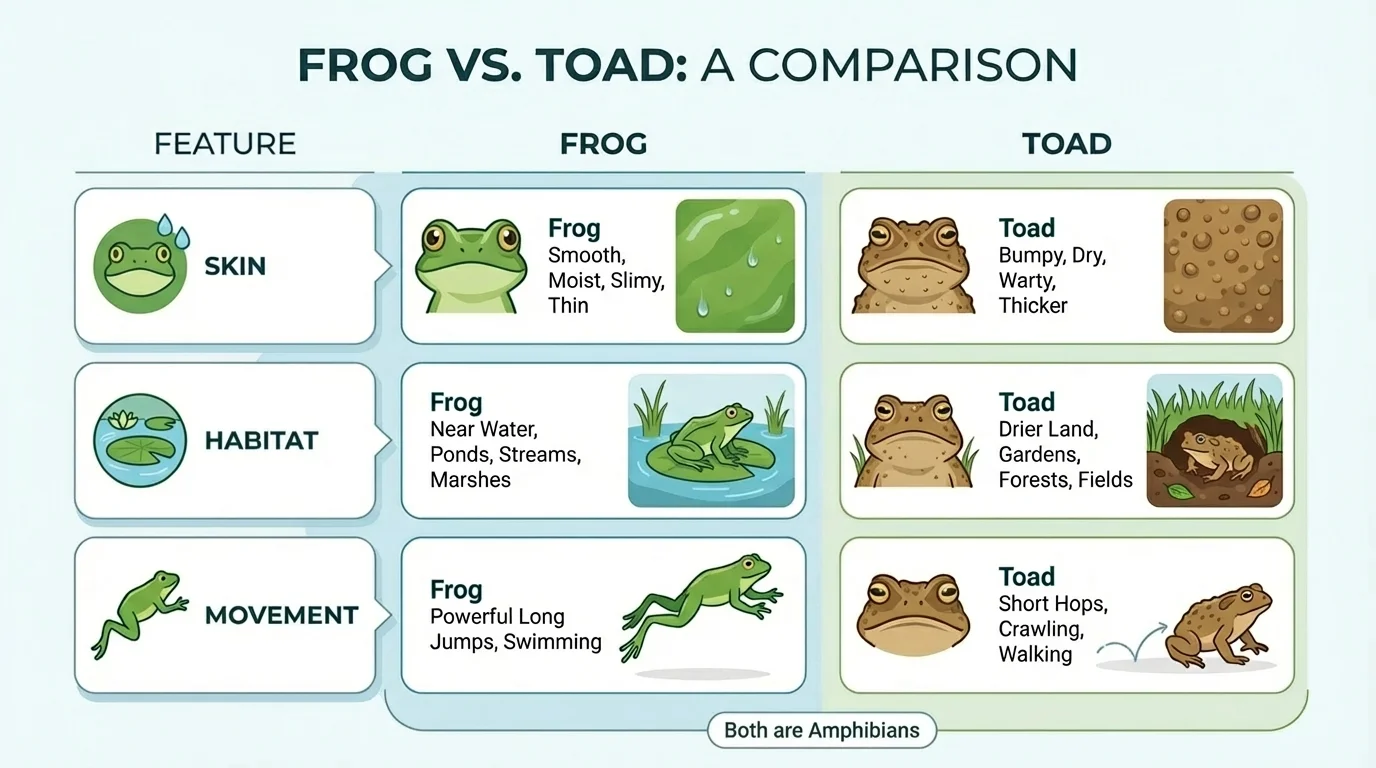
Writers can organize comparison-and-contrast in two main ways. One way is subject-by-subject: tell about one subject, then the other. The second way is point-by-point: compare the two subjects one feature at a time. For younger writers, point-by-point often makes the comparison clearer.
Here is an example: Both bicycles and scooters can help people travel short distances. However, bicycles usually move faster because riders can pedal continuously. Scooters are often lighter, so they may be easier to carry. Unlike scooters, bicycles usually have seats. This writing clearly compares and contrasts.
As in the side-by-side pattern in [Figure 4], strong comparison writing uses matching details. If you compare two animals, compare the same kinds of features, such as size, habitat, movement, and diet. Random details make the comparison weak.
One of the smartest things a writer can ask is, "What is my job in this piece of writing?" The answer helps the writer choose the right structure.
If the job is to teach a procedure, use sequence. If the job is to tell what happened over time, use chronology. If the job is to show what something is like, use description. If the job is to tell how or why something happens, use explanation. If the job is to show similarities and differences, use comparison-and-contrast.
| Writing Purpose | Best Structure | Example Topic |
|---|---|---|
| Teach steps | Sequence | How to make a paper airplane |
| Tell events in time order | Chronology | The life of Harriet Tubman |
| Show features | Description | What a glacier is like |
| Explain causes or processes | Explanation | Why tides rise and fall |
| Show similarities and differences | Comparison-and-contrast | Lakes and rivers |
Table 2. How a writing purpose connects to the most useful text structure.
Sometimes two structures may seem possible. For example, a paragraph about butterflies could be descriptive if it tells about wings, colors, and body parts. The same topic could be chronological if it tells the life cycle from egg to caterpillar to chrysalis to adult. The topic stays the same, but the purpose changes the structure.
Many longer pieces of writing use more than one structure. A report about hurricanes might begin with description, move into explanation, and end with sequence steps for safety. That is normal. Real writing is flexible.
Even so, a strong piece usually has one main structure that fits its main purpose. If the central purpose is to explain how hurricanes form, explanation should guide the whole piece. Small parts may include description or sequence, but the main organization should stay clear.
This is another reason structure matters so much. It helps the writer stay focused. It helps the reader know what kind of information is coming next.
One common mistake is mixing structures without a clear reason. A writer may begin with steps, jump into a random description, and then switch to a time-order story. That can confuse the reader.
Another mistake is choosing a structure that does not match the purpose. If you are writing about why earthquakes happen, a long list of descriptive details will not fully answer the question. If you are giving instructions for a class experiment, a comparison between two tools will not be enough.
A smart writer plans before beginning. The writer thinks about the topic, the purpose, and the most helpful order for the reader. This planning leads to clearer writing.
"The best structure is the one that helps the reader understand the writer's purpose."
Writers should also look for signal words, but they should not depend on them alone. A text can still be chronological even if it does not include many obvious time words. The overall pattern matters most.
Good informative writing does more than choose a structure. It also develops ideas with facts, definitions, concrete details, and precise language. These features make the structure useful and believable.
A comparison becomes stronger when it uses exact details. An explanation becomes clearer when it gives accurate reasons. A description becomes vivid when it includes important features. A sequence becomes easier to follow when each step is specific. A chronology becomes more meaningful when important events are included in the right order.
Domain-specific vocabulary can also help when it fits the topic. In a science piece about weather, words such as forecast, moisture, and temperature may be useful. In a geography piece, words such as valley, plateau, and region may help. The key is to use words accurately and explain them when needed.
When you choose the right structure, your writing becomes easier to read. Your ideas connect more smoothly. Your reader can focus on learning, not on untangling confusion. That is the real power of text structure.
