Have you ever listened to someone tell a story and thought, "Wait... what is the point?" That happens in writing too. A writer may have lots of facts, examples, and interesting details, but if those details are not organized well, the reader can get confused. Good writers do more than collect information. They choose the most important ideas, put them in a useful order, and make sure each part helps readers understand one clear message.
When you write an informative or explanatory text, you are teaching your reader something. Sometimes your goal is to explain a topic, such as how bees help plants grow. Other times your goal is to prove a point, such as why school gardens are valuable. In both cases, your writing needs a clear focus. Every detail should connect to that main idea.
Central idea is the main message a writer wants the reader to understand about a topic. A point is what the writer wants to show, explain, or prove. Relevant details are facts, examples, descriptions, or definitions that directly help explain the central idea or support the point.
Think of writing like packing a backpack for a field trip. You bring what you need. If the trip is to the zoo, binoculars, water, and a notebook might help. A snow shovel probably would not. In writing, unrelated details are like that snow shovel. They take up space, but they do not help.
Organization is the way ideas are arranged so readers can follow them easily. Strong organization helps readers know what the writing is mostly about, how one idea connects to the next, and why each detail matters. Without organization, even correct facts can feel messy.
Readers should not have to guess the writer's message. A well-organized piece of writing guides the reader. It begins with a clear focus, develops that focus with useful support, and keeps the reader moving in a sensible direction. This is important in school reports, science explanations, book responses, and even letters or speeches.
Many professional writers make a plan before drafting. They often sort ideas, move notes around, and test different orders before writing full paragraphs.
Good organization also makes writing stronger because it helps the writer think clearly. When you have to place each idea in the right spot, you notice which details are important, which ideas belong together, and which parts need more explanation.
Before choosing details, a writer must know the main message. If you do not know your central idea, you cannot decide what belongs in your writing. A central idea is not just the broad topic. For example, "dogs" is a topic. "Service dogs help people by guiding, alerting, and comforting them" is a central idea because it says something important about the topic.
A point is similar, but it often sounds more like something the writer wants to show or prove. For example, "Our town should build more bike paths because they make travel safer and healthier" is a point. The writer would need to support that point with good reasons and helpful evidence.
Here are some examples:
| Topic | Central Idea or Point |
|---|---|
| Rainforests | Rainforests are important because they support many living things and help the Earth. |
| Recycling | Recycling helps reduce waste by turning used materials into new products. |
| Class pets | A class pet can teach students responsibility if it is cared for properly. |
Table 1. Examples showing the difference between a broad topic and a clear central idea or point.
Once the central idea is clear, the writer can ask, "What does my reader need to know to understand this?" That question helps the writer choose the right support.
Not every fact about a topic belongs in every piece of writing. A detail is a relevant detail if it helps explain the central idea or support the point. A detail is not relevant if it is off-topic, too far from the main message, or interesting but unhelpful.
Suppose the central idea is: "Bees are important pollinators." Relevant details might include how bees move pollen, how pollination helps plants make fruit, and how farmers depend on pollinated crops. A detail about the color of a beekeeper's hat would probably not be relevant unless the writing is specifically about beekeeping clothing.
Writers often test details by asking simple questions:
Relevant details can include different kinds of support. Facts tell true information. Definitions explain what a word or concept means. Concrete details give specific examples a reader can picture. Examples help make a big idea easier to understand.
Example: sorting relevant and irrelevant details
Central idea: Sea turtles face dangers in the ocean and on the beach.
Step 1: Check the detail, "Plastic bags in the ocean can look like jellyfish to turtles."
This is relevant because it explains one danger sea turtles face.
Step 2: Check the detail, "Some turtles are dark green or brown."
This might be interesting, but it is not relevant unless the writing is about turtle appearance.
Step 3: Check the detail, "Beach lights can confuse baby turtles trying to reach the ocean."
This is relevant because it gives another clear danger connected to the central idea.
Choosing relevant details is like building with blocks. You pick the blocks that help the structure stand. If you add random pieces in random places, the structure becomes weak.
[Figure 1] Once writers collect useful details, they need to sort them into groups. Good writing usually does not pile every idea into one long paragraph. Instead, it places related information together. This helps readers understand one part at a time. Writers often organize ideas into subtopics so the central idea stays clear while each group of details has its own job.
For example, if you are writing about why trees are important, one group of details might explain how trees clean the air. Another group might explain how trees provide homes for animals. A third group might explain how trees give shade and help cool places down. All three groups support the same central idea, but each group covers a different part of it.
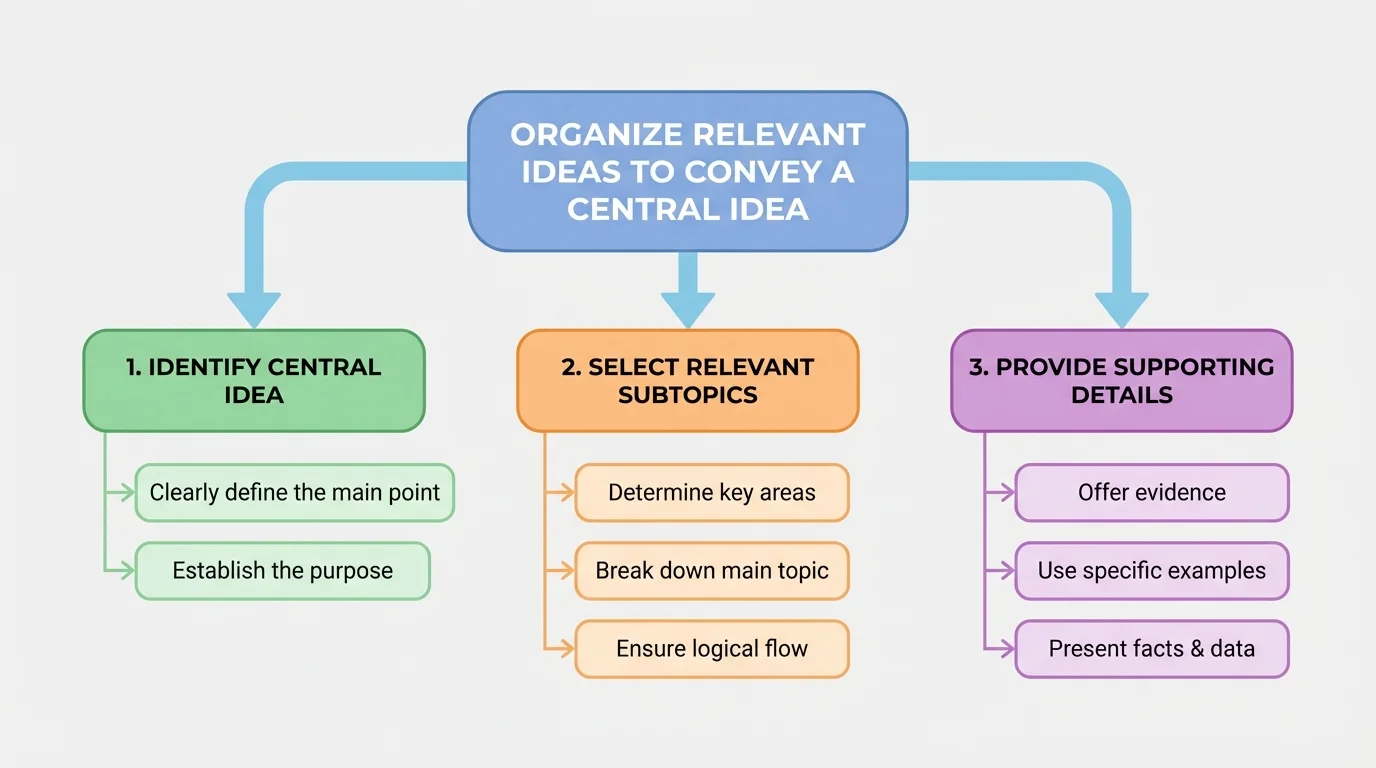
This kind of grouping helps both the writer and the reader. The writer sees where each detail belongs. The reader sees how the writing is built. When a piece of writing has clear groups, it feels easier to follow and easier to remember.
Sometimes writers use boxes, bullets, notes, or webs to sort ideas before drafting. That planning stage can help you discover missing information. If one subtopic has many details but another has only one weak detail, you may need to do more thinking or research.
One big idea, several smaller parts
A strong informative text often works like a tree. The trunk is the central idea. The branches are subtopics. The leaves are the supporting details. If the leaves are attached to the wrong branch, the tree does not make sense. If the branches do not connect to the trunk, the writing loses focus.
Later, when you revise, you can return to the same idea from [Figure 1]. If a detail does not fit under any subtopic, that may be a sign that it does not belong in the piece at all.
After grouping ideas, a writer chooses an order. The best order depends on the purpose. Writers do not organize every piece in the same way. Different topics need different structures.
[Figure 2] Text structure is the way a writer arranges information. Young writers often use these structures:
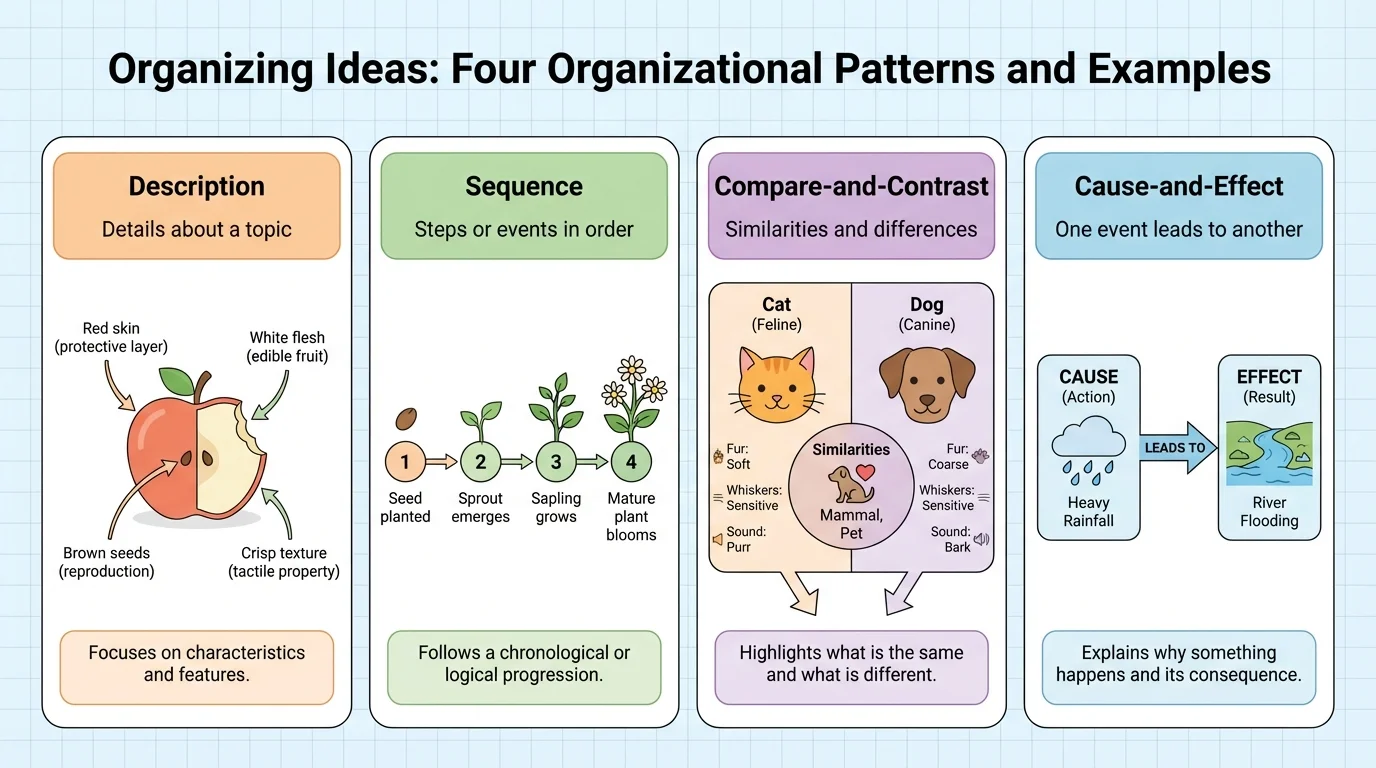
If you are explaining how to plant seeds, sequence works well because the steps need to happen in order. If you are explaining how frogs and toads are alike and different, compare and contrast is a better choice. If you are writing about why litter harms animals, cause and effect can help show the connection.
Writers also think about where to place the strongest ideas. Often, the beginning introduces the topic and central idea. The middle gives grouped support. The ending leaves the reader with a clear understanding of the point. The ending should not suddenly jump to a brand-new idea.
As seen in [Figure 2], organization is not random. The structure should match what the writer is trying to teach or prove.
[Figure 3] A paragraph works best when every sentence has a job. Most strong paragraphs begin with a sentence that tells the paragraph's main point. This is often called a topic sentence.
After the topic sentence, the writer adds supporting details. These may include facts, examples, definitions, or descriptions. The writer should make sure each support sentence matches the paragraph's focus. If a paragraph begins about how bats help farmers, a sentence about a bat costume at a party probably does not belong.
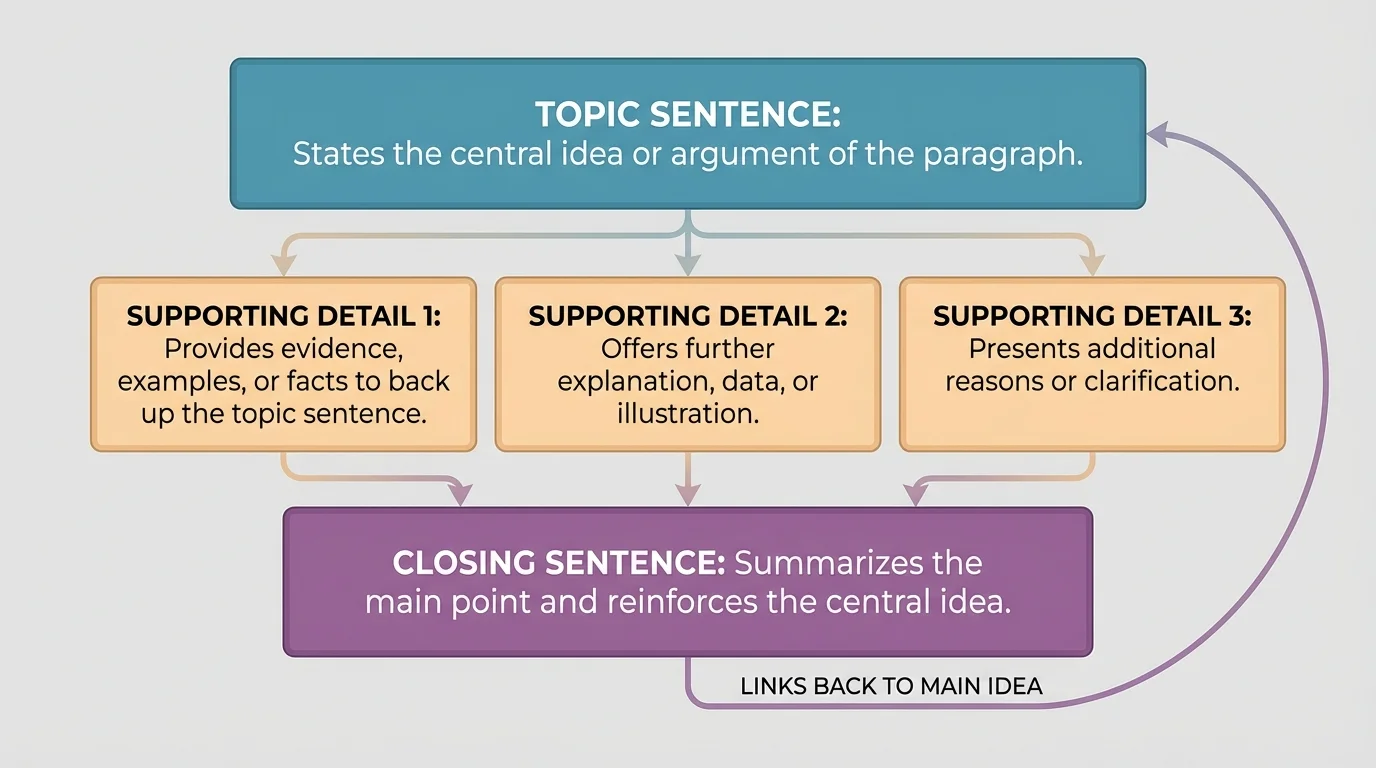
Some paragraphs also end with a sentence that wraps up the idea or connects it back to the central idea of the whole piece. This gives the paragraph a finished feeling and reminds the reader why the details matter.
Imagine a paragraph about community gardens:
Community gardens help neighborhoods in many ways. They provide fresh food for families. They also give neighbors a place to work together. In addition, gardens can make empty lots look beautiful. Because of these benefits, community gardens improve local communities.
This paragraph works because all the details support one idea. The paragraph does not wander away from its focus. That is exactly what writers should aim for.
When you look back at the diagram, notice that the paragraph is not just a group of sentences. It is a planned unit. Each part supports the one above it and connects to the bigger piece of writing.
Support becomes stronger when it is specific. Compare these two sentences: "Owls are helpful" and "Owls help farmers by eating mice that damage crops." The second sentence is stronger because it uses a concrete detail. It tells exactly how owls are helpful.
Concrete details help readers picture and understand what you mean. They may name a place, action, example, or fact. Definitions are useful when a topic includes words readers may not know. Facts add truth and accuracy. Examples make ideas clearer.
Precise language means using exact words instead of vague ones. Instead of saying "a thing," say "a nest." Instead of saying "animals," say "penguins," "foxes," or "whales" if those are the animals you mean. Precise words help the reader build a clearer picture.
Example: making support stronger
Weak sentence: Plants need stuff to grow.
Stronger sentence: Plants need sunlight, water, air, and nutrients from the soil to grow well.
The stronger sentence is better because it uses precise language and concrete details.
Writers should also avoid repeating the same idea again and again in slightly different words. Repetition can make writing feel slow unless it is used on purpose. If two sentences say nearly the same thing, one may be enough.
Strong organization does not usually happen by accident in a first draft. Writers revise to make the piece clearer. Revising means looking again at your writing and improving it. One important revision question is, "Does every part help convey the central idea or prove the point?"
When revising, writers can check for these common problems:
A helpful revision trick is to read one paragraph at a time and name its job. If you cannot quickly say what the paragraph is about, it may need work. Another trick is to underline the central idea and then check whether each detail truly supports it.
From earlier writing lessons, you may remember that planning, drafting, revising, and editing are different parts of the writing process. Organization improves most during planning and revising, when writers can move ideas, add missing details, and remove parts that do not fit.
Sometimes a writer loves a detail because it is funny or interesting. But if it does not help the main message, it may need to go. Good writers are willing to make choices that help the reader most.
Here is a short model of organized explanatory writing:
School gardens are valuable learning spaces. First, they teach students how plants grow. Students can observe seeds, roots, stems, and flowers in real life instead of only reading about them. Second, school gardens can support healthy habits. When children grow vegetables such as tomatoes or lettuce, they may become more interested in tasting fresh foods. Finally, gardens build responsibility and teamwork. Students must water plants, pull weeds, and care for shared spaces. For these reasons, school gardens are useful parts of a school.
This piece has a clear point: school gardens are valuable learning spaces. The details are grouped into three parts: learning, healthy habits, and responsibility. Each part supports the point. The order is easy to follow because the writer uses signal words such as first, second, and finally.
Why the model works
Step 1: The writer states a clear point.
School gardens are valuable learning spaces.
Step 2: The writer gives grouped reasons.
The reasons are learning, healthy habits, and responsibility.
Step 3: The writer adds relevant support.
Each reason includes concrete details, such as observing seeds and caring for shared spaces.
Step 4: The ending connects back to the point.
The final sentence reminds the reader why school gardens matter.
You can use the same approach with many topics. Start with a clear central idea or point. Choose only the details that truly support it. Group related ideas together. Put those groups in an order that makes sense. Then revise until every part helps the reader understand exactly what you want to say.
"Good writing is clear thinking made visible."
When ideas are organized well, readers do not get lost. They can follow your thinking, learn from your explanation, and trust that your details belong where they are. That is the power of careful organization.
