Have you ever wondered why some birds migrate, how video games are made, or what happens to trash after it leaves your house? Questions like these can lead to real research. Research is not just for scientists in labs or adults writing books. Students use research to explore ideas, solve puzzles, and learn about the world in a deeper way.
Good research usually begins with two important things: a topic and a strong question. A topic shows what you want to learn about. A question points your learning in a clear direction. When your question is open-ended, it helps you discover details, reasons, examples, and different points of view instead of just one short answer.
Learning how to choose a topic and ask strong questions is an important skill. It helps you in reading, writing, science, social studies, and everyday life. It also helps you become a careful thinker who does not stop at the first simple answer.
People research because they want to know more. A soccer player might research healthy foods for energy. A class might research local weather patterns before planting a school garden. A student who loves animals might research how wolves live in packs. In each case, research helps someone build knowledge by investigating a topic.
Research is more than looking up one fact. If you ask, "How many legs does a spider have?" you can find one quick answer. But if you ask, "How do spiders use their legs to survive?" you begin to investigate different parts of the topic. That second question can lead to information about movement, hunting, web-building, and defense.
Topic is the subject you want to learn about.
Research question is the question that guides what you will look for and learn.
Open-ended question is a question that cannot be answered with just yes, no, or one short fact. It invites explanation.
When students do short research projects, they often explore different aspects of one topic. For example, if the topic is bees, the project might include how bees help plants, how they live in colonies, and why they are important to food production. One good question can open the door to many connected ideas.
A topic can be broad or narrow. A topic such as "animals" is very broad. It includes many groups, places, and behaviors. A topic such as "how service dogs help people" is much narrower. Narrower topics are often easier for short research projects because they are easier to understand in a limited amount of time.
Choosing a topic works best when the topic is both interesting and manageable. If you care about the topic, you will be more excited to keep learning. If the topic is manageable, you can actually gather enough information without getting overwhelmed.
Here are some examples of broad and narrower topics:
| Broad Topic | Narrower Topic |
|---|---|
| Weather | How hurricanes form |
| Space | Why the Moon has phases |
| Plants | How cacti store water |
| Communities | How firefighters help a town |
| Animals | How penguins stay warm |
Table 1. Examples of broad topics and narrower topics for research.
A good topic for an elementary research project is one that can be explored through several sources, answered with more than one detail, and explained clearly to others. Topics connected to school subjects, nature, history, inventions, and community life often work well.
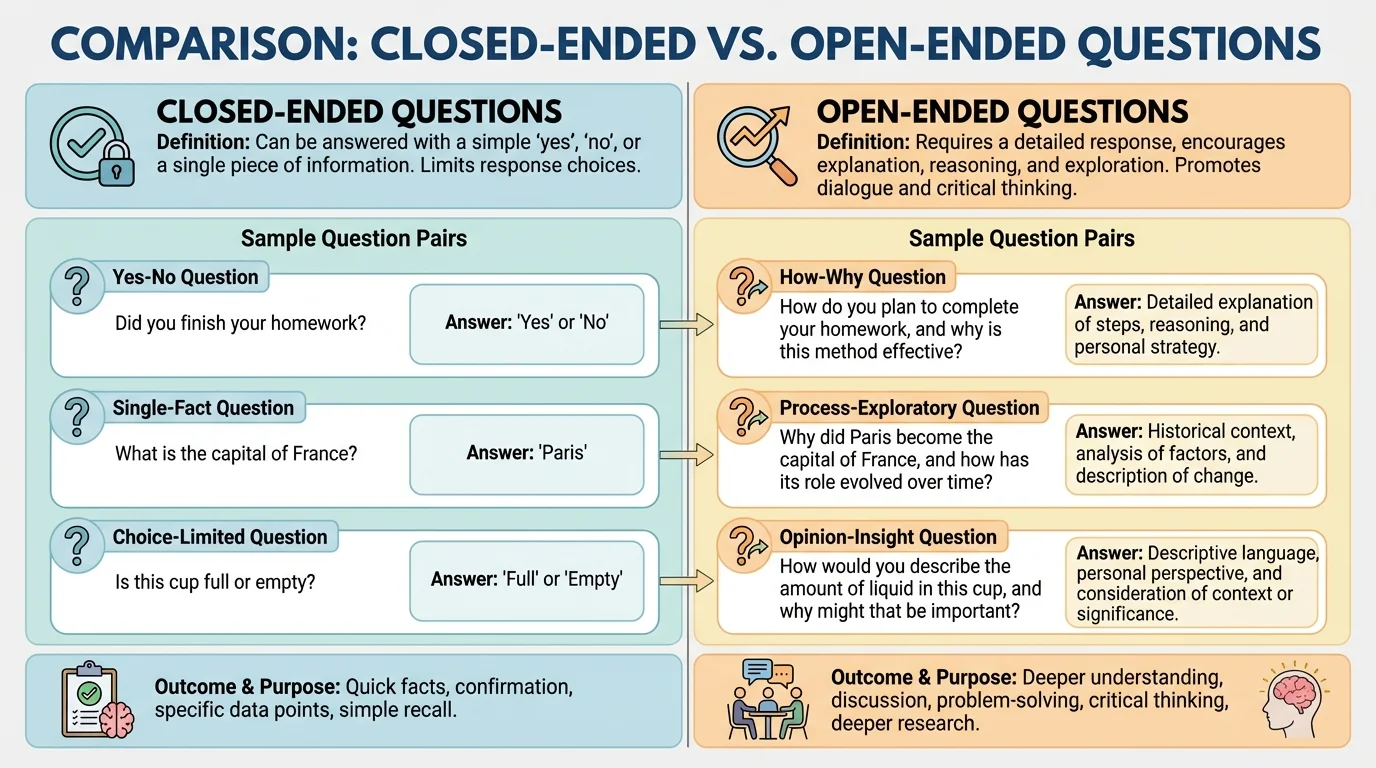
A strong research question helps you look beyond one tiny fact, and [Figure 1] shows that the best questions for research usually ask for explanation, description, or reasons rather than one-word answers. Questions that begin with how, why, or what happens when are often open-ended.
A open-ended question gives you room to investigate. For example, "Do polar bears live in cold places?" is a closed-ended question because the answer is simply yes. "How do polar bears survive in Arctic weather?" is open-ended because the answer needs details about fur, fat, paws, and behavior.
Closed-ended questions are not always bad. They can be useful for checking one fact. However, if your goal is a short research project, open-ended questions are usually better because they help you build knowledge instead of collecting only one answer.
Good research questions are also clear. A clear question is easy to understand. "Why is stuff in nature interesting?" is too vague because the word "stuff" does not tell enough. "How do frogs change as they grow from eggs into adults?" is clearer because it names a specific animal and a specific process.
Good research questions are also focused. If a question is too big, it becomes hard to answer well. "How does the whole world use energy?" is much too large for a short project. "How do solar panels help homes use energy from the Sun?" is more focused and easier to research.
Strong questions lead to strong learning
When your question is open-ended, clear, and focused, it guides your reading, note-taking, and writing. It helps you notice which facts matter most. Instead of gathering random information, you gather information that connects back to your question.
As you compare the question types, notice that open-ended questions often lead to several smaller questions. If you research how bats help ecosystems, you may also ask what bats eat, where they live, and how they affect insects and plants. One strong question can guide many discoveries.
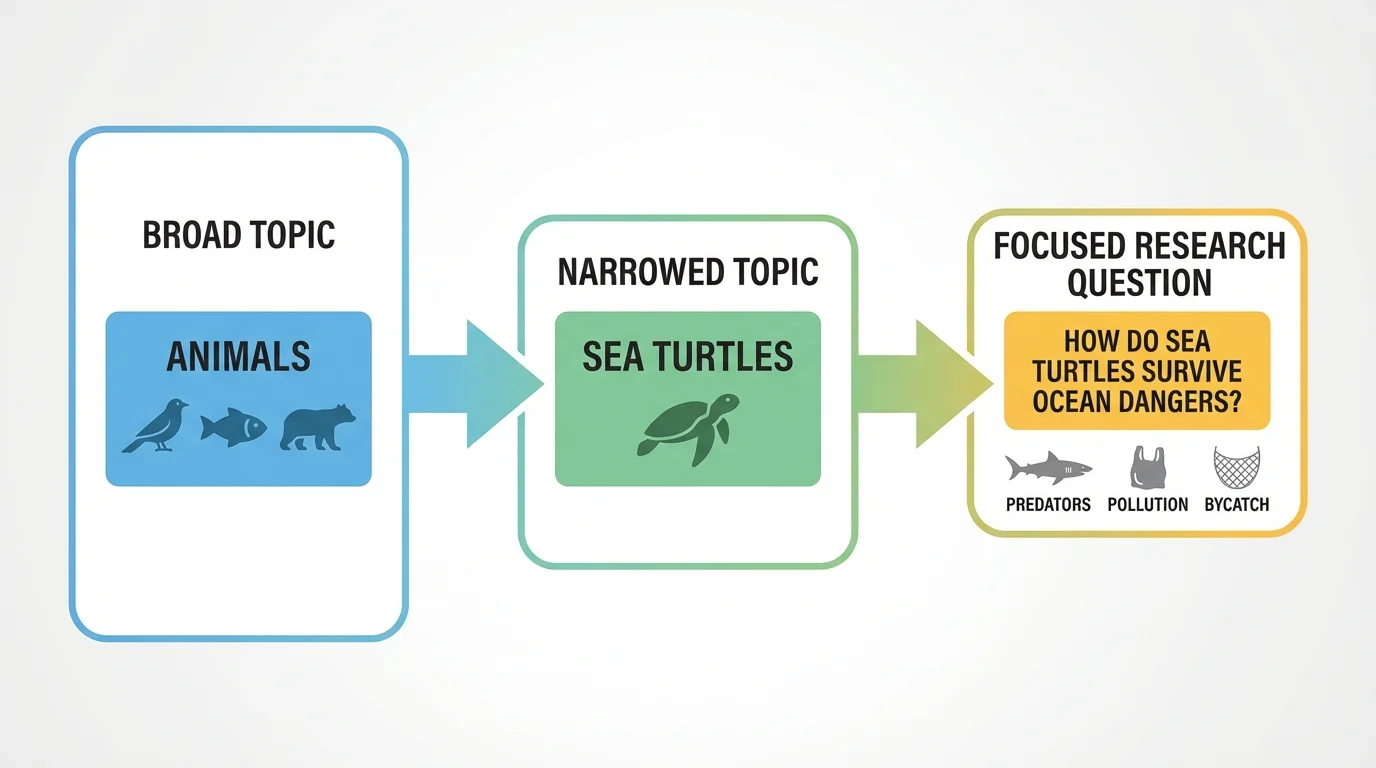
Many students begin with a broad idea and then narrow it. This is a smart way to start. If your first idea is "oceans," that is not wrong. It is simply too wide. Narrowing the topic helps you create a question you can truly answer, and [Figure 2] illustrates how a big subject can become a focused research path.
You can narrow a topic in several ways. You can narrow by place, such as studying rain forests instead of all habitats. You can narrow by group, such as studying dolphins instead of all sea animals. You can narrow by time, such as studying life in one historical period. You can also narrow by aspect, which means one part of a topic, such as food, shelter, communication, or movement.
Suppose your broad topic is "birds." You might narrow it to "owls." Then you might ask, "How do owls hunt at night?" That question is much easier to research than trying to study every kind of bird at once.
Here are more examples of narrowing:
| Broad Topic | Narrowed Topic | Open-Ended Question |
|---|---|---|
| Inventions | Wheelchairs | How do wheelchairs help people move more independently? |
| Water | River pollution | How does pollution affect animals living in rivers? |
| Sports | Swimming | How does practice help swimmers improve speed and technique? |
| Food | School lunches | How can healthy school lunches help students learn better? |
Table 2. Examples of broad topics turned into narrower topics and open-ended questions.
When a topic is narrowed well, research becomes less confusing. Instead of searching everywhere for everything, you know what kind of information you need. That saves time and helps you stay on track.
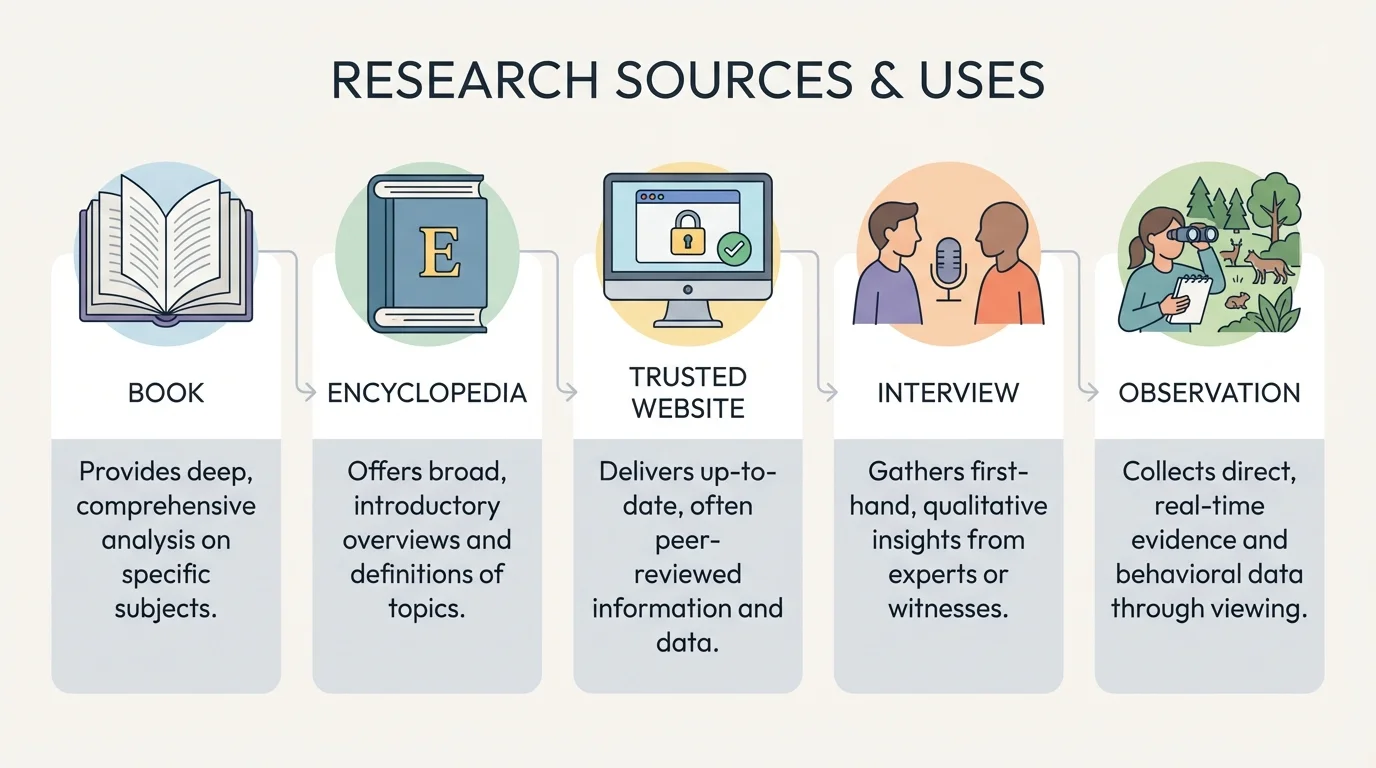
Strong researchers do not depend on just one source. They use different resources because each kind of source can teach something useful, as [Figure 3] makes clear. A book might explain the background of a topic, while an interview might provide real-life experiences.
Some helpful resources include nonfiction books, encyclopedias, trusted websites, library databases, articles, videos from reliable educational organizations, interviews with knowledgeable people, and direct observations. If you are researching birds in your neighborhood, observing them outside may be useful. If you are researching ancient Egypt, books and museum websites may help more.
Different questions need different resources. A question about how a machine works might be answered with diagrams, videos, and articles. A question about local history might be answered with old photographs, newspaper archives, or an interview with a community member.
It is also important to choose trustworthy sources. A trustworthy source is one you can rely on. Libraries, museums, schools, science organizations, and well-known educational publishers are often good places to start. If a website has no author, strange claims, or facts that do not match other sources, you should be careful.
Using several resources helps you check information. If two or three good sources explain the same idea, that idea is more likely to be accurate. This is called evidence—information that supports an answer or idea.
Some researchers spend more time choosing and checking sources than they do writing their final report. Good information is the foundation of good research.
The resource chart also reminds us that no single source does every job. A balanced short research project usually combines at least two kinds of sources so that learning is richer and more complete.
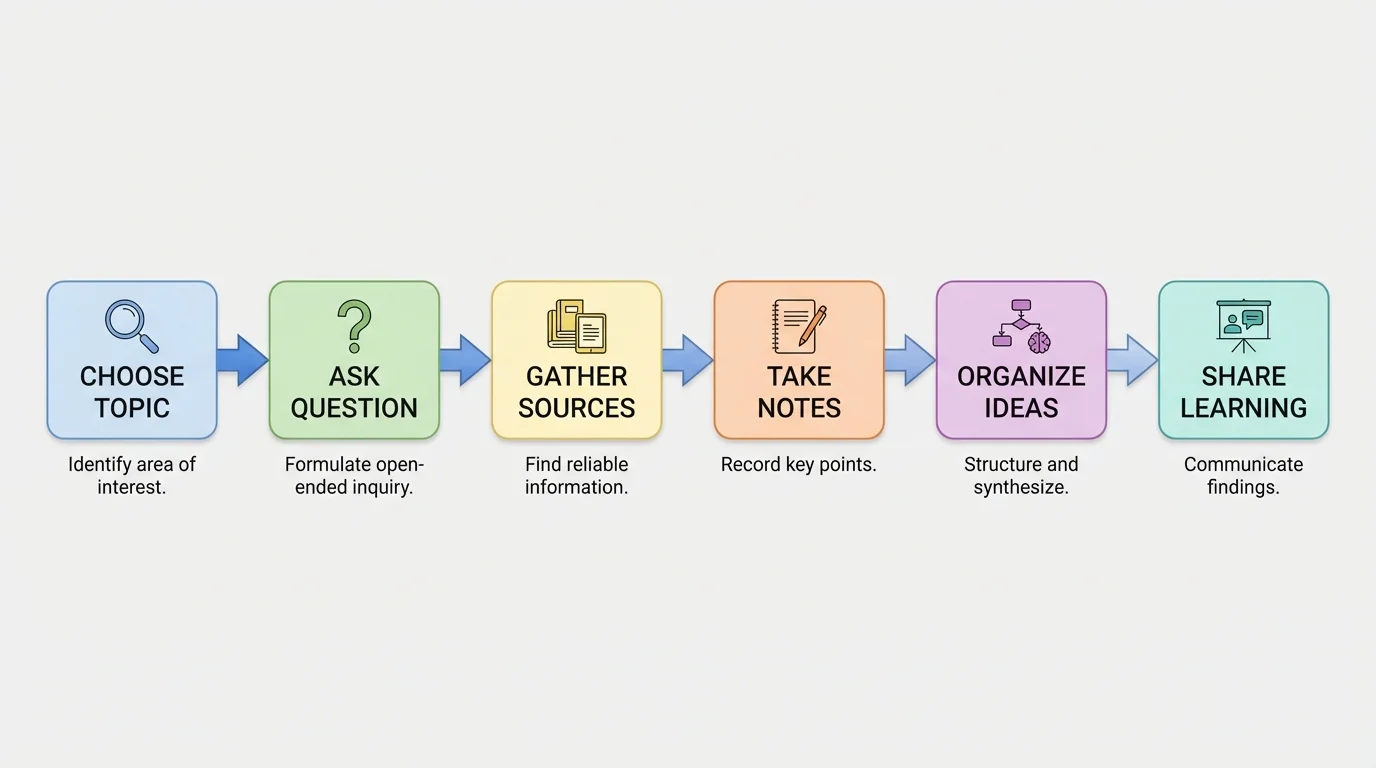
[Figure 4] shows that a short research project works best when it follows a simple plan and presents the process as a clear sequence you can follow. First, choose a topic. Next, turn it into one or two open-ended questions. Then gather sources, take notes, organize ideas, and share what you learned.
When you take notes, write important facts in your own words whenever possible. This helps you understand the information instead of just copying it. Good notes are short, clear, and connected to your question.
You can organize notes by creating categories. For a project about sea turtles, categories might include "habitat," "food," "dangers," and "protection." Organizing ideas into groups helps you see patterns and makes writing easier later.
After collecting notes, think about the main answer to your question. Then look for details and examples that support that answer. If your question is "How do plants survive in dry places?" your answer might include deep roots, water storage, and small leaves. Each of those details can become part of your explanation.
Short research projects do not need to answer everything about a topic. Their purpose is to investigate some important parts of one topic clearly and carefully. A smaller project done well is often stronger than a huge project that becomes confusing.
Example: Building a short research project
Topic: Penguins
Step 1: Start with a broad idea
The student is interested in animals that live in cold places.
Step 2: Choose a clearer topic
The topic becomes penguins.
Step 3: Write an open-ended question
The question becomes: "How do penguins stay warm in icy habitats?"
Step 4: Gather different resources
The student uses a book about Antarctic animals, a trusted science website, and a short documentary video.
Step 5: Organize the notes
The notes are grouped into feathers, body fat, huddling, and habitat.
This project is focused, researchable, and big enough to teach several connected ideas.
Later, when you are checking whether your work is complete, the process helps you see if you skipped an important step such as note-taking or organizing evidence.
One useful way to improve your research skills is to compare weak questions with stronger ones. Weak questions are often too broad, too simple, or unclear. Stronger questions ask for explanation and point to a specific part of a topic.
Look at these examples:
| Weak Question | Why It Is Weak | Stronger Question |
|---|---|---|
| Are volcanoes dangerous? | It can be answered with yes. | How do volcanoes change the land and affect people nearby? |
| What is basketball? | It is too basic and broad. | How do teamwork and practice help a basketball team succeed? |
| Why are animals cool? | It is vague and informal. | How do camouflage patterns help some animals survive? |
| Do plants need water? | It has a simple fact answer. | How does water help plants grow and stay healthy? |
Table 3. Comparison of weak research questions and stronger revised questions.
A stronger question often includes a topic and an action or idea to investigate. Words such as survive, change, affect, help, grow, and communicate can point you toward richer answers.
If you are not sure whether a question is strong, ask yourself these checks: Can this be answered with one word? Is it clear? Is it focused? Can I find information about it in more than one source? If the answers are good, the question is probably ready.
You may already know how to ask who, what, when, where, why, and how questions while reading. Research uses those same question words, but it asks them in a more focused way so that learning can go deeper.
Sometimes students write too many questions at once. It is usually better to have one main question and a few smaller supporting questions. That keeps the project organized and prevents the research from spreading in too many directions.
Research is not finished when you find information. You also need to communicate what you learned. This means sharing your ideas clearly so another person can understand them. You might write a report, give a short talk, make a poster, create a slide presentation, or record a video explanation.
When you communicate research, your main question should stay at the center. Begin by stating the topic and question. Then explain the answer using facts, examples, and details from your sources. The clearest projects are organized so the reader or listener can follow the thinking step by step.
For example, if your question is "How do bees help flowering plants?" your presentation might include sections on pollination, plant reproduction, and food crops. Each section should connect back to the main question instead of adding unrelated facts.
Good communication also means using your own words as much as possible and giving credit to the sources you used when your teacher asks for it. This shows honesty and respect for other people's work.
One common mistake is choosing a topic that is too big. A student may want to research "history" or "technology." These subjects are so broad that it becomes hard to know where to begin. The fix is to narrow the topic to a specific person, invention, event, or question.
Another common mistake is writing a question that can be answered with yes or no. That may be fine for checking one fact, but it usually does not support a full research project. The fix is to rewrite the question so it asks how or why.
A third mistake is gathering facts that do not connect to the question. For example, if your question is about how frogs survive in wetlands, facts about every amphibian in the world may not all be useful. The fix is to keep asking, "Does this information help answer my question?"
Some students also stop after finding one source. But good research uses different sources and compares information. If one source says something surprising, look for more evidence before trusting it.
Example: Revising a question
Original topic: Space
Original question: "Is space big?"
Step 1: Notice the problem
The question is too simple and too broad.
Step 2: Narrow the topic
Choose one part of space, such as stars.
Step 3: Rewrite the question
The new question becomes: "How are stars born and how do they change over time?"
The revised question is much better for research because it leads to explanations and connected details.
Asking strong questions is a skill that improves with practice. Every time you revise a weak question into a clear, open-ended one, you become a stronger researcher and thinker.
