People share research all the time. A weather reporter explains a storm, a scientist tells what was discovered, and a student shares what was learned from reading books, articles, interviews, or observations. When you present your research findings, you are doing something important: you are turning information into understanding for other people.
A good report is not about saying every single fact you found. It is about choosing the most important ideas and explaining them clearly. Your audience should be able to understand your topic, hear the main findings, and remember the big message after you finish speaking.
When students do short research projects, they investigate a question and gather information from different sources. Then they communicate what they learned. This final step matters because research is not complete until the learning is shared.
Presenting to an audience helps you do several things at once. You teach others, show what you learned, and practice speaking in a clear and organized way. You also learn how to choose the strongest facts instead of listing everything. That skill is useful in school and in everyday life.
News reporters, zoo guides, museum educators, and scientists all present research findings to audiences. They do not usually tell everything they know. They choose the facts that best answer the main question.
Audience members may be classmates, teachers, family members, or another group. Because of that, your report should fit the audience. If your listeners are your classmates, your explanation can use school words they know. If the audience knows less about the topic, you may need to explain more carefully.
A research finding is something you learned through research. It may be a fact, a pattern, a result, or an answer to part of your question. A brief report is a short presentation that tells the most important findings in a way others can understand.
You might research a question such as: Why are bees important? What makes a community park useful? How do dolphins communicate? After reading and taking notes, you decide what the key findings are. Then you present them in a short and clear way.
Your report does not need a huge amount of information. In fact, too much information can confuse listeners. A strong short report keeps the focus on the topic, the main findings, and the evidence that supports them.
Audience means the people who listen to a presentation. Evidence is the information that supports an idea or finding. Source is where information comes from, such as a book, article, website, interview, or observation.
Think of your report as telling a short, true story about what you discovered. First, tell the topic. Next, explain the important findings. Finally, end with the big idea the audience should remember.
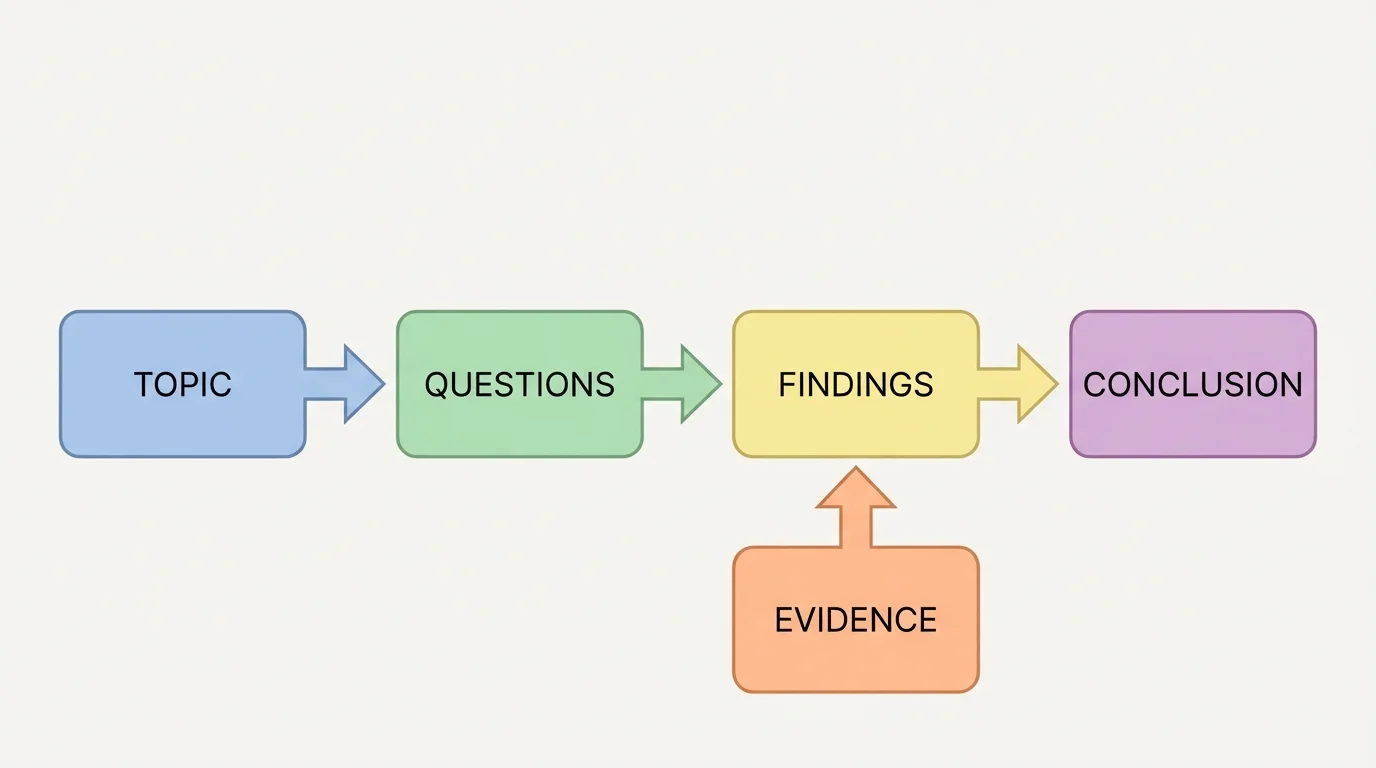
A strong report follows an easy order that listeners can track, as [Figure 1] shows. Even a short presentation needs a beginning, a middle, and an ending. This structure helps the audience stay with you from start to finish.
The beginning introduces the topic and sometimes the question you researched. You might say, "My research question was: Why do school gardens help students?" This gives listeners a clear starting point.
The middle shares the main findings. These are the most important facts and ideas you learned. Each finding should connect to your topic and be supported by evidence from your sources.
The ending gives a conclusion. A conclusion is not just stopping. It reminds the audience of the big message. For example, you might end by saying that school gardens help students learn science, eat healthy foods, and work together.
You should also mention your sources in a simple way. For a fourth-grade report, this may mean saying something like, "I learned this from a book about gardens, a kids' science website, and an interview with our school gardener." This shows that your ideas came from research, not guessing.
Sometimes students think a report must sound fancy. It does not. It should sound clear. Simple, exact words are often better than long, confusing ones. The goal is understanding.
Before speaking, you need to organize your notes. Sorting information into groups helps you decide what belongs together, as [Figure 2] explains. If your notes are mixed up, your audience may get lost.
One useful way to organize is by categories. If your topic is bees, your categories might be: what bees do, why bees matter, and problems bees face. If your topic is a local river, your categories might be: where it is, how people use it, and ways to protect it.
After grouping ideas, choose the most important facts in each group. You do not need every detail from every source. Pick details that best answer your research question.
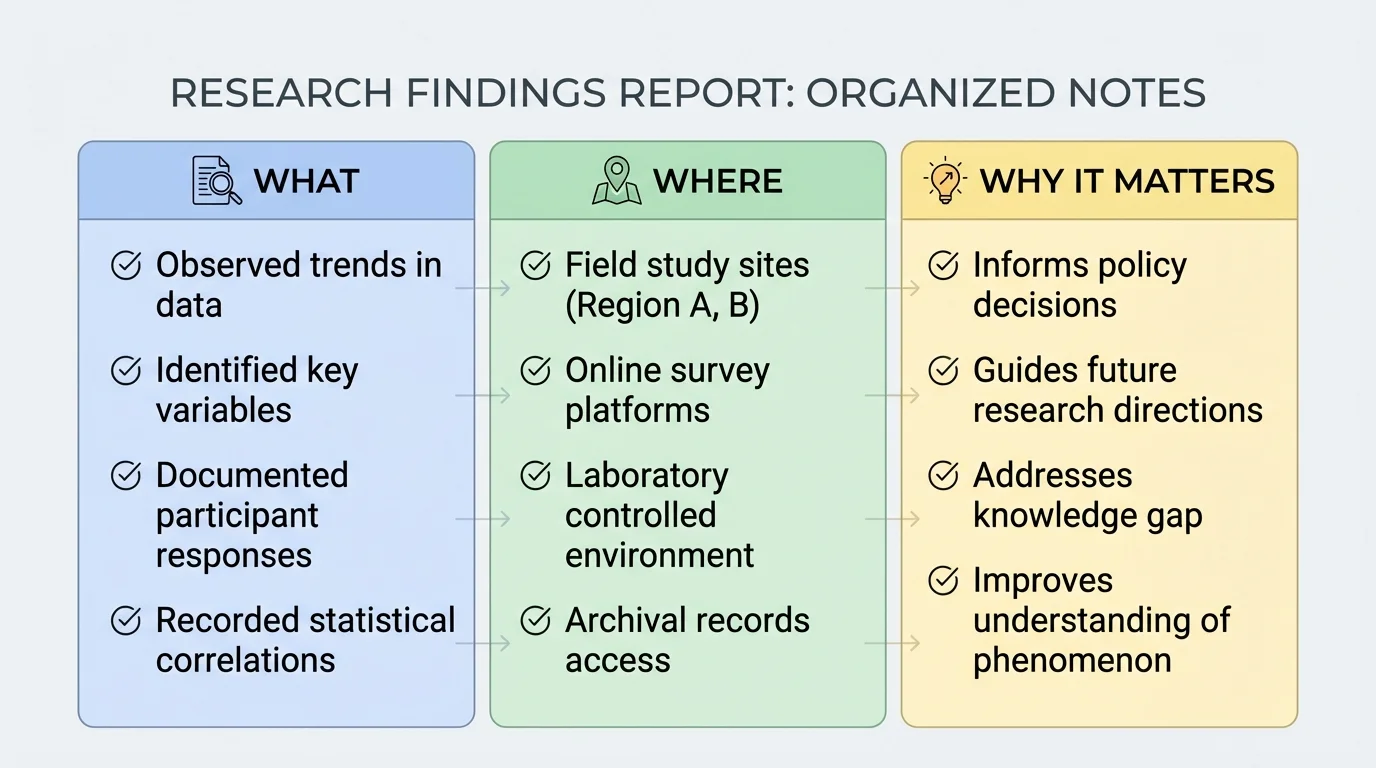
It also helps to put your ideas in order. Start with the topic, move through your main findings, and finish with the conclusion. You can write this as a short outline or place it on note cards.
Good notes are short. Instead of writing full paragraphs to read aloud, write key words or short phrases. For example, your note card might say: "Bees pollinate plants," "Many fruits depend on pollinators," and "Without bees, food choices shrink." Short notes remind you what to say without making you stare down and read everything.
Main idea and supporting details
Every strong report has a main idea, which is the most important message, and supporting details, which are the facts that help explain or prove that message. If your main idea is that community parks help neighborhoods, your supporting details might include places to exercise, space for families, and areas for plants and animals.
As you organize, ask yourself, "Does this fact help my audience understand the topic?" If the answer is no, it may not belong in the report. Choosing what to leave out is part of good presentation skills.
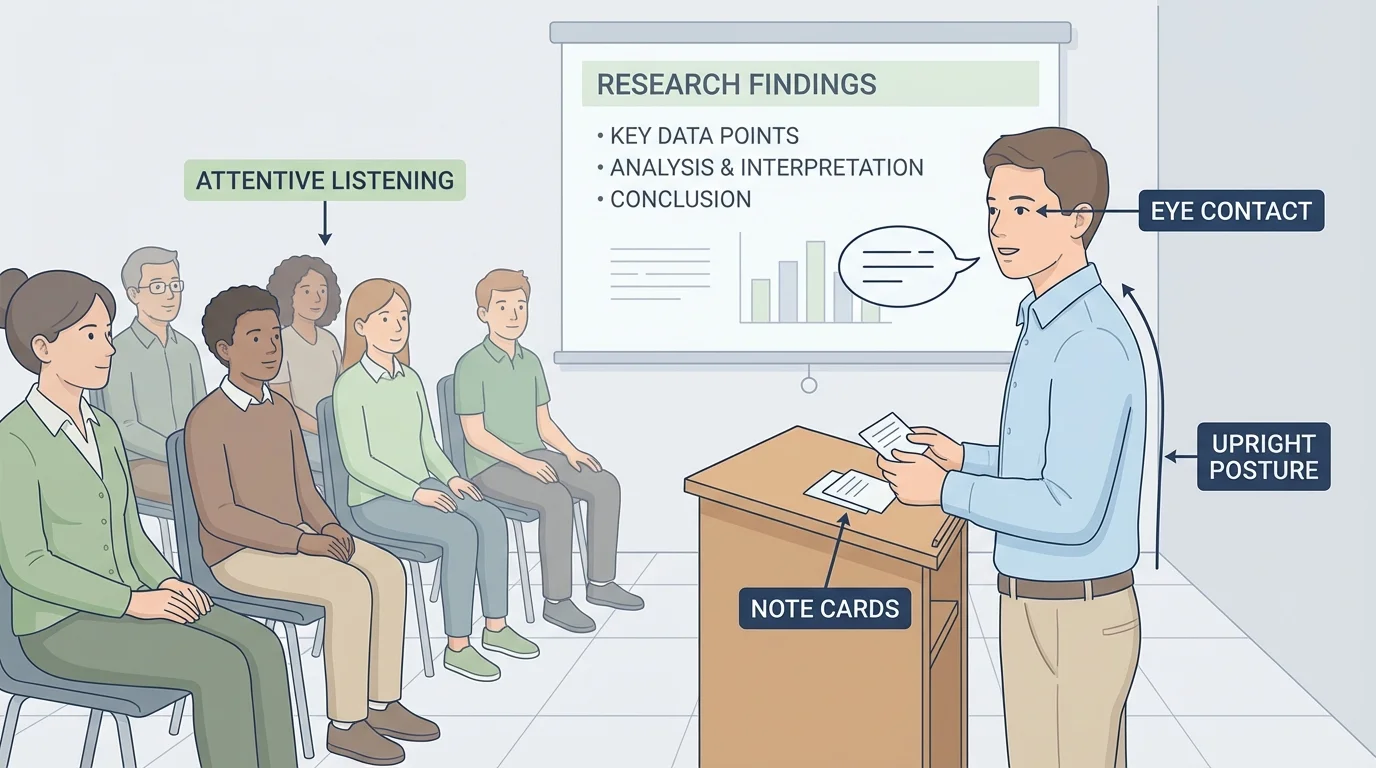
Your voice and body help carry your message. A listener understands more when the speaker uses clear words, steady pace, and confident posture, as [Figure 3] illustrates. Speaking is not only about the facts. It is also about how the facts are shared.
Speak loudly enough for everyone to hear, but do not shout. Use a pace that is not too fast and not too slow. If you rush, important words may disappear. If you speak too slowly, your report may lose energy.
Look at the audience often. You do not need to stare at one person. Instead, lift your eyes from your note cards and look around the room. This helps listeners feel included and shows that you are talking to them, not just reading at them.
Your face and expression matter too. If your topic is exciting, let your voice show interest. If a fact is surprising, pause before saying it. Small changes in expression can make your report easier to follow.
Pronounce words carefully. If your topic includes a hard word, practice saying it ahead of time. For example, if you are speaking about animal habitats, make sure you can say the word clearly and explain what it means.
Even strong speakers feel nervous sometimes. That is normal. Taking a slow breath before you begin can help. So can practicing your first sentence until it feels familiar.
When you ask and answer questions in class discussions, you already practice some presentation skills. You listen, speak clearly, and support ideas with facts. A research report uses those same skills in a more organized way.
Later, when you think about common mistakes, remember the posture and eye contact in [Figure 3]. They help the audience trust that you are prepared and focused.
Sometimes a report is stronger when it includes a simple visual. A chart, drawing, map, photo, or object can help listeners notice the most important information, as [Figure 4] shows. Visuals should support your words, not replace them.
If you researched bird types seen on the playground, a small chart might help show which birds were seen most often. If you researched recycling, a labeled picture of items that can and cannot be recycled may make your findings clearer.
A good visual is simple. It should have a clear title and only the most useful information. If a poster is covered with tiny writing, the audience will not know where to look.
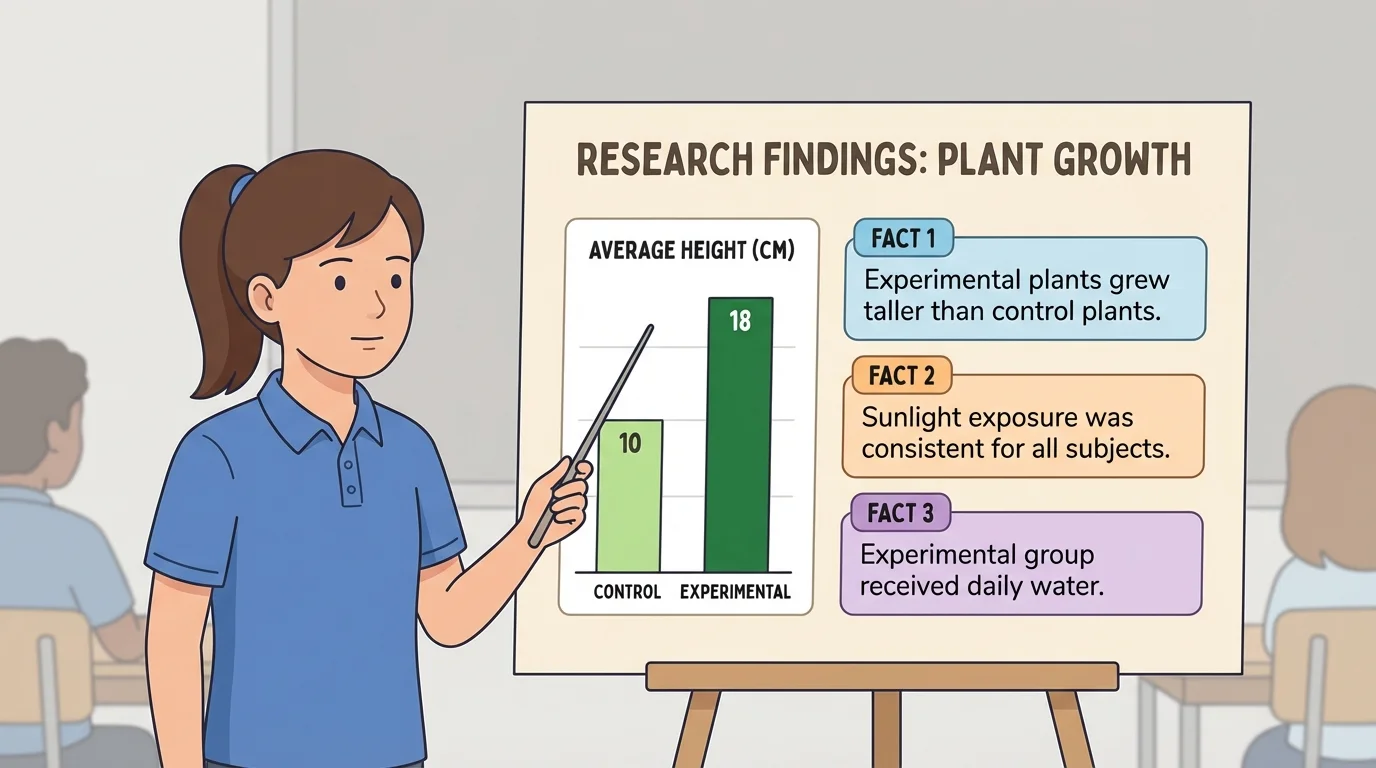
When using a visual, explain it. Do not just hold it up. You might say, "This chart shows that sparrows were the birds we saw most often during recess." Then point to the part you mean.
Examples are another kind of support. Suppose your finding is that parks help communities. You can give an example: "Our local park has a walking trail, a playground, and benches where families gather." Specific examples help ideas feel real.
As with the organized poster in [Figure 4], less is often more. One clear chart can help more than five crowded pages.
Here is a model of how a short report might sound. Notice that it has a topic, findings, evidence, and conclusion.
Sample oral report
"My research question was: How does a school garden help students? I used a book about gardens, a children's science website, and an interview with our school gardener. I found three main things. First, school gardens help students learn by letting them observe plant growth closely. Second, gardens can encourage healthy eating because students are more willing to try vegetables they helped grow. Third, gardens help students practice teamwork because many jobs, like watering and weeding, must be shared. These findings show that a school garden is not just a place to grow plants. It is also a place to grow learning and cooperation."
This sample report is brief, but it still includes the key parts. The speaker tells the question, names the sources, shares three findings, and ends with a strong conclusion.
A report can also include words that show order, such as first, next, also, and finally. These transition words help the audience follow your thinking.
Presenting is not only speaking. It is also listening. After a report, audience members may ask questions. A question might ask for a detail, ask what source you used, or ask why the topic matters.
When someone asks a question, listen all the way to the end. Then answer politely and clearly. If you know the answer, explain it using facts from your research. If you do not know, it is honest to say, "I did not find that out in my research," or "I am not sure, but I could learn more about that."
This honesty is part of good research practice. Researchers do not pretend to know things they have not learned. They share what the evidence supports.
"Good speakers help people understand, not just hear."
Audience members also have a job. They should watch, listen, and think respectfully. A good audience does not interrupt or distract the speaker. Respect helps everyone learn from one another.
When students ask thoughtful questions, the presentation becomes stronger. It turns into a conversation about learning instead of a one-way speech.
One common mistake is reading every word from a paper. This makes it hard to look at the audience, and the report may sound flat. A better choice is to use short notes and speak in your own words.
Another mistake is sharing too many facts. If your report includes ten small details but no clear main idea, listeners may forget everything. Pick the strongest findings and support them with a few useful details.
Some students speak so softly that only the front row can hear. Others speak too fast because they feel nervous. These problems can improve with practice. Read your report aloud and notice where you need to slow down, pause, or speak more strongly.
Another mistake is forgetting to connect facts to the main point. For example, if you researched turtles, do not just list turtle facts. Explain what those facts show. Maybe they show why clean water matters or how turtles survive in their environment.
The clear sequence we saw in [Figure 1] can help fix this problem. When you move from topic to findings to conclusion, your report stays focused.
Many skilled speakers practice out loud more than once. Reading silently in your head is helpful, but speaking aloud helps you notice tricky words, awkward pauses, and places where your meaning is unclear.
You can also check whether your categories are clear. If your notes still feel messy, think back to the grouped ideas in [Figure 2]. Sorting your facts again can make your report much easier to understand.
Before you present, make sure you know your opening sentence. Starting strongly helps you feel ready. Then review your note cards, visual if you have one, and the order of your main points.
Practice saying the report aloud. You do not have to memorize every word. You do need to know what comes next. If you can explain your findings in your own words, you are prepared.
Check that your report answers these questions: What was my topic or question? What are my main findings? What evidence supports them? What do I want my audience to remember? If you can answer all four, your report is likely strong and clear.
At the end, thank the audience or pause for questions. This shows that your presentation is complete and that you are ready to listen as well as speak.
