One tiny word can change the meaning of an entire sentence. If a character says, "I might go," that is very different from "I will go." That is why readers must pay close attention to exact words. When you explain a text, you are not just giving an opinion. You are showing what the author actually wrote and what those words help you understand.
When you use an exact quotation, you copy the author's words correctly from the text. Quoting accurately helps your explanation sound trustworthy. It proves that your idea is based on the text, not on a guess or a memory that may be a little off.
Readers often talk about text evidence. Text evidence is the part of the reading that supports your answer, idea, or conclusion. Sometimes the evidence is a sentence, sometimes only a few words, and sometimes part of a line of dialogue. The key is that it matches the text exactly.
Quote accurately means to copy the author's exact words from a text without changing them. Explicit information is what the text says directly. An inference is an idea a reader figures out by combining clues from the text with thinking.
If you change even one important word, you may change the meaning. For example, if a text says, "Lena whispered her answer," and you write that Lena "said" her answer, you have lost information. Whispered tells us something about Lena's voice, mood, or the situation.
Good readers notice both what the author states directly and what the author hints at, as [Figure 1] shows. Some answers live right on the page. Other answers must be built from clues. Both kinds of understanding need support from the text.
Explicit information is the easiest place to start. If a passage says, "The soccer game began at sunset," then you know directly that the game started at sunset. You do not have to guess. The text tells you plainly.
Inference is different. Suppose a passage says, "Maya pulled her jacket tighter and blew warm air into her hands." The text may not directly say, "Maya felt cold," but you can infer that she was cold. You use clues from the text and what you know about real life.
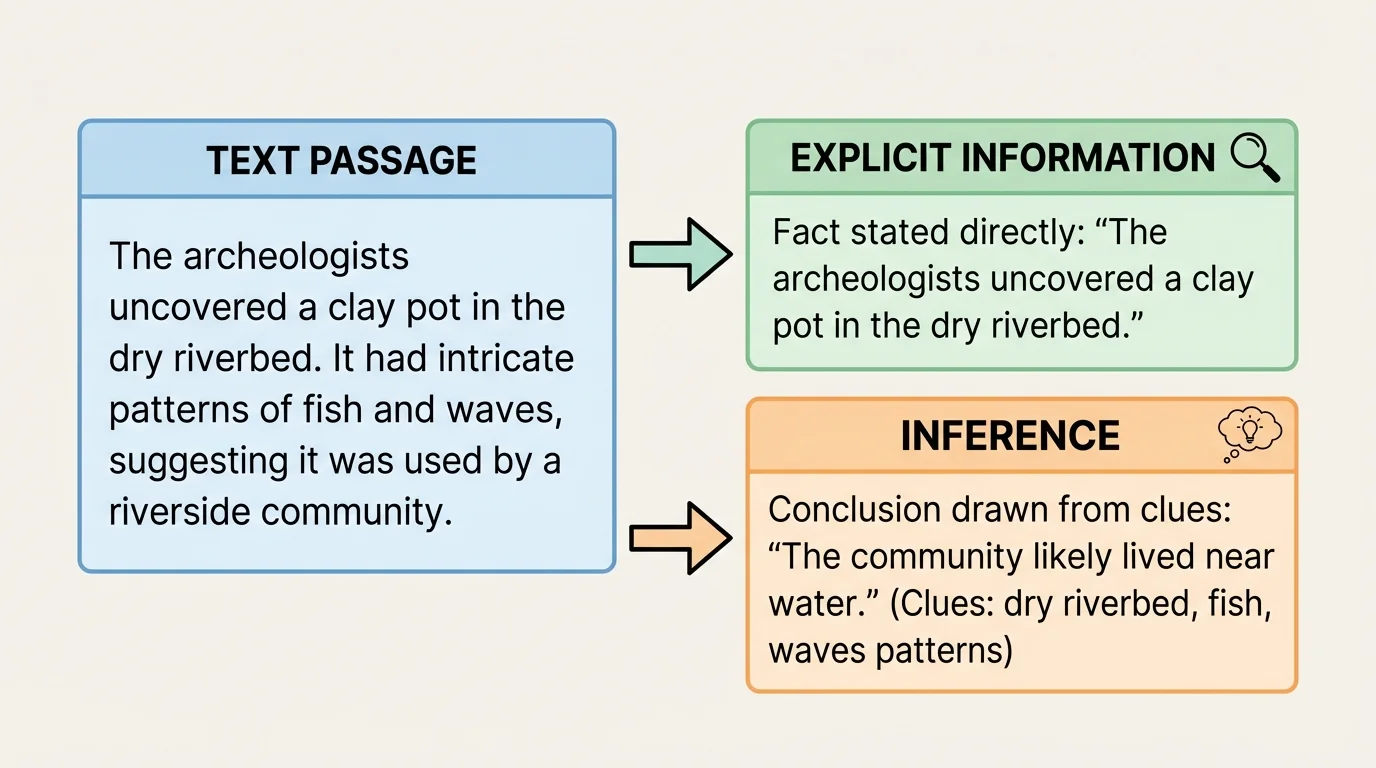
Here is a simple example. Read this sentence: "Carlos stared at the unopened letter for an hour before sliding it into a drawer." An explicit fact is that Carlos does not open the letter. An inference is that he may feel nervous, worried, or not ready to read it. The inference is not random. It comes from the clue that he stared at it for a long time and put it away unopened.
When you answer a question, it helps to ask yourself: Does the text say this directly, or am I figuring it out from clues? If it is direct, quote the part that states it. If it is an inference, quote the clue or clues that led you there.
When readers make an inference, they do not make it up. They combine clues from the text with careful thinking. A strong inference always has evidence behind it.
This is why accurate quoting matters in both cases. If you are explaining explicit meaning, the quote shows the exact statement. If you are explaining an inference, the quote shows the exact clue.
Not every sentence in a passage is equally useful. A strong reader chooses a quote that is relevant, meaning it directly connects to the question or idea being explained.
The best quote is usually short and powerful. You often do not need a whole paragraph. If the question asks why a character is upset, a few words like "kicked the gravel" or "would not meet anyone's eyes" may be enough. Those details can reveal mood more clearly than a long copied section.
A useful way to think is: Find the exact words that do the work. Which words prove the point? Which words reveal the important detail? Those are the words you should quote.
Choosing the strongest evidence
Question: What makes the reader think Ben is in a hurry?
Text: "Ben stuffed the map into his pocket, skipped breakfast, and ran out the door before the sun was fully up."
Step 1: Look for details connected to the idea of being in a hurry.
The important clues are "skipped breakfast" and "ran out the door."
Step 2: Choose the shortest quote that proves the point.
A strong choice is "skipped breakfast, and ran out the door."
Step 3: Explain what the quote shows.
These actions show Ben does not slow down for his normal routine, so the reader can infer that he is in a hurry.
Sometimes a question has more than one possible quote. That is fine. What matters is that the quotation is correct and clearly supports your explanation.
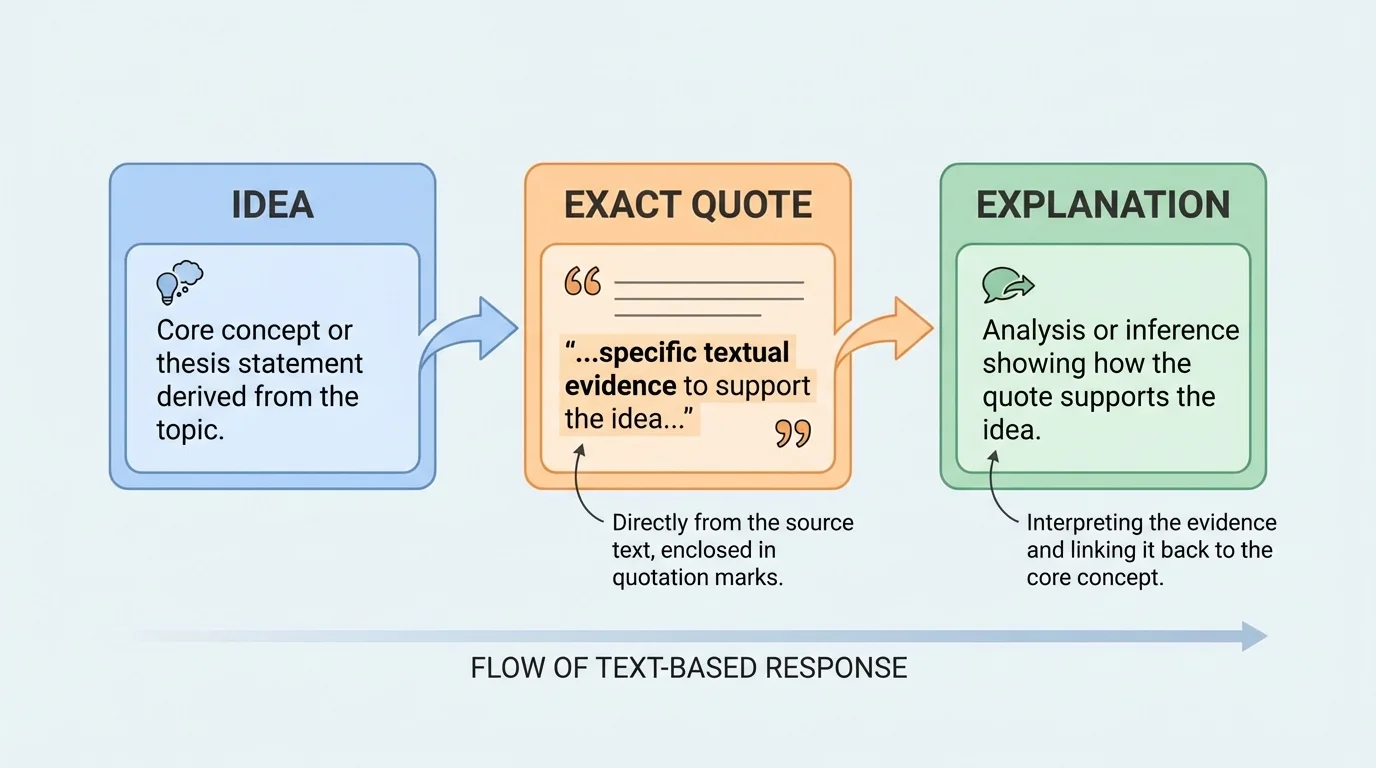
Strong responses are built in clear parts, and [Figure 2] illustrates a helpful pattern: state your idea, include an exact quote, and then explain how the quote supports your idea. A quotation should not sit alone like a dropped object. It should be part of your thinking.
Here is a simple structure you can use: state the answer, include the quote, and explain it. For example: The text shows that Amara is determined because she says, "I will finish before dark," which shows that she has made a firm decision and plans to keep going.
Notice what happens here. The response does not just copy words from the text. It also explains what those words mean. That explanation is important because evidence without thinking is incomplete.
You can introduce a quote with phrases such as the text states, the author writes, the narrator says, or the article explains. These introductions help your writing sound smooth and clear.
You should also copy punctuation and wording carefully. If the text says, "No one touched the painting," do not write "Nobody touched the painting" inside quotation marks. That would no longer be an exact quote.
When a question asks what the text says directly, your job is to find the exact line or detail that answers it. This kind of question often begins with words like who, what, when, where, or according to the text.
Suppose a passage says, "The class trip to the aquarium was moved to Friday because of Thursday's storm." If the question asks, "When is the class trip?" the answer should include the exact information from the sentence. You might write: The trip is on Friday. The text says it was "moved to Friday."
That quote is short, exact, and directly answers the question. It does not include extra information that the reader does not need.
Using a quote for explicit meaning
Text: "Mrs. Delgado keeps the old photographs in a cedar box on the top shelf."
Question: Where does Mrs. Delgado keep the photographs?
Step 1: Find the exact words that answer the question.
The answer is "in a cedar box on the top shelf."
Step 2: Put the quote into a complete sentence.
Mrs. Delgado keeps the photographs "in a cedar box on the top shelf."
Step 3: Check that the quotation matches the text exactly.
The wording stays the same as the original sentence.
When the answer is stated directly, you do not need to stretch for a complicated explanation. You still explain the evidence, but the explanation can be brief because the text already says it clearly.
Inference questions are more challenging because the text may not hand you the answer in one neat sentence. You have to gather clues. Then you quote the clue or clues that support your conclusion.
Think again about the difference shown earlier in [Figure 1]. An inference grows out of evidence. It is not a wild guess. If you cannot point to words in the text, the inference is too weak.
For example, read this line: "Nia checked the window latch twice, turned off every light, and listened at the door before stepping into the hallway." The text does not say, "Nia was nervous." But you can infer that she feels cautious or nervous. A strong response might say: Nia seems nervous because she "checked the window latch twice" and "listened at the door," showing that she is being extra careful.
Notice that the quotation includes clues, not the final idea itself. The reader must connect those clues to the conclusion.
From clue to conclusion
When you make an inference, move in two steps. First, identify the clue words the author gives you. Second, explain what those clue words suggest. The quote provides the clue, and your explanation provides the conclusion.
Sometimes one quote is enough. Other times, you may need two short quotes from the same passage. If a character's feelings are shown through actions in one sentence and dialogue in another, using both may give stronger support.
Not all text-based answers are equally strong. Some are accurate but vague. Others are detailed and convincing. The strongest answers connect the quote tightly to the idea.
| Type of response | Example | Why it is strong or weak |
|---|---|---|
| Weak | The character is sad because of the text. | No quotation and no clear evidence. |
| Better | The character is sad because she says, "I miss the old house." | Includes a quote, but explanation is brief. |
| Strong | The character is sad because she says, "I miss the old house," which shows she is still thinking about what she lost. | Includes accurate evidence and explains what it means. |
Table 1. Comparison of weak, better, and strong text-based responses.
A strong answer usually does three things: it answers the question, quotes accurately, and explains the meaning of the quote. If one of those pieces is missing, the response becomes less clear.
Readers in many jobs use this same skill. Lawyers quote laws exactly, historians quote original sources exactly, and reporters quote interviews exactly because small wording changes can change meaning.
This makes the skill useful far beyond reading class. Accurate quotation teaches careful attention, fairness, and precision.
One common mistake is misquotation, which means copying the words incorrectly. A misquotation can happen if you work from memory instead of checking the text. Always look back and compare your quotation to the original.
Another mistake is overquoting. If you copy a long chunk when only a few words matter, your answer may become hard to follow. Short, focused quotations are usually stronger than long copied passages.
A third mistake is giving a quote without any explanation. For example, writing only "The wind bent the trees nearly in half" does not tell the reader why that quote matters. You need to explain that it shows the storm was powerful.
Some readers also confuse inference with opinion. An opinion is simply what someone thinks. An inference must be supported by evidence from the text. If two readers make different inferences, the stronger one is the one with better evidence.
Fixing a weak answer
Question: What can you infer about the setting?
Text: "Dust floated through the broken sunlight, and the floorboards groaned under each step."
Step 1: Start with a weak answer.
The setting is scary.
Step 2: Add exact quotation.
The setting seems scary because "dust floated through the broken sunlight" and "the floorboards groaned."
Step 3: Explain the evidence.
These details create a quiet, old, unsettling mood, so the reader can infer that the place feels eerie.
When you revise an answer, ask: Did I quote exactly? Did I choose the best words? Did I explain what they show? Those questions improve almost every response, as [Figure 3] suggests.
The skill of accurate quoting works across many genres. The best evidence may come from different places depending on the kind of text. In a story, you may quote dialogue or description. In a poem, you may quote a repeated phrase or a vivid image. In an article, you may quote a fact or a statement from the author. In a play, you may quote what a character says or stage directions.
For a story, descriptive details often help with inference. If the narrator says, "The porch swing creaked in the empty yard," that detail may help create a lonely mood. For an article, explicit information is often easier to find because authors usually state facts directly.
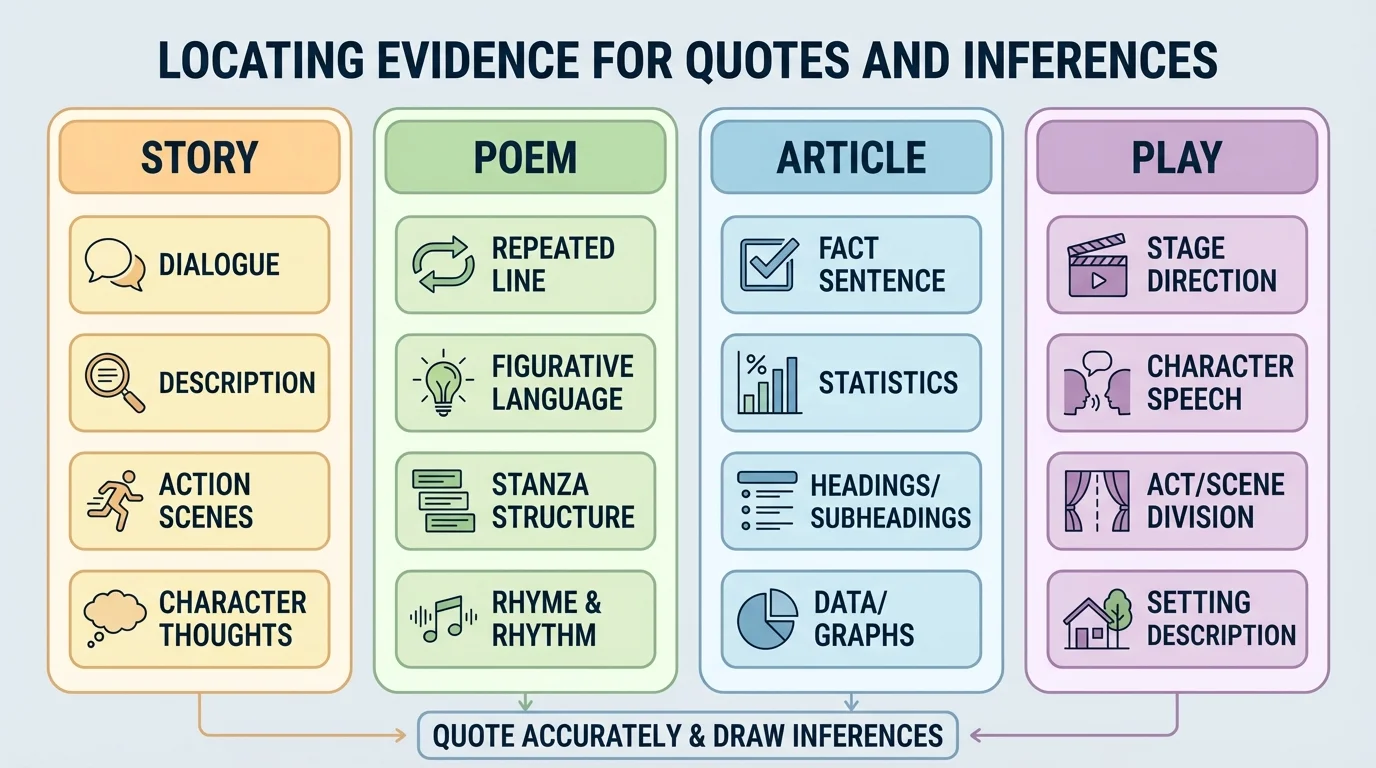
Poetry can be especially interesting because a few carefully chosen words can carry a lot of meaning. If a poem repeats the phrase "still waiting," a reader may infer patience, hope, or sadness depending on the surrounding lines.
In plays, stage directions can be excellent evidence. If a script says a character enters slowly and avoids eye contact, those details can support an inference about emotion even before the character speaks.
Later, when you compare genres again, remember that the location of evidence changes, but the need to quote accurately stays the same.
Good readers build habits that make quoting easier. They reread important lines, underline key details, and ask what each detail shows. They do not rush to the first quote they see. They choose evidence on purpose.
It also helps to keep your explanation close to the words of the text. If the text says a character "dragged" his backpack, that verb may suggest tiredness, boredom, or disappointment. Paying attention to exact verbs, adjectives, and dialogue helps you make stronger explanations.
As you continue reading harder texts, the pattern stays the same. Find the important words. Copy them exactly. Explain what they say directly or what they help you infer. That is how readers support their interpretations with confidence and care.
"The evidence is in the words."
— A strong reader's reminder
Every time you support an answer with a precise quotation, you are showing respect for the author's language and for the truth of the text. Careful reading is not only about understanding more. It is also about understanding accurately.
