One of the most useful academic skills is being able to read something new, difficult, and important without needing someone else to explain every part. That matters when you read about ancient civilizations, ecosystems, weather instruments, inventions, or directions for building something. Informational reading is not just a school task. It is how people learn from the world.
An informational text gives facts, explanations, ideas, or directions. Unlike a story, which mainly entertains with characters and plot, informational writing teaches the reader about the real world. A strong reader can learn from many kinds of nonfiction: an article about volcanoes, a chapter on the American Revolution, a chart about animal habitats, or directions for using a microscope.
When you read informational texts well, you become better at asking questions, finding evidence, and learning independently. That means you can understand more challenging material by the end of the year and feel confident doing it. Good readers do not always know every word at first. They know how to keep thinking, keep noticing, and keep making meaning.
Informational text is nonfiction writing that explains, describes, gives facts, or teaches about a real topic. It can include history/social studies texts, science texts, and technical texts.
Informational reading appears in different school subjects. History and social studies texts may explain events, people, laws, or communities. Science texts may describe observations, experiments, systems, or causes. Technical texts may teach how to do something step by step. The comparison helps show how these kinds of texts can look different while all still being informational.
[Figure 1] Informational reading appears in different forms. Some informational texts are written in paragraphs like an article. Others include diagrams, labels, tables, maps, captions, or numbered steps.
A science article about the water cycle may include headings and a labeled diagram. A history page may include a timeline and a primary source quote. A technical page may include a materials list and warnings.
Even when these texts look different, they all ask the reader to do similar thinking: notice key ideas, connect details, understand important vocabulary, and use the text features to build meaning.
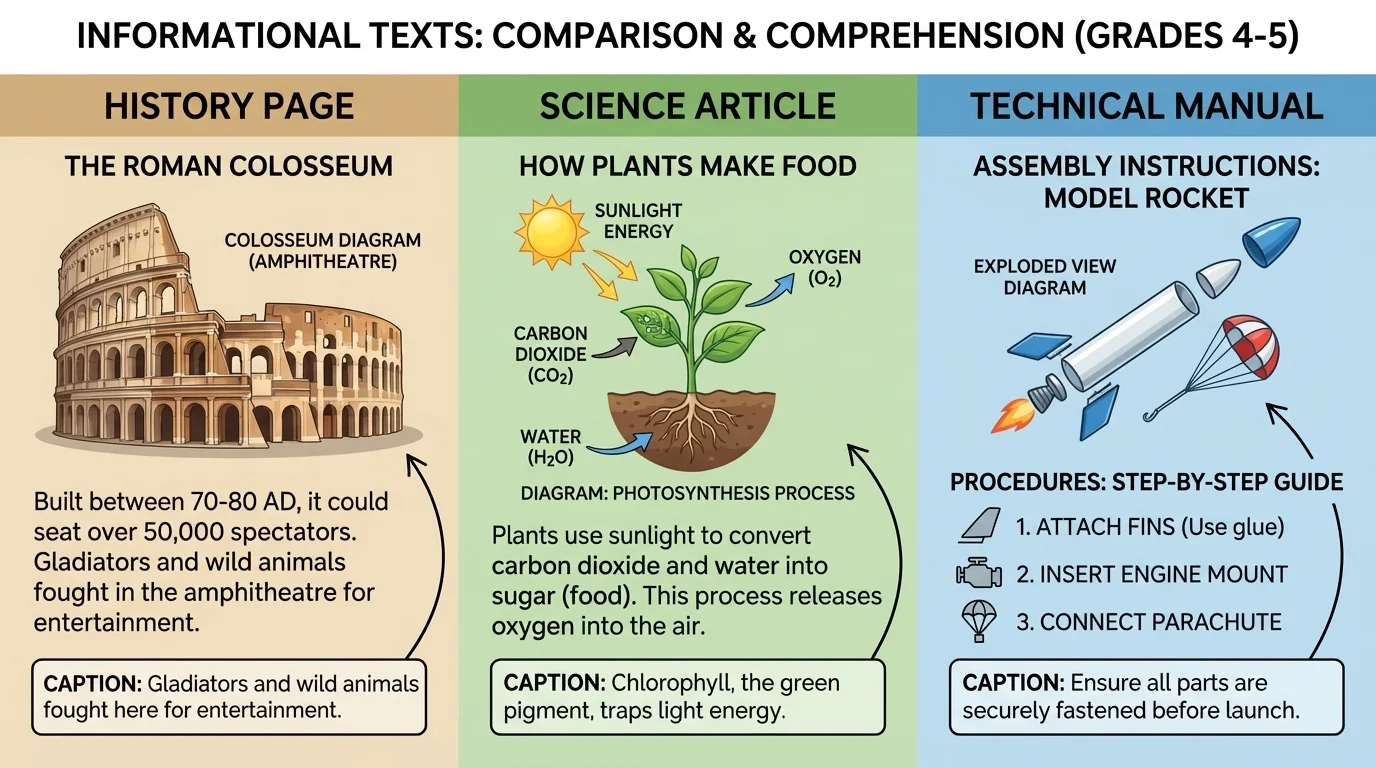
Reading across these text types prepares you for real life. Adults read news reports, recipes, manuals, maps, science articles, and historical information all the time. Students who can move from one kind of nonfiction to another are stronger learners in every subject.
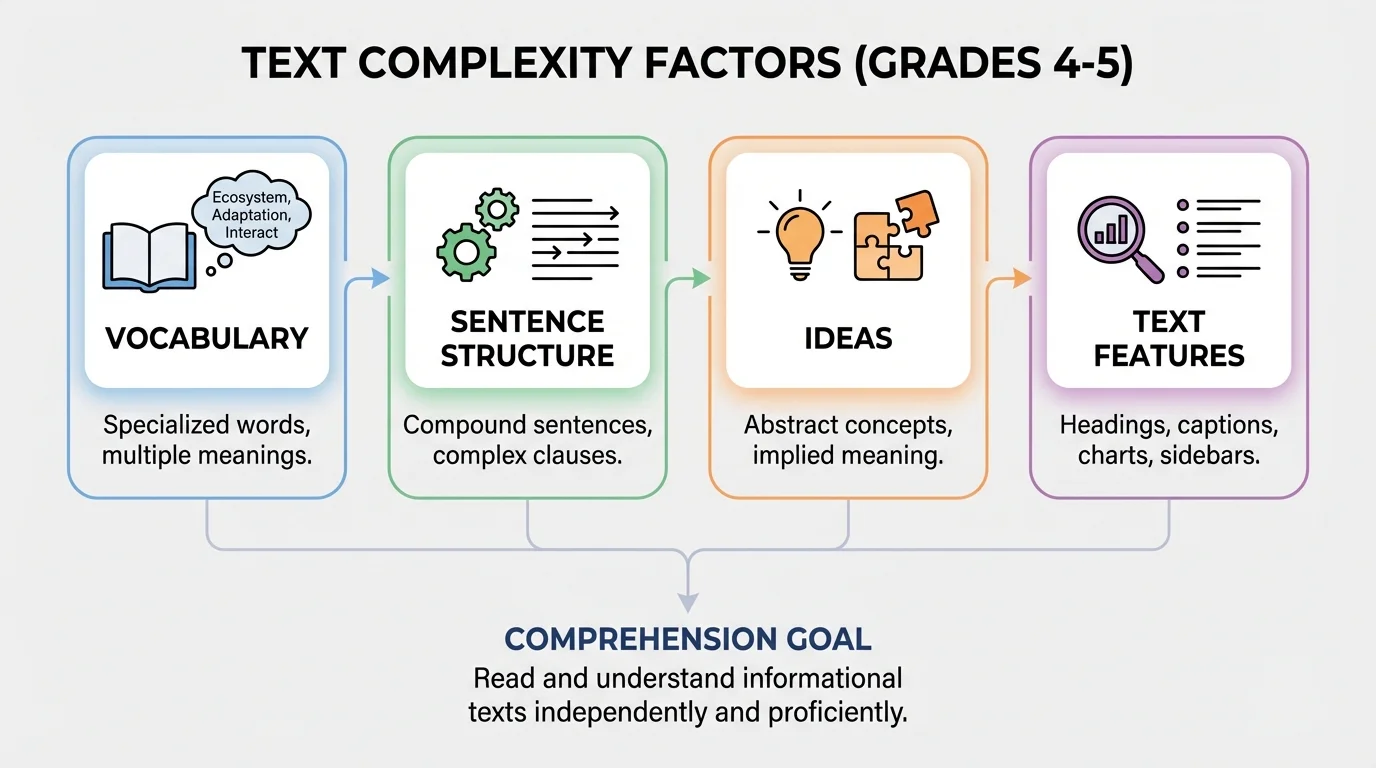
[Figure 2] Not all texts are equally easy to understand. Some are short and simple. Others are packed with new ideas. Four major things can make an informational text more complex: vocabulary, sentence structure, ideas, and text features.
First, a text may include difficult words. A social studies text might use words like evidence, government, migration, or economy. A science text may include words such as organism, adaptation, or condensation. A technical text may use exact words for parts, tools, or actions. Sometimes the words are new, but the context around them helps explain their meaning.
Second, a text may have longer or more complicated sentences. Some sentences compare ideas, show causes and effects, or include several details at once. Readers need to slow down and notice how the parts of the sentence fit together.
Third, a complex text may contain ideas that connect in tricky ways. For example, a science text may explain a chain of events. A history text may describe several causes for one event. A technical text may require you to understand the order of steps exactly.
Fourth, text features can add challenge. Charts, maps, sidebars, diagrams, captions, and bold words are helpful, but only if the reader knows how to use them. Strong readers do not skip these features. They treat them as part of the text's meaning.
When you read at the high end of the grade 4–5 complexity band, you may feel stretched. That is normal. Challenging reading does not mean impossible reading. It means the text asks you to think carefully and use strategies on your own.
Text complexity is the level of challenge in a text. A text becomes more complex when it includes advanced vocabulary, detailed ideas, unusual organization, or features that require close attention. Strong readers rise to that challenge by using strategies instead of giving up.
A reader becomes proficient by noticing difficulty and responding to it. If a section is confusing, stop and reread. If a word is unfamiliar, use nearby clues. If a diagram adds important information, study it closely. Proficient readers are active thinkers, not passive readers.
Before reading, preview the text. Look at the title, headings, pictures, captions, graphs, or bold words. Ask yourself what the topic might be and what you already know. This gives your brain a place to put the new information.
During reading, pay attention to the main idea of each section. Notice supporting details and ask, "How does this detail help explain the big idea?" Keep track of sequence words such as first, next, and finally. Watch for cause-and-effect words such as because, so, therefore, and as a result.
After reading, pause and put the ideas into your own words. If you cannot explain what you just read, that is a sign to go back. Rereading is not a mistake. It is a smart reading move.
You already know that every text has a main idea and supporting details. In more challenging informational texts, that same skill still matters, but now the details may come from several paragraphs, charts, captions, or diagrams instead of just one obvious sentence.
Another important strategy is asking questions while you read. You might ask: What is the author explaining? What caused this event? What does this word probably mean here? Which detail is most important? Questions keep your mind active and focused.
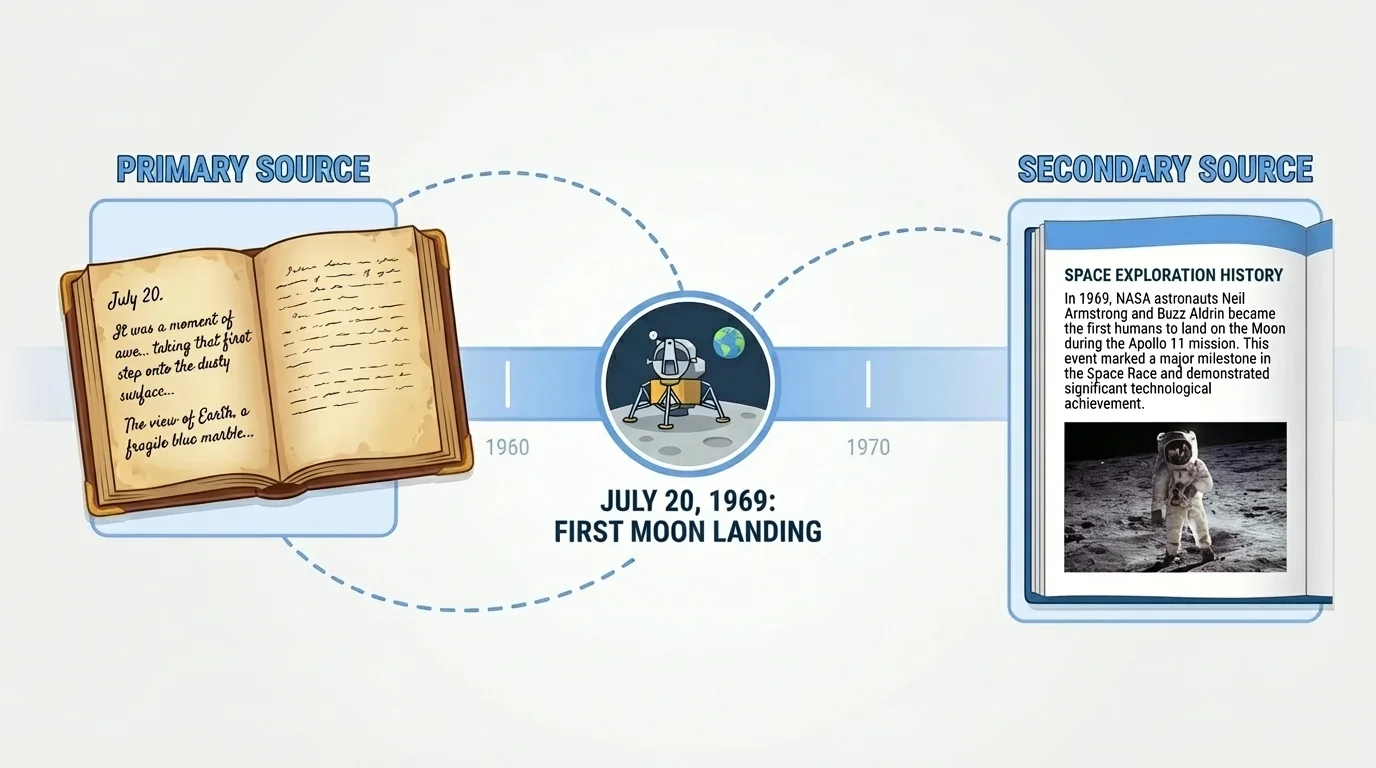
[Figure 3] History and social studies texts often explain people, places, events, and changes over time. They may include dates, maps, quotes, timelines, and descriptions of causes and effects.
The diagram illustrates how readers connect an event with both a primary source and a secondary source.
A primary source comes from the time being studied, such as a diary, letter, speech, law, photograph, or newspaper from that period. A secondary source is created later and explains or analyzes what happened, such as a textbook or encyclopedia article.
When you read history, pay close attention to who is speaking and when. Different people may describe the same event in different ways. One person may focus on courage, another on fear, and another on the results. That is why historians look for evidence from more than one source.
History texts also often use sequence and cause-and-effect structure. For example, if a text explains why settlers moved west, it may list several causes: land, trade, law, or conflict. A strong reader keeps these causes organized and asks how they connect.
Suppose you read a paragraph about a protest in history. To understand it well, you would ask: What happened first? What caused the protest? Who was involved? What changed afterward? Those questions turn details into understanding.
Case study: reading a history paragraph
A student reads a short passage about a new law that made colonists angry.
Step 1: Identify the main idea.
The paragraph explains that the law increased tension between colonists and the British government.
Step 2: Find important details.
The text says the law added taxes, led to protests, and increased distrust.
Step 3: Explain the cause and effect.
The cause is the new law. The effects are anger, protest, and growing conflict.
By organizing the details, the student understands more than just isolated facts.
Later, when you compare sources, remember the relationship shown earlier in [Figure 3]: one source may come directly from the event, while another explains it from a later point of view. Knowing that difference helps you judge how the information is being presented.
Science texts explain how the natural world works. They often describe systems, changes, experiments, observations, and evidence. Science reading asks you to be precise. A tiny difference in wording can matter.
A process is a series of actions or changes that happen in order. In science, many ideas are processes: the water cycle, plant growth, digestion, erosion, and the life cycle of an animal. When reading about a process, track what happens first, next, and last.
Science texts also include special vocabulary. Sometimes a word has a different meaning in science than in everyday speech. For example, theory in science does not mean a random guess. It means an explanation supported by evidence. That is why context matters so much.
Another important science reading skill is connecting words to visuals. A diagram of a food chain, the parts of a flower, or layers of Earth can add meaning that is not fully explained in one sentence. Good readers move back and forth between the paragraph and the visual.
Many scientists spend as much time reading and writing as they do experimenting. Discoveries matter, but they only help others when the information is explained clearly and read carefully.
Suppose a science passage explains that water vapor cools and changes into liquid water. If you miss the word cools, you may misunderstand the whole process. Science reading rewards careful attention to sequence, conditions, and exact word choice.
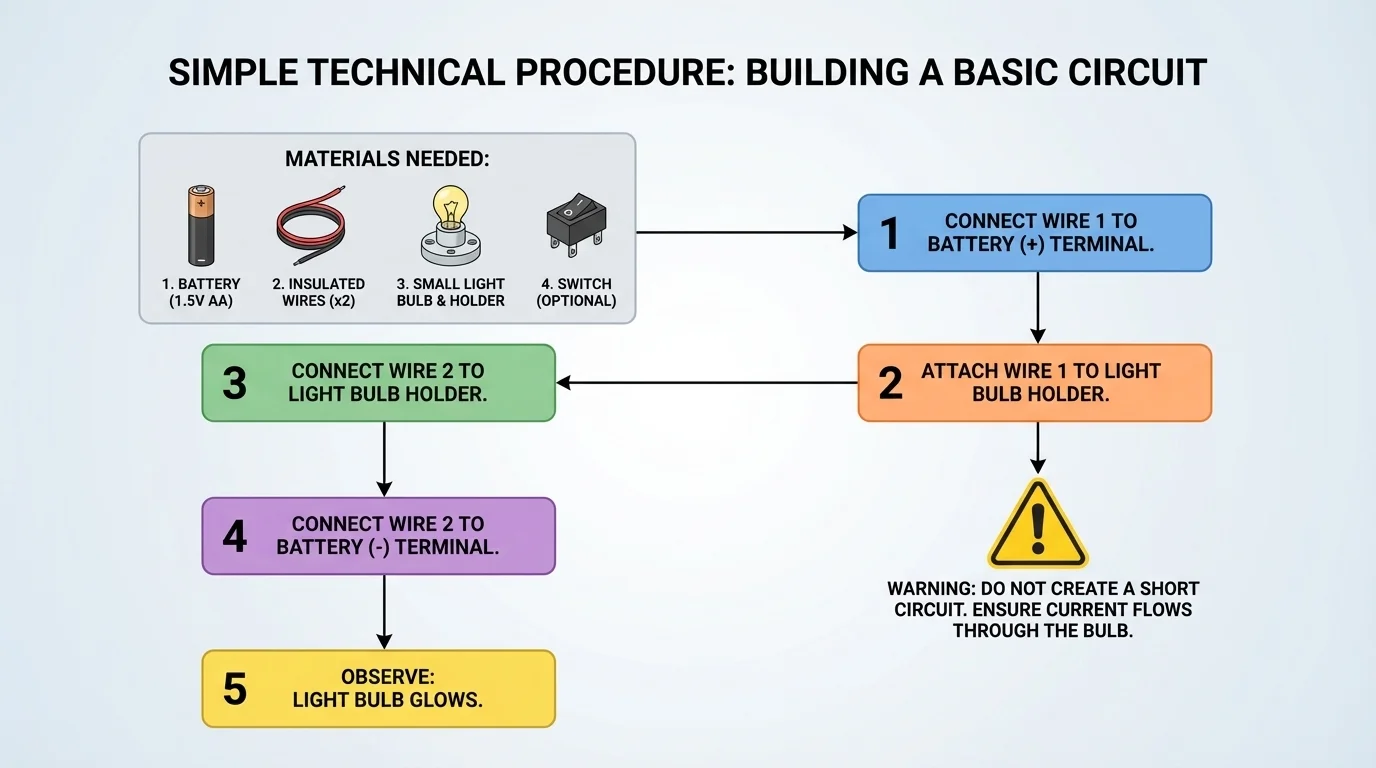
[Figure 4] Technical texts teach how to do something or how something works. They may include directions, manuals, safety rules, labeled parts, and numbered steps. Reading technical writing depends on order and precision.
In a technical text, sequence is extremely important. If the steps are out of order, the task may fail. Imagine planting seeds but watering before the soil and seeds are in place, or trying to connect wires before identifying the correct parts. Technical reading requires exact attention.
These texts also often include warnings, measurements, and labels. A reader must notice signal words such as caution, warning, do not, and make sure. Even simple directions can become confusing if you skip one word or one step.
The flowchart shows how order, labels, and warnings work together in a technical procedure.
Technical texts are all around you: game instructions, appliance manuals, coding directions, recipes, craft guides, and science lab procedures. Reading them well helps you act safely and successfully.
If a set of directions says to attach part A before part B, there is usually a reason. The order in [Figure 4] reminds us that technical reading is not just about understanding words. It is about understanding action.
Informational texts often include features that guide readers. These include headings, subheadings, captions, maps, diagrams, charts, glossaries, bold words, indexes, and sidebars. Each feature has a job.
A heading tells what a section is mostly about. A caption explains a picture or chart. Bold words point out important vocabulary. A map helps show location. A diagram shows parts or steps. A table helps compare information quickly.
| Text Feature | How It Helps |
|---|---|
| Heading | Names the topic of a section |
| Caption | Explains an image, chart, or diagram |
| Bold word | Signals an important term |
| Diagram | Shows parts, steps, or relationships |
| Map | Shows location and movement |
| Table | Organizes facts for comparison |
Table 1. Common informational text features and how each one supports understanding.
Readers who ignore text features miss information. Readers who use them gain clues that make the text easier to understand. That is especially important when the writing is challenging.
Using text features actively means stopping to ask what each feature adds. A diagram may explain what the paragraph only hints at. A caption may clarify what is important in an image. A heading may reveal the main idea before you read the details.
As you saw earlier in [Figure 1], different subject areas use different features, but the reader's job stays the same: gather information from all parts of the page, not just the body paragraphs.
Strong readers notice when understanding breaks down. That skill is called monitoring comprehension. It means checking your own thinking as you read.
If a paragraph stops making sense, there are several ways to repair understanding. Reread the sentence slowly. Look for context clues around an unknown word. Break a long sentence into smaller ideas. Study the heading to remember the section topic. Read the caption or examine the diagram. Ask yourself what the author is trying to explain.
Sometimes summarizing one paragraph at a time helps. You can silently say, "This paragraph is mostly about how erosion changes land," or "This section explains why a law was passed." Short mental summaries keep you focused on the big idea.
Fixing confusion while reading science
A student reads a paragraph about evaporation and does not understand one sentence.
Step 1: Reread the sentence and the one before it.
The earlier sentence explains that the Sun heats water.
Step 2: Use context clues.
The next sentence says the water changes into vapor and rises, so the student infers that evaporation is water changing from liquid to gas.
Step 3: Restate the idea.
The student says, "Evaporation happens when heated water turns into vapor and goes into the air."
Now the text makes sense again.
Readers who monitor comprehension become more independent because they do not wait for someone else to rescue them. They notice confusion early and choose a strategy to solve it.
Reading independently does not mean reading perfectly on the first try. It means using what you know to make meaning without needing constant help. Independence grows through practice, attention, and confidence.
Proficient readers handle challenging texts accurately and thoughtfully. They can identify main ideas, explain details, use evidence, understand subject-specific words, and work through confusion. They also read with stamina, which means they can stay focused long enough to understand a longer or more demanding text.
To become more independent, choose a mindset of steady effort. Preview the text. Read closely. Use text features. Ask questions. Reread when needed. Explain ideas in your own words. Over time, the very texts that once felt difficult begin to feel manageable.
"Reading is a way to travel through facts, ideas, and time without leaving your chair."
That is especially true in informational reading. One page can take you into a coral reef, a colonial town, a weather lab, or the inside of a machine. The more skillfully you read, the more places knowledge can take you.
