Some words act like keys. If you know what they mean, a whole passage suddenly opens up. If you do not, the text can feel like a locked door. This happens all the time in grade 5 reading, especially in science, social studies, health, and math. Strong readers do not stop every time they encounter an unfamiliar word. Instead, they use smart strategies to determine meaning.
Informational texts are full of important words and phrases. Some appear in many subjects. Others belong mostly to one subject. Learning how to figure out both kinds helps you understand directions, explanations, articles, textbooks, and source texts more clearly.
When you read informational text, every word has a job. Some words explain actions, such as compare or identify. Some words name special ideas, such as evaporation or legislature. If you miss the meaning of these words, you may misunderstand the whole paragraph.
Suppose a science text says, "Plants absorb water through their roots." If you do not know the word absorb, you may not understand what roots do. But if you use the sentence and topic to decide that absorb means "take in," the sentence becomes clear.
General academic words are words that appear in many subjects and help explain thinking, actions, or relationships. Words like analyze, process, result, and compare are general academic words.
Domain-specific words are words that are used mostly in one subject area. Words like photosynthesis, colony, numerator, and habitat are domain-specific words.
Knowing which kind of word you are reading helps you choose the best strategy. A general academic word may be understood by reading carefully across several sentences. A domain-specific word may also require attention to diagrams, captions, labels, or a glossary.
Readers often meet both kinds of vocabulary in the same paragraph, and [Figure 1] shows how these word types differ. For example, in a social studies article, the sentence "Citizens participate in government by voting in an election" includes one general academic word and one domain-specific word.
In that sentence, participate is a general academic word because people can participate in a game, a class discussion, a science experiment, or a government activity. The word election is domain-specific because it belongs especially to civics and government.
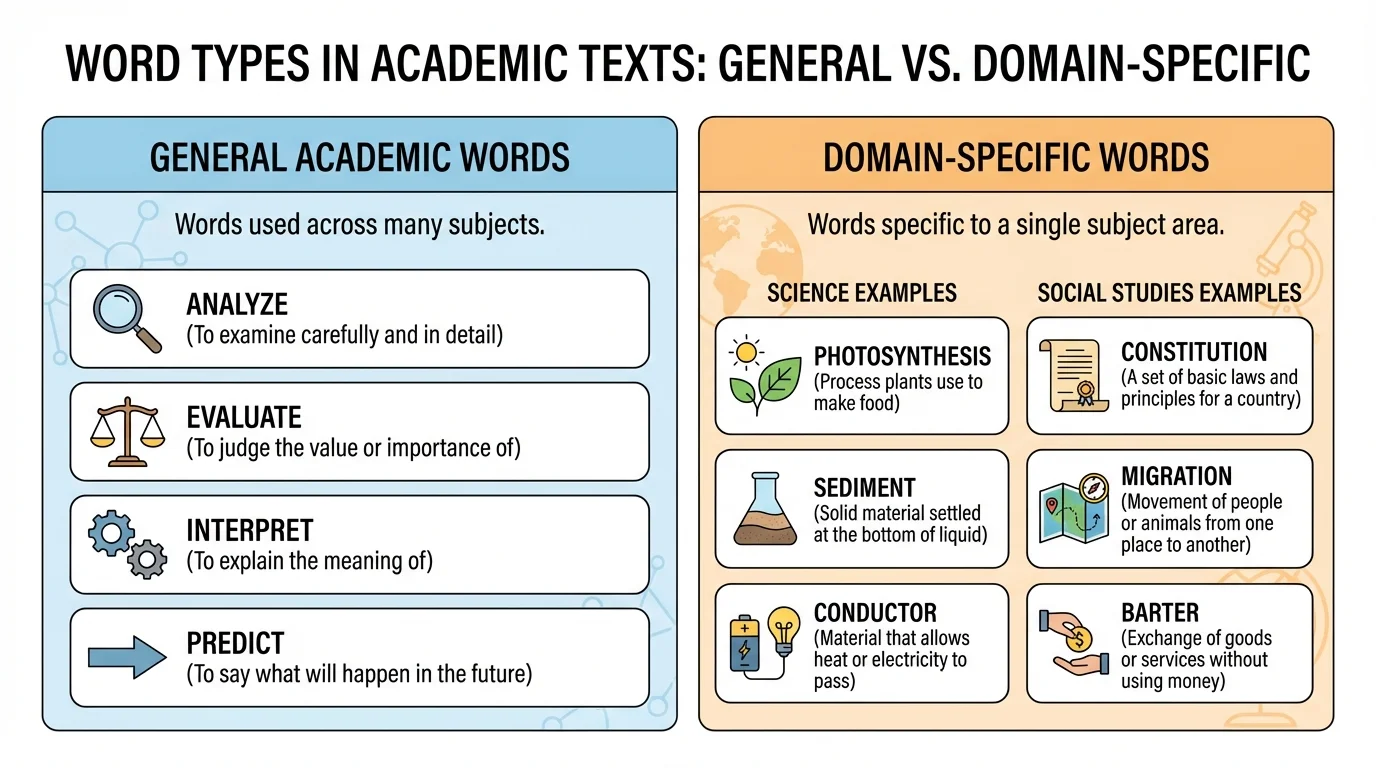
A reader should ask, "Is this a word used in many school subjects, or is it special to this topic?" That question helps narrow the meaning. If the word is domain-specific, the topic itself gives a strong clue. If the text is about space, the word orbit probably relates to movement around a planet or star, not just any path.
Here are some examples of each kind:
| Type of word | Example | How it is used |
|---|---|---|
| General academic | compare | Used in reading, science, math, and social studies to look at similarities and differences |
| General academic | result | Used to describe what happened because of something else |
| Domain-specific | evaporation | Mostly used in science to describe liquid changing into gas |
| Domain-specific | legislature | Mostly used in government and social studies to name a lawmaking group |
Table 1. Comparison of general academic and domain-specific vocabulary in informational texts.
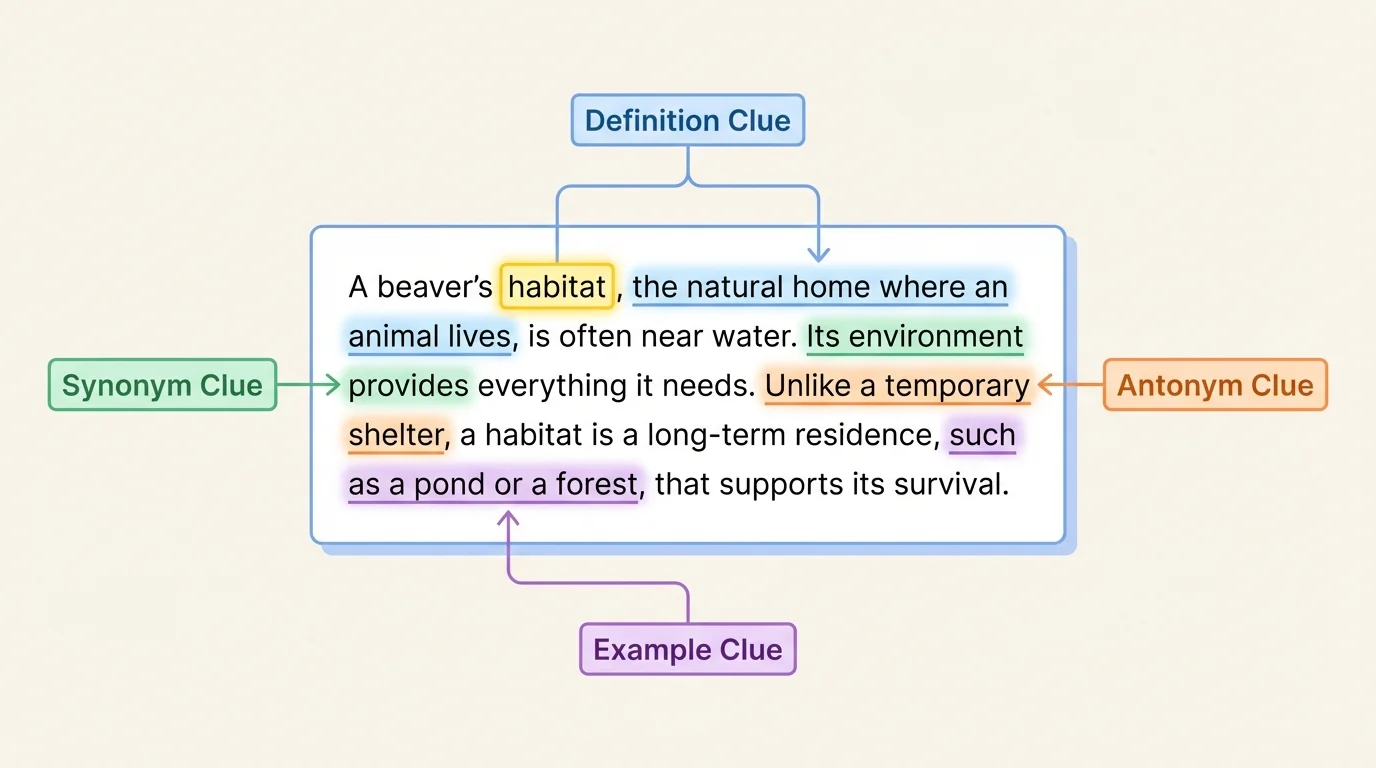
One of the most powerful reading strategies is using context clues, and [Figure 2] illustrates how nearby words and sentences can point to meaning. A context clue is information around an unfamiliar word that helps a reader figure it out.
There are several common kinds of context clues. A text may give a direct definition. It may give a synonym, which is a word with a similar meaning. It may give an antonym, which is a word with an opposite meaning. It may also give examples or details that let you infer the meaning.
Read this sentence: "The desert is an arid place, receiving very little rain each year." The phrase receiving very little rain each year acts like a definition clue. It tells you that arid means dry.
Now read this one: "Unlike the shallow pond, the lake is deep enough for large boats." The phrase beginning with unlike gives an antonym clue. Since the pond is shallow, the lake must be deep.
Here is an example: "Some nocturnal animals, such as owls, bats, and raccoons, are active at night." Even if you have never seen the word nocturnal before, the examples tell you that it means active at night.
Sometimes the clue is not direct. You must put details together. For example: "The metal bridge expanded in the heat of the afternoon. By evening, when the air cooled, it became shorter again." From these details, you can infer that expanded means became larger or longer.
Using context clues in a science sentence
Sentence: "A predator hunts other animals for food. Wolves, hawks, and sharks are all predators."
Step 1: Notice the words around the unfamiliar term.
The sentence says the animal hunts other animals for food.
Step 2: Look at the examples.
Wolves, hawks, and sharks are named as examples.
Step 3: Combine the clues.
A predator is an animal that hunts other animals for food.
Good readers do not use only one clue. They collect clues from the whole sentence and from nearby sentences. That is why reading just one line may not be enough.
Informational texts are built to teach, and [Figure 3] shows several text features that help readers unlock unfamiliar words. These features include headings, subheadings, bold print, captions, charts, sidebars, labels, and glossaries.
If you see a bold word in a textbook, the author is often signaling that it is important. That word may be defined nearby, explained in a diagram, or listed in the glossary at the back of the book. A caption under a picture may also explain a word that appears in the paragraph.
Suppose you read a page about weather and find the word meteorologist. A photo caption might say, "A meteorologist studies weather patterns and makes forecasts." Without the caption, the word may seem hard. With the caption, its meaning becomes much easier to determine.
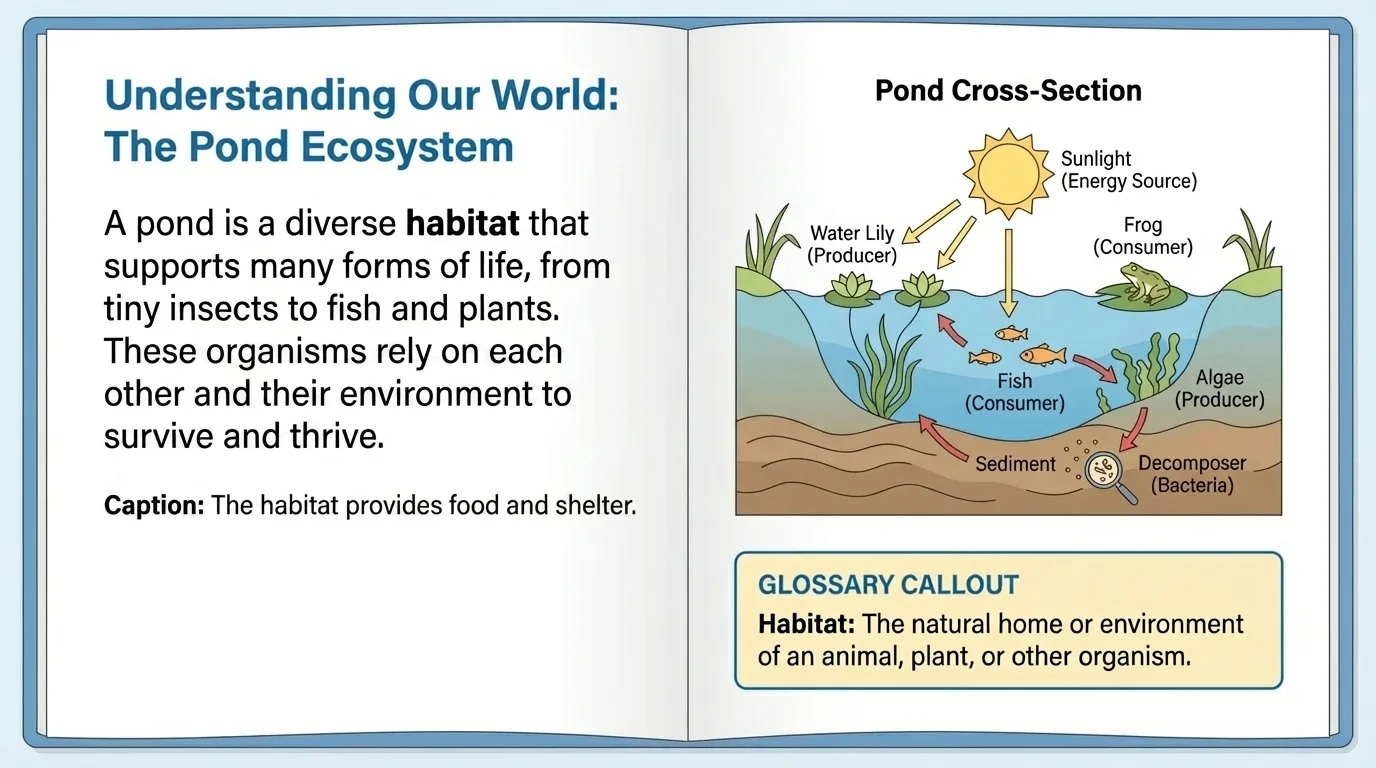
Headings also prepare your thinking before you read. A heading called Life in the Rainforest tells you that unfamiliar words in the section will probably connect to animals, plants, climate, or habitats. This background helps you choose the most likely meaning of a word.
Later, when you meet a new science term in another text, you can remember how these text features provide support. Strong readers do not ignore these features. They treat them as part of the text, not as decoration.
Sometimes a word gives away its own meaning if you look closely at its parts, and [Figure 4] presents a clear model of this strategy. Many English words contain a prefix, a root, or a suffix.
A prefix is a word part added to the beginning of a word. A suffix is added to the end. A root is the main part that carries the core meaning. When you know common word parts, you can make a smart guess about an unfamiliar word.
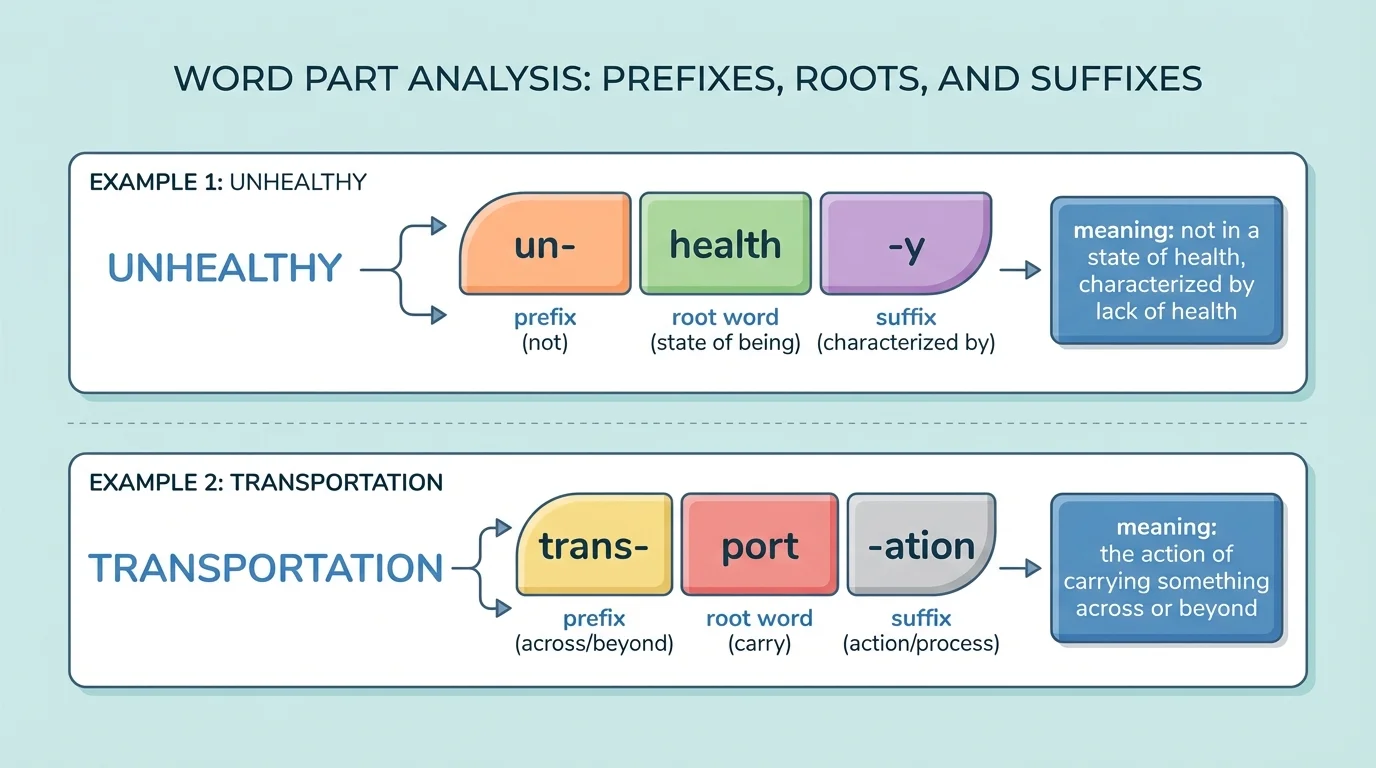
For example, the word unhealthy can be broken into un-, health, and -y. The prefix un- often means "not." The root health relates to wellness. So unhealthy means "not healthy."
Now look at transportation. The part port relates to carrying. In a text about cities, transportation means systems for carrying people or goods from one place to another.
How word parts help in subject-area reading
Word parts are especially useful with academic and technical vocabulary because many subject-area words are built from smaller parts. In science, social studies, and math, readers often meet long words. Breaking the word apart can turn a confusing word into understandable pieces.
Here are some useful word parts for grade 5 readers:
| Word part | Meaning | Example |
|---|---|---|
| pre- | before | preview |
| re- | again | rebuild |
| un- | not | unfair |
| -ful | full of | helpful |
| -less | without | harmless |
| bio | life | biology |
Table 2. Common word parts that help readers determine meaning.
Word parts do not always give the whole meaning, but they often point you in the right direction. Then you can check your guess with the context of the sentence.
Some words have more than one meaning. A reader must use the topic and sentence to decide which meaning fits. This is especially important in informational texts because school subjects often use words in special ways.
Take the word volume. In everyday life, it can mean how loud a sound is. In math, it means the amount of space inside a solid figure. In a library, it can even mean one book in a series. The correct meaning depends on the topic and the sentence around it.
If a math text says, "Find the volume of the rectangular prism," you know the word is not about sound. The subject tells you which meaning fits. If a music article says, "Lower the volume before the concert begins," the meaning changes.
The same thing happens with words like table, cell, mass, and power. In one subject, the word may mean one thing; in another subject, it may mean something else. Readers should always ask, "What is this text about?" before choosing a definition.
When you infer meaning, you are making a smart conclusion based on evidence. You already use this skill when you infer what a character feels in a story. In informational text, you infer what an unfamiliar word means by using details from the text.
This is why guessing too quickly can cause trouble. A familiar word may look easy, but its subject-area meaning may be different from its everyday meaning.
These strategies work in many classes. In science, you may read, "During condensation, water vapor cools and changes into liquid water." The phrase after the comma gives a definition clue, so you can determine the meaning of condensation.
In social studies, you may read, "The colony depended on trade, or the exchange of goods, with other settlements." The phrase the exchange of goods directly explains the word trade.
In health, you may see, "A balanced diet includes nutrients such as vitamins, minerals, proteins, and carbohydrates." The examples help explain what nutrients are.
Even in math texts, vocabulary matters. Words like estimate, equivalent, and operation are academic or domain-specific depending on how they are used. A student who understands the language of the problem is much more likely to solve it correctly.
Many long school words become less intimidating when you notice familiar pieces inside them. The word geography contains parts related to Earth and writing, which matches its connection to describing places on Earth.
The more subjects you read, the stronger your word knowledge becomes. A word first learned in science may appear later in a news article or a nonfiction book. Academic vocabulary travels from one subject to another.
When you encounter an unfamiliar word or phrase, use a clear process. First, read the whole sentence. Second, read the sentence before and after it. Third, look for context clues such as definitions, examples, or contrasts. Fourth, check text features like bold print, captions, and glossaries. Fifth, look for helpful word parts. Finally, ask whether your guessed meaning makes sense in the topic.
This process keeps you from making unsupported guesses. It also helps you become more independent. Instead of waiting for someone else to explain every word, you learn how to investigate the text yourself.
Using several strategies together
Passage: "The canyon walls showed signs of erosion. Over many years, wind and water slowly wore away the rock."
Step 1: Identify the topic.
The topic is landforms and changes to Earth's surface.
Step 2: Look for context clues.
The phrase wind and water slowly wore away the rock explains what happened.
Step 3: State the meaning.
Erosion means the process of rock or soil being worn away by natural forces such as wind and water.
Notice that the reader did not need a dictionary first. The text itself gave enough evidence to determine the meaning.
One common mistake is reading too fast and skipping over unfamiliar words. Another is using only part of the sentence instead of the whole idea. A third is choosing the everyday meaning of a word when the subject requires a special meaning.
For example, if you see the word cell in a science text, it probably does not mean a small room in a jail. If you see draft in a writing lesson, it probably does not mean a breeze. The subject area changes the meaning.
Another mistake is holding onto a wrong guess even when later sentences disagree. Good readers stay flexible. If new information appears, they revise their thinking.
Vocabulary grows step by step. Each time you figure out a word from context, text features, or word parts, you strengthen your reading power. Over time, these strategies become habits.
Readers who are strong with informational text pay attention to important words, notice clues around them, and connect meaning to the topic. They understand that words are not just decorations on a page. Words carry the ideas of the subject.
As you read more nonfiction, articles, and textbooks, keep asking: "What clues does the author give me?" That question turns you from a stuck reader into an active one. And active readers understand more, learn more, and remember more.
