One small word can completely change a story. If a character says, "The test was a breeze," the word breeze probably does not mean moving air from a fan or an open window. It means the test felt easy. Strong readers notice this right away. They know that authors choose words carefully, and they know that meaning comes from more than just a dictionary. It comes from the sentence, the paragraph, the speaker, and the whole text.
When you read a story, poem, scene from a play, or article, you meet words and phrases that may not mean exactly what they seem to mean at first. Sometimes a word is unfamiliar. Sometimes it has more than one meaning. Sometimes an author uses language in a creative way to paint a picture or share a feeling. Learning how to determine meaning helps you understand what the author is really saying.
Reading is a little like solving clues in a mystery. Authors do not always stop and explain every word. Instead, they place hints around the word. A careful reader notices these hints and builds meaning from them. This matters because understanding a single important word can help you understand a character, a setting, a mood, or an important event.
For example, read this sentence: "Jada trudged through the snow, her backpack tugging at her shoulders." Even if you do not know the word trudged, the sentence gives clues. Snow is hard to walk through, and the heavy backpack makes movement even harder. So trudged means walked slowly and with effort. You did not need someone to tell you directly. You used the text.
Context clue means a hint in the words or sentences around an unfamiliar word that helps a reader determine meaning.
Figurative language is language that is not meant to be taken exactly or literally. It creates comparisons, pictures, or stronger feelings.
Literal language means the exact, ordinary meaning of words.
Good readers stay flexible. They do not lock onto the first meaning that pops into their minds. They test a meaning against the sentence and ask, "Does this make sense here?" That question is one of the most powerful reading tools you can use.
Context clues are often the fastest way to figure out meaning, and [Figure 1] shows how readers gather different kinds of hints around an unfamiliar word. The words before and after the mystery word act like helpers. Sometimes they define the word directly. Sometimes they offer a similar word. Sometimes they give an opposite idea. Sometimes they provide an example.
Here are some common types of context clues:
Definition clue: The text explains the word right away. Example: "The desert is arid, or very dry, for most of the year." The phrase very dry tells the meaning.
Synonym clue: A nearby word has a similar meaning. Example: "The puppy was tiny, a very miniature ball of fur." The word tiny helps explain miniature.
Antonym clue: A nearby word shows the opposite meaning. Example: "Unlike his gloomy brother, Marco stayed cheerful all day." Because gloomy means sad, cheerful means happy.
Example clue: The text gives examples that reveal the meaning. Example: "Celestial objects, such as the moon, stars, and planets, filled the night sky." The examples tell you that celestial relates to the sky or space.
Inference clue: The text does not directly explain the word, but details help you infer the meaning. Example: "Mina glanced at the dark clouds, grabbed her raincoat, and sprinted inside. A storm was imminent." From the clues, imminent means about to happen.
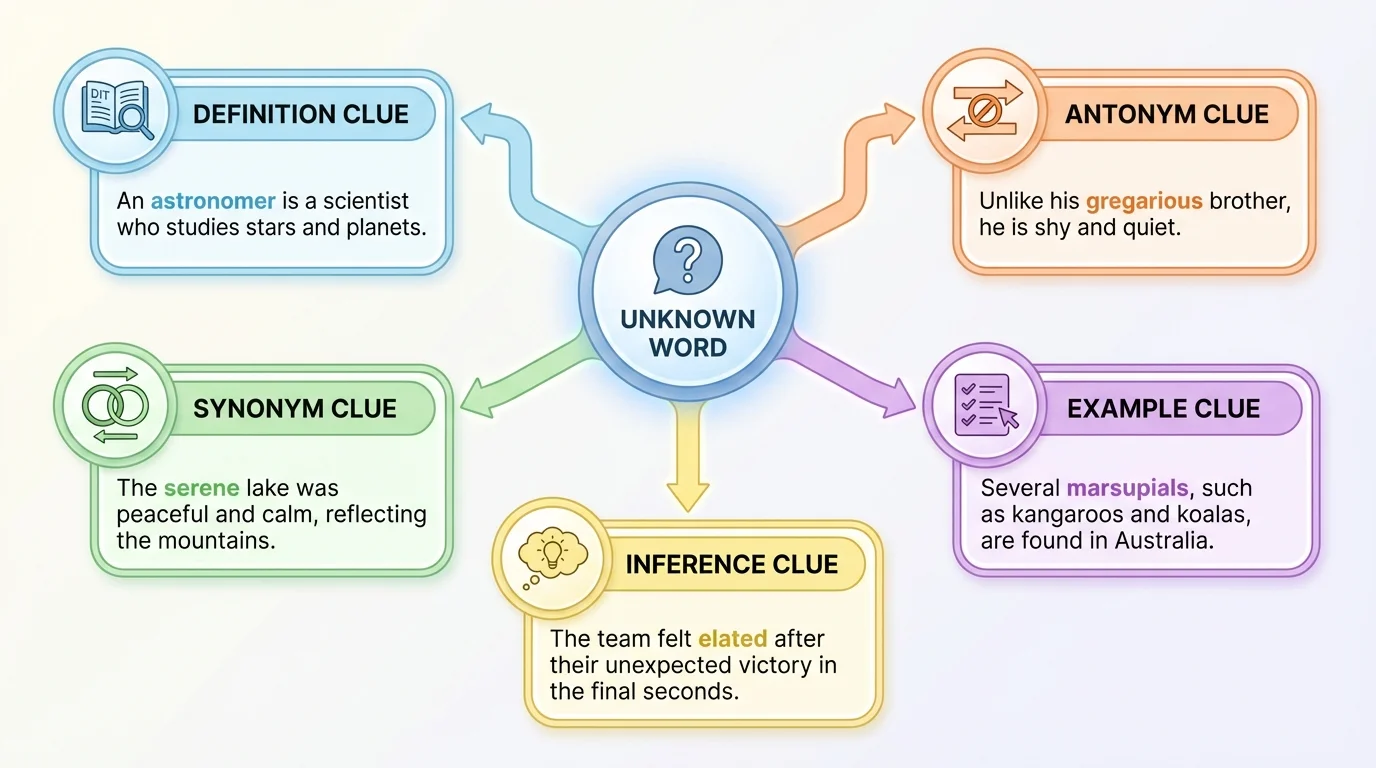
Sometimes more than one clue appears at once. Look at this sentence: "The exhausted hikers collapsed beside the trail, too weary to speak." The word weary can be understood by the words exhausted and too tired to speak. Several clues point to the same meaning.
Context clues do not always give a perfect answer, but they usually help you get close enough to understand the text. Later, if needed, you can confirm the meaning. In reading, a smart temporary meaning is often better than stopping every few seconds.
Sometimes the surrounding sentence is not enough. Then it helps to examine parts of the word itself. Many English words contain prefixes, suffixes, and roots.
A prefix is a word part added to the beginning of a word. A suffix is a word part added to the end. A root is the main part that carries the core meaning.
For example, in the word preview, the prefix pre- means before. If you know that, you can figure out that a preview is something you see before the main event. In careless, the suffix -less means without, so careless means without enough care.
Using word parts with context
The strongest readers combine tools. If you know that re- means again and the sentence says, "After missing the first announcement, the class had to reread the directions," you can tell that reread means read again. Word parts give one clue, and context confirms it.
Be careful, though. Word parts help, but they do not solve every word. Some words change over time or come from different languages. That is why readers use both word parts and context instead of depending on only one strategy.
Many words have more than one meaning. The word bat can mean an animal or a piece of sports equipment. The word bright can describe strong light or a smart person. To choose the correct meaning, you must use context.
Read these two sentences: "The stage lights were so bright that Malik squinted." Here, bright means full of light. Now read: "A bright student often asks thoughtful questions." In this sentence, bright means intelligent. Same word, different meanings.
Authors also use word choice to create tone, the feeling or attitude in a text. Compare these sentences: "The dog walked into the room" and "The dog pranced into the room." Both describe movement, but pranced sounds more lively and playful. The specific word matters because it shapes the reader's picture and feeling.
The English language has many words with several meanings. Readers are constantly choosing the meaning that fits best, often without even noticing they are doing it.
This is why you should read more than one sentence whenever possible. A word that seems confusing by itself often becomes clear when you look at the whole paragraph.
Authors do not always write in a plain, exact way. They often use figurative language to make ideas more vivid. Instead of saying, "The classroom was noisy," a writer might say, "The classroom was a buzzing beehive." That phrase creates a stronger image in your mind.
Literal language says exactly what is happening. If someone says, "The ice is cold," that is literal. Figurative language compares, exaggerates, or describes in a creative way. If someone says, "Her smile was sunshine," that is figurative. A smile is not actually made of sunlight, but the comparison tells us the smile seems warm and joyful.
When you interpret figurative language, do not ask only, "What do these words usually mean?" Also ask, "What idea or feeling is the author comparing?" That question helps you move beyond the literal meaning.
Two of the most common types of figurative language are the simile and the metaphor, and [Figure 2] compares how each one works. Both compare two unlike things to help the reader understand an idea more clearly. The difference is in how they make the comparison.
A simile compares two things using the words like or as. Example: "The baby's skin was as soft as silk." The baby's skin is being compared to silk to show softness.
A metaphor compares two things by saying one thing is another thing. Example: "The city was a jungle." The city is not really a jungle with vines and wild animals. The writer means it feels crowded, wild, confusing, or hard to navigate.
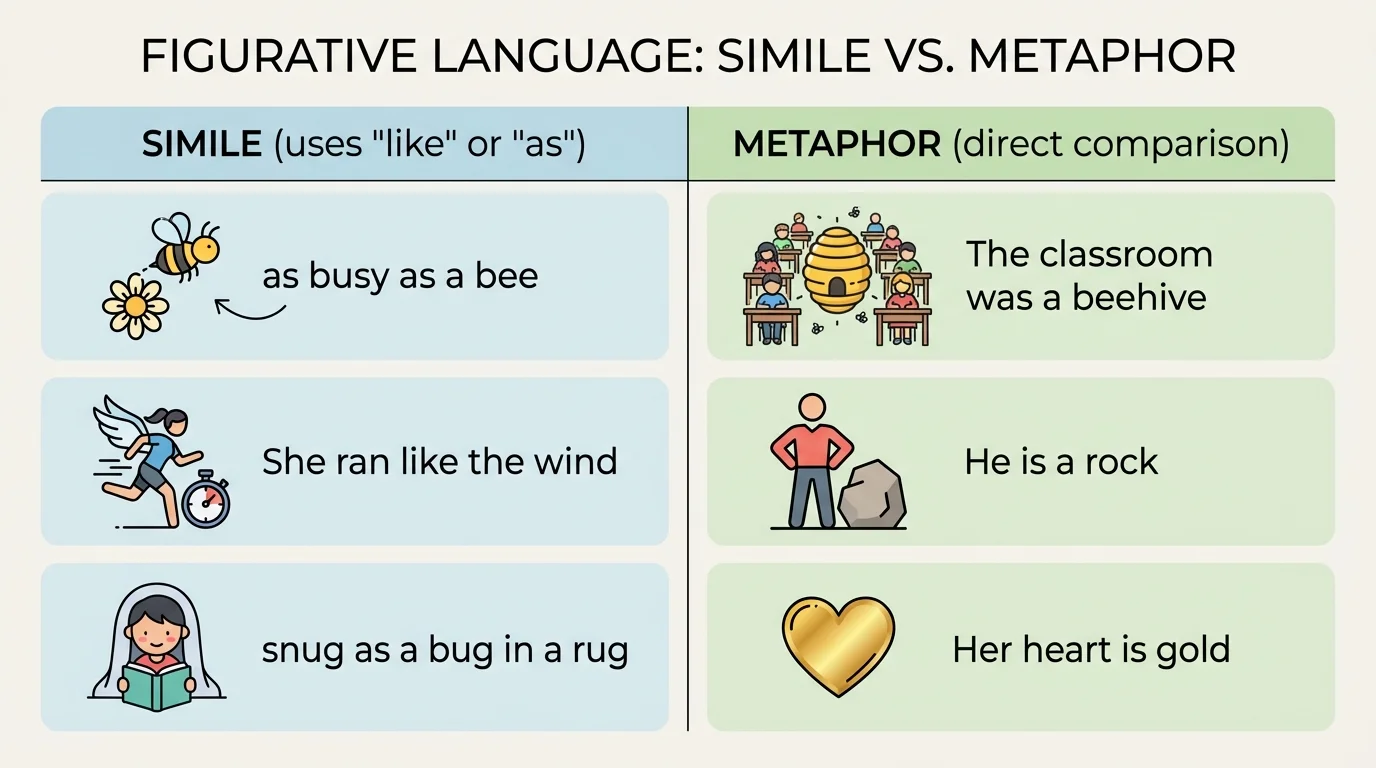
To interpret a simile or metaphor, think about the qualities being compared. If a story says, "My little brother is a tornado," ask what a tornado is like. It is noisy, fast, and destructive. So the sentence probably means the brother creates chaos and mess wherever he goes.
Here are more examples:
"The lake was like glass." This simile suggests the lake was smooth and still.
"Fear wrapped around him like a cold blanket." This simile suggests the fear felt heavy, close, and uncomfortable.
"Her voice was music." This metaphor suggests her voice sounded beautiful or pleasant.
"Time is a thief." This metaphor suggests time takes things away, such as youth or special moments, just as a thief steals.
Interpreting a metaphor in context
Sentence: "By the final lap, Elena was a rocket on the track."
Step 1: Find the comparison.
Elena is being compared to a rocket.
Step 2: Think about the qualities of a rocket.
A rocket is extremely fast and powerful.
Step 3: Connect those qualities to the sentence.
The sentence means Elena was running very fast and powerfully near the end of the race.
The metaphor helps the reader feel Elena's speed more strongly than the words very fast would.
When you read poetry, you may find many metaphors and similes packed into a small space. In stories, figurative language often reveals a character's feelings or helps set the mood. As shown in [Figure 2], the key is to notice the comparison and then identify the shared quality.
Writers use more than similes and metaphors. They also use other figurative expressions that readers should recognize.
An idiom is a phrase whose meaning is different from the exact meaning of the words. If someone says, "It's raining cats and dogs," no animals are falling from the sky. The phrase means it is raining very hard.
Personification gives human qualities to things that are not human. Example: "The wind whispered through the trees." Wind cannot truly whisper, but the description helps the reader imagine a soft sound.
Hyperbole is a strong exaggeration used for effect. Example: "I've told you a million times." The speaker does not mean exactly one million times. The exaggeration emphasizes frustration.
Imagery is language that appeals to the senses. It helps readers see, hear, smell, taste, or feel what is happening. Example: "The warm bread filled the kitchen with a buttery, sweet smell." Imagery helps create a vivid picture.
These phrases should also be interpreted through context. If you took every idiom or exaggerated phrase literally, many stories would stop making sense.
When readers determine meaning carefully, they often follow a process, and [Figure 3] lays out this sequence clearly. First, they notice a word or phrase that seems important or confusing. Next, they read the sentences around it. Then, they think about clues, test possible meanings, and choose the meaning that best fits the whole text.
Here is that process in a simple way:
Step 1: Read the whole sentence.
Step 2: Read the sentence before and the sentence after.
Step 3: Look for context clues, word parts, and comparisons.
Step 4: Ask whether the language is literal or figurative.
Step 5: Choose the meaning that makes the most sense in the passage.
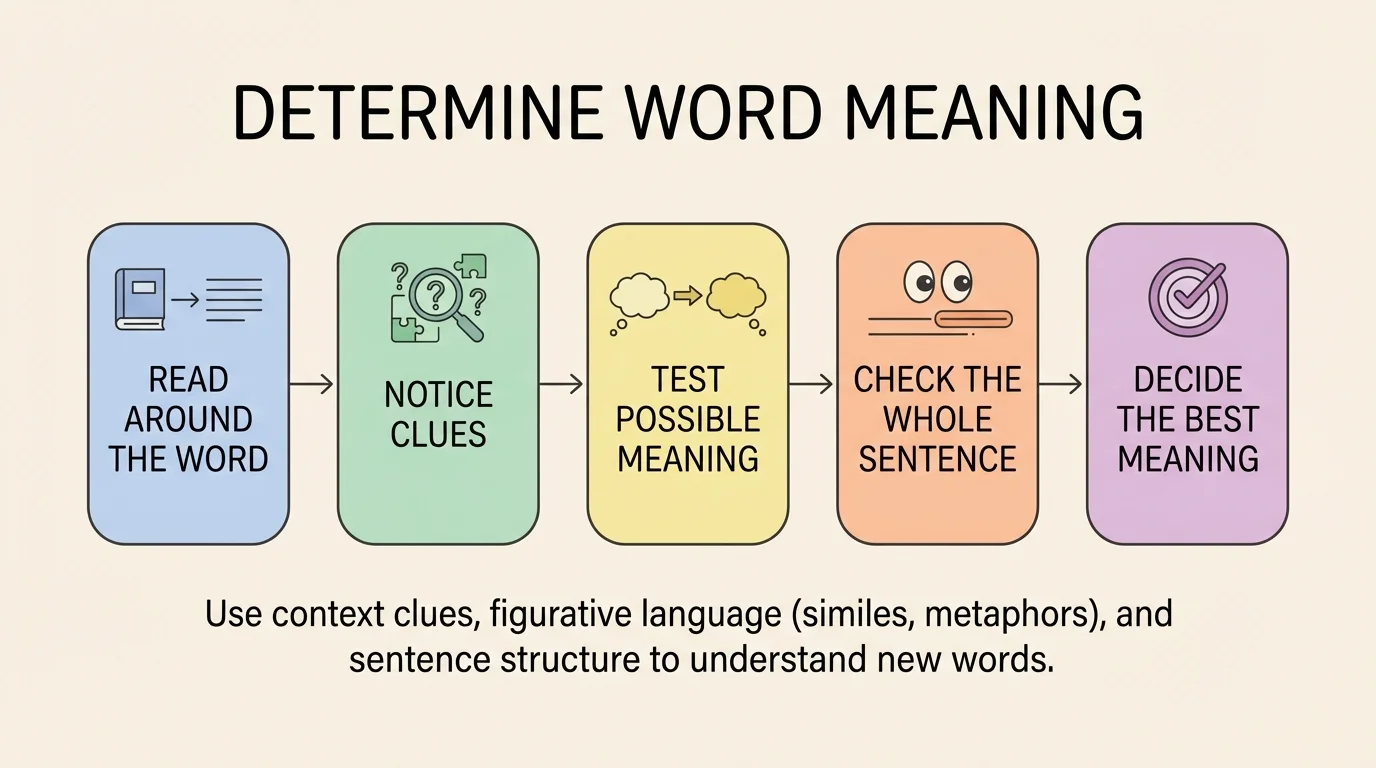
This process slows you down at first, but the strategy soon becomes natural. Skilled readers use it almost automatically while reading.
Using the detective process on a short passage
Passage: "The hallway erupted when the final bell rang. Lockers banged, voices crashed together, and students poured through the doors like water through a broken dam."
Step 1: Find a phrase to interpret.
The phrase "students poured through the doors like water through a broken dam" is figurative.
Step 2: Notice the clues around it.
The hallway erupted, lockers banged, and voices crashed together. The setting is loud, sudden, and crowded.
Step 3: Interpret the simile.
Water rushing through a broken dam moves quickly and powerfully. The simile means students rushed out all at once in a strong wave.
The figurative phrase helps the reader feel the speed and force of dismissal time.
Later, when you meet a different figurative phrase, the same detective process still works. As we saw in [Figure 3], good interpretation is not guessing wildly. It is using evidence from the text.
The meaning of a word or phrase may change depending on the kind of text you are reading. In a science article, the word charge might relate to electricity. In a story, it might mean to rush forward. In a restaurant, it can mean a cost added to a bill. The setting and subject matter guide the meaning.
The speaker matters too. If a nervous character says, "My stomach is tied in knots," that is figurative language showing worry. If a sailor talks about knots, the meaning might be literal. Readers must ask who is speaking and what situation they are in.
| Word or Phrase | Text Clue | Best Meaning |
|---|---|---|
| cold shoulder | A friend ignores someone at lunch | unfriendly treatment |
| stormy | Dark clouds gather over the field | weather-related |
| stormy | Two characters argue loudly | angry or full of conflict |
| light | A feather is easy to lift | not heavy |
| light | A lamp brightens the room | brightness |
Table 1. Examples showing how context changes the meaning of words and phrases.
This is one reason close reading matters. Words do not travel alone. Their meanings are shaped by the company they keep.
Remember that a reader does not need to know every word instantly. What matters is using evidence from the text to build the most accurate meaning possible.
In literary texts, this skill becomes especially important because authors often choose rich, layered language. A single phrase can reveal mood, character, and theme at the same time.
Readers grow stronger by noticing patterns. If you often ask, "Is this literal or figurative?" you will catch more hidden meanings. If you regularly look before and after an unfamiliar word, context clues become easier to spot. If you pay attention to word parts, you will unlock many new words.
Another helpful habit is rereading. On a first reading, a phrase may seem confusing. On a second reading, after you understand the scene better, the meaning may become clear. Strong readers are willing to return to the text and think again.
Finally, remember that authors use words for a reason. A writer chooses crept instead of walked, or glimmered instead of shone, because each choice adds a special shade of meaning. Determining the meaning of words and phrases helps you see those shades. It turns reading from simply saying the words into truly understanding the text.
