Have you ever listened to someone explain something and thought, "Now I get it"? That kind of speaking is powerful. A strong speaker does more than talk loudly or stand in front of a group. A strong speaker helps listeners understand a topic, follow ideas in order, and remember the most important points. Whether you are reporting on an animal, explaining how something works, or sharing your opinion about school rules, your words need to be clear, organized, and supported by information that matters.
Speaking well is useful in school, but it also matters outside school. People use these skills when they give directions, tell a story, explain a game, present news, or convince others to care about a cause. Good speakers know their purpose, choose the right facts, and speak so listeners can keep up. They do not just say many words. They say the right words in the right order.
When you speak to inform, explain, or persuade, you are helping other people build understanding. If your ideas are out of order, your audience may get confused. If you do not include enough facts or details, people may not trust what you say. If you speak too quickly, listeners may miss key information. Oral communication works best when the speaker thinks carefully about both the message and the audience.
A presentation can have different goals. You might report on what you learned from a text about volcanoes. You might explain why recycling helps a community. You might share an opinion that recess should be longer. In each case, the goal is slightly different, but the same main skills are important: clear ideas, logical sequence, relevant support, and understandable speech.
Opinion is what a person thinks, feels, or believes about something.
Fact is information that can be checked and proven true.
Relevant details are details that directly connect to the main idea and help explain or support it.
Sequence is the order in which ideas are presented.
Knowing the difference between a fact and an opinion is especially important. If you say, "Dogs are the best pets," that is an opinion. If you say, "Dogs can be trained to help people with disabilities," that is a fact. Opinions are stronger when they are supported by facts.
A good presentation usually includes a clear topic, a main idea, supporting facts or examples, and a conclusion. If you are reporting on a text, you should explain what the text is mostly about and include important details from it. If you are presenting an opinion, you should clearly state what you believe and support it with reasons and evidence.
Strong speaking also includes audience awareness. Your audience is the group of people listening. A speaker should think about what the audience already knows, what they need to know, and what language will help them understand. For example, if you are explaining the water cycle to classmates, you should use simple, clear terms and define any difficult words.
Main idea and support work together
The main idea is the central point of a talk. Everything else in the presentation should help explain, prove, or describe that main idea. If a detail does not connect to the main idea, it may distract the listener instead of helping.
Suppose your topic is school gardens. Your main idea might be that school gardens help students learn. Helpful supporting details could include that students observe plant growth, measure changes over time, and learn where food comes from. A detail about your favorite movie would not belong because it is not connected to the topic.
Some presentations are meant to inform. That means the speaker shares accurate information about a topic. For example, a report about sea turtles would tell where they live, what they eat, and what dangers they face.
Some presentations are meant to explain. Explaining goes a step further than reporting. It helps listeners understand how or why something happens. For example, a speaker might explain how erosion changes land over time or why exercise helps the heart stay healthy.
Other presentations are meant to persuade. Persuading means trying to convince listeners to agree or take action. A student might persuade others that the library should add more graphic novels or that students should reduce food waste at lunch.
Even though these purposes are different, they often overlap. A persuasive talk should still include facts. An informational report should still be organized clearly. An explanation should still use details that help listeners picture the idea.
Skilled speakers often combine information and opinion. A person arguing for safer bike lanes, for example, may share facts about traffic safety and then explain why the community should make changes.
Before speaking, it helps to ask: "Am I mostly informing, explaining, or persuading?" The answer will help you choose the best opening, examples, and conclusion.
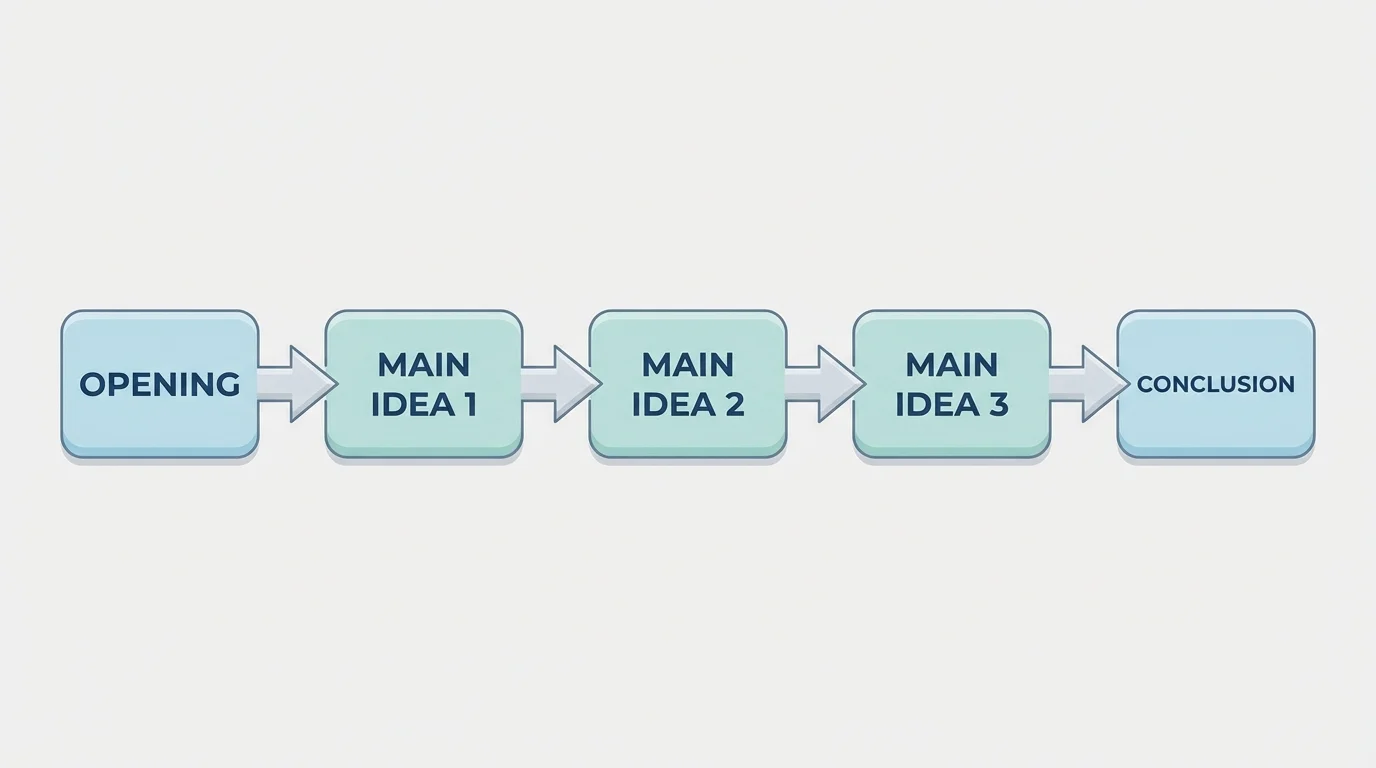
A strong sequence helps listeners follow your thinking, as [Figure 1] shows with a simple presentation structure. When ideas jump around, the audience has to work too hard to figure out what comes first, what matters most, and how the parts connect.
Most presentations work well with three big parts: an introduction, a body, and a conclusion. The introduction states the topic and grabs attention. The body gives the main points in order. The conclusion wraps up the important message. This structure helps your speech feel complete instead of scattered.
There are different ways to organize the body of a presentation. You might use time order when reporting historical events or steps in a process. You might use order of importance when giving reasons for an opinion. You might use cause and effect when explaining why something happens.
Transitions are words and phrases that guide listeners from one idea to the next. Words like first, next, for example, because, as a result, and finally act like bridges. They help your audience stay with you as your ideas move forward.
Think about the difference between these two openings. One says, "I'm talking about bees. Honey is sweet. Pollination matters. Some bees sting. Flowers need insects." The ideas are related, but they feel disconnected. A stronger opening might be: "Today I will explain why bees are important. First, bees help plants grow through pollination. Next, they support food production. Finally, I will explain why protecting bees matters." The second version prepares listeners for what is coming.
Later, when you build your own speaking plan, the structure in [Figure 1] remains useful because it reminds you that every part of a talk should lead naturally to the next part.
Good speakers support their ideas with facts, examples, and descriptions. These make a presentation stronger because they give listeners something solid to understand. If you say, "Rain forests are important," that is a start. But your audience needs more. You could add that rain forests are home to many species, help regulate Earth's climate, and provide resources people use.
Evidence is the information that supports a claim. In speaking, evidence can include facts from a text, observations, examples, or details from research. Evidence should match the point you are making. If your point is about exercise improving focus in school, then details about favorite sports teams may not be the best support unless they connect directly to the point.
Example: weak support and strong support
Opinion statement: "Our school should have a garden."
Step 1: Notice the weak support.
"Gardens are nice. Plants are cool." These statements may be true, but they are too vague.
Step 2: Add relevant facts and details.
"A school garden can help students learn science by observing plant growth. It can also provide a habitat for insects such as butterflies and bees."
Step 3: Make the connection clear.
"Because the garden supports science learning and local wildlife, it would benefit the whole school."
Descriptive details are also important. They help listeners form a picture in their minds. If you report on a text about the Arctic, saying "It is cold" is accurate but not very vivid. Saying "The Arctic has icy winds, frozen water, and long winters with very little sunlight" gives listeners a clearer understanding.
However, details should be relevant. If they do not help explain the main idea, they can distract from the message. A good speaker chooses details carefully instead of adding random information.
How you say something matters just as much as what you say. A clear speaker uses words the audience can understand, pronounces them carefully, and speaks at a pace that gives listeners time to think. If a speaker rushes, important ideas blur together; if the speaker goes too slowly, the audience may lose focus.
As [Figure 2] shows, clear speaking includes pace, volume, and expression. Pace is how fast or slow you speak. Volume is how loudly or softly you speak. Expression is the way your voice shows meaning and feeling. A speaker who never changes tone may sound flat, while a speaker who emphasizes key words can make ideas easier to follow.
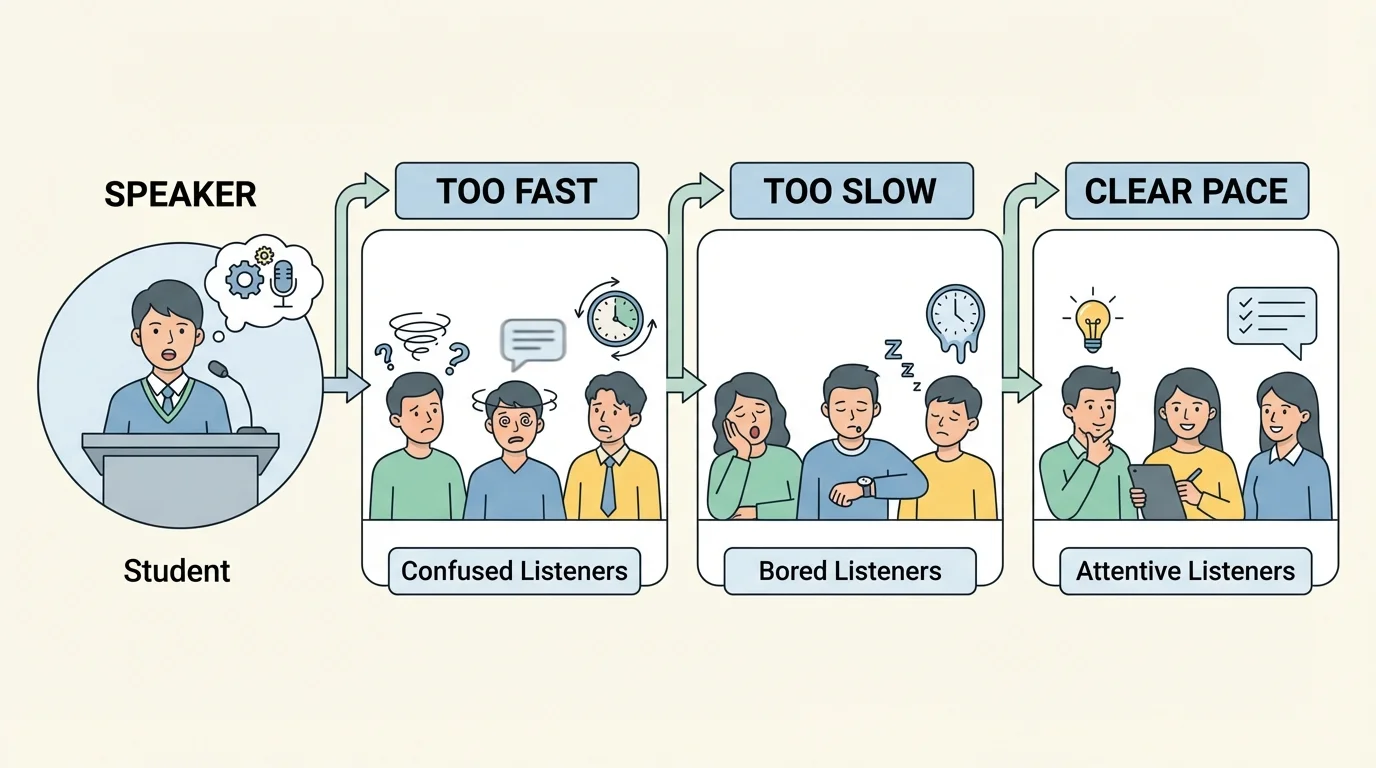
Speaking at an understandable pace does not mean speaking unusually slowly. It means speaking steadily enough that your audience can follow you. If you are sharing an important fact, you may slow down slightly. If you are moving to a new point, a small pause can help listeners notice the change.
Pronunciation matters too. When words are mumbled or dropped, listeners may miss information. It helps to open your mouth fully, face the audience, and practice any tricky words before presenting. For example, if you are reporting on the environment, you may want to practice words such as ecosystem, pollution, or conservation.
Eye contact and posture also affect clarity. Looking up from notes shows confidence and helps you connect with listeners. Standing in a balanced way and avoiding too much fidgeting can make your message easier to follow. These physical habits support the voice rather than replacing it.
When speakers pay attention to the balance shown in [Figure 2], they are more likely to keep listeners engaged and help them understand each point.
When reading aloud, punctuation gives clues about pace and expression. Periods, commas, and question marks can help you know when to pause or change your voice while speaking.
If you feel nervous, that is normal. Many good speakers feel nervous before they begin. Taking a breath, starting with a prepared sentence, and focusing on one idea at a time can help you stay calm and understandable.
Oral communication is not only about speaking. It also includes listening. When someone else presents, respectful listeners face the speaker, avoid interrupting, and think about the main ideas. Good listening helps the class learn from one another.
Sometimes a presentation includes questions from the audience. A speaker should listen all the way to the end of the question before answering. If the question is unclear, the speaker can politely ask for it to be repeated or explained. A respectful response might begin with, "I think your question is asking…" or "One reason is…"
Listening also helps speakers improve. By paying attention to how others organize ideas, use details, and manage pace, students can notice techniques they want to use in their own speaking.
"Say what you mean, mean what you say, and make it easy to follow."
Even when you disagree with someone's opinion, you can still respond respectfully. Good speakers and listeners focus on ideas rather than making rude comments about people.
There are several kinds of oral presentations. Looking at short examples makes it easier to see what effective speaking sounds like.
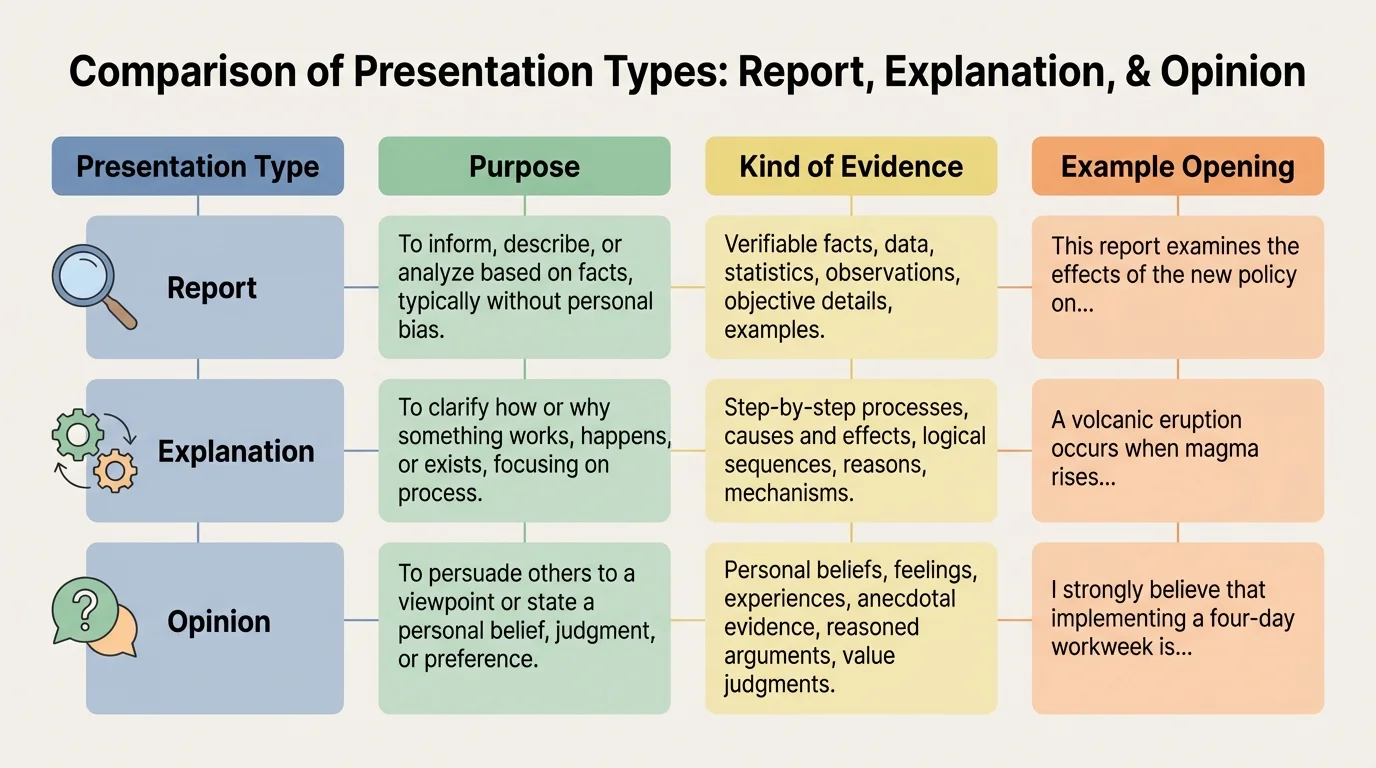
As [Figure 3] shows, these examples compare how different presentation types use different goals and support.
Model 1: Reporting on a topic
"Sea otters live along the Pacific coast of North America. They spend much of their time in the water and use thick fur to stay warm. Sea otters also help kelp forests by eating sea urchins, which can damage kelp if too many are present." This works because it gives clear facts and stays focused on one topic.
Model 2: Explaining a process
"The water cycle moves water through the environment. First, the sun heats water and causes evaporation. Next, the water vapor cools and forms clouds. Then precipitation falls as rain or snow. Finally, water collects again in rivers, lakes, and oceans." This works because the steps are in time order and use transitions.
Model 3: Presenting an opinion
"I believe our school should reduce single-use plastic at lunch. First, plastic waste can harm the environment. Second, reusable containers create less trash over time. Finally, making this change would help students build responsible habits." This works because the opinion is clear and each reason supports it.
The comparison also shows that all three types of talks need structure. Even when the purpose changes, the speaker still needs a strong opening, focused details, and a meaningful ending.
Example: turning notes into a short oral report
Topic: Bats
Step 1: Start with a main idea.
"Bats are important animals that help many ecosystems."
Step 2: Add organized support.
"Some bats eat insects, which can help control pests. Other bats spread seeds or pollinate plants."
Step 3: End with significance.
"Because bats help plants and control insect populations, they are valuable to nature and to people."
Notice that the report does not include every fact about bats. It selects the facts that best support the main idea. That is what strong speakers do: they choose, organize, and present information with a purpose.
One common mistake is giving too much information without a clear order. This can make the audience feel lost. Another mistake is giving an opinion without support. Listeners may hear what you think but not understand why they should agree. A third mistake is using details that are interesting but unrelated to the main idea.
Some speakers also read every word from notes without looking up. Notes are helpful, but they should support speaking, not replace it. Short bullet points often work better than long paragraphs because they remind you of key ideas without pulling your eyes away from the audience the whole time.
Another common problem is unclear delivery. Speaking too softly, too quickly, or with little expression can make strong ideas sound weak. The good news is that these problems can improve with practice, feedback, and careful planning.
| Problem | What Happens | Better Choice |
|---|---|---|
| No clear order | Listeners get confused | Use introduction, body, and conclusion |
| Too few facts | Ideas sound unsupported | Add evidence and relevant details |
| Too many unrelated details | Main idea gets lost | Keep only details that fit the point |
| Speaking too fast | Listeners miss information | Pause and speak steadily |
| Reading every word | Weak connection with audience | Use notes as reminders |
Table 1. Common presentation problems and better speaking choices.
Improvement often happens in small steps. A student may first work on stronger organization, then on better volume, then on adding more evidence. Clear speaking is a skill that grows over time.
Good preparation begins with understanding your topic. If you are speaking from a text, make sure you know the main idea and key details. If you are giving an opinion, make sure you can explain your reasons clearly. Gather facts that are accurate and choose examples that match your purpose.
Next, plan your sequence. Decide how to begin, what points belong in the middle, and how to end. You do not need a huge number of points. In many cases, two or three strong points are better than many weak ones.
Then practice aloud. Practicing in your head is helpful, but speaking aloud lets you hear your pace, notice awkward wording, and fix places where you stumble. It also helps you find spots where a pause or stronger expression will improve understanding.
Finally, remember that speaking is about helping others understand. Your goal is not to sound fancy. Your goal is to communicate clearly, logically, and meaningfully. When you report on a topic or text, explain an idea, or present an opinion with good evidence and clear delivery, you become a speaker people can trust and learn from.
