Some pieces of writing take weeks. Others take only ten minutes. A scientist may spend days gathering facts for a report, while a student may answer a reading question in one class period. Strong writers know that both kinds of writing matter. They learn how to write carefully when they have lots of time, and they also learn how to think clearly and write well when time is short.
Writing is not just for language arts. You write in science, social studies, math, health, and even in everyday life. You may explain an idea, tell a story, give directions, share an opinion, or report what you learned. Because of that, writers need flexible skills. They must be able to match their writing to the job they are doing.
Writing changes depending on the task, purpose, and audience. If you are writing a quick answer to your teacher, you might be brief and direct. If you are creating a report for classmates, you will likely include more details, facts, and stronger organization. If you are writing a letter to the principal, your language may sound more formal and respectful.
That is why good writers write routinely. Writing routinely means writing often, in many situations, and for different reasons. The more students write, the more natural planning, organizing, revising, and editing become. Regular writing also helps students discover their own voice and build confidence.
Task is the writing job you are doing, such as explaining, reporting, persuading, or narrating.
Purpose is the reason you are writing, such as to inform, entertain, describe, or convince.
Audience is the person or group who will read your writing.
When writers understand task, purpose, and audience, they make better choices. They choose what details to include, what words to use, and how formal or casual their writing should sound.
Writers often work within two main time frames, and [Figure 1] helps compare them clearly. One is an extended time frame, which means writing over a longer period of time. The other is a shorter time frame, which means writing in one sitting or over a day or two.
An extended time frame gives a writer time for research, reflection, drafting, revision, and editing. A shorter time frame still requires thought, but the writer must plan and write more quickly. Both are important because school and life require both kinds.
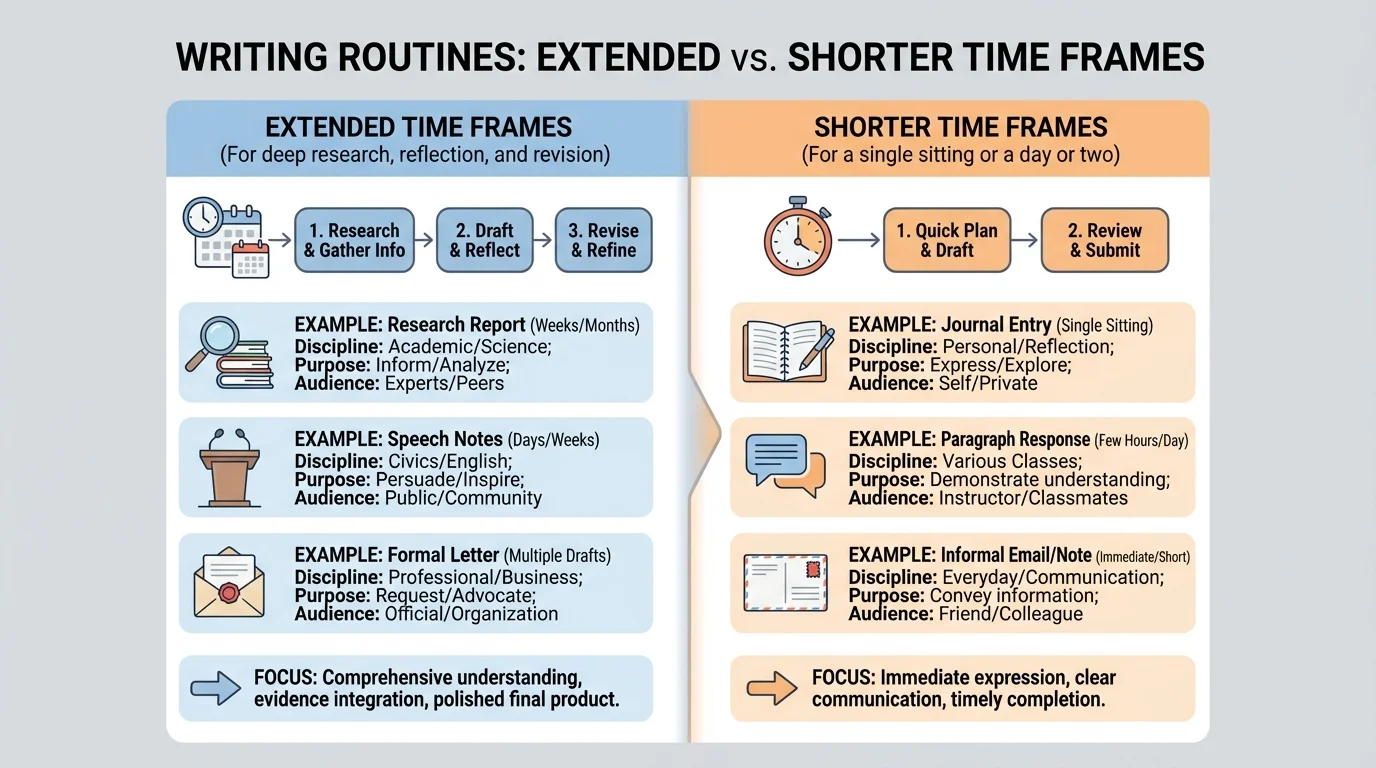
Here are some examples of writing over an extended time frame: a report about animal habitats, a biography of a historical figure, a science explanation using research, or a multi-paragraph opinion essay. These pieces usually need strong organization and time to improve them.
Here are some examples of writing over a shorter time frame: a response to a reading question, a quick science observation, a summary of a class discussion, or a note explaining your thinking. These pieces may be shorter, but they still need clear sentences and correct conventions.
| Time Frame | Common Writing Tasks | What the Writer Usually Does |
|---|---|---|
| Extended | Reports, essays, projects, research writing | Plans, researches, drafts, reflects, revises, edits |
| Shorter | Responses, notes, summaries, quick explanations | Plans quickly, writes clearly, checks for errors |
Table 1. A comparison of longer and shorter writing time frames.
One topic can be written in very different ways, and [Figure 2] shows that clearly. Suppose the topic is recycling. In science, you might explain how recycling helps reduce waste. In social studies, you might describe how a community recycling program helps a town. In a letter to families, you might encourage people to recycle at home. The topic stays the same, but the writing changes.
This change happens because the task, purpose, and audience are different. A science explanation should be clear, accurate, and full of facts. A friendly letter may sound warmer and more personal. A report for classmates may need headings and organized paragraphs. Writers must think, "Who is reading this?" and "What do I want that reader to understand or do?"
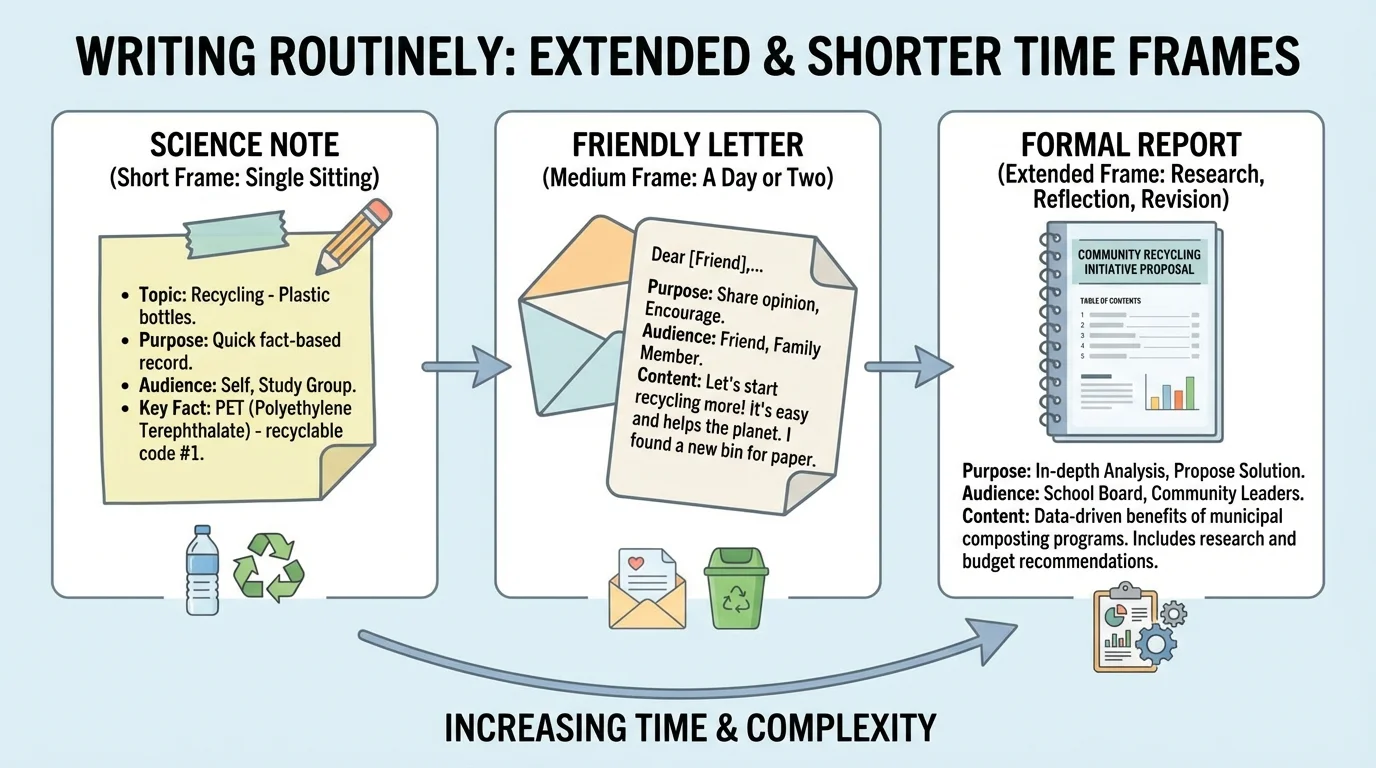
The word discipline-specific writing means writing that fits a particular school subject or field of study. Science writing often explains evidence and observations. Social studies writing may describe events, causes, and effects. Reading responses often use ideas from a text. Each subject has its own style and expectations.
For example, in science you might write, "The plant near the window grew taller because it received more sunlight." In social studies, you might write, "The settlers moved west to find land and opportunity." In reading, you might write, "The character changed because she learned to be brave." These examples all explain ideas, but they do so in subject-specific ways.
How audience changes writing
If your audience is your teacher, you may focus on accuracy and complete explanations. If your audience is younger students, you may use simpler words and shorter sentences. If your audience is classmates, you may use examples they know. Writers adjust tone, details, and structure to help the reader understand.
As writers grow stronger, they learn to make these choices on purpose. They do not just write words on a page. They shape writing to fit the situation.
Longer writing usually moves through several stages, and [Figure 3] shows the process as a sequence rather than a single step. Strong writers do not usually produce their best work in one try. They build it piece by piece.
The first stage is planning. A writer chooses a topic, thinks about the purpose, and gathers ideas. Sometimes that includes brainstorming, making a list, or creating an outline. If the writing requires facts, the writer also begins research, which means finding information from books, articles, trustworthy websites, interviews, or class notes.
After planning comes drafting. A draft is a version of writing that is still being developed. In a draft, the goal is to get ideas down clearly. It does not have to be perfect yet. Many writers discover new ideas while drafting.
Next comes reflection. Reflection means stepping back and thinking about the writing. Does it make sense? Is anything missing? Are the ideas in the best order? Reflection helps writers notice strengths and weaknesses before they begin changing the piece.
Then comes revision. Revision means changing the writing to improve ideas, organization, word choice, and sentence flow. A writer may add examples, remove repeated ideas, move a paragraph, or rewrite a weak beginning. Revision is about making the writing stronger, not just fixing tiny errors.
After revising comes editing. Editing focuses on grammar, spelling, punctuation, capitalization, and usage. At this stage, the writer checks whether every sentence is complete and clear. Finally, the writer prepares a final copy to share or publish.
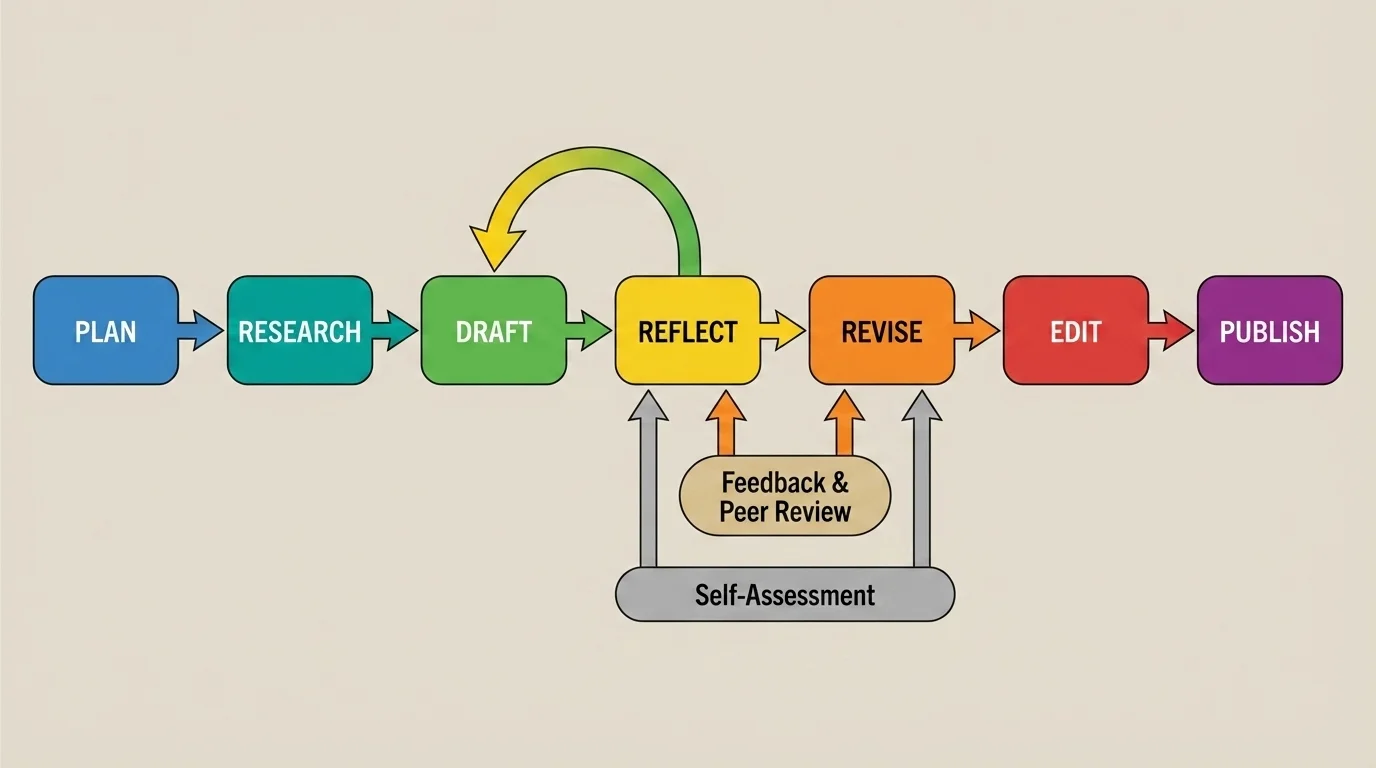
Even though the process looks like a path, writers do not always move in a perfectly straight line. Sometimes they draft, then return to research. Sometimes they revise one paragraph many times. The important idea is that longer writing improves through careful work over time.
Example: writing a report about sea turtles over an extended time frame
Step 1: Plan the topic and purpose
The writer decides to explain where sea turtles live, what they eat, and why they need protection.
Step 2: Research
The writer uses a book, class notes, and a trusted website to gather facts.
Step 3: Draft
The writer creates an introduction, body paragraphs, and a conclusion.
Step 4: Reflect and revise
The writer notices that the paragraph about dangers is too short, so more details are added and some sentences are reorganized.
Step 5: Edit
The writer corrects capitalization, commas, and spelling before turning in the final report.
This kind of writing takes time because the writer is building knowledge as well as improving the piece itself.
Shorter writing time frames are different, but they still require skill. A quick written response is not careless writing. It is focused writing. When time is short, a writer must think fast, stay on topic, and choose the most important ideas.
For a short piece, planning may take only a minute or two. A student might underline the key part of the prompt, jot down two or three main ideas, and begin writing. Because there is less time to revise later, the writer tries to make each sentence clear the first time.
Suppose your teacher asks, "Why did the main character make that choice?" You may have one class period to answer. A strong response will state the answer clearly, include details from the text, and end without wandering off topic. The piece may be short, but it should still be organized.
Short-time writing also appears in science notebooks, math explanations, social studies exit tickets, and journal entries. In each case, the writer should answer the question, use accurate words, and check basic conventions before finishing.
Complete sentences need a subject and a predicate. A sentence fragment leaves out an important part. A run-on joins ideas incorrectly. Remembering these basics helps both short and long writing stay clear.
One helpful habit for quick writing is to reread the prompt before turning in the work. Another is to reread your last sentence and ask, "Did I answer the question?" Those small checks can make a short piece much stronger.
Writing is not only about ideas. It is also about how those ideas are expressed. Grammar, usage, and mechanics help readers understand what the writer means. When these conventions are used well, writing becomes clearer and stronger.
Grammar includes how words work together in sentences. Writers need complete sentences, correct verb forms, and pronouns that clearly match the nouns they replace. For example, "The dogs runs" is incorrect because the subject and verb do not agree. "The dogs run" is correct.
Usage means choosing words in the correct and natural way. For example, a writer should use words that fit the audience and purpose. In a formal report, "Many people recycle to reduce waste" fits better than "A bunch of people recycle stuff." Both communicate an idea, but one matches formal school writing more effectively.
Mechanics includes capitalization, punctuation, and spelling. A missing period can confuse a reader. A missing capital letter can make writing look unfinished. Commas help separate ideas and make long sentences easier to follow.
Good conventions also strengthen style. Style is the way writing sounds and feels. Short sentences can create strong emphasis. Precise words can paint a clearer picture. Compare these two sentences: "The animal moved." "The fox slipped silently through the grass." The second sentence is more vivid because the word choice is more exact.
Clear writing versus confusing writing
Clear writing helps the reader follow ideas without stopping to guess. Confusing writing often has missing words, mixed-up sentence order, weak punctuation, or vague word choice. Conventions are not just rules to memorize. They are tools that help meaning travel from the writer's mind to the reader's mind.
Whether a piece is long or short, strong writers use conventions to support meaning. In fact, when time is short, clear grammar and punctuation matter even more because the writer has fewer chances to explain again.
Many students think finishing a draft means the writing is done. Skilled writers know better. They pause and look again. That pause is important because a writer often notices problems more easily after stepping back.
Reflection means asking questions such as these: Does my beginning draw the reader in? Are my ideas in a logical order? Did I include enough details? Did I repeat myself? Reflection helps writers decide what needs revision.
Revision and editing are not the same. Revision changes the content of the writing. Editing fixes the surface features of the writing. If a paragraph is boring or unclear, revision is needed. If a sentence has a spelling mistake or a missing comma, editing is needed.
As seen earlier in [Figure 3], writers often move back and forth between stages. That is normal. Real writing is active. It grows through thinking and rethinking.
Professional authors often revise many times before a book is published. Even strong writers rarely publish a first draft exactly as they wrote it.
This can be encouraging. If writing feels hard at first, that does not mean you are doing it wrong. It means you are doing the real work of writing.
Writing happens in every subject, so students should be ready for different kinds of tasks. Looking across subjects helps show how flexible writing can be.
In science, a student might write an explanation after an experiment: "The ice melted faster in the sun because the sunlight warmed it." This kind of writing should be accurate and based on observation. The audience may be the teacher or classmates, so the writer should use clear, precise language.
In social studies, a student might answer a question about cause and effect: "The new law changed the town because it improved safety." This writing often explains events, reasons, and results. It should be organized and supported with facts from class materials.
In reading, a student may write a short response about theme or character. That response may be completed in one sitting, but it still needs a clear main idea and details from the text. As shown in [Figure 2], even when the topic stays the same, the form changes depending on subject and audience.
Example: one topic, three different writing tasks
Topic: school gardens
Science task: Explain how plants in a school garden grow.
This writing includes facts about sunlight, water, and soil.
Opinion task: Convince the principal to support a school garden.
This writing includes reasons and persuasive language.
Narrative task: Tell a story about working in the garden.
This writing includes characters, events, and descriptive details.
The topic is the same, but the writing changes because the task and purpose change. That is one of the most important lessons writers can learn.
Strong writing habits do not appear all at once. They are built by practice. Writing routinely means using writing as a regular tool for learning, thinking, and communicating.
One good habit is to keep track of the kind of writing a task requires. Ask yourself: Is this a quick response or a longer piece? Do I need research? Who is my audience? What is my purpose? These questions help you begin in the right way.
Another good habit is to leave time to reread. Even one extra minute can help you catch a missing word, a confusing sentence, or a punctuation error. Over longer time frames, repeated rereading leads to deeper revision and stronger final work.
Writers also improve by noticing what works. If a strong introduction helped your last report, try that strategy again. If making a short outline helped organize your quick response, keep using it. Reflection is not only for one piece of writing. It also helps writers grow over time.
"Good writing is clear thinking written down."
When students write often, across many subjects, they learn more than writing itself. They learn how to explain, question, organize, and communicate ideas. That is why writing routinely over both long and short time frames is such an important skill.
