Have you ever started telling a story and someone stopped you right away to ask, "Wait—who was there?" or "Where did this happen?" That is exactly what happens to readers when a narrative does not begin clearly. A strong narrative opening is like turning on the lights in a room: suddenly the reader can see the people, the place, and the situation. Once that happens, the events can move forward in a way that makes sense and feels real.
When writers orient the reader, they help the reader understand the basic situation at the start of the story. That means the reader should quickly learn important information such as who is involved, where the story takes place, when it happens, and what is beginning to happen. A good beginning does not have to explain every single detail. It simply gives the reader enough clues to step into the story without confusion.
At the same time, a narrative should not feel like a list of facts. It should feel alive. Writers do this by blending information into action, thoughts, dialogue, and description. Instead of writing, "My name is Ava. I am ten. I was at the pool. It was Saturday," a writer can create a stronger opening by placing the reader directly into the moment: "On Saturday morning, I tightened my goggles at the edge of the community pool while Coach Ramirez checked his stopwatch." This version still gives information, but it sounds more like a real story.
A narrative is a piece of writing that tells a story about real or imagined events. A narrator is the voice that tells the story. An event sequence is the order in which things happen in the story.
The beginning of a narrative is important because readers make quick decisions. If they are confused, they may lose interest. If they understand the situation and care about the characters, they are more likely to keep reading. A strong opening gives direction. It says, in effect, "Come this way. Here is the world of the story."
Openings also create expectations. A funny beginning prepares readers for humor. A mysterious beginning makes readers curious. A tense beginning suggests that something important may go wrong. Even in a short school narrative, the first few sentences shape the reader's experience.
One useful way to think about an opening is to ask four questions: Who is here? Where are they? What are they doing? Why does this moment matter? If a writer can answer those questions naturally, the reader is oriented.
[Figure 1] A story's setting is more than a place on a map. It includes location, time, and the feeling of the moment. In a strong narrative opening, these details work together to help the reader understand the situation right away. A parking lot at noon feels different from a forest trail at sunset. A classroom during a spelling test feels different from the same classroom during a class party.
To establish a situation, choose details that matter. If the story begins at a science fair, mention the buzzing gym, the tri-fold boards, or the smell of glue and poster paper. If the story begins during a thunderstorm, mention the flicker of lightning or the drumming rain on the roof. Specific details help the reader picture the scene.
The situation also includes what is happening when the story begins. Often, the opening shows an ordinary moment that is about to change or a problem that is already beginning. For example, "I was halfway through setting up my volcano model when the baking soda spilled across the floor" gives the reader a situation and hints at a problem.
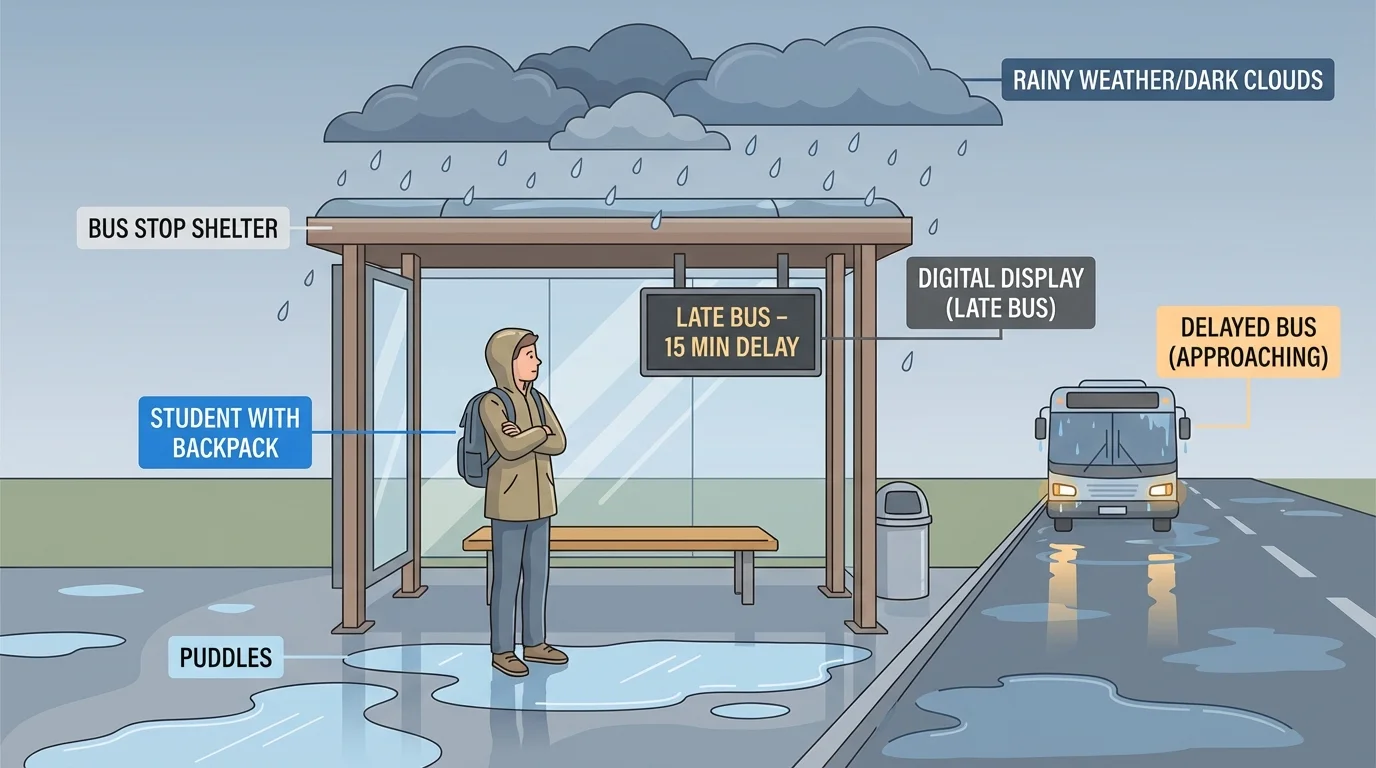
Writers do not need to explain everything at once. In fact, too much information can slow the story down. Instead, they can sprinkle in details naturally. A line of dialogue, a short action, or one vivid description can do a lot of work. "Dad honked from the driveway while I searched under the couch for my missing permission slip" tells us who is involved, what is happening, and why the moment matters.
Many memorable stories begin with a small problem, not a huge one. A missing shoe, a wrong turn, or a forgotten lunch can quickly grow into a story worth telling because the reader wants to know what happens next.
As the story continues, the writer can add more information about the setting. The key is that the reader should never feel lost. The rainy scene in [Figure 1] makes this clear: a few strong details can reveal place, mood, and the challenge starting to form.
The narrator is the voice telling the story. In some narratives, the narrator is a character in the story and uses words like I and we. This is called first-person point of view. In other narratives, the narrator is outside the story and tells about characters using words like he, she, or they. That is called third-person point of view.
Both choices can work well. First-person can feel personal and immediate: "I gripped the microphone so tightly that my hands hurt." Third-person can give a slightly wider view: "Maya gripped the microphone so tightly that her hands hurt." What matters most is staying consistent. If a story begins in first-person, it should not suddenly switch to third-person unless there is a clear reason.
Characters should be introduced in ways that feel natural. Instead of listing traits, let readers notice characters through what they say, do, think, and notice. Compare these two introductions:
"Leo was brave, funny, and messy."
"Leo kicked open the shed door, grinned at the bat hanging from the ceiling, and said, 'If this thing flies at me, I'm still going in.'"
The second version reveals character through action and dialogue. It lets the reader infer that Leo is bold and maybe a little reckless.
Showing characters instead of listing facts
Strong narratives often show who a character is. A writer can reveal personality through choices, body language, reactions, and speech. When characters act like real people, the reader gets to know them while the story is moving forward.
Writers should also decide which characters truly belong in the opening. If too many people appear at once, readers may get confused. In a short narrative, it is often best to focus on the narrator and one or two important characters at first, then add others only if they matter to the events.
[Figure 2] A strong narrative does not jump around randomly. The sequence of events should feel logical, and each event should grow out of the one before it. Readers should be able to follow the path of the story without having to stop and puzzle out what happened first.
Usually, events unfold naturally when writers think about cause and effect. One thing happens because something else happened. For example, a student forgets a project at home. Because of that, she runs to the office to call her grandmother. Because she is rushing, she bumps into the principal. Because of that, her problem becomes even bigger. This chain makes sense.
Natural sequence also depends on pacing, or the speed at which the story moves. Important moments deserve more detail. Unimportant moments can move quickly. If the key event is a lost dog finally running back home, the writer may slow down and describe the sound of paws on the sidewalk, the swing of the gate, and the feeling of relief. The walk home from school earlier that day may only need one sentence.
Writers sometimes make events feel unnatural by adding scenes that do not connect to the main story. If a narrative is about a soccer game and the missed final kick, a long paragraph about breakfast may not belong unless it connects clearly to the later events. Good organization means choosing events that support the main experience.
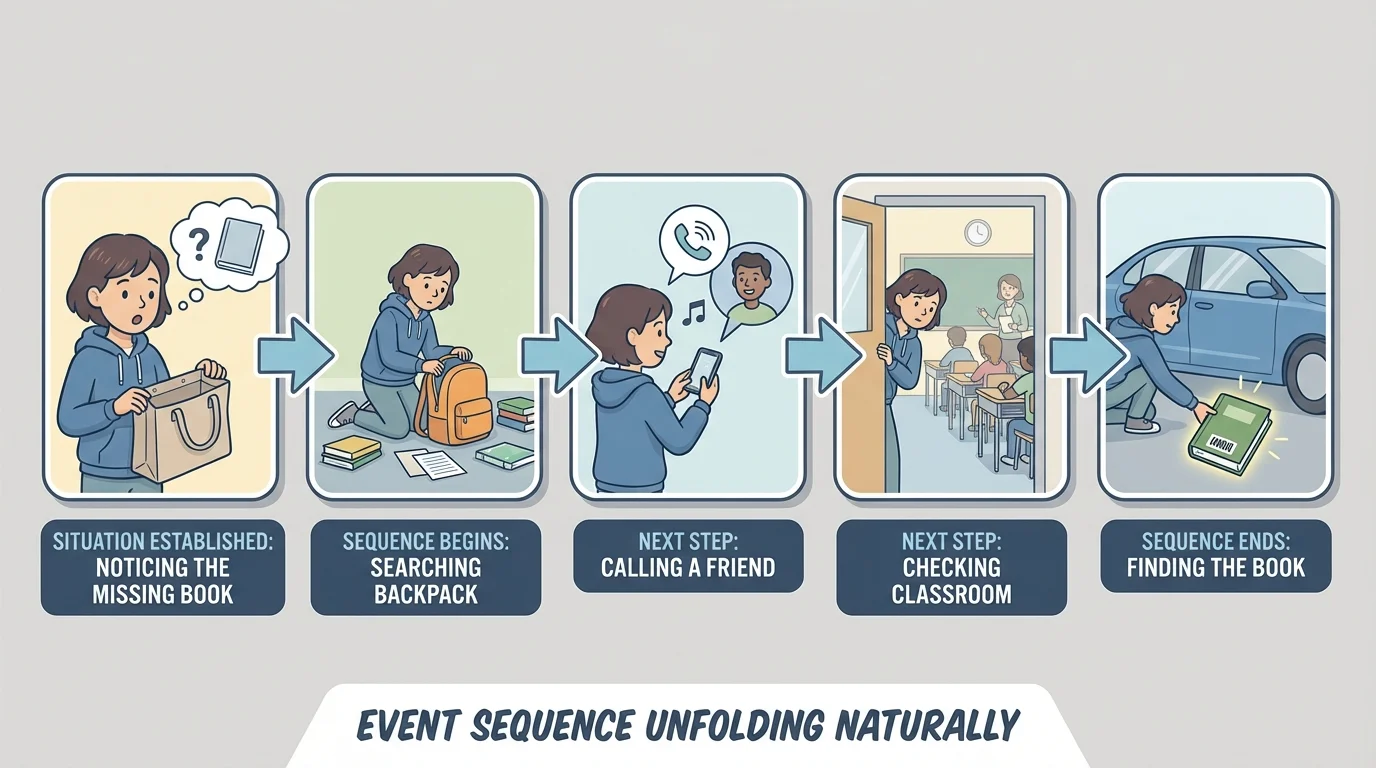
Another way to keep the sequence natural is to stay focused on a single timeline. Flashbacks can be effective, but for many grade 5 narratives, a clear time order works best: first this happened, then this, then this. The flowchart in [Figure 2] makes it easy to see how each event leads to the next instead of appearing out of nowhere.
Example: weak sequence and improved sequence
Here is a weak version:
"I got to school late. Last year I had a different teacher. My backpack was heavy. I ran into class. The bus had splashed water on my jeans."
Step 1: Notice the problem
The events do not connect smoothly. One sentence about last year interrupts the action, and the order is confusing.
Step 2: Reorder and connect the events
"The bus splashed muddy water across my jeans just as I reached the corner. Because I had to run home and change, I got to school late. By the time I rushed into class, my backpack felt as heavy as a bag of bricks."
The improved version follows a logical order and shows how one event causes the next.
Transition words are words and phrases that show how ideas and events are connected. They help the reader move through time and understand what happens next. Examples include first, next, then, after a moment, suddenly, meanwhile, finally, and at last.
Transitions are helpful, but they should not sound repetitive. If every sentence begins with "then," the writing may feel flat. Writers can vary their transitions and sometimes connect events without a transition word at all. For example, "The whistle blew. Everyone froze." The order is clear even without a transition.
Some transitions show time. Others show contrast, cause, or a change in place. In narratives, time transitions are especially useful because they help the reader follow the event sequence.
| Type of transition | Examples | How it helps |
|---|---|---|
| Beginning a sequence | first, at the start, that morning | Shows where the story begins |
| Continuing events | next, soon, after that, a few minutes later | Moves the action forward |
| Surprising moment | suddenly, without warning, all at once | Signals a change or problem |
| Ending a sequence | finally, in the end, at last | Shows closure |
Table 1. Common transition types that help readers follow narrative events.
Strong writers use transitions like road signs: enough to guide the trip, but not so many that they become distracting.
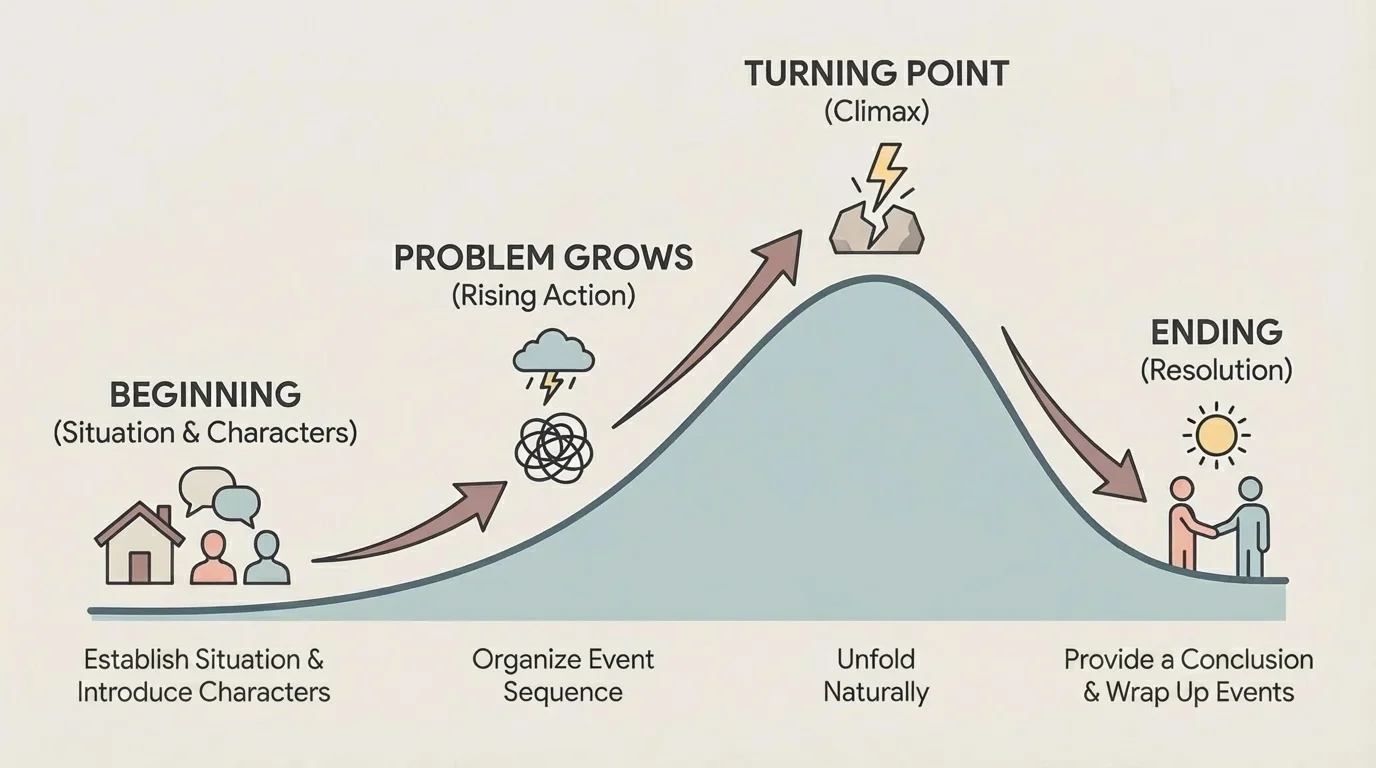
[Figure 3] Most narratives are easier to follow when they have a clear structure. This structure often includes a beginning that sets up the situation, a middle that develops the main events or problem, and an end that shows the result or change. This does not make stories boring; it makes them understandable.
In the beginning, the writer orients the reader. In the middle, the problem grows, decisions are made, and the most important action happens. In the end, the story reaches a conclusion. The ending should connect to what came before. If the story begins with a lost pet, the ending should somehow return to that problem.
A natural unfolding does not mean every story must be predictable. Surprises are welcome. But even surprising events should make sense inside the story. If a class election narrative suddenly ends with a spaceship landing, readers will probably feel confused unless the story has prepared them for science fiction from the start.
The structure in [Figure 3] also helps writers avoid a common problem: rushing the ending. Sometimes writers spend many sentences setting up the story and only one short sentence ending it. A satisfying narrative gives enough space to the important final moment and its effect.
Remember that a paragraph is a group of sentences about one main part of the story. In narratives, paragraphs often change when the action changes, when a new speaker begins talking, or when the setting or time shifts.
One common problem is an opening that is too vague. "It was a day I will never forget" does not tell the reader much yet. A clearer version gives details: "I knew the day would be unusual when our principal climbed onto the cafeteria table with a megaphone."
Another problem is introducing characters without helping the reader know who they are. If a story starts with five names in the first two sentences, readers may have trouble remembering them. It often helps to start with the narrator and the most important person in the scene.
A third problem is jumping between events without connections. Writers can fix this by checking the order carefully. Ask: What happens first? What happens because of that? Does each event lead naturally to the next one?
Point of view problems can also confuse readers. If the story starts with "I" but later says "Marcus wondered if he should run," the reader may ask how the narrator knows Marcus's thoughts. Staying in one point of view helps the story feel stable and believable.
Finally, some narratives include lots of details that are interesting but not important. Good writers choose details that build the setting, reveal character, or move the action forward.
Reading like a writer can help you understand how narratives work. Look at this model opening:
"The gym smelled like floor polish and popcorn when I stepped onto the stage for the school talent show. My little brother, Owen, sat in the front row swinging his legs so hard that his sneaker flew off. I almost laughed, but then I remembered the violin in my hands and the hundred faces staring at me. Mrs. Bell whispered, 'You're up,' and the curtain began to open."
This opening orients the reader quickly. We know the place is the school gym, the event is a talent show, the narrator is about to perform, and there is nervousness in the moment. Owen is introduced through action, which also adds personality.
The next events can unfold naturally from this opening: the narrator begins playing, something goes wrong or right, the narrator reacts, and the performance ends. Because the beginning is clear, the rest of the story has a strong foundation.
Analyzing how the event sequence develops
Step 1: Opening situation
The narrator is on stage at a talent show, holding a violin, with the curtain opening.
Step 2: Natural next event
The narrator starts playing or struggles to begin. This follows directly from the setup.
Step 3: Rising action
A string could snap, the bow could slip, or the audience could react. The problem grows from the performance itself.
Step 4: Ending
The narrator finishes, learns something, or changes in some way. The ending connects to the fear introduced at the start.
This kind of planning helps the writer keep the sequence focused. Notice that the story does not suddenly switch to an unrelated trip to the grocery store. Every event belongs to the same main experience.
Clear organization does not mean plain or boring writing. A narrative becomes engaging when the writer uses sensory details, precise verbs, and believable dialogue. Instead of saying "I went fast," a writer might say, "I sprinted across the wet grass." Instead of saying "I was scared," a writer might say, "My stomach tightened as the judge unfolded the score sheet."
Sensory details appeal to sight, sound, smell, taste, and touch. They help readers experience the story. But they should support the main event, not bury it. One or two strong details are often better than a long list.
Dialogue can also help orient the reader and move the sequence forward. A line like "You brought the wrong poster board!" immediately reveals a problem. Dialogue should sound natural and serve a purpose. It can show relationships, reveal character, or push the action ahead.
Writers should choose verbs carefully. Strong verbs like stumbled, whispered, darted, collapsed, or snatched make scenes clearer than general verbs like went or said. Good word choice helps the reader picture each event as it unfolds.
"The right detail at the right moment can make a story feel true."
— A useful rule for narrative writing
When all these elements work together, the reader can move smoothly through the story. The opening creates orientation, the characters feel real, and the event sequence unfolds naturally from one moment to the next. That is what makes a narrative both clear and memorable.
