Have you ever read a page about sharks, space, or weather and then realized you remember lots of facts but are not quite sure what the author was really trying to teach? Strong readers do more than collect details. They look for the biggest ideas holding those details together. When you can find the important ideas in a text, reading becomes clearer, faster, and much more powerful.
Informational texts are everywhere: science articles, history books, websites, directions, news reports, and even signs at museums or zoos. These texts are written to explain, describe, teach, or inform. To understand them well, readers need to figure out what matters most and how the details connect to those ideas.
When you read an informational text, you are like a detective. Authors give clues in the form of facts, examples, definitions, and explanations. Your job is to ask, "What is the big point here?" If you can answer that question, you are finding the main ideas of the text.
Knowing the main ideas helps you remember what you read, discuss it with others, and explain it in your own words. It also helps when a text is long. Instead of trying to memorize every single fact, you organize the facts into a few important ideas.
Readers already know that a text can have a topic. The topic is the general subject, such as rain forests, bridges, or volcanoes. The next step is to identify what the text says about that topic.
[Figure 1] That is why finding main ideas is useful in every subject. In science, it helps you understand how an ecosystem works. In social studies, it helps you track important events and causes. In everyday life, it helps you read instructions, articles, and online information without getting lost in extra details.
A main idea is the most important point the author wants the reader to understand. It is more than just the subject. The subject might be "bees," but the main idea tells what the author is teaching about bees.
A topic is usually one or two words. A main idea is usually a full sentence. The topic is broad, while the main idea gives a specific message about that topic. For example, the topic might be "bees," but the main idea might be "Bees are important because they pollinate many plants that people and animals depend on."
The facts that help prove or explain that sentence are called key details. These details might tell how bees move pollen, name crops that depend on pollination, or explain what happens if bee populations shrink.
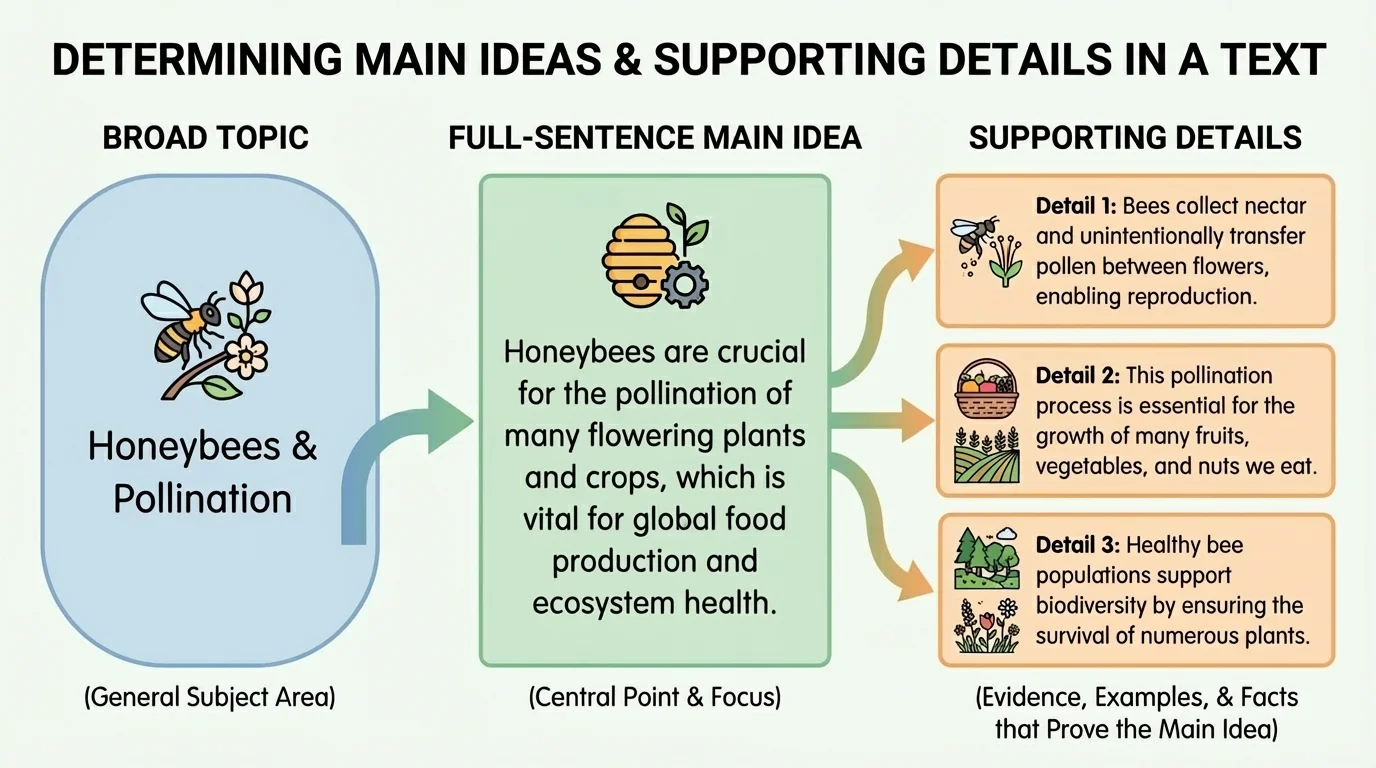
Here is a simple way to think about it:
| Part of the Text | What It Means | Example |
|---|---|---|
| Topic | The subject | Bees |
| Main idea | The most important point about the topic | Bees help plants grow by pollinating them. |
| Key details | Facts, examples, or explanations that support the main idea | Bees carry pollen from flower to flower; many fruits and vegetables depend on pollination. |
Table 1. The table compares a topic, a main idea, and key details in an informational text.
Main idea is the most important point a text or section is mostly about. Key details are the facts, examples, and explanations that support that point. Summary is a short retelling of the most important ideas in your own words.
Sometimes the main idea is stated directly in the text. An author may write it clearly in the first sentence, the last sentence, or even the title. Other times, the reader has to infer it by putting several details together and asking what they all have in common.
Some texts are short and focus on just one main idea. But many longer informational texts include two or more main ideas. As [Figure 2] illustrates, one article may have an overall subject and then separate sections, each with its own important point.
Think about an article on volcanoes. One section may explain how volcanoes form. Another section may describe different kinds of eruptions. A third section may explain how scientists monitor volcanoes to keep people safe. All of these belong to the same topic, but each section has its own main idea.
That means good readers do not stop after finding one big idea. They keep reading and ask whether the author is introducing another important point. In a longer text, each paragraph or section may build a different part of the whole message.
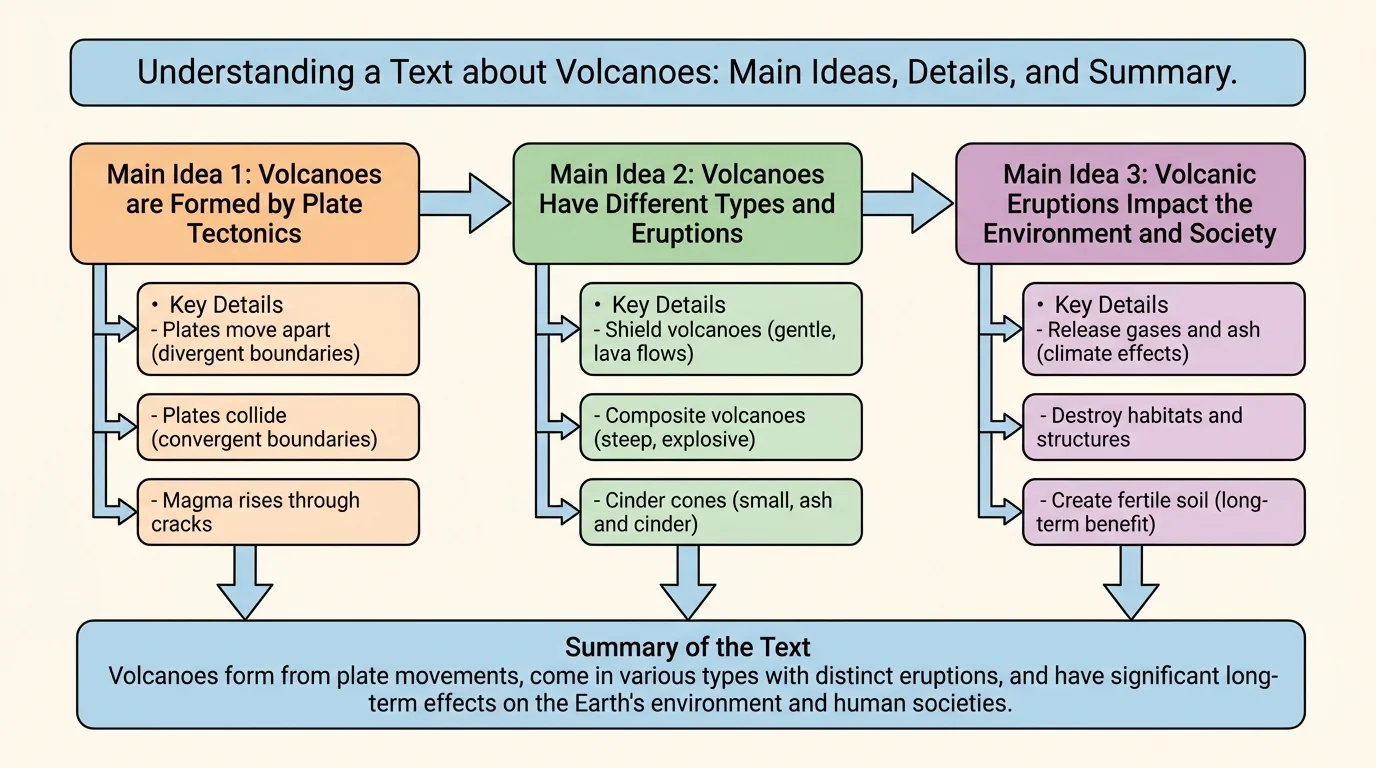
You can think of it this way: the whole article is like a tree trunk, and the section main ideas are like large branches. The minor details are the leaves. If you only collect leaves, you miss the shape of the tree.
News articles often give the most important idea very early, but textbooks and feature articles may spread their main ideas across several sections. That is why readers adjust their thinking depending on the kind of text they are reading.
Later, when you explain the text, you may need to name two or more main ideas, especially if the question asks what the text teaches in different parts. A strong answer does not just list random facts. It groups details under the important ideas they support.
A main idea is strong when it is supported by evidence in the text. Authors build support in different ways. They may use facts, examples, descriptions, definitions, causes and effects, or comparisons.
A supporting detail works like a piece of proof. If the main idea is "Recycling helps reduce waste," then a supporting detail might explain that recycling turns used materials into new products. Another might give an example such as paper, aluminum, or plastic being reused instead of thrown away.
Not every detail has the same importance. Some are key details because they directly help explain the main idea. Other details are interesting but less central. For example, if an article about sea turtles says they can live for many years, that might be important. But the exact color of one photographed turtle might not be a key detail unless the author connects it to the text's main point.
How readers test a detail
Ask, "If I remove this fact, do I still understand the author's main point?" If the answer is no, the detail is probably important. If the answer is yes, the detail may be minor or extra information.
This is also where headings, captions, and repeated words help. Authors often repeat an important term or idea when they want readers to notice it. If several details all connect to the same repeated idea, that idea may be a main idea.
Finding main ideas is a process. It becomes easier when you read actively instead of letting the words slide past you.
First, preview the text. Look at the title, headings, images, and bold words. These features give clues about the subject and the most important parts.
Second, read one section or paragraph at a time. After reading, stop and ask, "What is this mostly teaching me?" Answer in a full sentence, not just a single word.
Third, look for details that repeat or connect. If several facts all show how something works, why it matters, or what causes it, they may support the same main idea.
Fourth, decide whether the text has more than one important point. In longer texts, each section may contain a new main idea. The volcano example in [Figure 2] helps show how one topic can branch into several section ideas.
Fifth, put the main ideas together in your own words. This prepares you to explain the text and eventually write a summary.
One common mistake is choosing a detail that is too small. For example, if a passage about deserts mentions that one lizard hides under rocks during the hottest part of the day, that is probably not the main idea of the whole passage. It is just one detail.
Another mistake is making the main idea too broad. If a student says the main idea of an article is "animals," that answer is too general. The author is almost certainly saying something more specific than that.
A better main idea sentence gives the topic and the point. Instead of "animals," you might say, "Desert animals survive harsh heat by using special behaviors and body features." That statement is focused enough to be useful and broad enough to include several details.
"The best readers do not just notice details. They connect details to ideas."
Strong readers also avoid adding their own opinions. If you think sharks are scary or robots are exciting, that may be true for you, but it is not automatically the main idea. The main idea must come from the text itself.
A summary is a short explanation of the most important parts of a text. A summary starts by identifying the main ideas and then condenses them into a shorter form. A summary includes central ideas and key details, but it leaves out minor details, repeated information, and personal opinions.
When you summarize, you are not copying whole sentences from the text. You are showing that you understand the ideas well enough to restate them in your own words. Good summaries are shorter than the original text but still accurate.
[Figure 3] A helpful way to build a summary of an informational text is to ask these questions: What is the text mostly about? What are the most important ideas the author explains? Which key details are necessary to make those ideas clear?
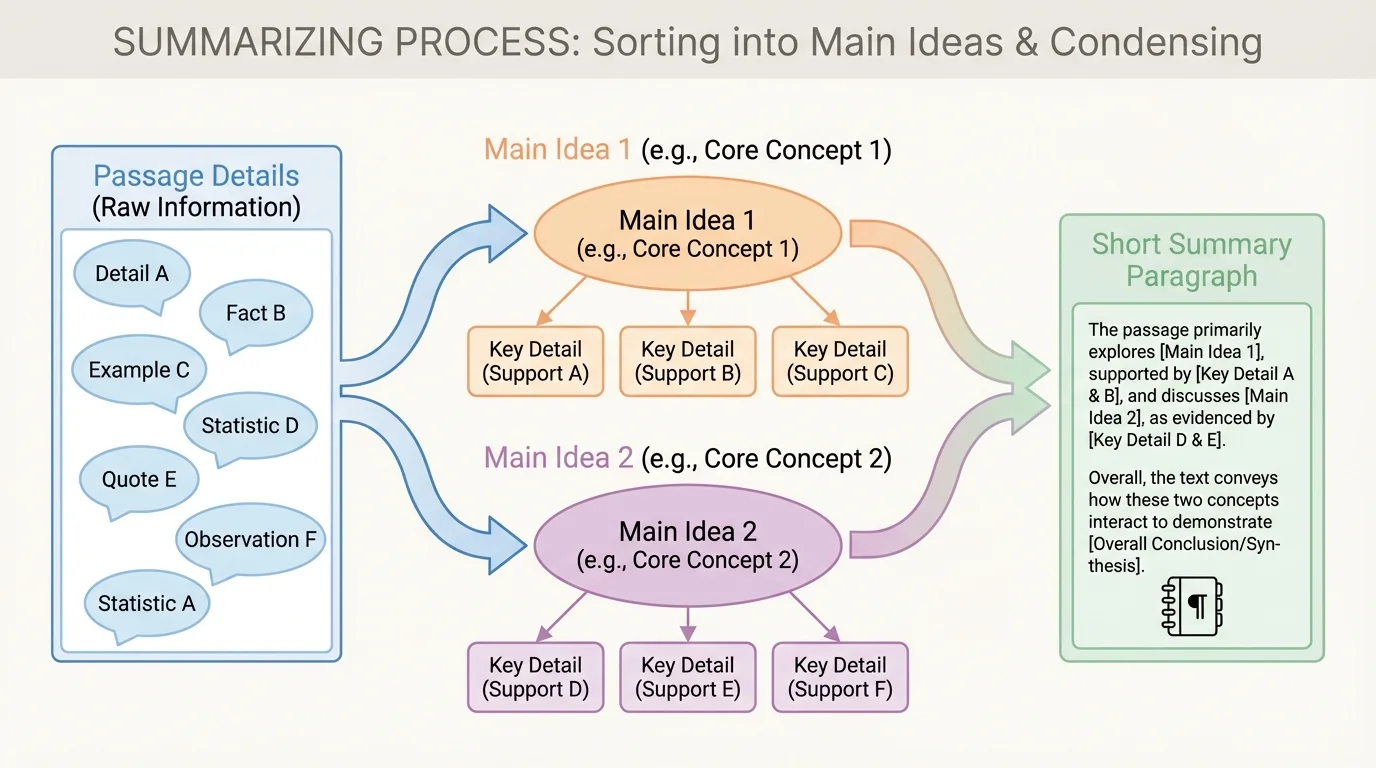
If a text has two or more main ideas, your summary should include each important idea briefly. You do not need every example. You need just enough detail to show how the ideas connect.
Turning notes into a summary
Suppose a text explains that rain forests have many layers, that each layer provides habitats for different plants and animals, and that deforestation harms these habitats.
Step 1: Identify the main ideas.
Main idea 1: Rain forests are made of different layers. Main idea 2: The layers support many living things. Main idea 3: Deforestation damages the rain forest ecosystem.
Step 2: Choose the most useful supporting details.
Useful details include that the canopy blocks much sunlight, different animals live in different layers, and cutting trees destroys habitats.
Step 3: Write a short summary in your own words.
A possible summary is: Rain forests are made of several layers, and each layer provides a different habitat for plants and animals. Because so many living things depend on these layers, deforestation can seriously harm the ecosystem.
Notice that the summary is shorter than the full text, but it still includes the most important ideas. It does not list every animal or every tree type. It stays focused.
Let us look at how this works with short informational passages.
Example 1: School gardens
Passage: Many schools are creating gardens on their grounds. These gardens teach students how plants grow, give them a chance to observe insects and soil, and can provide vegetables for the cafeteria. Teachers also use gardens to connect science, math, and health lessons.
Step 1: Find the topic.
The topic is school gardens.
Step 2: Identify the main ideas.
Main idea 1: School gardens help students learn about nature and science. Main idea 2: School gardens can also provide food and connect different subjects.
Step 3: Match key details to each main idea.
Details for main idea 1: students observe plants, insects, soil. Details for main idea 2: gardens provide vegetables and support science, math, and health lessons.
Step 4: Write a summary.
Schools create gardens to help students learn about nature while also connecting different subjects and sometimes growing food for the cafeteria.
This example shows that even a short passage can contain more than one important idea. One idea is about learning. Another is about practical uses.
Example 2: Migrating birds
Passage: Some birds migrate thousands of miles each year. They travel to find warmer weather, more food, or safer nesting places. Scientists study migration by tracking birds with tiny devices and by observing when flocks arrive in different places.
Step 1: Identify the main ideas.
Main idea 1: Birds migrate for important survival reasons. Main idea 2: Scientists have ways to study bird migration.
Step 2: Find supporting details.
Details for main idea 1: birds seek warmer weather, more food, and nesting places. Details for main idea 2: scientists use tracking devices and observations.
Step 3: Write the summary.
Birds migrate to survive and reproduce, and scientists learn about these journeys by tracking birds and observing their movements.
Notice how the summary does not include every phrase from the passage. It keeps the ideas but trims the extra wording.
Example 3: Bridges
Passage: Engineers design different kinds of bridges for different places and purposes. Beam bridges work well for shorter distances, arch bridges use curved shapes for strength, and suspension bridges can span long distances over water or deep valleys. Safety, cost, and the environment all affect how a bridge is built.
Step 1: Identify two or more main ideas.
Main idea 1: Different bridge designs are used for different needs. Main idea 2: Engineers must consider several factors when choosing a design.
Step 2: Choose key details.
Details for main idea 1: beam bridges suit shorter spans, arch bridges use curved strength, suspension bridges cross long distances. Details for main idea 2: safety, cost, and environment influence decisions.
Step 3: Summarize.
Bridge design depends on purpose and location, so engineers choose among different types of bridges while also considering safety, cost, and environmental conditions.
These examples show a pattern: identify the big ideas, connect the details, and then state the ideas briefly and clearly.
One mistake is writing a summary that is too long. If it includes almost every detail from the text, it is no longer a true summary. The fix is to keep only the details that directly support the main ideas, much like the sorting process in [Figure 3].
Another mistake is choosing a sentence straight from the text without thinking. Sometimes the author's words do state the main idea, but you should still make sure you understand why that sentence is central and how the details support it.
A third mistake is forgetting one of the important ideas in a multi-section text. If the text explains both causes and effects, or both problems and solutions, your answer should include both when they are central.
It also helps to check your work by asking three questions: Does my main idea tell what the text says about the topic? Do my details really support that idea? Is my summary short, accurate, and in my own words?
Finding main ideas is not just a school skill. It helps when you read a recipe and need the essential steps, when you read sports news and want the key update, or when you read a website and need to decide what information matters most.
In science, you may read about how hurricanes form and why they are dangerous. In social studies, you may read about a historical event and need to identify several major causes. In health, you may read about nutrition and explain why certain foods help the body. In each case, the reader must separate the big ideas from the small facts.
The more you practice this way of thinking, the more confidently you can handle longer and more complex texts. You stop reading as a collector of disconnected facts and start reading as someone who understands how ideas fit together.
