Have you ever watched a movie where one scene made no sense until a later scene explained it? Books, plays, and poems work that way too. Authors do not place parts of a text in random order. They carefully arrange chapters, scenes, or stanzas so each part helps build the whole. When readers notice how those parts fit together, they understand the text more deeply.
Structure is the way a text is organized. It is the framework that holds the writing together. Just as a house needs walls, doors, and rooms arranged in useful ways, a literary text needs parts arranged so the reader can follow ideas, actions, and emotions.
If you only read one chapter of a novel, one scene from a play, or one stanza of a poem, you might understand a piece of the text but miss the full meaning. A strong reader asks, "Why is this part here? What does it add? How does it connect to what came before and what comes next?" Those questions help reveal the overall structure.
Overall structure is the complete way a text is built from beginning to end. In a story, the parts may be chapters. In a drama, the parts may be scenes or acts. In a poem, the parts may be stanzas. Each part has its own job, but all the parts work together to create one whole text.
Understanding structure helps readers do more than retell events. It helps them explain how an author builds suspense, shows change, develops a theme, or creates a certain feeling.
When readers talk about literary structure, they often use special words. A chapter is a major section of a story or novel. A scene is a part of a play that usually takes place at one time and in one place. A stanza is a group of lines in a poem. Sequence means the order in which parts appear. A transition is the shift from one part to another, such as a move in time, setting, mood, or idea.
These words help readers explain not just what happens, but how the text is built. That is important because two texts can tell similar ideas in very different ways depending on their structure.
Readers already know that literary texts often have a beginning, middle, and end. Thinking about structure means looking even more closely: how does each chapter, scene, or stanza help create that beginning, middle, and end?
One useful way to think about structure is to imagine puzzle pieces. A puzzle piece matters by itself, but it becomes much more meaningful when connected to the other pieces.
In a story, chapters often act like building blocks. Together, they create the full plot, as [Figure 1] shows through a story arc that moves from introduction to resolution. One chapter may introduce a character, another may reveal a problem, another may raise the stakes, and a later chapter may solve the problem. When readers explain structure well, they show how each chapter moves the story forward.
Many stories follow a pattern: the beginning introduces characters, setting, and the main problem; the middle develops the problem through events and choices; the ending brings change, a solution, or a lesson. Chapters divide that pattern into smaller parts. Some chapters are quiet and thoughtful. Others are full of action. Their order matters.
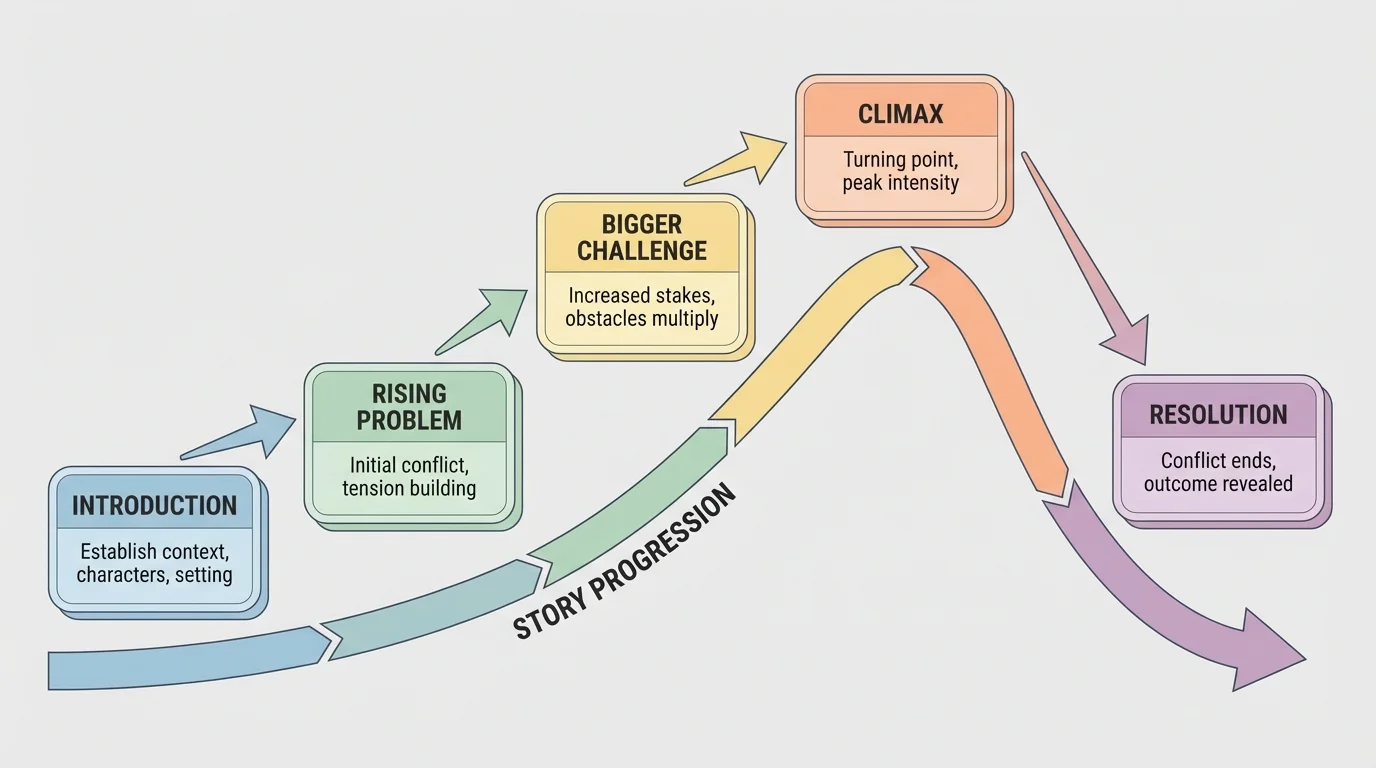
For example, think about a made-up novel called The Lost Key. In Chapter 1, Maya finds a map in her grandmother's attic. In Chapter 2, she learns the map points to a hidden garden. In Chapter 3, her best friend disagrees about whether they should go. In Chapter 4, they get lost in a storm. In Chapter 5, they finally find the garden and understand why the map mattered. These chapters fit together in a clear sequence. If Chapter 5 came first, the mystery would disappear. If Chapter 3 were missing, the friendship conflict would feel weak.
Authors sometimes use chapters to show change over time. Early chapters may show a character feeling scared or unsure. Later chapters may show that same character becoming brave. Structure helps readers notice growth.
To explain how chapters fit together, pay attention to each chapter's job. Ask whether a chapter introduces, develops, complicates, or resolves something. A chapter might also switch the setting, reveal new information, or slow the pace so readers can understand a character's thoughts.
Suppose a story has six chapters about a boy preparing for a big race. Chapter 1 introduces the race and the boy's fear. Chapter 2 shows him training. Chapter 3 shows an injury. Chapter 4 shows him deciding whether to quit. Chapter 5 shows the race itself. Chapter 6 shows what he learns. This is not just a list of events. It is a structure. Each chapter depends on the earlier ones. The injury matters because the training came first. The lesson matters because the race came before it.
Example: Explaining chapter structure in a story
Text situation: A novel has four chapters about two sisters rebuilding a treehouse after a storm.
Step 1: Identify what the first part does.
Chapter 1 introduces the storm damage and the sisters' disappointment.
Step 2: Notice how the middle chapters build the problem.
Chapter 2 shows them arguing about how to rebuild, and Chapter 3 shows them learning to cooperate.
Step 3: Explain how the ending connects to the earlier parts.
Chapter 4 shows the finished treehouse, which matters because the earlier chapters built the problem and the teamwork needed to solve it.
A strong explanation would say that the chapters move from problem to conflict to cooperation to resolution.
Stories do not always move in a straight line, but even when they include surprises, the parts still work together. Later in the lesson, we will look at special patterns such as flashbacks and circular structure.
When you think back to the story arc in [Figure 1], notice that the middle chapters often do the hardest work. They connect the opening problem to the ending and keep readers interested.
A drama, or play, is built differently from a story because it is meant to be performed. Instead of chapters, plays usually use acts and scenes. Scenes fit together to build the action of the play, as [Figure 2] illustrates with a conflict that grows from one setting to the next. One scene may introduce a problem, another may show characters arguing, and another may reveal the result of a choice.
A new scene often begins when the setting changes, the time changes, or different characters enter and leave the stage. Because drama depends heavily on dialogue and stage directions, each scene must do important work quickly. Scenes are like stepping stones. If one is removed, the audience may not understand why the next event happens.
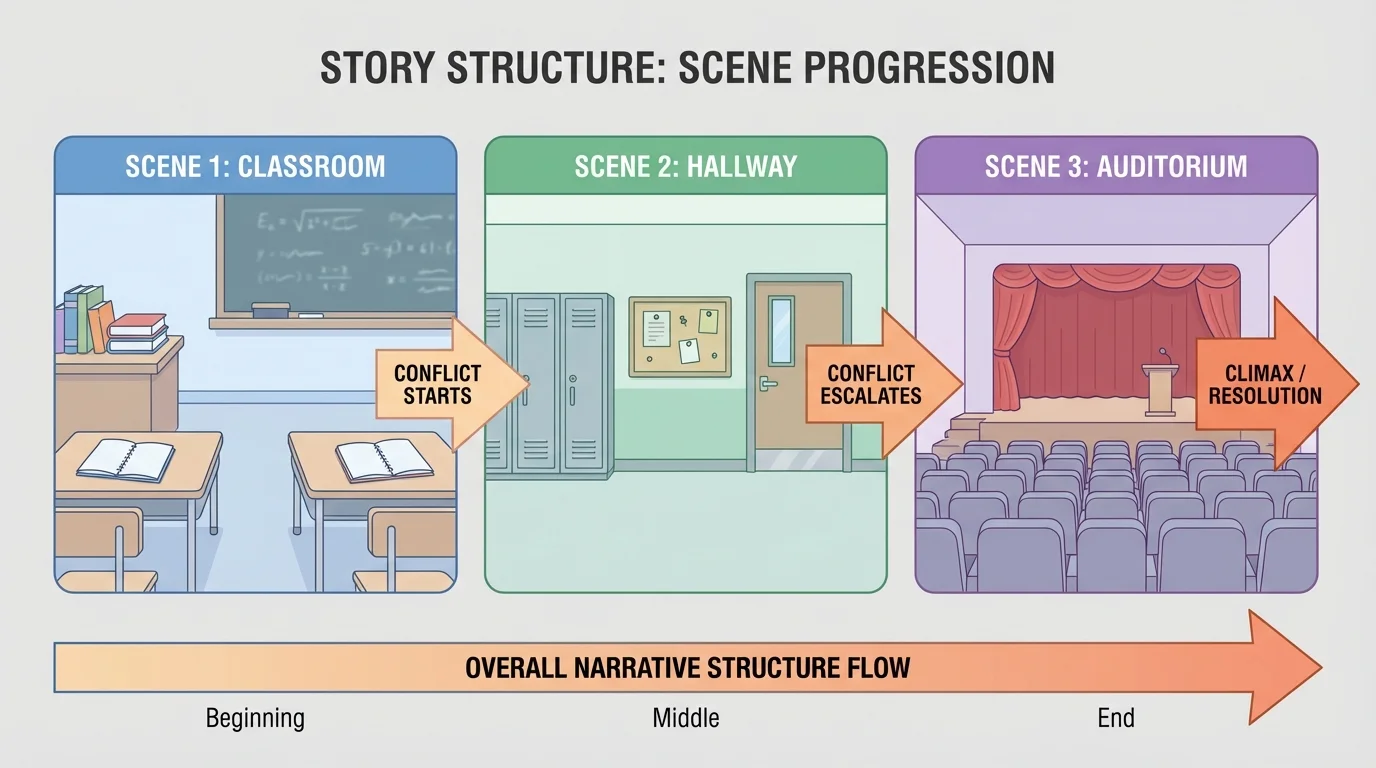
Imagine a short play called The School Election. Scene 1 takes place in a classroom, where two students decide to run for class president. Scene 2 takes place in the hallway, where rumors spread and create misunderstanding. Scene 3 takes place in the auditorium, where the students speak honestly and solve the conflict. The scenes fit together by moving from decision to complication to resolution.
Scenes also help control pacing. A short scene can create excitement. A longer scene can build tension through conversation. In drama, structure is not only about what happens but also about when the audience sees it happen.
How scenes build a play
Each scene usually has a purpose. It may reveal character, move the plot forward, create conflict, or prepare the audience for an important event. When scenes are arranged carefully, the audience can follow the rising action, the turning point, and the ending of the play.
Later scenes often depend on information from earlier ones. If Scene 1 shows a promise, Scene 3 may show whether that promise was kept. That connection is part of the play's overall structure. The movement across settings in [Figure 2] helps show how a play can carry one conflict through several scenes while changing time or place.
Poems are often shorter than stories or plays, but they still have structure. In poetry, [Figure 3] shows how stanzas can build from an image to a feeling and then to a reflection. A stanza is not just a chunk of lines. Each stanza often adds a new idea, a new image, a new feeling, or a new point of view.
Some poems move in time, almost like tiny stories. Other poems move through thoughts and feelings. The first stanza may describe something seen in nature. The second may explain what that image makes the speaker feel. The third may connect that feeling to a larger message or theme.
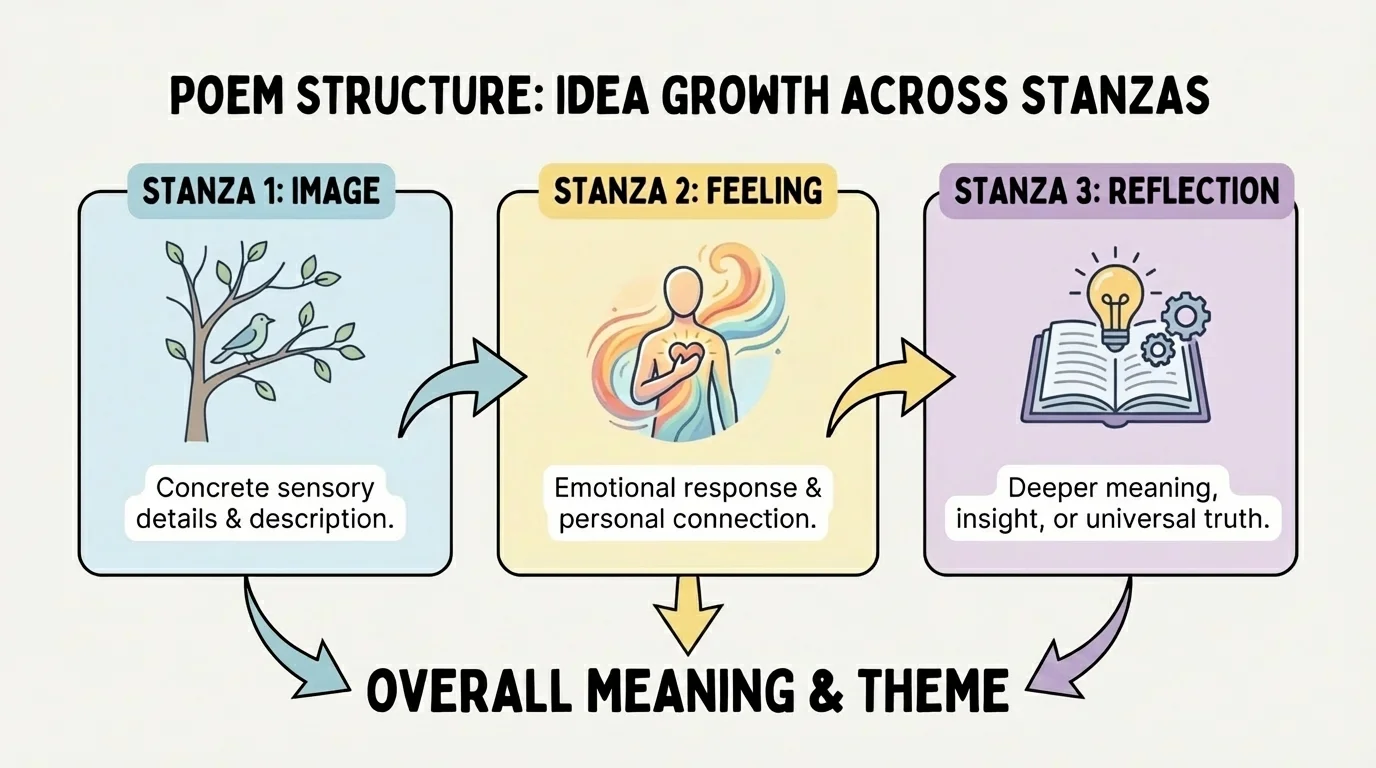
Think about an imaginary poem called Morning Snow. Stanza 1 describes snow covering houses and trees. Stanza 2 describes the quiet feeling the snow creates. Stanza 3 explains how the speaker feels calm and hopeful. The stanzas fit together by moving from what is seen, to what is felt, to what is understood.
Poets also use repeated words, line breaks, and refrains to connect stanzas. A repeated line can remind readers of an important idea. A final short stanza can stand out and leave a strong impression.
Some very short poems still have strong structure. Even a poem with only two stanzas can move from one idea to another in a powerful way.
When readers study a poem, they should not stop after naming the stanzas. They should explain how one stanza leads into the next. The pattern in [Figure 3] helps readers notice that stanza breaks often signal a meaningful shift, not just a pause on the page.
Stories, dramas, and poems all have parts that fit together, but they do not organize those parts in exactly the same way. The chart below compares common structural units in these three kinds of literary texts.
| Type of Text | Main Parts | What the Parts Often Do | What Readers Notice |
|---|---|---|---|
| Story | Chapters | Develop plot, characters, setting, and conflict over time | How chapters move from beginning to middle to end |
| Drama | Acts and scenes | Show action through dialogue, stage directions, and changes in setting | How scenes build tension and lead to important moments |
| Poem | Stanzas | Build images, feelings, ideas, or repeated patterns | How stanzas shift or deepen meaning |
Table 1. Comparison of how stories, dramas, and poems are commonly structured.
Even though these forms are different, readers ask similar questions about each one: What does this part add? Why does it come here? How would the whole text change if this part were moved or removed?
Strong readers pay attention to patterns. They notice whether a text starts by introducing a problem, whether the middle builds tension, and whether the ending solves something or leaves readers thinking. They also notice when an author repeats a line, shifts to a new setting, or begins a new chapter at an important moment.
Useful questions include: What is the job of this chapter, scene, or stanza? How does it connect to the part before it? How does it prepare readers for the part after it? What changes from one part to the next? These questions help readers explain overall structure clearly.
"The right order turns separate parts into one meaningful whole."
That idea matters in every kind of literary text. Structure is not decoration. It shapes understanding.
Consider a story about a stray dog finding a home. The first chapter introduces the dog alone in the park. The second chapter shows a child noticing the dog. The third chapter shows the family deciding whether to keep it. The fourth chapter ends with the dog finally belonging somewhere. This chapter structure moves from loneliness to connection.
Now consider a play about a broken friendship. The first scene shows the friends arguing. The second scene shows each friend speaking to someone else about the problem. The third scene brings them back together to talk honestly. The scenes fit together because each one changes the conflict and leads toward the final choice.
Finally, consider a poem about the ocean. The first stanza describes the waves. The second stanza describes the speaker's fear of the storm. The third stanza shows respect for the ocean's power. The stanzas fit together because they move from description to emotion to understanding.
How to write a strong explanation
Weak explanation: "The poem has three stanzas."
Strong explanation: "The poem's three stanzas build the overall structure by moving from the ocean's appearance, to the speaker's fear, to a final feeling of respect. Each stanza adds a new layer of meaning."
Notice how the stronger explanation tells how the parts work together, not just how many parts there are.
Not every text follows a simple beginning-middle-end pattern in an obvious way. Some stories use a flashback, which is a section that returns to an earlier time. A flashback can explain why a character acts a certain way in the present. Even though the order shifts, the flashback still supports the overall structure by filling in important information.
Some texts use circular structure. That means the ending connects back to the beginning. For example, a story may open and close at the same lake, but the character feels different at the end. The repeated setting shows change.
Poems may use a refrain, a repeated line or phrase, to connect stanzas. Plays may return to the same stage setting again and again, with each scene revealing something new. These variations remind readers that structure can be creative while still being purposeful.
When you explain a text's structure, be specific. Name the parts, describe their jobs, and show their connections. Instead of saying, "The chapters go together," explain how they go together: "The first chapter introduces the mystery, the next two chapters build suspense by adding clues, and the final chapter solves the mystery."
It also helps to use evidence from the text. Mention details, turning points, or repeated ideas. Good explanations often use words such as first, next, later, finally, because, therefore, and as a result. These words show relationships between parts.
A complete explanation usually includes three things: the name of the parts, the purpose of the parts, and the way the parts build the whole. If any of those pieces are missing, the explanation may sound too simple.
