A story can turn a tiny moment into something unforgettable. A dropped lunch tray, a missed goal, a surprise phone call, or a dog racing through an open gate might last only a few seconds in real life. But in writing, those seconds can become exciting, funny, scary, or meaningful. Writers do that by choosing narrative techniques that help readers experience events and understand how characters respond.
When writers tell a real or imagined story, they do more than list what happened first, next, and last. They shape the story. They decide when characters should speak, which details readers should notice, and which moments should move quickly or slowly. Three powerful tools for this work are dialogue, description, and pacing.
These techniques help a narrative feel alive. They can show excitement before a big game, nervousness before a speech, or relief after a problem is solved. They also help readers understand characters better, not because the writer simply tells them what to think, but because the writer shows it through words, actions, thoughts, and details.
Dialogue is the spoken words of characters in a story. Description is the use of details to help readers picture people, places, objects, and events. Pacing is the speed at which a story moves.
Strong narratives usually use all three. Dialogue lets readers hear the characters. Description lets readers see and feel the world of the story. Pacing controls tension by slowing down important moments and moving more quickly through less important ones.
If a writer only says, "I had a hard day at school," the reader learns very little. But if the writer adds specific techniques, the moment becomes clearer and more interesting: "My math paper slipped from my hand and fluttered to the floor. 'Wait,' I whispered, but three kids had already seen the giant red 62 at the top." That version gives the reader a scene, not just a report.
Narrative techniques also help with character development. A character's response to a situation tells a lot about that person. One character may laugh after making a mistake. Another may hide. Another may ask for help right away. These responses make characters feel real because real people react in different ways.
Writers also use transition words and phrases to guide the reader through events. Words such as first, next, later, meanwhile, after that, and finally help create a clear sequence. Even when a story includes vivid scenes, the events still need to make sense in order.
Many exciting scenes in books feel fast when you read them, but they are often carefully slowed down by the writer. A single second of surprise may take several sentences to describe.
That is one reason narrative writing can feel powerful. It does not just tell what happened. It helps readers experience what happened.
When writers use dialogue well, readers learn about the story in several ways at once. They hear the characters' voices, notice relationships, and understand conflict through the parts of a dialogue line: the spoken words, the tag, and the action connected to the speech.
[Figure 1] Dialogue should sound natural, but it should also have a purpose. It can reveal feelings, show a problem, give important information, or show how characters treat one another. Compare these two examples:
Plain: Maya was nervous about the audition.
With dialogue: "Do I have to go first?" Maya asked. "Maybe someone else should start."
In the second example, the reader hears Maya's worry instead of being told about it in a general way. Her words reveal her feeling.
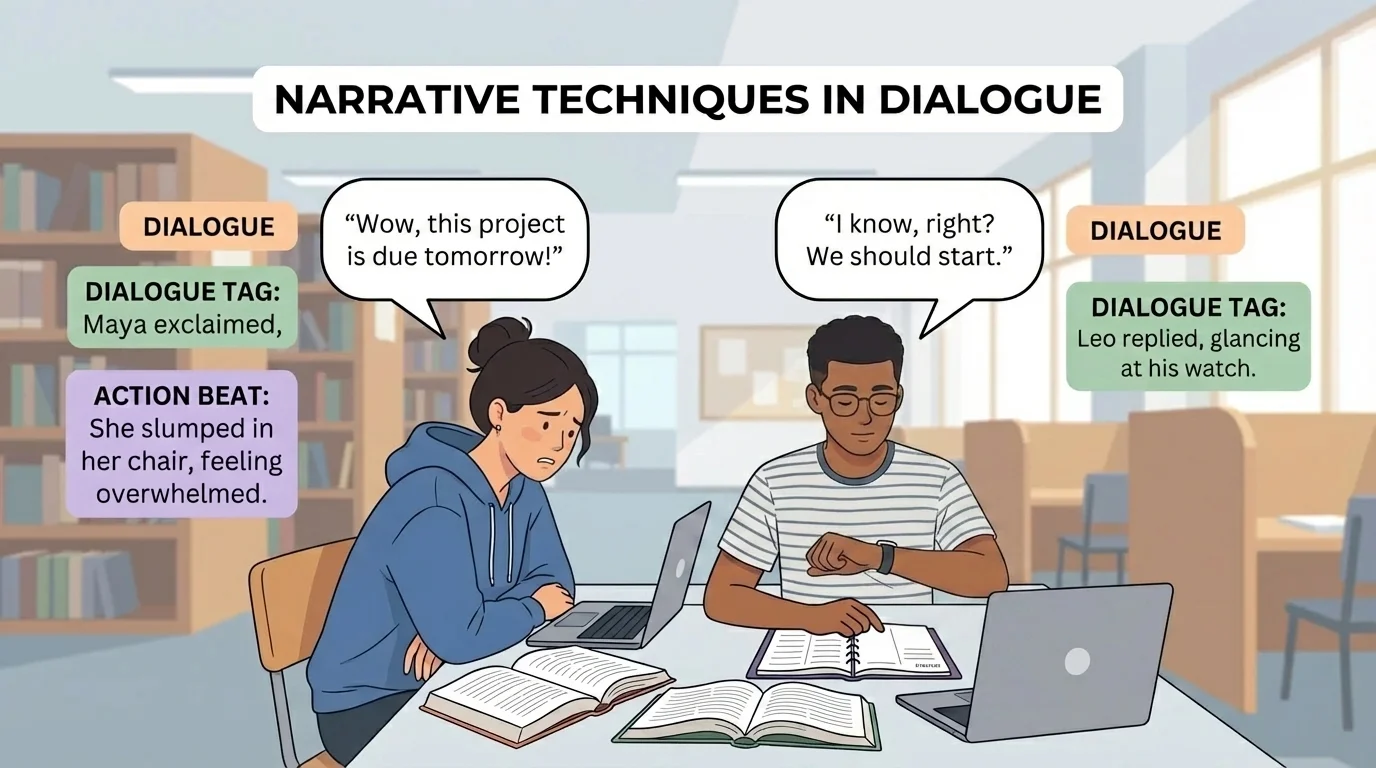
Writers often include a dialogue tag to show who is speaking. A dialogue tag is a phrase like he said, she asked, or they shouted. Dialogue tags help readers follow the conversation. For example: "I found the missing key," Luis said.
Writers can also use an action beat, which is a short action placed near dialogue. Instead of writing, "I found the missing key," Luis said, a writer might say, "I found the missing key." Luis lifted his hand from behind his back. The action beat adds movement and helps the scene feel less repetitive.
Good dialogue is usually not too long. If characters speak for many lines without any action or description, the scene can feel flat. Readers need pauses that show facial expressions, gestures, or changes in the setting. As we saw in [Figure 1], dialogue works best when it connects to what characters are doing.
Dialogue can also show relationships. Look at how the same message changes depending on the speaker:
"Move," Marcus snapped.
"Excuse me, can I get by?" Marcus asked.
Both lines might happen in a crowded hallway, but they show very different sides of Marcus. Word choice matters.
Example: Dialogue that reveals character
Situation: A student discovers her science project is missing just before the fair.
Step 1: A weak version tells the feeling directly.
Jenna was upset because her project was gone.
Step 2: A stronger version lets dialogue reveal the reaction.
"No. No, no, no," Jenna muttered. "It was right here. I checked this table twice."
Step 3: Add a small action to deepen the moment.
"No. No, no, no," Jenna muttered, gripping the edge of the table. "It was right here. I checked this table twice."
The stronger version shows panic through words and action.
Notice that dialogue does not have to be loud or dramatic. Even a whisper, a pause, or a one-word answer can reveal a lot.
Good description creates a clear picture in the reader's mind. It uses specific details, often based on the senses, to build the world of the story. A writer may describe what a character sees, hears, smells, tastes, touches, or feels emotionally, and sensory details can turn an ordinary setting into a vivid scene.
[Figure 2] Instead of writing, "The cafeteria was noisy," a writer could say, "Lunch trays clattered, sneakers squeaked on the tile, and voices bounced off the walls." That sentence gives sound details that make the setting more real.
Description also works best when it is precise. Compare these two examples:
General: The dog ran fast.
Precise: The golden dog shot across the wet grass, ears flying, paws kicking up muddy drops.
The second sentence helps the reader picture the motion much more clearly.
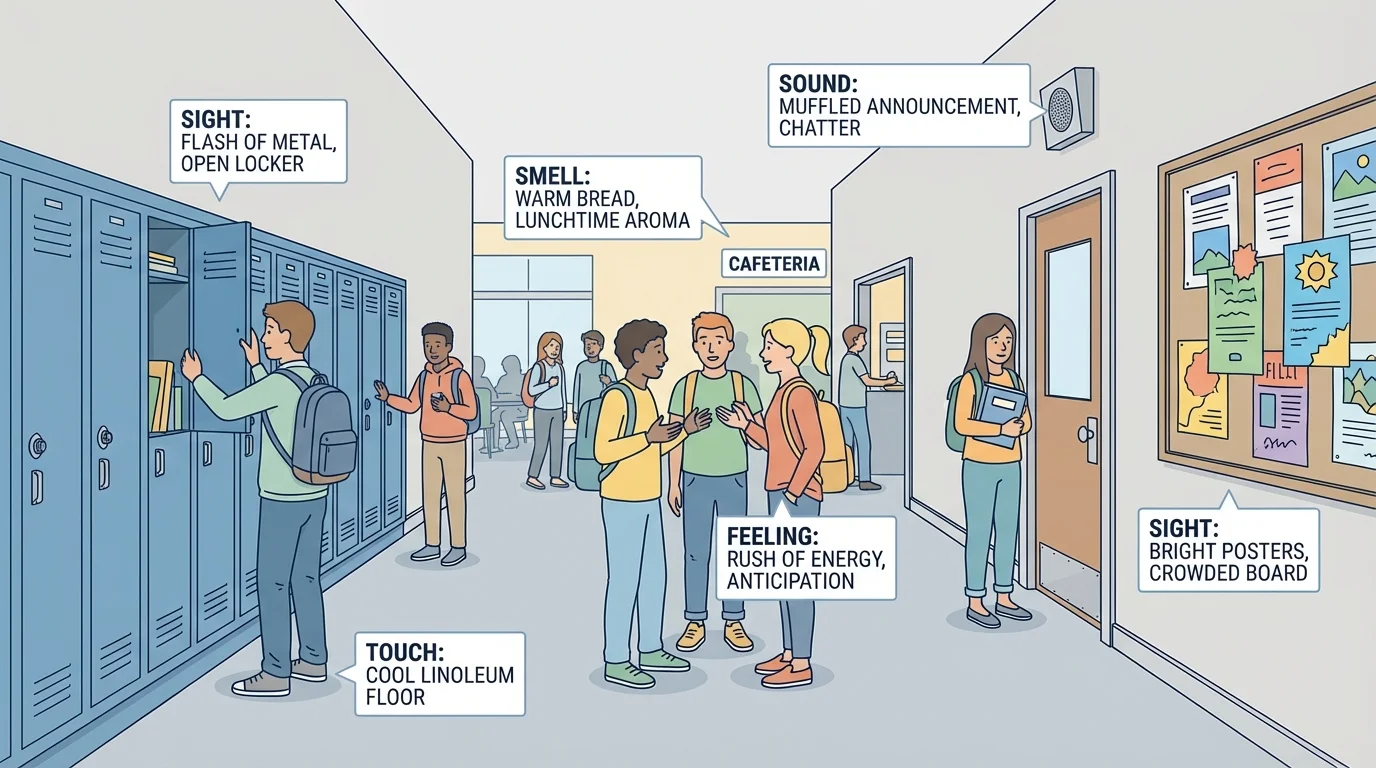
Description is not only about setting. It also shows how characters react. If a student is nervous before speaking in front of the class, the writer might describe sweaty palms, a dry throat, or the way the student keeps smoothing a wrinkled note card. These details help readers understand feelings without the writer saying, "She was nervous."
This is called showing rather than just telling. Telling is sometimes useful, especially to move the story along, but showing often makes important moments stronger. The sensory scene in [Figure 2] reminds us that a place becomes more believable when readers can imagine being there.
Strong description depends on choosing the right details, not the most details. If a writer describes every object in a room, the story may slow down too much. Instead, writers pick details that match the mood and purpose of the scene. For a spooky scene, a writer might mention flickering light, a creaking floorboard, and cold air under the door. For a cheerful scene, the writer might mention sunlight, music, and the smell of cinnamon rolls.
Choosing sensory details with purpose
Sensory details are strongest when they help the reader understand something important. A detail can reveal mood, setting, or character. For example, describing a backpack as "stuffed with crumpled papers and one broken pencil" tells more about the character than simply saying "a backpack sat on the floor."
Word choice matters, too. Strong verbs such as stomped, drifted, snapped, and lunged often do more work than weaker verbs such as went or moved. Specific nouns and adjectives can make writing sharper and more memorable.
A writer does not spend the same amount of time on every event. This control of story speed is called pacing, and it helps readers know which moments matter most.
[Figure 3] Important moments are often slowed down. A writer may stretch a few seconds into several sentences by describing thoughts, movements, sounds, and feelings. This helps build suspense, excitement, or emotion. For example, right before a soccer player kicks the game-winning penalty shot, the writer might slow the scene: the whistle blows, the crowd goes quiet, the player adjusts one shoelace, breathes in, and stares at the corner of the goal.
Less important moments are often sped up. A writer might summarize hours, days, or even weeks in one sentence or short paragraph. For example: "For the next three days, Ava practiced her speech in front of the mirror before school and again before bed." That sentence moves the story forward without giving every detail.
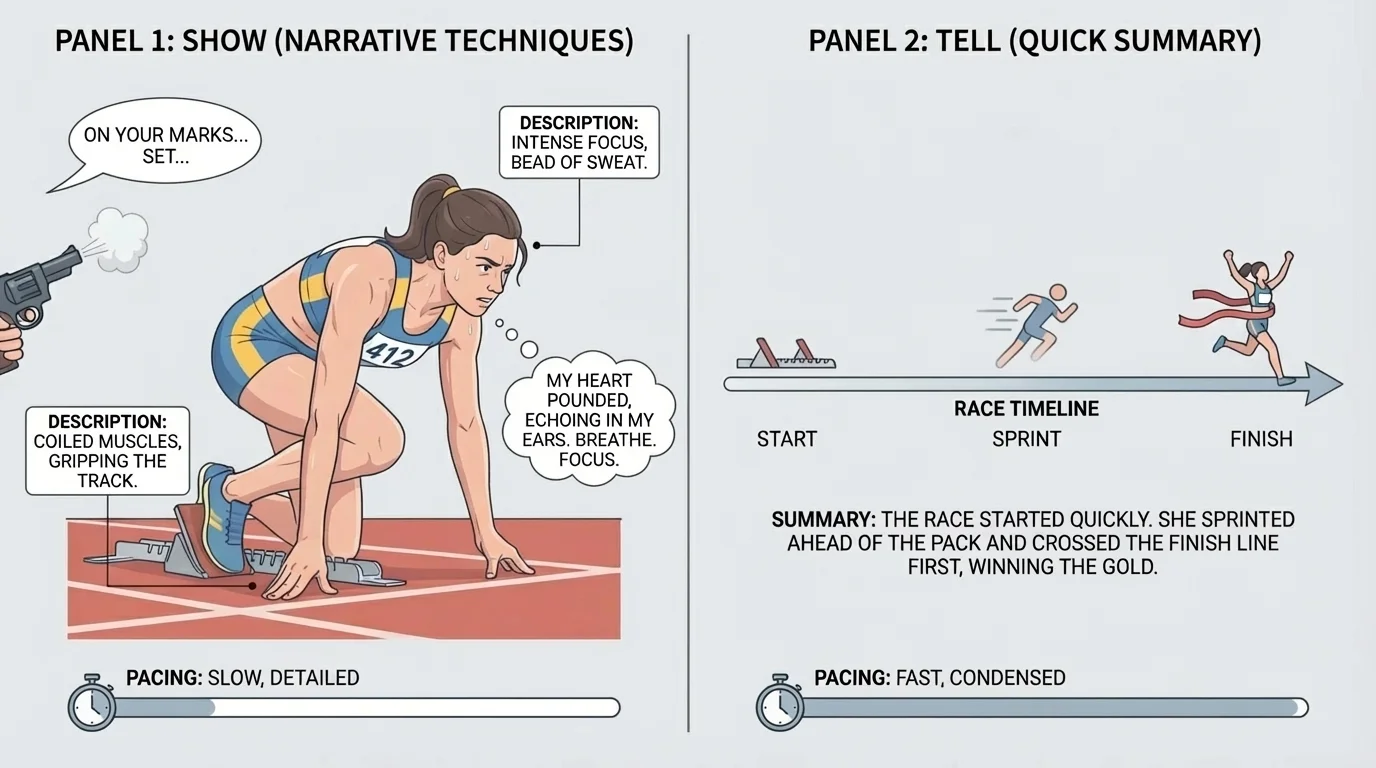
Writers often switch between scene and summary. A scene usually unfolds moment by moment, with dialogue and detailed description. A summary covers events quickly. Both are useful. A narrative with only scene may feel too slow, while a narrative with only summary may feel distant or rushed.
Pacing also affects mood. Fast pacing can create action and urgency. Slow pacing can build tension or focus attention on something meaningful. Think about a roller coaster climbing slowly before a sudden drop. Stories often work the same way.
Later in a narrative, a writer may return to the balance shown in [Figure 3] by slowing the most emotional or suspenseful moments and summarizing the parts that simply connect one big event to another.
Example: One event, two pacing choices
Fast summary: Ben hurried through the museum, checked three rooms, and finally found his class by the dinosaur exhibit.
Step 1: The writer covers several actions quickly.
The sentence moves the reader through the event without stopping.
Step 2: Slow the key moment.
Ben skidded around the corner and froze. A giant dinosaur skeleton towered above him. Under its shadow, he spotted Ms. Carter waving both arms. "Ben! Over here!"
The second version slows down the important discovery so the reader experiences it with Ben.
Writers choose pacing on purpose. They ask, "Which part should my reader feel deeply, and which part only needs to be understood?"
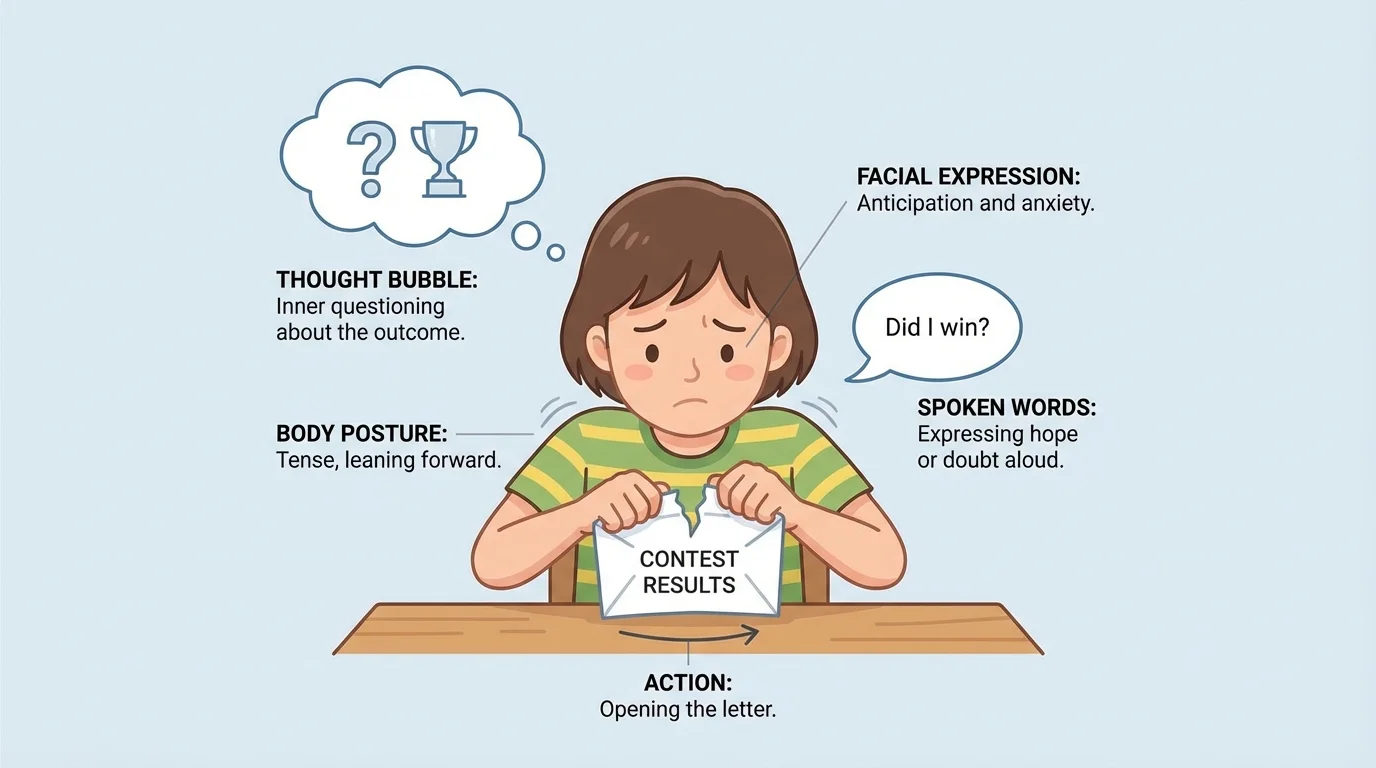
Stories become more powerful when readers can tell how a character responds to what happens. Writers can show a response in several ways: thoughts, facial expression, body language, spoken words, and action.
[Figure 4] Suppose a character opens an envelope and learns she has won a contest. A writer could simply say, "She was excited." But that gives only a basic idea. A stronger response might include a quick breath, wide eyes, a grin she cannot hide, a shouted "I did it!" and a sudden run to find her brother. The reader sees the excitement.
The same event can lead to different reactions in different characters. One student who gets called to the principal's office may feel worried. Another may feel annoyed. Another may walk in calmly because he knows he did nothing wrong. Responses reveal personality.
Body language is especially useful. Crossed arms, slumped shoulders, bouncing knees, clenched fists, and a lowered head all communicate something. Inner thoughts matter, too. A narrative may include a character thinking, Please don't let them laugh, or I can handle this. Those thoughts help readers understand what the character does next.
Characters can also have mixed responses. A student chosen for the lead role in a play might feel proud and nervous at the same time. A child moving to a new town might feel sad about leaving friends but curious about the new place. Realistic responses are not always simple.
When the response matters a lot, writers often slow the pacing and add more detail. The response pattern in [Figure 4] shows that an important situation often deserves more than one kind of reaction. A character may think something, say something, and do something all within a few seconds.
Readers understand a character best when the story includes both events and reactions. An event answers "What happened?" A reaction answers "What did that mean to the character?"
Showing responses helps readers connect emotionally to the story. It also helps explain why the next event happens. If a character feels embarrassed, she may hide. If she feels inspired, she may take action. Reactions move the plot forward.
The strongest narratives usually combine dialogue, description, and pacing instead of using each one separately. Here is a short example:
Ty's name echoed through the gym. For one second, he did not move. The polished floor seemed too bright, and the paper certificate in the principal's hand flashed under the lights. Then his best friend hissed, "Go on!" Ty stood so quickly his chair legs scraped backward. His ears burned as he walked to the front, but when the principal smiled and said, "Most Improved Musician," a laugh burst out of him before he could stop it.
This short passage uses pacing by slowing down the moment Ty hears his name. It uses description through details such as the bright floor, the flashing certificate, and the scraping chair. It uses dialogue with the friend's whispered words and the principal's announcement. Together, these details show Ty's surprise, embarrassment, and happiness.
Blending techniques helps a narrative feel complete. If the writer had used only summary, the same moment might sound like this: "Ty won an award at the assembly and felt happy." That tells the main idea, but it loses the experience.
Example: Revising a flat moment
Flat version: Kim lost the spelling bee and was disappointed.
Step 1: Add description.
The final word seemed to hang in the air while Kim stared at the stage lights.
Step 2: Add action and body language.
She pressed her lips together and folded the contest card in half.
Step 3: Add dialogue or inner thought.
"I knew that one," she whispered.
Step 4: Put the lines together with careful pacing.
The final word seemed to hang in the air while Kim stared at the stage lights. She pressed her lips together and folded the contest card in half. "I knew that one," she whispered.
The revised version lets the reader feel the disappointment instead of just hearing its name.
When writers revise, this is often what they do: they look for places where the story sounds too plain, then they add techniques that make the scene more vivid and meaningful.
One common mistake is using dialogue that sounds unnatural. Real people do not usually announce every thought clearly and formally. A line like, "I am extremely upset that you forgot my notebook at exactly 8:15 this morning," may sound stiff unless the character speaks that way on purpose. Natural dialogue is usually shorter and more believable.
Another mistake is overloading the narrative with description that does not matter. If a character is racing to catch a bus, readers probably do not need a long paragraph about every poster on the wall. Strong writers choose details that support the event or mood.
A third mistake is rushing important moments. Sometimes a story spends many sentences on setup and only one sentence on the biggest event. If the main event matters most, it often deserves slower pacing, stronger detail, and clearer responses from the characters.
Writers also need to avoid repeating the same pattern too often. If every line of dialogue is tagged in exactly the same way and every description starts with there was, the writing can feel dull. Variety in sentence structure, dialogue placement, and detail helps keep a narrative lively.
Writers make choices based on purpose. If the goal is to reveal a relationship, dialogue may be the best tool. If the goal is to create a strong setting, description may lead. If the goal is to build suspense before an important event, slow pacing may work best.
Sometimes one moment needs all three. A child stepping onto the stage for the first time may notice the hot lights, hear the crowd whispering, and think, Do not trip. A friend may whisper encouragement. The writer may stretch that short walk into a fuller scene because it matters to the character.
At other times, a writer may summarize quickly. Walking home after school every day for a month probably does not need a scene each time unless something important changes. The writer can simply say that the routine continued for weeks, then slow down the day when something unusual happens.
Good narrative writing is a series of smart choices. Writers ask what readers need to hear, see, and feel. Then they use the right technique at the right moment.
| Technique | What it does | Best used when |
|---|---|---|
| Dialogue | Reveals character, relationships, and conflict through speech | You want readers to hear what characters say and how they say it |
| Description | Creates clear images and mood with sensory details | You want readers to picture a setting or feel a moment strongly |
| Pacing | Controls how fast or slow events unfold | You want to emphasize key events or move quickly through less important ones |
| Character response | Shows thoughts, feelings, actions, and body language | You want readers to understand what an event means to a character |
Table 1. A comparison of major narrative techniques and the purposes they serve in storytelling.
As writers become more skillful, they learn not only how to use each technique, but also how to combine them smoothly. That is what helps narratives sound natural, engaging, and true to life.
"A good story does not just tell what happened. It helps the reader live it."
Whenever a writer turns a plain event into an experience, narrative techniques are doing their job.
