One small word can completely change a sentence. Compare these two ideas: "The storm was strong. We went outside." Now read: "The storm was strong; however, we went outside." That one signal word helps your brain understand the relationship between the ideas right away. Strong readers and writers do this all the time. They choose words that do more than fill space. They help explain, compare, connect, and clarify.
As you grow as a reader and writer, you need more than everyday words like good, bad, or thing. You need words that are more exact. Some of these are used in many subjects, and some belong mostly to one subject. You also need connecting words that act like bridges between ideas. When you know how these words work, you can understand harder texts and express your own thinking more clearly.
Words are tools. If you are building a birdhouse, a hammer and a paintbrush do different jobs. Language works the same way. A broad word like nice may be useful sometimes, but a more exact word such as generous, careful, or pleasant tells much more. Precise words help a reader picture what you mean.
Academic language is the kind of language often used in school, books, reports, and discussions. It helps people explain ideas carefully. When you read an article about weather, a science explanation, or a historical account, you will notice that the writer chooses words that are specific and organized. Those choices are not random. They help the reader follow the thinking.
General academic words are words that appear in many subjects and help people think, explain, and discuss ideas. Words like analyze, compare, evidence, and method are useful in reading, science, social studies, and more.
Domain-specific words are words used mostly in one subject or field. Words like photosynthesis in science, quotient in math, and legislature in social studies belong to particular domains.
If you know these types of words, you can unlock meaning faster. You can also explain your ideas with more power. Instead of saying, "The character did something bad," you might say, "The character made a selfish decision." Instead of saying, "The experiment changed," you might say, "The results varied." That is how vocabulary improves thinking.
[Figure 1] General academic words travel across many subjects. They are useful because they help you think and talk about learning itself. For example, if a teacher asks you to analyze a poem, a map, or a science result, the word analyze means you look closely and think carefully about parts and meaning. The exact topic changes, but the academic word still works.
This difference is clear: some words work in almost every classroom, while others belong mostly to one subject. A word such as compare can be used when comparing two animals, two fractions, or two historical events. A word such as habitat is much more specific. You usually see it in science when discussing where an organism lives.
Here are some examples of general academic words: observe, infer, summarize, contrast, method, and conclude. These words are important because school texts use them often. If you understand them, many assignments become easier to understand.
Domain-specific words are often the key to understanding the content of a subject. In science, you may read words like evaporation, molecule, or erosion. In math, you may meet quotient, denominator, or equation. In social studies, words such as colony, economy, or citizen carry important meanings. In literature, words like narrator, theme, and dialogue help readers discuss stories.
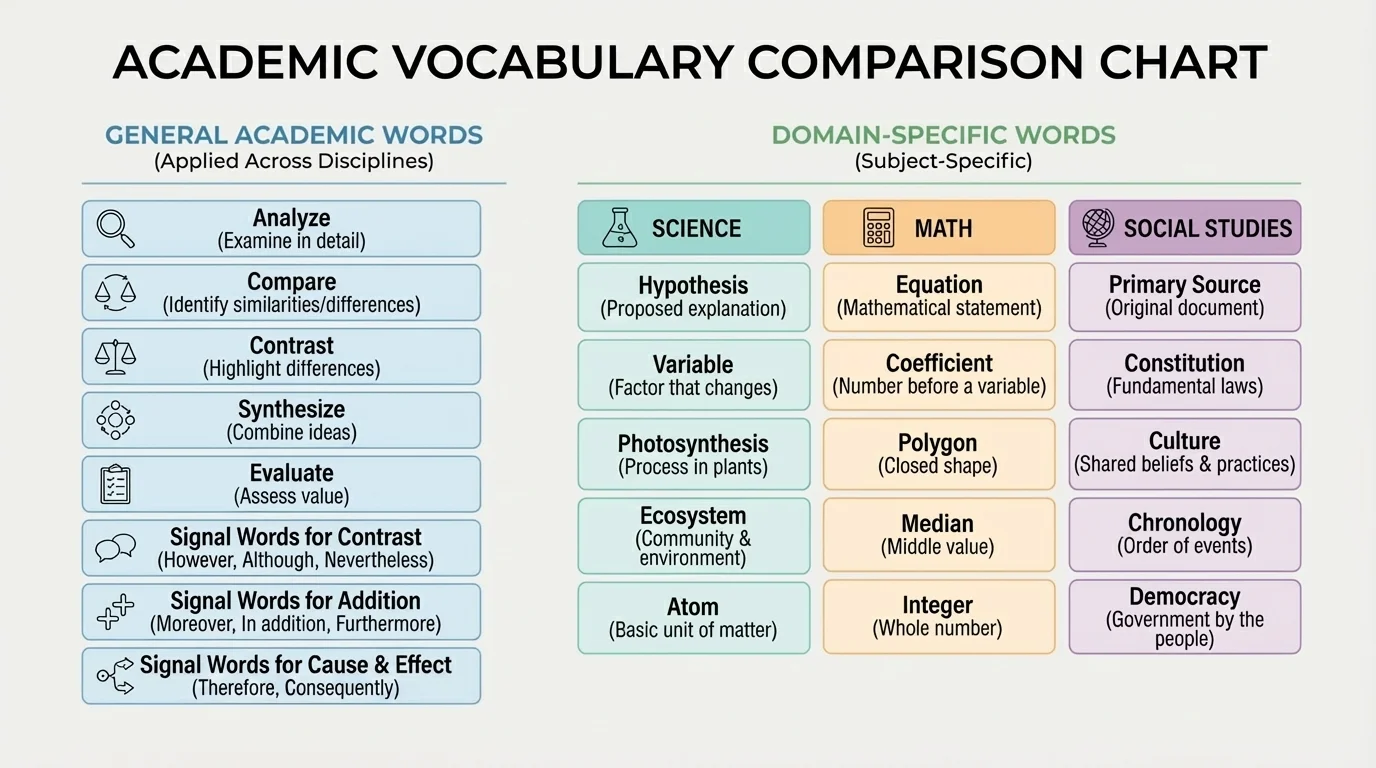
When you read, ask yourself: "Is this a word I can use in many subjects, or is it connected to one topic?" That question helps you sort vocabulary in your mind. It also helps you remember it better. Later, when you return to [Figure 1], you can see that both kinds of vocabulary matter. One helps you think across subjects, and the other helps you understand a topic deeply.
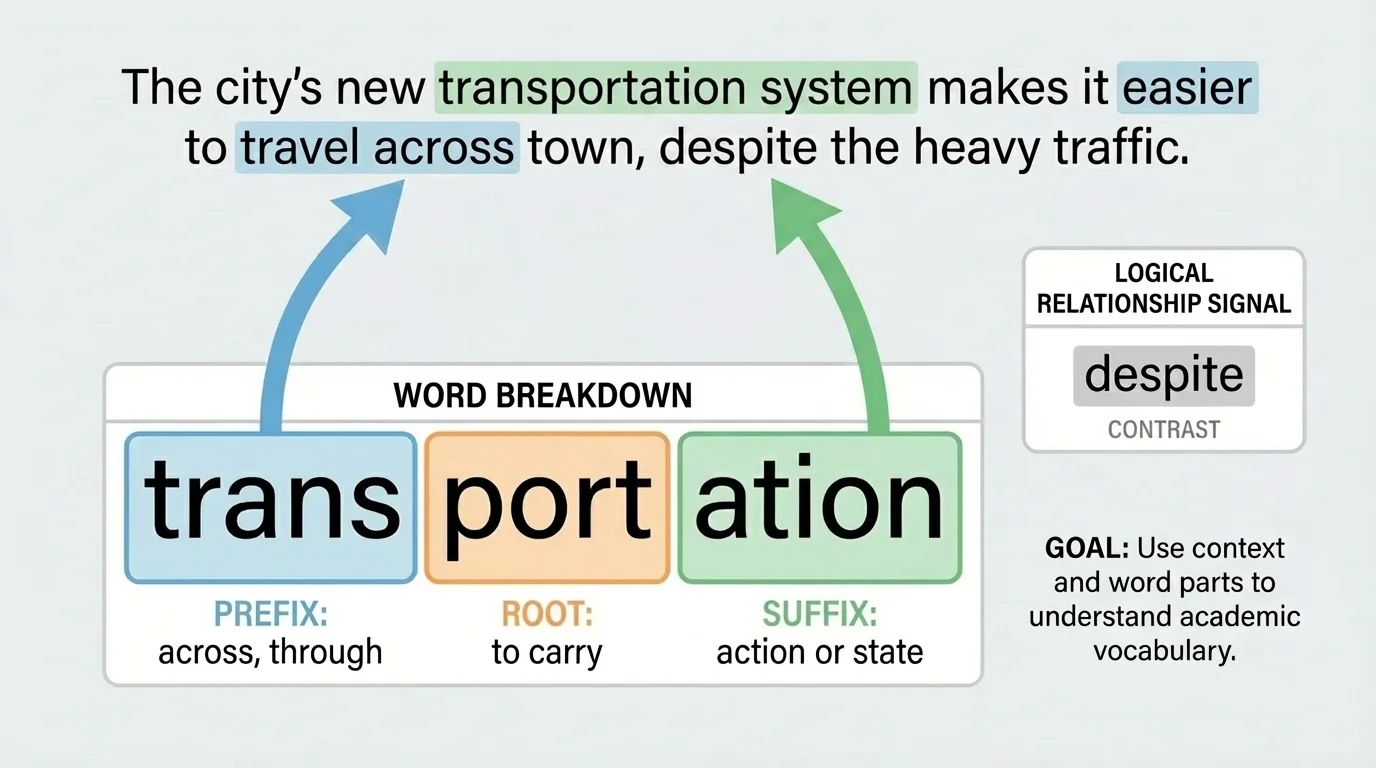
Sometimes you meet a word you do not know. Good readers do not always stop right away to ask someone else. They become word detectives. One important clue comes from context clues, which are hints in the words and sentences around an unfamiliar word. Another clue comes from morphology, the study of word parts and how they build meaning. As [Figure 2] illustrates, prefixes, roots, and suffixes can work together like puzzle pieces.
Suppose you read, "The class took transportation to the museum because the walk was too long." Even if you are unsure about transportation, the sentence suggests it has something to do with getting from one place to another. Then you can look at parts of the word. The root port means carry. The prefix trans- means across. The suffix -ation turns it into a noun. Together, the parts point toward the idea of carrying people or things across distance.
Word relationships also help. If a sentence gives an example, a synonym, an antonym, or a definition, you can use that relationship to determine meaning. Read this sentence: "The desert was arid, or very dry, for most of the year." The phrase very dry defines the unknown word. In another sentence, "Unlike the calm lake, the ocean was turbulent," the contrast helps show that turbulent means rough or stormy.
Common prefixes and suffixes are especially useful. The prefix un- often means not. The prefix re- often means again. The suffix -ful means full of, and -less means without. If you know that careful means full of care and careless means without care, you are using morphology to unlock meaning.
This skill matters in every subject. If you meet the word preview, you can notice that pre- means before. A preview is something you see before the main event. If you meet submarine, the prefix sub- means under, helping you understand that a submarine travels under water. The more word parts you know, the more powerful your reading becomes.
How word detectives think
Strong readers combine clues instead of relying on only one. They look at the sentence, the paragraph, familiar roots or affixes, and nearby examples or contrasts. When several clues point in the same direction, the meaning becomes much clearer.
Later, when you face a long science or social studies word, remember [Figure 2]. Breaking a word apart does not always give a perfect definition, but it often gives a strong starting point. Then context can help you confirm whether your guess makes sense.
[Figure 3] Signal words are words and phrases that show how ideas are connected. They act like road signs for your thinking, and the figure groups them by the kind of relationship they show. If you understand these signals, reading becomes smoother because you can tell whether the writer is adding information, showing contrast, giving an example, explaining a cause, or putting events in order.
Some signal words show contrast. These include however, although, but, on the other hand, and nevertheless. Contrast means the ideas are different or opposed in some way. In the sentence, "The trail was steep; however, the hikers continued," the word however signals that the second idea goes against what you might expect.
Other signal words show addition. These include moreover, in addition, also, besides, and furthermore. They tell the reader that more information is coming. In "The robot can sweep the floor. In addition, it can map the room," the phrase in addition adds one fact to another.
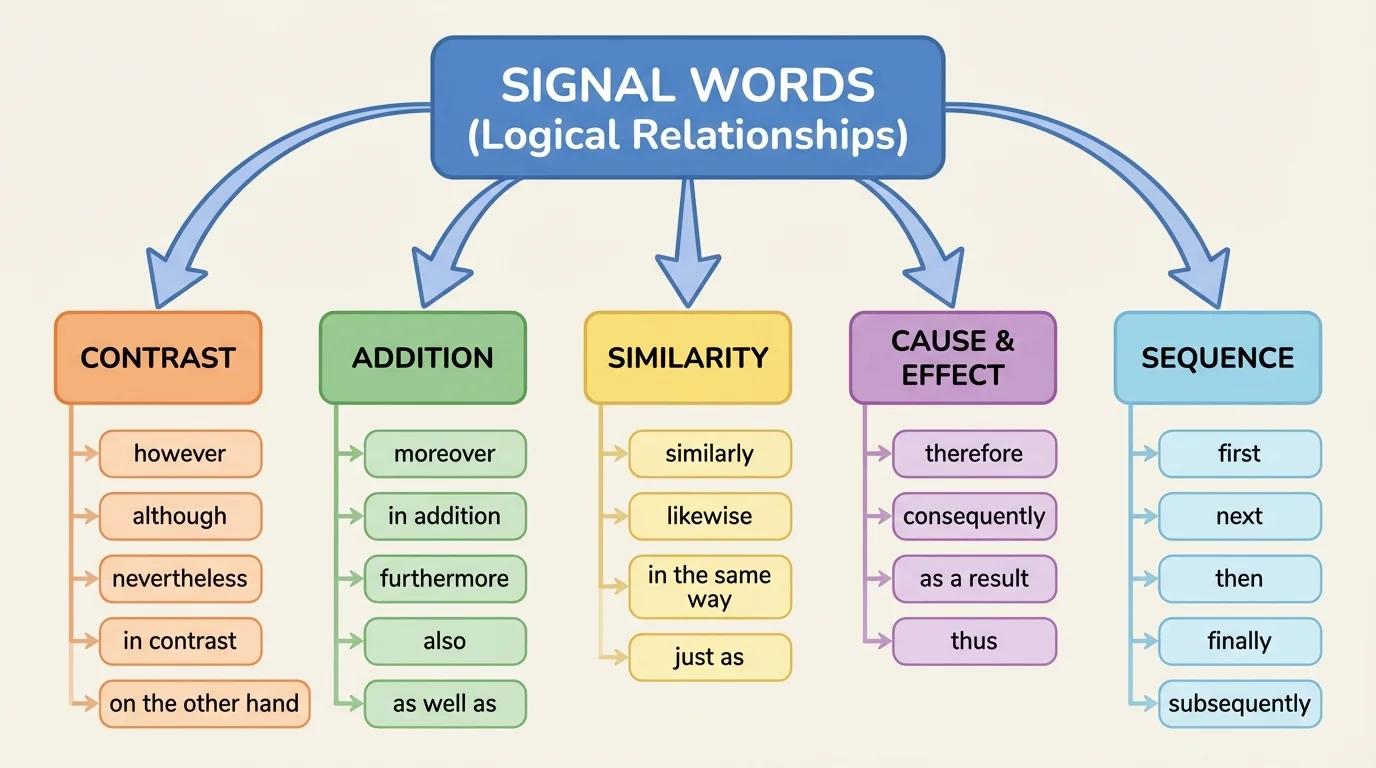
Some signal words show similarity, such as similarly, likewise, and in the same way. These help readers see that two things are alike. In "Bird wings and airplane wings both create lift; similarly, both must move through air," the signal word points to a shared idea.
Other signal words show cause and effect. Examples include because, therefore, as a result, and since. These words show that one event leads to another. Sequence words such as first, next, then, and finally show order. These are useful in instructions, science procedures, and historical events.
| Relationship | Signal Words | Example |
|---|---|---|
| Contrast | however, although, nevertheless | The rain was heavy; however, the game continued. |
| Addition | moreover, in addition, also | The book is funny. In addition, it teaches facts. |
| Similarity | similarly, likewise | Owls hunt at night; similarly, bats are active after dark. |
| Cause and effect | because, therefore, as a result | The roads were icy; therefore, school started late. |
| Sequence | first, next, then, finally | First mix the dough, then bake it. |
Table 1. Common signal words organized by the relationships they show.
These words matter in writing too. If you want your ideas to make sense, the connections between sentences must be clear. Without signal words, writing can sound choppy. With them, ideas flow. When you look back at [Figure 3], notice that each category helps answer a question: Are these ideas alike? Different? Added together? In order? Connected by cause?
Choosing the right signal word
Read the pair of ideas: "Mia studied hard. She felt nervous before the test."
Step 1: Think about the relationship.
The ideas do not show addition. They show a surprising contrast because even though Mia studied, she still felt nervous.
Step 2: Pick a signal word that fits.
Words like however, although, or nevertheless fit better than moreover or in addition.
Step 3: Rewrite clearly.
"Mia studied hard; however, she felt nervous before the test."
The signal word helps the reader understand the exact relationship between the two ideas.
A powerful writer does not choose signal words just because they sound fancy. A powerful writer chooses the one that matches the relationship exactly. That is why however and moreover are not interchangeable. One shows contrast; the other shows addition.
Strong vocabulary is not about using the longest word possible. It is about using the right word. If you say a volcano is nice, the word is too vague. If you say it is active, dangerous, or unpredictable, the reader understands much more. Good word choice reflects careful thinking.
Writers often revise to make language more precise. A first draft might say, "The dog went fast." A revised sentence might say, "The dog sprinted across the yard." The second sentence is clearer and more vivid. The word sprinted carries more meaning than went fast.
Academic words are helpful because they let you explain your thinking in a mature way. Instead of saying "I think these are the same," you might say, "I compare these ideas because both show teamwork." Instead of saying "This proves it," you might say, "This evidence supports the claim." Those choices make your speaking and writing stronger.
Some of the most powerful words in school writing are not nouns at all. Connectors such as however, therefore, and similarly can completely change how a reader understands your ideas.
When you read, pay attention to how authors use precise words. In nonfiction, exact vocabulary helps teach information. In fiction, exact vocabulary helps build mood, setting, and character. A character who murmurs sounds different from one who shouts. A sky described as gloomy feels different from one described as bright.
Each school subject has its own language. That does not mean the subjects are completely separate. It means each one has special vocabulary that helps people talk about important ideas. As [Figure 4] shows, students move from one subject to another and adjust their word choice to fit the topic.
In science, you often need precise terms because they describe real processes and structures. Instead of saying "the place an animal lives," scientists often say habitat. Instead of saying "living things in an area," they may say ecosystem. Those words are shorter, more exact, and shared by people studying science.
In math, words must also be exact. If a teacher asks for the quotient, that does not mean any number in the problem. It means the answer to a division problem. If a problem uses words like sum, difference, product, or quotient, those words tell you what operation or result is being discussed.
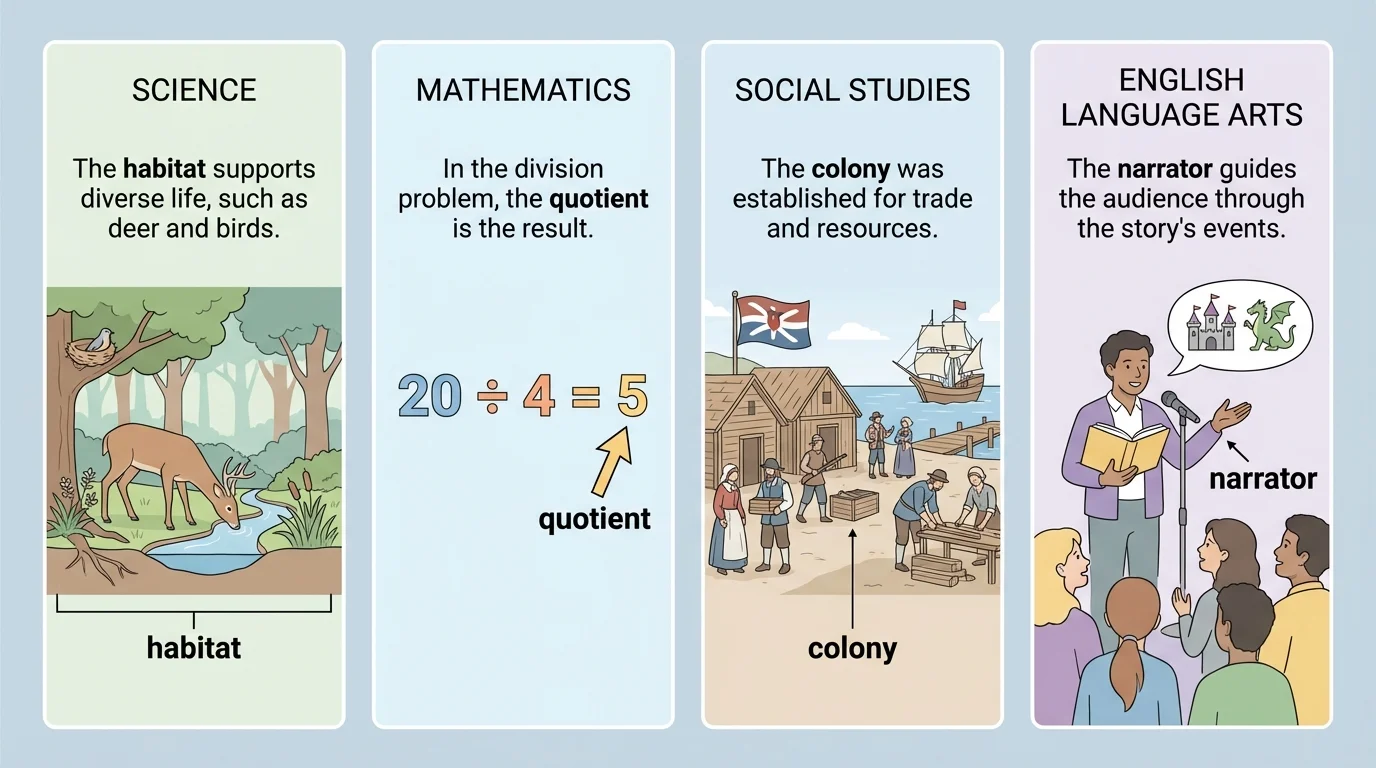
In social studies, vocabulary helps explain people, places, and systems. A colony is not just any place where people live. It has a special meaning in history. In literature, a narrator is not simply a person in a book. The narrator is the voice that tells the story. Knowing these terms helps you understand what you are reading and discuss it accurately.
When you think back to [Figure 4], notice that precise vocabulary changes with the subject, but the goal stays the same: clear meaning. Whether you are reading about animal habitats, solving for a quotient, learning about a colony, or identifying a narrator, exact language helps you learn more deeply.
One common mistake is using a word that is too general. Words like stuff, things, and good are not always wrong, but they usually do not say enough in academic writing. Specific words make your ideas easier to understand.
Another mistake is choosing the wrong signal word. For example, if two ideas are opposite, you should not connect them with moreover. That word adds information instead of showing contrast. A better choice might be however or although.
Students also sometimes assume a familiar-looking word must mean what they expect. But many words have more than one meaning. The word table can mean a piece of furniture, and it can also mean an organized chart of information. The word volume can describe loudness or the amount of space inside a solid figure. Context tells you which meaning fits.
When a word seems confusing, slow down and check three things: the sentence around it, the parts inside it, and the subject you are studying. Those three clues often work together.
It is also important not to force a "fancy" word into a sentence if you do not fully understand it. Clear writing is better than writing that sounds complicated but is inaccurate. Accuracy matters more than sounding impressive.
You build vocabulary over time. Every time you notice a useful word in a book, article, discussion, or lesson, you add another tool to your thinking. This is one reason reading often helps students become stronger writers. They meet academic words in action.
Pay attention to repeated words in school texts. If a word appears again and again, it is probably important. Ask what the word means, what subject it belongs to, and how it connects to nearby ideas. Notice signal words too. They often reveal the writer's plan.
When you speak or write, try replacing vague words with more exact ones. Try connecting ideas with clear signal words. Try using domain-specific words correctly when the subject calls for them. Over time, these choices become habits, and your communication becomes stronger, clearer, and more thoughtful.
"The difference between the almost right word and the right word is really a large matter."
— Mark Twain
The best readers and writers do not just know more words. They understand how words work together. They notice contrast, addition, examples, and cause. They use context clues, word parts, and subject knowledge. They choose words that match their meaning. That is how vocabulary turns into understanding.
