Have you ever heard two people describe the exact same game, field trip, or classroom moment in completely different ways? One person might say it was exciting. Another might say it was chaotic. Both may be telling the truth, but each person sees, remembers, and explains events from a different angle. Strong readers know how to compare these different versions and understand what each one adds.
An account is a description of an event or topic. When readers study more than one account, they are not just looking for facts. They are also noticing how each writer or speaker presents those facts. Two accounts can agree on the basic event but still sound different because the people involved have different experiences, feelings, goals, and knowledge.
For example, imagine a school assembly. A principal might describe it as a successful event that brought students together. A student might describe it as too long but funny in parts. A visitor might focus on how respectful the audience was. These accounts are about the same event, yet each one highlights different details. That is the power of point of view.
Point of view is the position or perspective from which someone describes an event or topic. It is shaped by what that person knows, feels, notices, and wants the audience to understand.
Perspective is a person's way of seeing something based on experiences and background. Bias is a leaning or preference that may affect how a person presents information.
When you compare multiple accounts, you are doing more than finding differences. You are also asking an important question: Why does each account sound the way it does? That question helps you become a thoughtful reader instead of a reader who accepts every account in exactly the same way.
You will often hear a few special terms when studying informational texts. A firsthand account is told by someone who directly experienced the event. A secondhand account is told by someone who learned about the event from others, from notes, from recordings, or from research. A secondhand account is not automatically worse. In fact, it may include a wider view because the writer gathered information from many sources.
You may also hear the word bias. Bias does not always mean someone is trying to mislead others. Sometimes people naturally focus on ideas they care about most. A coach may notice teamwork first. A photographer may notice visual details first. A scientist may notice evidence first. Bias becomes especially important when it causes a person to leave out key information or present one side unfairly.
Readers already know how to find main idea and supporting details. This skill builds on that knowledge. Now, instead of studying one text by itself, you examine how two or more texts handle the same subject.
Another useful term is emphasis. Emphasis means the parts a writer chooses to stress most. If two accounts include the same facts but focus on different details, their emphasis is different. That can change how readers understand the event.
When readers compare accounts of the same event, [Figure 1] helps organize the most important features to examine: who is speaking, what details are included, what tone is used, and what purpose the account seems to have. These clues reveal how the writer's or speaker's point of view shapes the account.
Start by asking Who is telling this? A witness, a reporter, a scientist, a fan, a leader, and a child may all describe the same event differently. Then ask What details are included? Some accounts focus on actions. Others focus on feelings, causes, or results. Next ask What words are used? The words can sound calm, excited, proud, worried, or critical. Finally ask What seems to be the purpose? Is the writer trying to inform, persuade, explain, celebrate, or warn?
It also helps to notice what is missing. If one account describes only the good results of an event and ignores the problems, that omission matters. If another account focuses only on mistakes and leaves out success, that also matters. Careful readers pay attention not only to what appears in a text but also to what the text leaves out.
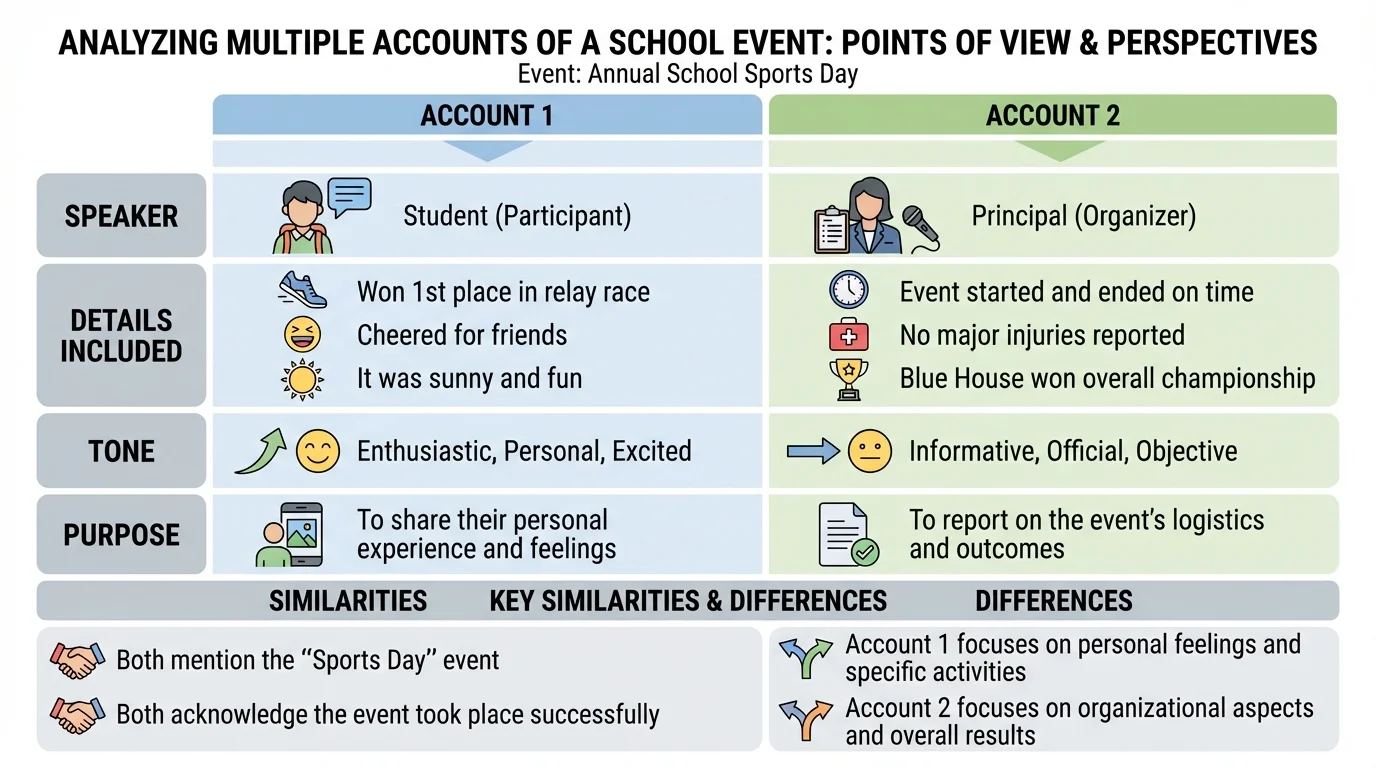
A strong comparison includes both similarities and differences. Similarities often include shared facts: the same date, place, people, or main event. Differences often appear in descriptions, opinions, importance, and tone. When students compare accounts, they should avoid saying only, "These are different." They should explain how and why they are different.
Suppose two articles are about a new city park. Both may state that the park opened in June and includes a playground and walking path. Those are similarities. But one article may focus on families enjoying the space, while the other focuses on the cost of building it. One may sound cheerful and proud; the other may sound concerned and questioning. These are differences in point of view.
Point of view is not just about whether someone likes or dislikes something. It also affects what seems most important. A parent may care about safety. A mayor may care about community improvement. A local business owner may care about whether more people visit the area. Each account gives a different window into the same topic.
Comparing facts and perspectives
Good readers separate the facts that accounts share from the perspectives that make them sound different. Shared facts answer questions like who, what, when, and where. Perspectives shape which facts get the most attention and how those facts are explained.
As you read, try making mental categories: same event, same facts, different focus, and different tone. This habit helps you stay organized and keeps you from confusing disagreement with dishonesty. Sometimes writers simply care about different parts of the same story.
A key difference between accounts often involves whether they are firsthand or secondhand. As [Figure 2] shows, a person who experiences an event directly and a person who reports on it later do not have the same relationship to the information. That difference changes what the account can include.
A firsthand account may include vivid details such as sights, sounds, feelings, and immediate reactions. For example, "I heard the dog barking near the river and saw a firefighter climb down the bank." This kind of account can feel personal and powerful. However, it may also be limited because one person only sees one part of the whole event.
A secondhand account may sound more distant, but it can bring together many pieces of information. For example, a news article might include interviews, a timeline, and facts from officials. It may not capture one person's emotions as strongly, but it may explain the event more completely. Later in the lesson, the playground example connects back to this same idea with a witness and a reporter working from different kinds of information.
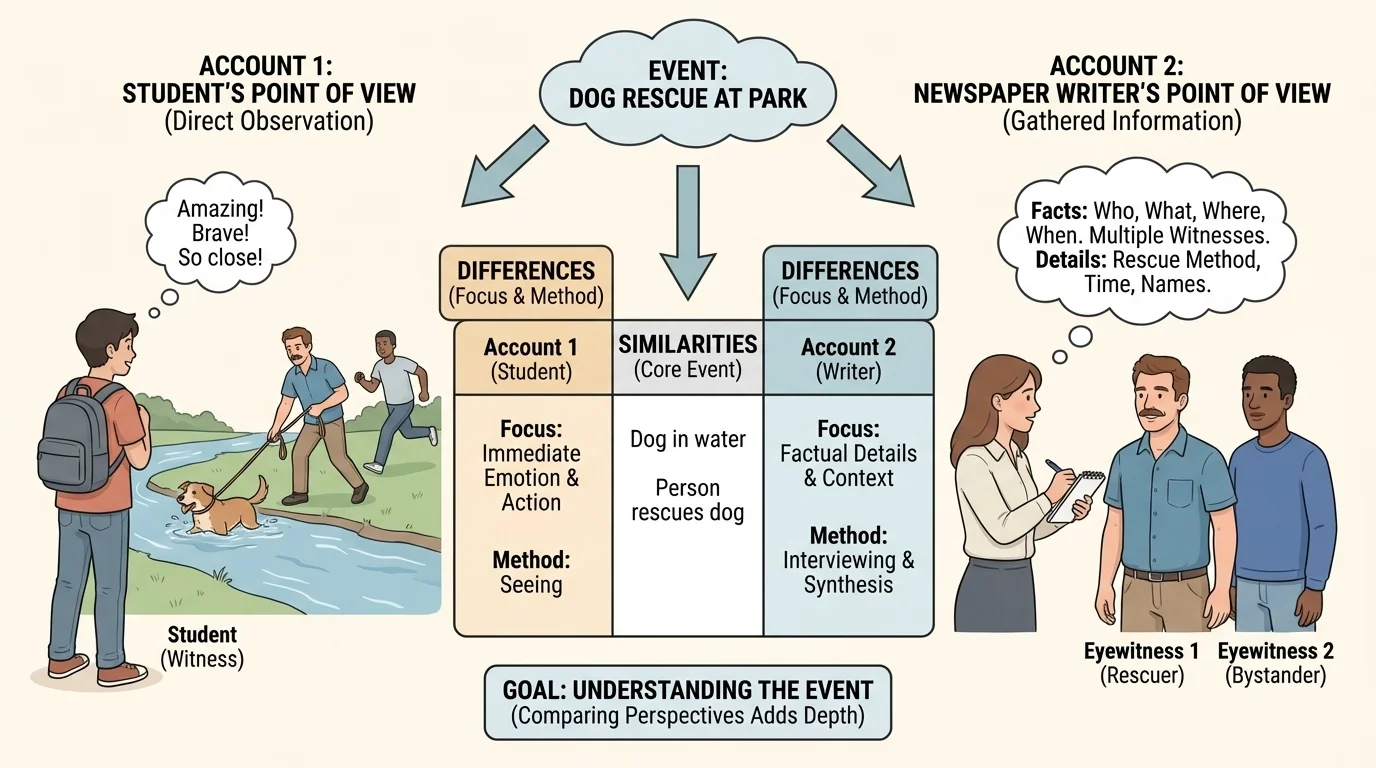
Neither type is always better. A smart reader asks what each type does well. A firsthand account gives direct experience. A secondhand account often gives broader context. When both are available, reading both can give a stronger understanding than reading only one.
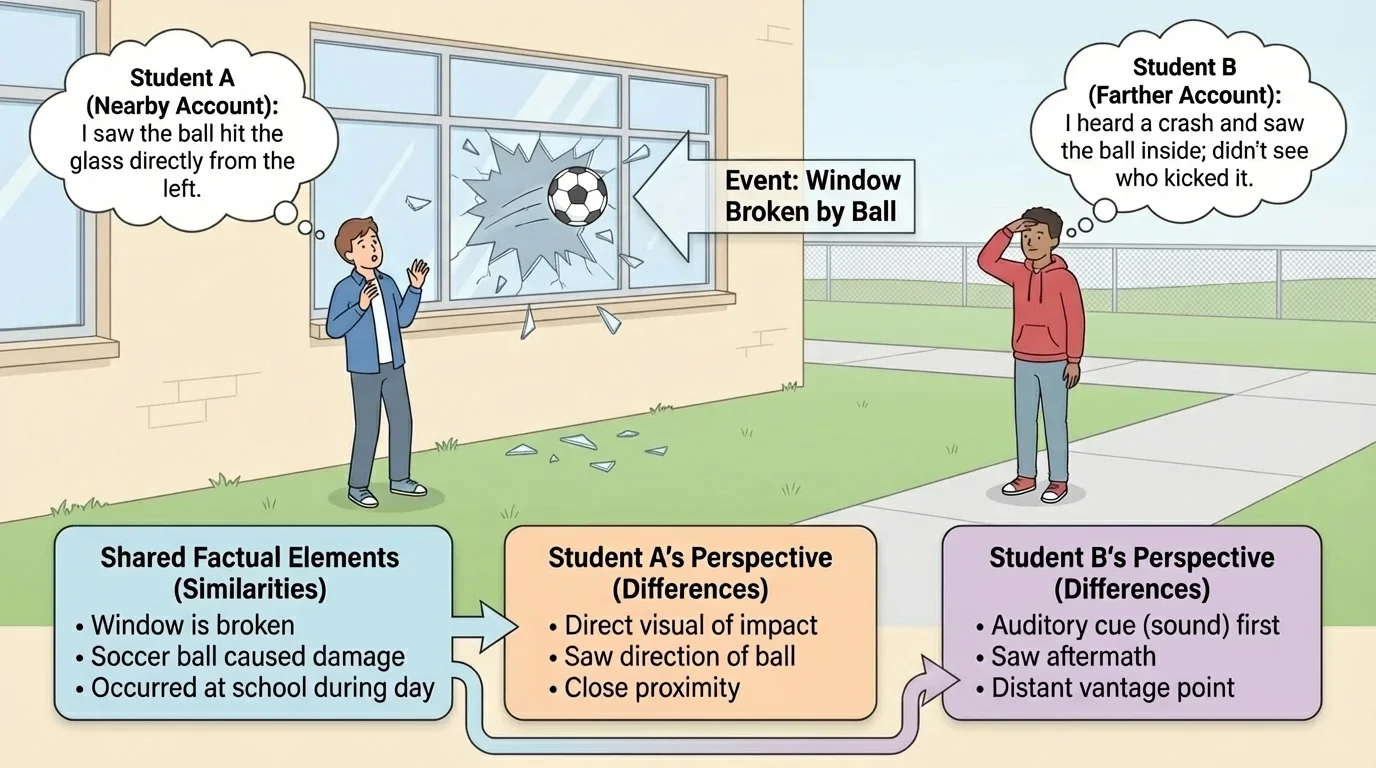
Consider a playground accident in which a soccer ball breaks a classroom window. One student stands close to the kick while another watches from farther away. These two students might describe the same event in different ways because they notice different details and may feel differently about what happened.
Student A says, "Marco kicked the ball too hard during recess, and everyone yelled when it hit the window." Student B says, "We were passing the ball, and it bounced off someone's shoe before it hit the window." Both agree that the window broke during recess because of the soccer ball. But Student A emphasizes Marco's strong kick, while Student B emphasizes that the hit may have been accidental. Their point of view changes the story's focus.
Now think about history. One text about a famous march might focus on the leaders who organized it. Another might focus on the children and families who attended. A photograph, a speech, and a textbook paragraph may all describe the same event but represent it differently. Historical understanding becomes stronger when readers compare these accounts rather than depending on only one.
Science texts can also present different accounts of the same topic. One article about wolves returning to a national park may explain how wolves affect the food chain. Another may focus on how ranchers feel about livestock safety. Both are about wolves, but one uses an ecological point of view and the other uses an economic or community point of view. The topic is the same, yet the emphasis is different.
Case study: A storm in the town
Read these two short account ideas: one from a child who lived through the storm and one from a weather report written later.
Step 1: Find the shared facts.
Both accounts may say the storm began in the evening, strong wind knocked down branches, and the power went out for several hours.
Step 2: Find the differences in point of view.
The child may focus on fear, loud noises, and using flashlights. The weather report may focus on wind speed, damage, and safety instructions.
Step 3: Explain why the accounts differ.
The child experienced the storm personally, while the weather report aims to inform the public using collected facts.
A strong comparison names both the similar facts and the different perspectives.
Notice that this kind of reading is like putting together pieces of a puzzle. One account gives one part. Another account gives another part. When you compare them carefully, the full picture becomes clearer.
Even when two accounts include almost the same facts, the words they choose can shape meaning. [Figure 4] displays how different word choices can make the same event sound positive, neutral, or negative. This is sometimes called tone, the writer's attitude toward the subject.
For example, one account might say a crowd was "cheering loudly." Another might say the crowd was "shouting wildly." Both could describe the same sound level, but the feeling is different. "Cheering" sounds positive. "Wildly" sounds less controlled. These choices influence how readers picture the event.
Writers also use words that frame a person or action in a certain way. A player may be described as "confident" or "arrogant." A decision may be called "careful" or "slow." These are not small changes. They guide the reader's judgment. When you compare accounts, pay close attention to these differences because they reveal point of view.
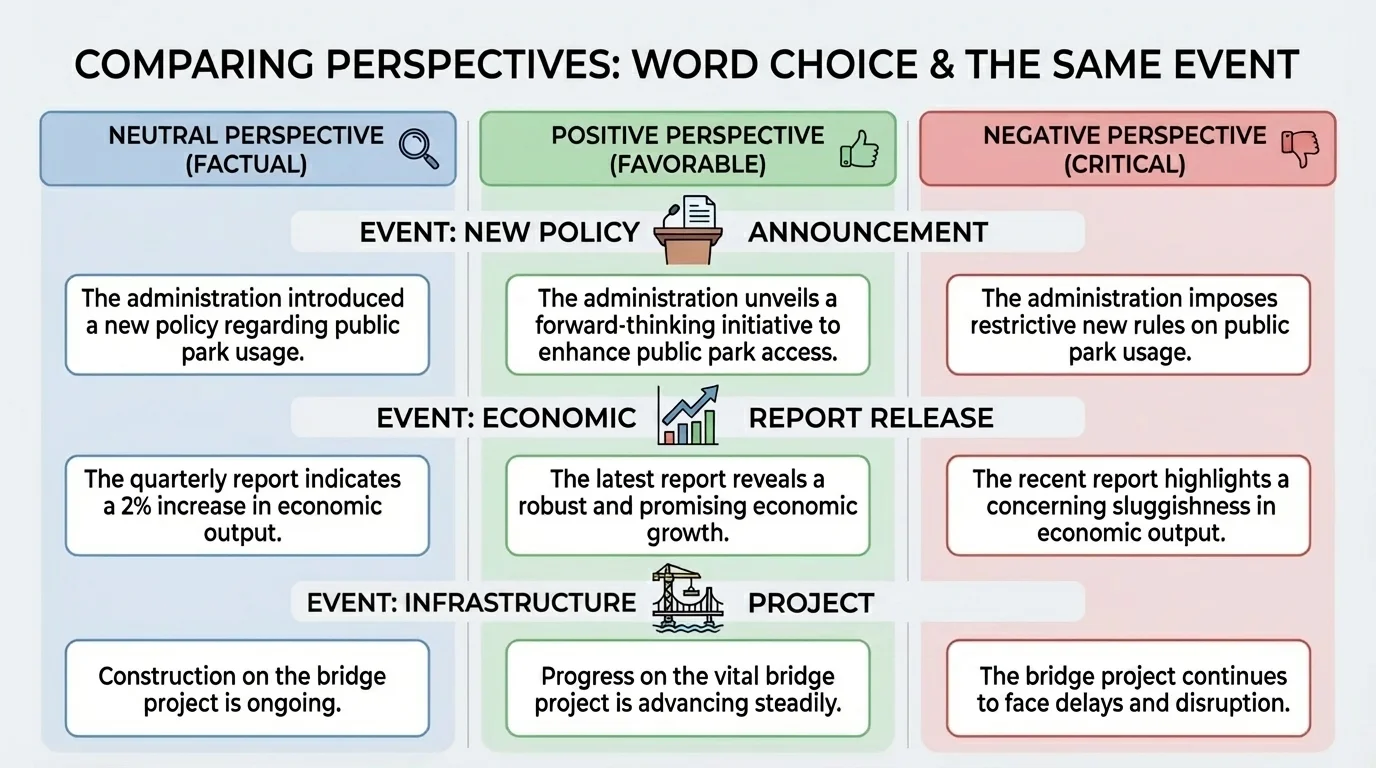
Later, when you compare historical speeches, news reports, or science articles, this same idea still matters. The contrast in description works the same way: the facts may stay similar while the language shifts the reader's understanding.
Professional historians often study diaries, letters, newspaper reports, photographs, and official records together because no single source tells the whole story.
That is why readers should not only ask, "What happened?" They should also ask, "How is the writer making me feel about what happened?"
Strong readers act like investigators. They gather clues from each account and compare them. One helpful method is to ask a series of questions: Who created this account? When was it created? Why was it created? What details are included? What details are missing? What attitude does the writer seem to have?
You can also compare the structure of texts. One account may tell events in time order. Another may explain causes and effects. Another may answer questions and provide evidence. Different structures can influence which details stand out most. A timeline-style account may focus on sequence, while a cause-and-effect account may focus on reasons and results.
| Question to Ask | What It Helps You Notice |
|---|---|
| Who is telling this account? | The speaker's relationship to the event or topic |
| What details are included? | What the writer thinks is important |
| What words stand out? | Tone and attitude |
| What is the purpose? | Whether the account informs, explains, or persuades |
| What is missing? | Possible limits or bias in the account |
Table 1. Questions readers can use to compare accounts of the same event or topic.
When students use these questions regularly, they become better at noticing subtle differences. That matters in school, but it also matters outside school when people read articles, watch videos, or listen to people discuss current events.
Sometimes accounts do not just sound different. Sometimes they conflict. One witness says the event started at one time; another says it started later. One article blames one cause; another article gives a different cause. When this happens, careful readers do not panic. They look for evidence.
Ask which account gives the strongest support. Does the writer include direct quotes, records, observations, photographs, or expert information? Is the source close to the event? Is the account trying to inform fairly, or does it seem to push one side only? A difference between accounts is not a reason to quit reading. It is a reason to read more closely.
Conflicting details do not always mean one source is useless
People can remember events imperfectly, see different parts of the same moment, or have access to different information. Comparing accounts helps readers test ideas, check evidence, and build a more accurate understanding.
Sometimes the truth is that an event is complicated. A careful comparison can reveal that one source is strongest for personal experience, while another is strongest for dates and data. Good readers learn to use both wisely.
Comparing accounts is useful in many parts of life. In history, it helps readers understand that events looked different to different groups of people. In science, it helps readers compare findings, explanations, and viewpoints about real-world issues. In daily life, it helps people judge news, stories, and online information more thoughtfully.
If you only read one account, you may get a narrow view. If you compare several accounts, you are more likely to notice what is shared, what is debated, and what each source adds. This makes you a stronger reader, a stronger thinker, and a more careful learner.
By paying attention to speaker, evidence, emphasis, tone, and purpose, you learn to understand not just the event itself but also the people describing it. That is the heart of analyzing multiple accounts: seeing both the story and the storyteller.
