Have you ever wondered why one article about animals, weather, or space never seems to tell the whole story? One text might explain the basic facts, another might add surprising details, and a third might give examples from the real world. Strong readers do not stop at one source. They put ideas together from several texts so they can understand a topic more fully and explain it clearly.
When you integrate information, you do more than collect facts. You connect ideas from different texts, notice patterns, compare what each author says, and build a bigger picture in your mind. This helps you become a more thoughtful reader, writer, and speaker.
A single text may be useful, but it always has limits. An author chooses what to include, what to leave out, and how to explain the topic. If you read only one source about volcanoes, for example, you may learn what a volcano is, but you may miss information about famous eruptions, safety steps, or how scientists study volcanic activity.
Reading multiple texts helps you do several important things. You can confirm facts that appear in more than one source. You can add new details that one text includes and another does not. You can also notice differences in how authors explain the same subject. This leads to a deeper, stronger understanding.
Suppose you read three texts about bees. One explains how bees pollinate flowers. Another explains the jobs of worker bees and the queen. A third focuses on why bee populations are declining. If you combine ideas from all three, you can talk about bees in a much more informed way than if you used only one text.
Several key ideas work together in this skill. A source is the text, article, book, chart, or video transcript where information comes from. A topic is the subject all the texts are about. The central idea is the most important point a text teaches about that topic. Evidence includes facts, examples, quotations, or details that support an idea. Synthesis means putting ideas from different sources together into one clear understanding.
When you integrate information well, you are not just reading more. You are reading smarter. You are asking, "How do these texts fit together?" and "What do I know now that I could not have learned from only one source?"
You will often see a source named in research, reports, and nonfiction reading. A source might be a science article, a biography, a website from a museum, or even a diagram with labels. Different sources may give different kinds of information, so it helps to think about what each one contributes.
The shared topic is what holds the texts together. If one text is about hurricanes and another is about tornadoes, they may both connect to weather, but they are not exactly the same topic. To integrate information well, you need texts that connect closely enough to compare and combine.
Each text also has a central idea. One text about recycling might mainly explain why recycling matters, while another might mainly explain how recycling systems work. These are related, but not identical. Recognizing the central idea helps you understand each text before trying to combine them.
Authors support ideas with evidence. Evidence can include facts, examples, expert statements, data, and descriptions. When you combine information from several texts, you should pay attention to which details are important and which details are just extra.
Finally, good readers think about credibility. Credibility means how trustworthy a source seems. A national park website, a science magazine for kids, and a textbook are often more reliable than a random online post with no author listed.
When you find the main idea of one text, you are already doing part of the work. Integrating information builds on that skill. First understand each text on its own, and then connect the texts together.
If you skip that first step, you may mix details together without really understanding where they came from or why they matter.
There is a clear process for this skill. Readers begin by identifying the shared topic and then sorting what is the same and what is different across texts, as [Figure 1] shows. This keeps the reading organized and helps important ideas stand out.
Step 1: Read each text carefully. Do not rush to combine them before you understand them separately. Ask yourself: What is this text mostly about? What are the most important details?
Step 2: Name the shared topic. Maybe all the texts are about earthquakes, the water cycle, or the Underground Railroad. Be specific.
Step 3: Identify each text's central idea and key details. You may underline, highlight, or write notes in a chart.
Step 4: Compare the texts. Which details appear in more than one source? Which source adds something new? Which ideas seem different?
Step 5: Combine the information into a new understanding. This is the moment when you truly synthesize. You are not copying one author. You are building your own explanation based on several texts.
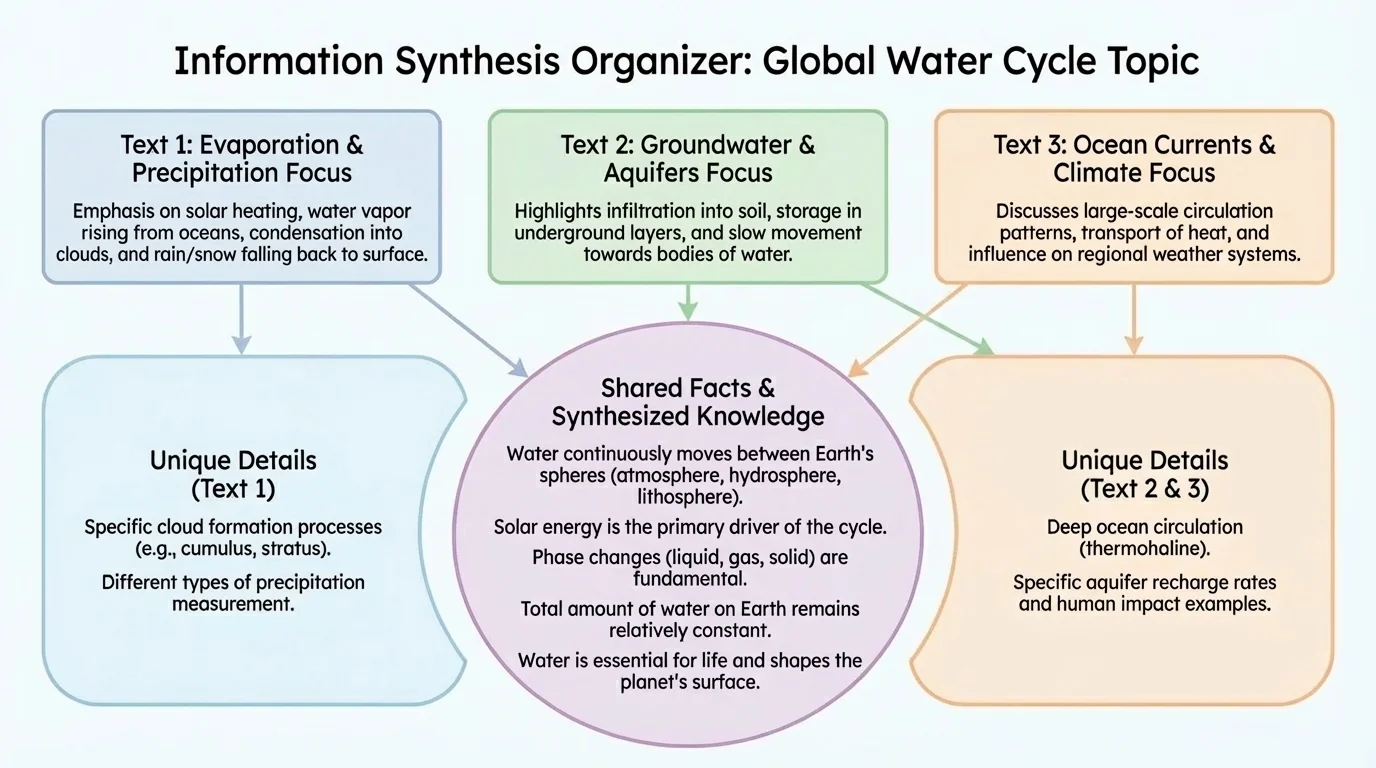
A simple organizer can help. You might make columns labeled Text 1, Text 2, and Text 3. Then list the central idea, key details, and special facts from each source. After that, add a final section called "What I know from all the texts." That final section is where integrated understanding appears.
Readers often discover that one text gives broad background, another gives close-up details, and another provides real examples. Together, these create a fuller explanation than any single text could give.
Let's see how this works with a real example. A reader studies three texts about sea turtles and organizes the information by category, as [Figure 2] illustrates. The categories are habitat, dangers, and ways people protect sea turtles.
Text 1 explains that sea turtles live in oceans around the world and return to beaches to lay eggs. Its main job is to give basic background information.
Text 2 focuses on dangers. It explains that sea turtles can be harmed by plastic trash, fishing nets, and loss of nesting beaches.
Text 3 describes protection efforts. It tells how volunteers guard nests, reduce beach lights, and help injured turtles recover.
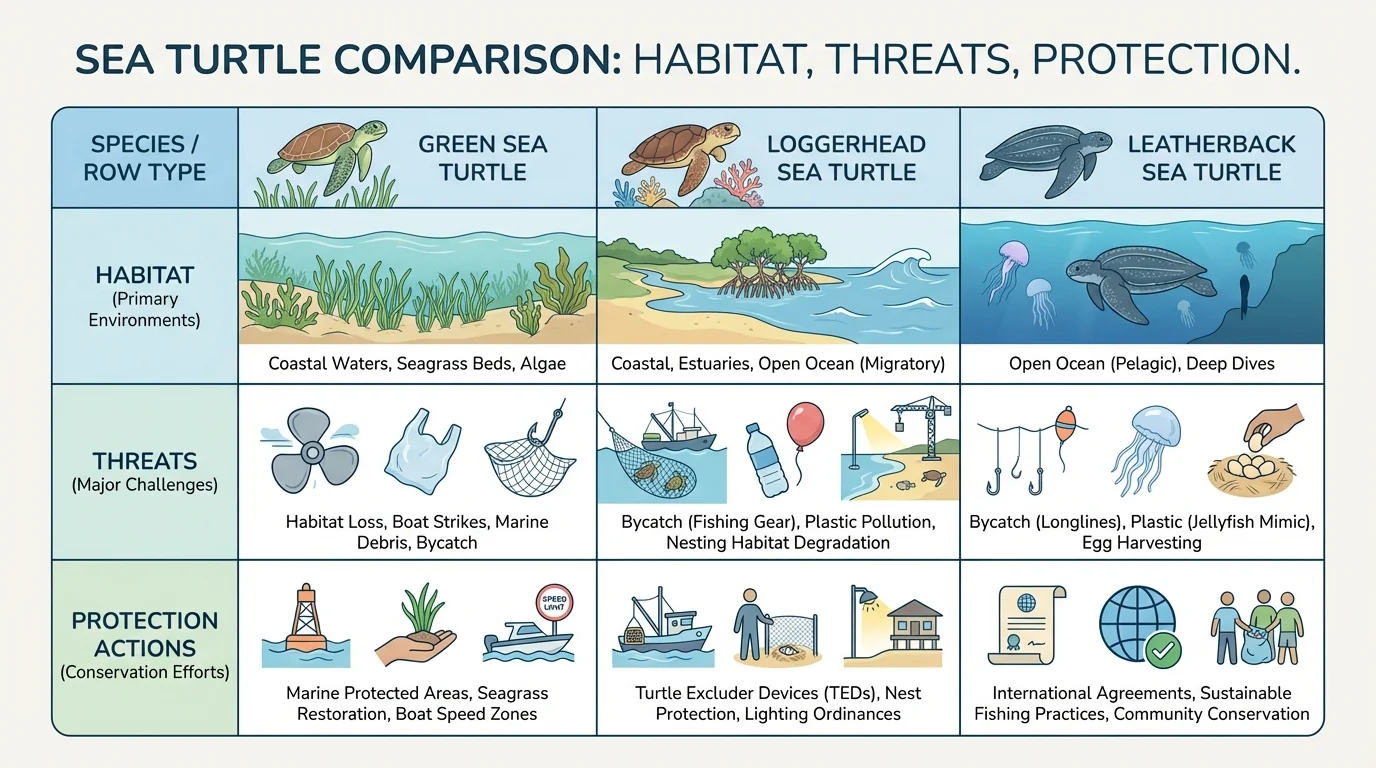
If a student used only Text 1, the student could explain where sea turtles live. If the student used only Text 2, the student could explain the dangers. But by combining all three, the student can say something much stronger: sea turtles live in many oceans, face serious threats from human activity, and can be helped through conservation efforts.
Integrated response from the three sea turtle texts
Step 1: Identify shared topic
All three texts are about sea turtles.
Step 2: Pull key ideas from each source
One text gives habitat information, one explains threats, and one describes protection.
Step 3: Combine the ideas
Sea turtles live in oceans worldwide and return to beaches to nest. They are threatened by plastic, fishing gear, and changes to beaches, but people can help by protecting nests and cleaning habitats.
This final statement is stronger than a summary of just one text because it blends important information from all three sources.
That is what knowledgeable speaking and writing sound like. The student understands the subject from more than one angle.
Not every source does the same job. Sometimes two texts agree. For example, both might say that bats are important because they eat insects. When texts agree, that repeated information often becomes more trustworthy.
Sometimes a source adds on to another source. One article may explain that bats are mammals, while another adds that some bats also pollinate plants. These details do not fight each other. They simply build a larger picture.
Sometimes texts seem to contradict, or disagree. One text may say a certain animal is active mostly at night, while another says it is active at dawn and dusk. When that happens, do not panic. Look closely. Are the texts talking about different species? Different places? Different times of year? Careful readers investigate before deciding that one source must be wrong.
When you notice differences, ask smart questions: Which source is newer? Which source gives stronger evidence? Which source sounds more exact and carefully explained? This is one reason credibility matters.
Scientists often read many sources on the same topic before making conclusions. Even experts do not rely on a single text when they want accurate understanding.
As with the organizer in [Figure 1], comparing agreement, new details, and differences helps readers avoid confusion and build a balanced understanding.
When you integrate information, not every detail should be treated equally. Some evidence is stronger because it is specific, accurate, and closely connected to the topic. "Many forests are in danger" is vague. "Some forests are shrinking because of fires, drought, and logging" is clearer and more useful.
Trustworthy sources usually have clear authors, careful facts, and information that can be checked. A zoo website about panda habitats may be more reliable than a social media post with no source named. This does not mean every website is bad or every book is perfect. It means readers should think carefully about where information comes from.
Author purpose matters too. One author may want to inform. Another may want to persuade. Another may want to entertain. If you know the author's purpose, you can better understand why certain details are included.
| Question | Why it matters |
|---|---|
| Who wrote this? | Knowing the author helps you judge expertise. |
| What is the source? | Books, museum sites, and educational articles may be more dependable. |
| When was it published? | Newer information may be important for science or current events. |
| What evidence is given? | Strong details support stronger understanding. |
| Does it match other sources? | Repeated facts across texts are often more believable. |
Table 1. Questions readers can ask to evaluate sources and evidence.
Using strong evidence does not mean using every detail. It means choosing the details that most clearly support the ideas you want to explain.
Good note-taking makes integration much easier. If your notes are messy, your thinking may become messy too. Try organizing by categories instead of by text alone. For a topic like weather, categories might be causes, effects, safety, and examples.
This method helps you see connections quickly. If Text 1 and Text 3 both explain causes, you can place those ideas in the same category and compare them. If Text 2 focuses on effects, you can add those details where they belong.
You can also use sentence starters in your notes, such as All texts say..., One source adds..., and The texts differ because... These note stems prepare you for writing and speaking later.
From collecting to connecting
Many students stop after collecting facts. True integration happens when you connect facts into patterns and ideas. Instead of listing, "Text 1 says this. Text 2 says this. Text 3 says this," a stronger reader asks, "What do these sources together teach me?"
That shift from collecting to connecting is what makes your explanation sound informed instead of scattered.
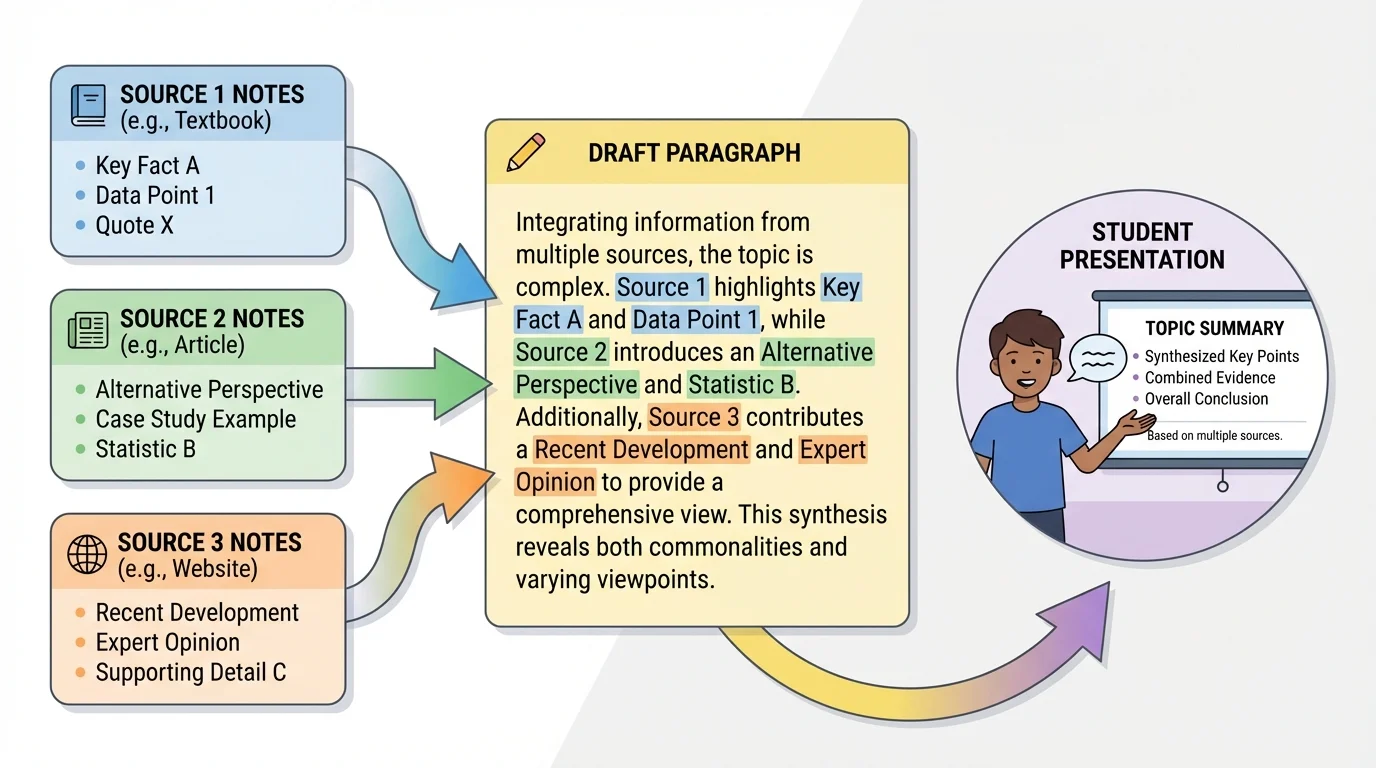
Once notes are organized, you can turn them into a clear paragraph or short talk, as [Figure 3] shows. The goal is to explain the topic in your own words using ideas learned from several texts.
A strong response usually begins with the topic and a main idea. Then it adds combined evidence from more than one source. Finally, it explains what all those details show together.
Here is a weak response: "One text says sharks have skeletons made of cartilage. Another text says some sharks migrate. Another text says sharks are predators." This response lists information, but it does not connect the ideas.
Here is a stronger response: "The texts show that sharks are highly adapted ocean predators. One source explains their cartilage skeletons, another describes long migrations, and a third explains how they hunt. Together, the texts show how shark bodies and behaviors help them survive."
Notice the difference. The stronger response combines ideas into a meaningful whole. It does not just stack facts on top of each other.
How to build a knowledgeable paragraph
Step 1: Start with the topic and main idea
Example: "Several texts explain that rain forests are important ecosystems with rich biodiversity."
Step 2: Add evidence from different sources
Example: "One source describes the many layers of the forest, another explains how animals depend on those layers, and a third shows how deforestation harms the habitat."
Step 3: End with a combined understanding
Example: "Taken together, the texts show that rain forests support many living things and need protection."
This kind of paragraph sounds knowledgeable because it is based on integrated information.
When speaking, the same idea applies. You can say, "According to several sources," or "The texts together show..." These phrases remind listeners that your ideas come from combined reading.
Later, when you build a report from notes, the sequence in [Figure 3] stays useful: gather, group, connect, and explain.
One common mistake is copying instead of combining. If you repeat one text almost word for word, you are not integrating information.
Another mistake is listing details without explaining how they connect. A pile of facts is not the same as understanding.
A third mistake is using weak or unrelated details. If the topic is desert animals, a long note about the history of a desert city may not belong unless it truly supports the main explanation.
Some students also forget to notice important differences among texts. But differences matter. They help you ask better questions, choose stronger evidence, and avoid oversimplifying the topic.
As the sea turtle chart in [Figure 2] demonstrates, organizing details by category helps you avoid mixing up which facts are about habitat, which are about threats, and which are about protection.
"The more ways you look at a topic, the more clearly you can understand it."
That idea is at the heart of reading across texts. Strong readers gather information from several places, think carefully about what fits together, and then create a clear explanation that shows real understanding.
