Have you ever noticed that two people can walk into the same place and react in very different ways? One person may feel excited, while another feels nervous. Stories work the same way. Authors often place different characters in the same situation, or similar characters in very different situations, so readers can notice important patterns. When you compare and contrast story elements, you are doing more than spotting what is the same and what is different. You are figuring out why those similarities and differences matter.
Strong readers pay attention to connections. They notice when one character is brave while another is cautious. They notice when a forest feels mysterious but a school hallway feels busy and loud. They notice when one event solves a problem and another event creates a new one. These comparisons help readers understand the author's message, the characters' choices, and the structure of the story or drama.
In a drama, comparison is especially important because readers and viewers learn a lot from dialogue, stage directions, and interactions. In a story, readers may learn from narration, description, and actions. In both forms, details matter. A good comparison is not based on guessing. It is based on what the text actually shows.
Compare means to tell how two or more things are alike. Contrast means to tell how they are different. Specific details are exact clues from the text, such as what a character says, does, thinks, or feels, and what the setting or events are like.
When you compare and contrast well, you move past simple statements like "They are different" or "Both are nice." Instead, you explain the details. For example, saying that two characters are different is weak. Saying that one character speaks kindly to others while the other interrupts and complains is much stronger because it uses evidence from the text.
To compare and contrast, you need to look closely at at least two story elements. These elements might be characters, settings, events, or even the ways problems are solved. Readers ask questions such as: What does each character want? How does each setting feel? What causes each event? What changes after each event?
A comparison can focus on similarities, differences, or both. Often, the best thinking includes both. If two characters are both determined, that is important. If one uses patience and the other uses force, that difference is important too. Looking at both sides gives a fuller understanding.
Remember that a story element is a part of a literary text, such as characters, setting, plot, conflict, or theme. Comparing and contrasting works best when you study how these elements connect instead of looking at each one alone.
Readers should also be careful not to confuse comparing with summarizing. A summary retells what happened. A comparison explains relationships. If you only retell events in order, you are not yet analyzing. Analysis means looking at details and explaining what those details show.
Characters are often the easiest place to begin. A character trait is a quality that describes a character, such as generous, stubborn, honest, or curious. Readers can compare characters by studying their traits, goals, problems, choices, and relationships. A visual organizer helps readers sort these details into clear categories instead of mixing everything together.
[Figure 1] When you compare characters, look at what they say, what they do, what they think, and how other characters respond to them. These clues help you decide what each character is really like. Sometimes two characters seem similar at first, but their actions reveal important differences.
Suppose a story has two brothers, Mateo and Luis, who both enter a school science fair. Mateo carefully tests his project three times before presenting it. Luis rushes to finish his project the night before. Both boys want to win, so they are similar in their determination. But they are different in how they work. Mateo is prepared and patient, while Luis is impulsive and hurried.
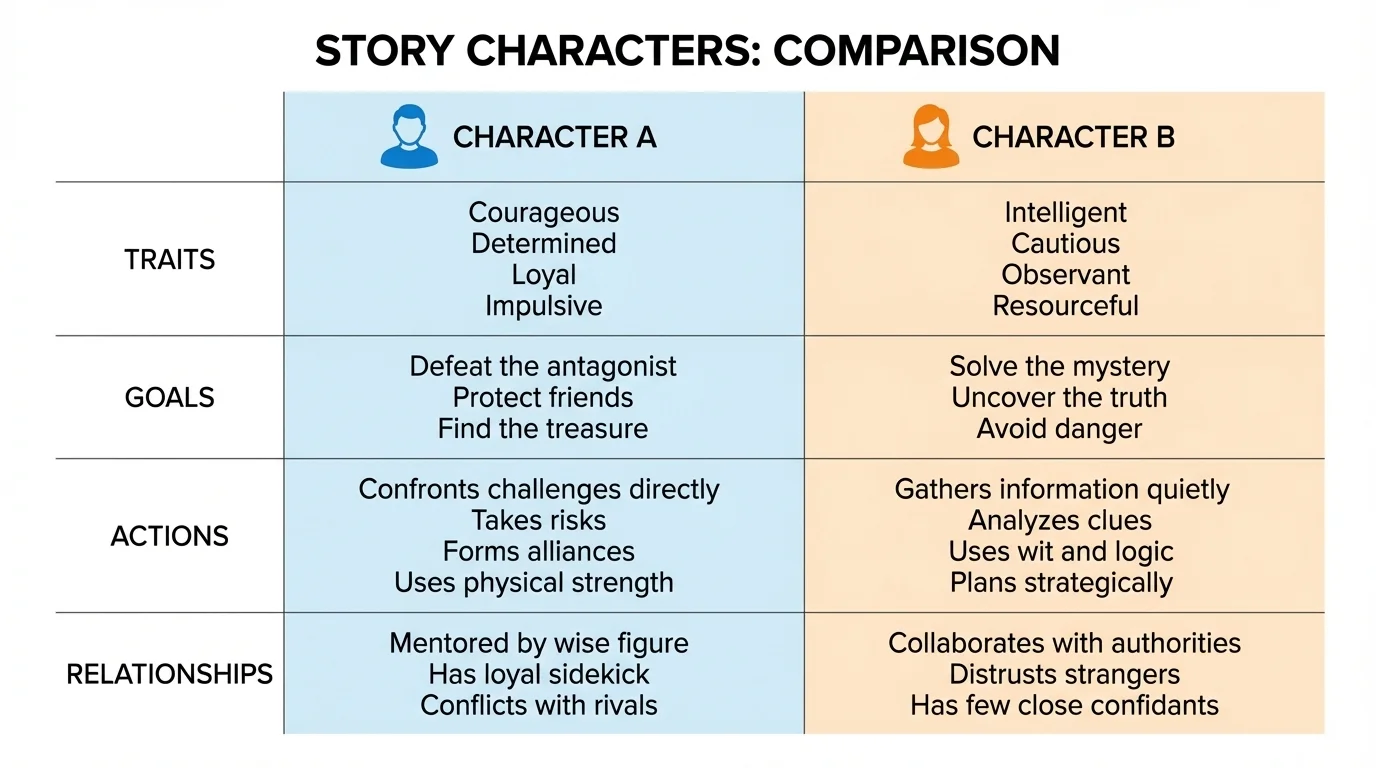
Readers should also compare how characters interact with others. A character who is calm alone may become competitive around a rival. Another character may seem shy but become confident when helping a friend. Interactions reveal personality. They also reveal change. If a character begins by arguing with someone and later works together with that person, that shift is meaningful.
In dramas, interactions are often shown through short lines of speech and stage actions. For example, if one character says, "Go ahead. I know you can do it," while another says, "You'll probably mess it up," the difference between them becomes clear. Even without long description, their words reveal attitude.
Character comparison example
In a fictional story, Ava and Nia both want to help their class win a recycling contest.
Step 1: Find a similarity.
Both girls care about helping their class. That shows they are responsible and cooperative.
Step 2: Find a difference using actions.
Ava creates a plan and asks everyone to sort materials correctly. Nia runs from room to room collecting items quickly without checking labels.
Step 3: Explain what the details show.
The details show that Ava is organized, while Nia is energetic but less careful.
A strong comparison explains both the similarity and the difference with details from the text.
Later, when you make a claim about characters, support it with exact moments. You might explain that one character encourages others while another pressures them. That kind of evidence-based thinking is much stronger than simply saying one is "better."
The setting of a story is the time and place in which it happens, but setting includes more than a location. It often shapes mood, affects behavior, and influences the events of the plot. The same kind of character can act differently depending on where the story happens.
[Figure 2] Think about the difference between a stormy beach at night and a sunny neighborhood park in the afternoon. Even before anything important happens, each setting creates a different feeling. The stormy beach may feel dangerous, lonely, or tense. The park may feel cheerful, open, or safe. Comparing settings helps readers understand why characters act the way they do.
Settings can also affect what events are possible. A mountain village in winter may make travel difficult. A busy city may create chances for people to meet strangers. A small stage room in a drama may create a private, intense conversation, while a public town square may invite conflict in front of others.
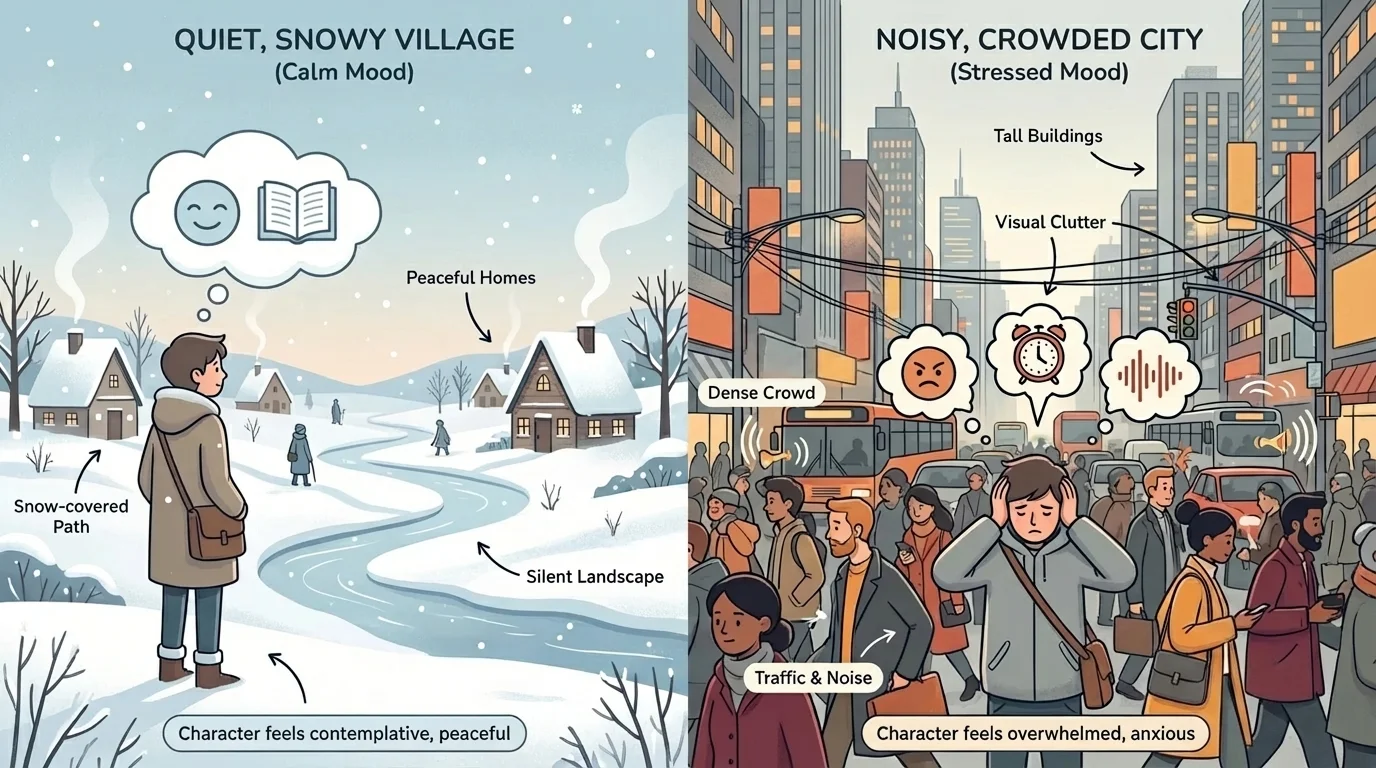
When comparing settings, ask questions such as: What details describe each place? What mood does each setting create? How does each setting affect the characters' choices? Does the setting make a problem easier or harder to solve?
For example, in one story a child searching for a lost dog in a quiet countryside may hear barking from far away. In another story, a child searching in a noisy city may struggle because car horns and crowds drown out the sound. The goal is similar, but the setting changes the challenge.
Setting can act almost like an extra character. In many famous stories, the place is so important that readers remember it as strongly as the people in it.
Much later in a story, the same setting may even change meaning. A house that first seems warm and welcoming may begin to feel crowded or secretive. When you compare settings, notice not only place but also the effect that place has on feeling and action.
An event is something that happens in the plot. When readers compare events, they examine causes, actions, results, and importance. This work becomes clearer when you track what happens before and after key moments.
[Figure 3] Some events are similar because they both involve a challenge, a choice, or a discovery. Other events are different because one creates conflict while another resolves it. A smart comparison explains the role each event plays in the story.
Imagine two events in a drama. In the first, two friends argue over who should lead a project. In the second, those same friends finally listen to each other and divide the work fairly. These events are connected. Both center on leadership, but the first event shows conflict and the second shows growth.
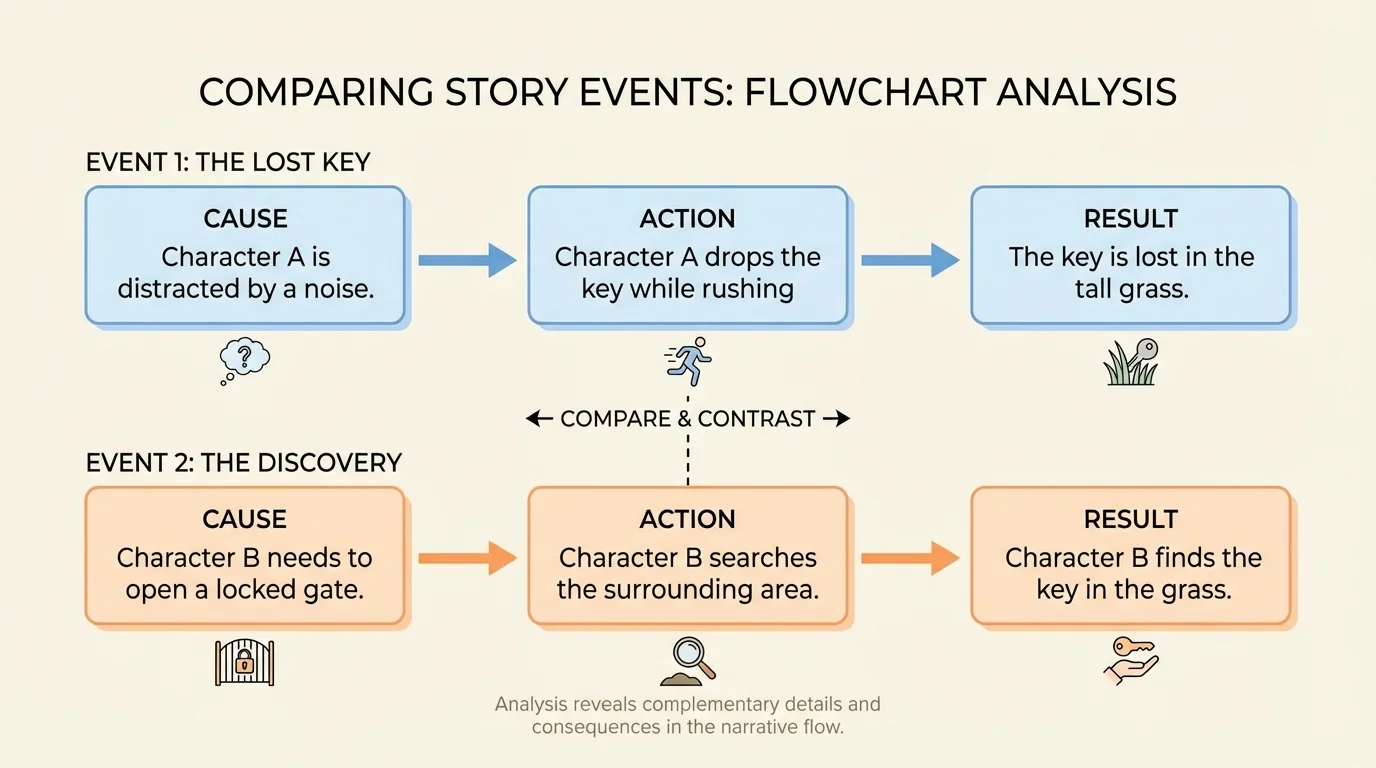
When comparing events, pay attention to sequence. If an early event teaches a lesson, a later event may show whether the character learned it. You should also ask what changes because of each event. Does the problem get worse? Does a character change? Does a new idea appear?
Events can also be compared across stories. In two different folktales, for example, a hero may face a test. In one tale the hero succeeds through kindness. In another the hero succeeds through cleverness. Both events involve a test, but the different responses reveal different values.
Cause and effect in event comparison means looking at why something happens and what happens next. Two events may seem alike on the surface, but if they have different causes or different results, they may have very different meanings in the story.
That is why event comparison should not stop at "both are important." Instead, explain how they are important. One event might push the plot forward, while another helps reveal a character's true nature.
The strongest comparisons depend on evidence. Evidence includes exact details such as actions, descriptions, lines of dialogue, and reactions. You may quote short parts of the text or paraphrase by putting the idea into your own words. Either way, your explanation should stay close to the text.
Compare these two responses. A weak response says, "Jamal and Theo are different." A stronger response says, "Jamal stays calm and suggests solutions, but Theo blames others and storms away when the robot breaks." The second response is better because it includes details that prove the idea.
Specific details also prevent unfair guesses. Readers should not decide that a character is selfish just because the character is quiet. The text must support the idea. Maybe the character is shy, thoughtful, or worried. Text evidence keeps analysis accurate.
Turning a weak comparison into a strong one
Weak statement: "The settings are different."
Step 1: Name the settings clearly.
One setting is a crowded apartment building. The other is a farm with open fields.
Step 2: Add details from the text.
The apartment building is full of noise, footsteps, and neighbors. The farm has wind, animal sounds, and wide spaces.
Step 3: Explain why the difference matters.
The apartment makes the character feel trapped, while the farm makes the character feel free and calm.
Now the comparison uses details and explains significance.
Good readers often use words and phrases like both, however, similarly, in contrast, while, and on the other hand. These signal words help connect ideas clearly.
One especially important kind of comparison involves how characters interact. Interactions include conversations, arguments, teamwork, advice, competition, and even silence. The way characters treat one another can reveal feelings, power, trust, jealousy, or change.
For example, if a girl speaks gently to her little brother but sharply to her teammate, readers learn that her behavior changes depending on the relationship. If another character is rude to everyone, that suggests a more constant trait. Comparing interactions helps reveal complexity.
In a drama, a lot of meaning comes from who interrupts, who answers, who avoids eye contact, and who gives commands. The words may be short, but the interaction can be rich. The character chart in [Figure 1] remains useful here because relationships and responses are major clues to personality.
Sometimes characters influence each other in opposite ways. One friend may encourage risk-taking, while another encourages caution. Comparing those interactions shows how a main character is pulled in different directions.
"A character is revealed by the choices he or she makes under pressure."
That idea is important because many interactions happen during tense moments. A person's response during pressure can reveal more than ordinary conversation does. Comparing how characters act in these moments helps readers understand the story more deeply.
Often, the richest analysis connects characters, settings, and events instead of treating them separately. A cautious character in a dangerous setting may avoid risk, while a bold character in the same setting may take action. In this way, comparing characters can lead directly to comparing how they respond to setting.
Events also connect to character and setting. A storm may force two enemies to work together. A crowded festival may create a misunderstanding. A quiet library may allow a secret to be discovered. You can compare not only the events themselves but also how different people react to them.
As you saw earlier with settings in [Figure 2], place often shapes feeling and choice. As you saw with events in [Figure 3], cause and effect shape meaning. These connections help you move from simple observations to deeper interpretation.
Consider this short fictional scenario. In a story, two cousins, Serena and Jo, are visiting their grandmother's old house before it is sold. A thunderstorm knocks out the power. Serena wants to explore the attic immediately, hoping to find family treasures. Jo wants to wait until morning because the house creaks and the stairs are narrow. Later, when they hear a strange sound, Serena grabs a flashlight and climbs up, while Jo follows slowly, calling out warnings. In the attic, they discover not a ghost but a box of letters from their grandmother's childhood.
You could compare the cousins by saying both are curious about the house. That is true, but it is not enough. A stronger comparison explains that Serena is bold and eager, while Jo is cautious and thoughtful. The evidence comes from their choices during the storm and their different reactions to the attic.
You could also compare two settings within the scenario: the dark lower hallway and the attic filled with letters. The hallway feels tense and uncertain because of the storm and darkness. The attic, though still mysterious, becomes a place of discovery. This change in setting helps shift the mood from fear to understanding.
Full compare-and-contrast response
Serena and Jo are similar because both care about learning more about their family. However, they respond differently to the storm and the attic. Serena acts quickly and climbs the stairs with a flashlight, which shows she is brave and impulsive. Jo hesitates, warns Serena, and moves carefully, which shows he is more cautious. The setting also changes across the scene. The dark hallway creates suspense, but the attic becomes meaningful when the cousins find the letters. These details show that the same event can reveal different character traits and change the mood of the story.
Notice how that response does more than retell the plot. It identifies similarities, differences, and supporting details. It also explains why those details matter.
One common mistake is making a claim without evidence. If you say a character is kind, prove it with words or actions from the text. Another mistake is focusing on tiny details that do not matter. Hair color may be a difference, but unless it affects the story, it may not be worth discussing.
Another mistake is comparing only one side. For example, some students explain everything about one character and then everything about another, but they never actually connect the ideas. A real comparison should bring the two sides together with signal words and clear explanations.
Students also sometimes confuse difference with opposition. Two characters do not have to be complete opposites to be meaningfully different. One may be more patient, while the other is slightly more direct. Small differences can still matter.
Writers often create pairs of characters who are alike in one way and different in another because this makes conflict, humor, and change more interesting for readers.
Finally, avoid ending with vague language such as "they are different in many ways." Instead, name the ways. Be exact. Precision makes your thinking stronger.
A strong response usually begins with a clear idea, sometimes called a claim. Then it adds details and explanation. For example, you might begin, "Both Maya and Eli want to solve the mystery, but Maya depends on logic while Eli depends on instinct." After that, you would support the idea with actions, dialogue, and outcomes from the text.
You can organize your thinking in several ways. You might discuss similarities first and then differences. You might compare one category at a time, such as traits, actions, and interactions. Or you might compare two events by describing each event's cause and result. The key is clarity.
Good literary analysis asks not only what is similar or different, but also why the author might have made those choices. Perhaps the author wants readers to notice two ways of solving a problem. Perhaps the setting highlights how brave a character really is. Perhaps one event mirrors another to show growth.
When you compare and contrast effectively, you become a more thoughtful reader. You notice patterns, relationships, and meaning. You do not just read the story. You study how it works.
