Two mystery books can both begin with something missing, and two adventure stories can both send characters into danger, but they may still feel completely different. One might be quiet and spooky. Another might be fast and funny. Strong readers notice more than what happens. They notice how the author tells the story and what message grows from the events.
When you compare stories, you look for ways they are alike. When you contrast stories, you look for ways they are different. If the stories are in the same genre, they share some basic features. For example, mystery stories often include clues, suspects, questions, and a solution. Adventure stories often include danger, travel, risk, and a goal that pushes the characters forward.
A genre is a type of literature. Knowing the genre helps readers know what to look for. In a mystery, readers pay attention to clues and secrets. In an adventure story, readers pay attention to obstacles, action, and survival. But even in the same genre, authors make different choices. Those choices change the reader's experience.
Theme is the deeper message or lesson a story explores, such as trust, courage, justice, or friendship. Topic is the subject the story is about, such as a missing necklace, a treasure hunt, a storm, or a secret note.
It is important to understand the difference between topic and theme. A topic can often be named in just a word or short phrase. A theme usually takes a whole idea, such as "working together helps people solve hard problems" or "being brave does not mean being unafraid."
Stories in the same genre are easier to compare because they already have something in common. If you compare a mystery to a poem about spring, the stories are too different in structure and purpose. But if you compare two mysteries, you can look closely at how each author handles clues, suspects, and suspense. If you compare two adventure stories, you can study how each author builds danger, movement, and excitement.
Genre gives readers a starting point, but it does not make all stories the same. Think about sports. Two soccer games follow the same rules, but one may be defensive and careful while another is fast and aggressive. Stories work the same way. The genre gives the framework, but the author chooses the style, pace, and message.
Some readers think genre only tells what kind of action will happen, but it also helps reveal what questions the story will ask. A mystery often asks, "What really happened?" An adventure often asks, "Can the characters make it through?"
That is why comparing stories within the same genre is such a powerful reading skill. It helps you move from simply retelling events to analyzing an author's craft.
Many stories in the same genre share topics. Mystery stories may include theft, missing objects, suspicious behavior, secrets, lies, or hidden messages. Adventure stories may include journeys, storms, wild places, rescues, survival, and teamwork. But the bigger thinking comes when you look for the theme.
For example, two mysteries may both be about a missing object. That is the topic. Yet one mystery might focus on the theme that honesty matters, while the other focuses on the theme that appearances can fool us. Two adventure stories may both include a dangerous trip. That is the topic. Yet one may show that courage grows through action, while the other shows that teamwork is stronger than pride.
Topic and theme work together. The topic gives the story a surface subject, but the theme gives it meaning. Readers often discover theme by asking what the characters learn, what the ending suggests, and which ideas keep repeating.
When comparing stories, ask yourself: Are these stories about similar situations? Do they seem to teach similar lessons? If they teach similar lessons, do they teach them in the same way?
[Figure 1] shows that even when two stories share a theme, authors can shape that theme through different story parts. Readers can compare the setting, the characters, the main conflict, the mood, and the point of view to understand each story's approach.
One author may place a mystery in a crowded school where many people could be suspects. Another may place a mystery in a quiet farmhouse where only a few people are involved. One author may tell an adventure through a brave narrator who loves risk. Another may use a cautious narrator who is scared but keeps going anyway. Both stories might explore courage, but courage will feel different in each one.
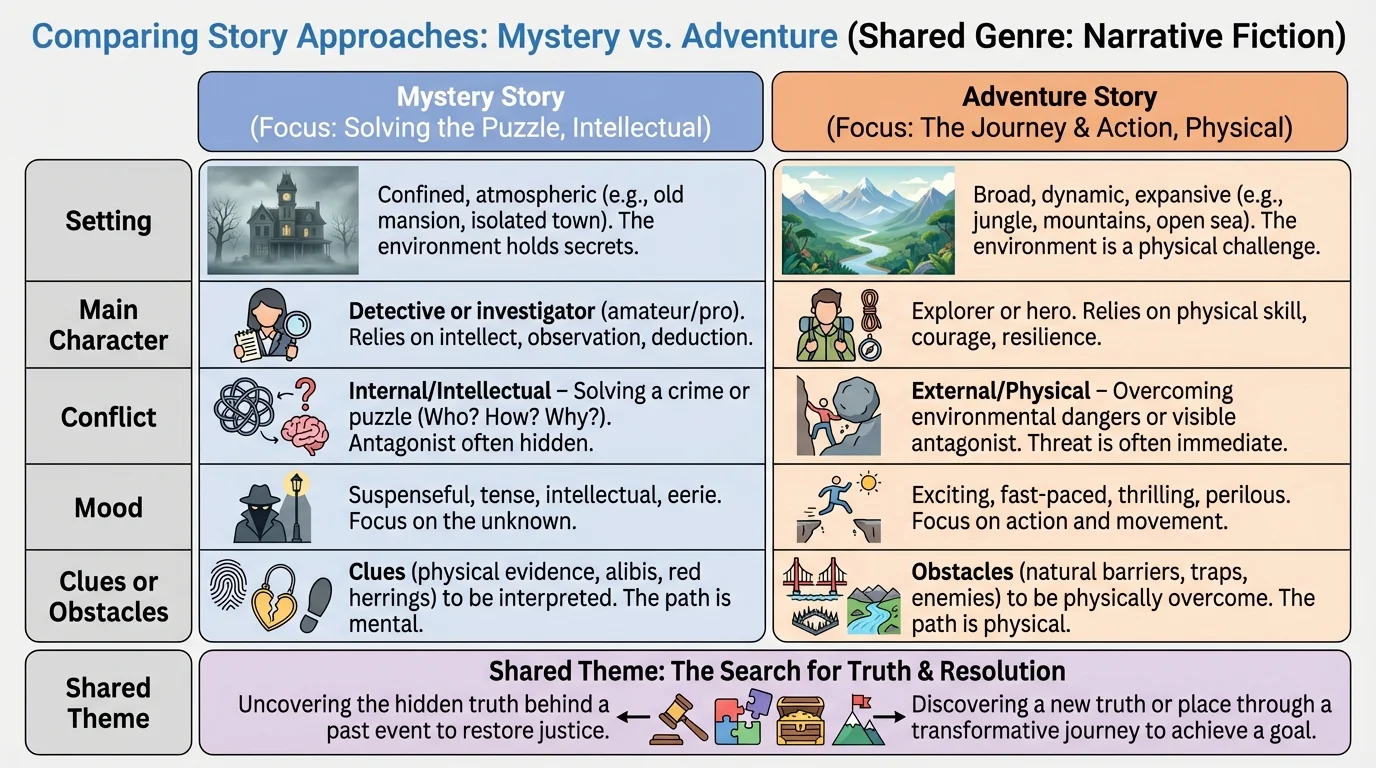
Authors also choose how fast events move. This is called pace. A quick pace can make a story feel urgent and exciting. A slower pace can make readers notice details, clues, and feelings. In mysteries, a slow pace may build suspense by making readers wait for answers. In adventure stories, a fast pace may create danger and momentum.
Another important idea is suspense, the feeling of wondering what will happen next. In a mystery, suspense may come from hidden information. In an adventure story, suspense may come from physical danger. The same theme, such as trust, may feel very different depending on how the suspense is built.
As the chart in [Figure 1] shows, the same genre does not force stories to be identical. Instead, it helps readers notice which elements stay similar and which choices make each story unique.
[Figure 2] helps show how two made-up mystery stories, The Locked Desk and The Library Map, build meaning in different ways through their clue settings. Both are mysteries, and both involve something missing. In The Locked Desk, a student's science fair notebook disappears from a classroom desk. In The Library Map, an old hand-drawn map vanishes from the town library. Both stories include clues, suspects, and a final solution.
In The Locked Desk, the author focuses on close observation. Tiny details matter: pencil marks, a bent key, and a muddy footprint. The theme may be that careful thinking leads to truth. In The Library Map, the author focuses more on relationships between people. The missing map connects to family history, and the mystery is solved when characters finally speak honestly. The theme may be that trust and truth go together.
These stories also create different moods. The Locked Desk feels tense and narrow because most of the action happens in one room during one afternoon. The Library Map feels broader and more curious because the search moves through shelves, records, and old town stories. The clue patterns and suspects shape each mystery in a different way.
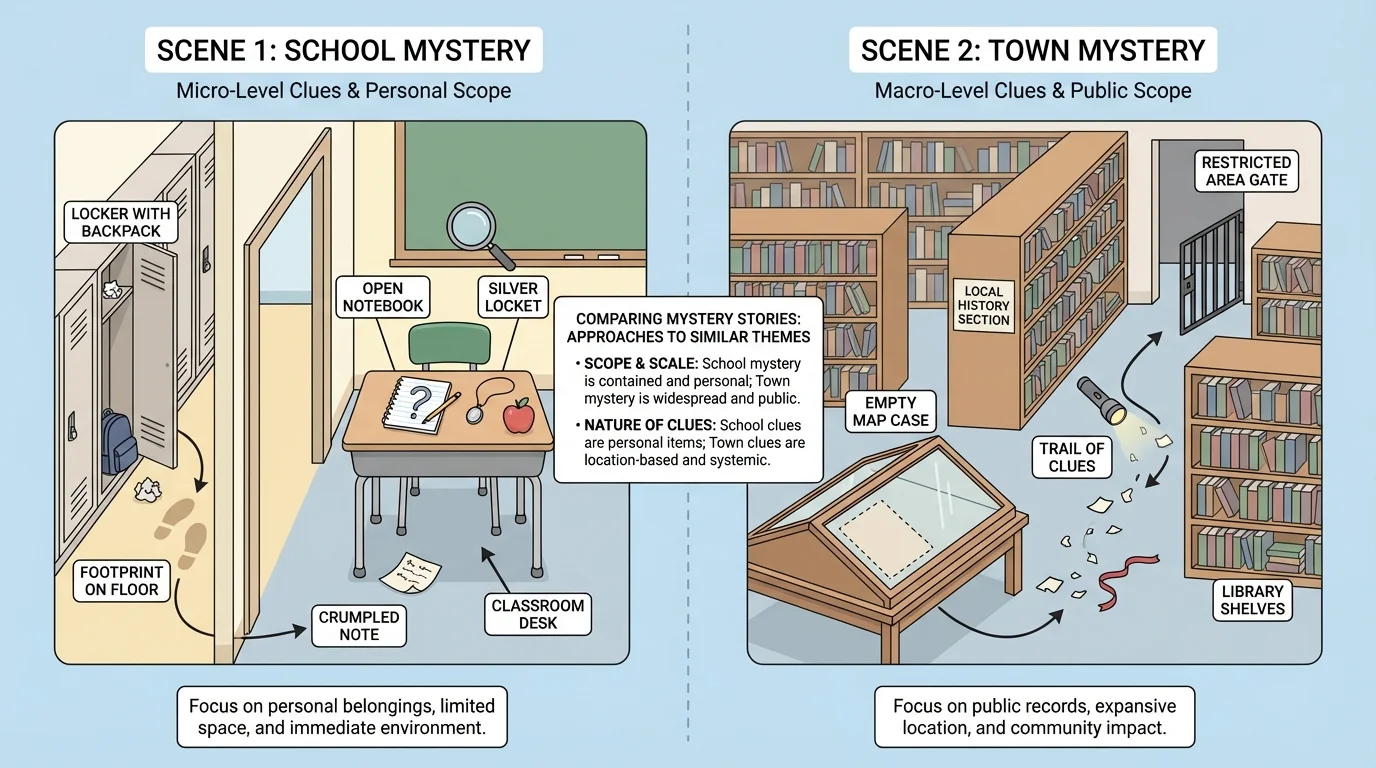
The mood matters because it changes how the reader feels about the same kind of problem. A missing object in a strict school setting can feel stressful. A missing object in a library full of history can feel curious and mysterious. Both stories are mysteries, but their approaches to the same topic are different.
Case study: comparing two mystery stories
Step 1: Identify the shared genre and topic.
Both stories are mysteries, and both focus on a missing item.
Step 2: Identify the shared or related theme.
Both stories suggest that truth can be uncovered, but one emphasizes observation while the other emphasizes honesty.
Step 3: Compare how the author develops that theme.
One uses physical clues and a tight setting. The other uses conversations, family history, and a broader search.
A strong comparison explains both the similarity and the difference.
When writing or speaking about these two stories, a reader should use evidence. Instead of saying "They are both interesting," say something clearer: "Both mysteries involve missing objects, but one solves the problem through careful physical clues while the other solves it through people sharing the truth."
[Figure 3] highlights how two made-up adventure stories, River Rescue and Peak at Dawn, explore danger and bravery through very different kinds of journeys. Both are adventure stories. In River Rescue, two cousins travel by raft to bring medicine to a village after a storm. In Peak at Dawn, a team climbs a mountain to place a weather sensor before a blizzard arrives.
Both stories share the topic of a difficult journey. Both may also share the theme that courage is choosing to act even when a person is afraid. But their approaches are different. River Rescue may focus on quick choices, changing water, and physical movement. Peak at Dawn may focus on planning, endurance, and the slow challenge of climbing higher.
The setting changes the kind of challenge the characters face. On a river, danger moves fast and can surprise the characters. On a mountain, danger may build slowly through cold, height, and exhaustion. That means each story teaches courage in a different way.
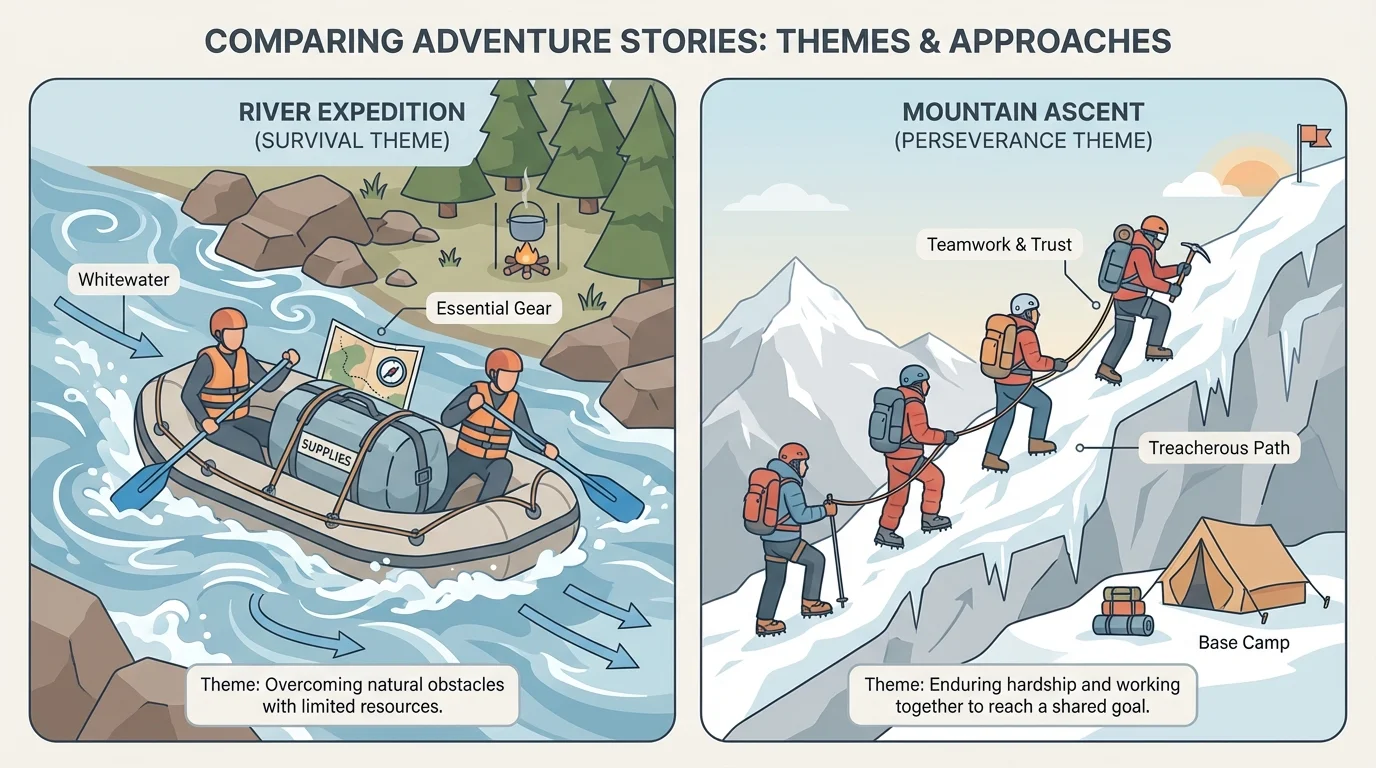
Character relationships matter too. In River Rescue, courage might appear through protecting someone else. In Peak at Dawn, courage might appear through refusing to give up. Both stories value bravery, but one shows bravery as action during sudden danger and the other shows bravery as determination over time.
Looking back at [Figure 3], you can see that adventure stories often use setting almost like another character. The river pushes, speeds, and threatens. The mountain tests, delays, and wears people down. That difference helps shape the theme.
Sometimes the most interesting comparison is not just between plot and plot, but between message and message. Two stories in the same genre may both teach about justice, friendship, loyalty, or courage. Readers should ask whether the stories agree completely, partly agree, or offer different shades of the same idea.
For example, two mysteries might both explore justice. In one, justice comes when the guilty person is caught and punished. In another, justice comes when the truth is known and a misunderstanding is healed. These are related ideas, but not exactly the same. One focuses on punishment. The other focuses on understanding.
The same is true in adventure stories. Two adventures may both show teamwork. Yet one may suggest that teamwork means dividing jobs wisely, while another may suggest that teamwork means trusting each other emotionally. The themes connect, but the authors approach them differently.
When you compare stories, do not stop at "both have the same lesson." Ask how each story builds that lesson through details, scenes, and character choices.
This is where literary analysis becomes stronger. A reader moves from "both stories are about courage" to "both stories value courage, but one presents courage as fast decision-making in danger while the other presents courage as staying committed during a long struggle."
Strong readers use questions to guide their comparisons. What does each character want? What stands in the way? How does the setting increase the challenge? What details create suspense? What lesson seems most important by the end?
They also ask how the author wants the reader to feel. Should the reader feel worried, curious, inspired, or relieved? In mysteries like the ones suggested in [Figure 2], authors may use hidden clues, red herrings, or secret conversations to make readers curious and uncertain.
A red herring is a false clue that distracts readers from the real answer. This is common in mysteries. In adventure stories, authors may use sudden weather, broken tools, or hard choices to create tension instead. Different tools can support similar themes.
"A good reader notices not only what a story says, but how it says it."
That idea is at the heart of comparing stories in the same genre. You are not just matching events. You are studying author choices.
One common mistake is comparing only small plot details. For example, saying that one mystery has a stolen watch and another has a missing notebook is a start, but it does not go very deep. A stronger comparison asks what these missing objects reveal about the story's message and structure.
Another mistake is mixing up topic and theme. "Both stories are about a storm" names a topic. "Both stories show that people become stronger when they help one another during hard times" states a theme. Readers need both levels of thinking.
A third mistake is forgetting evidence. If you say one story feels more suspenseful, explain why. Mention the clues, the pacing, the chapter endings, or the dangerous situation. The comparison chart in [Figure 1] reminds us that every claim should connect to a story element.
A strong comparison usually includes three parts: the shared genre, the shared theme or topic, and the different approaches. You might begin with a sentence such as: "Both stories are mysteries about missing objects, but they approach the search for truth in different ways." Then you would explain those ways with evidence.
You can organize a comparison by story element. First compare setting, then character, then conflict, then mood, and finally theme. You can also organize by idea. First discuss the shared theme, then explain how each story develops it differently. Either way, the goal is clear thinking supported by details.
Model comparison statement
The Locked Desk and The Library Map are both mystery stories about missing items, but they develop the search for truth differently. One uses close observation in a tight school setting to show that careful thinking solves problems, while the other uses family secrets in a wider community setting to show that honesty brings hidden truths to light.
The same pattern works for adventure stories: "Both River Rescue and Peak at Dawn are adventure stories about dangerous journeys, but one presents courage through quick action in a fast-moving emergency while the other presents courage through endurance during a slow, exhausting climb."
When readers compare and contrast stories this way, they become better thinkers. They learn to see patterns across texts, notice important differences, and understand that authors can explore the same big ideas through very different paths.
