Have you ever listened to someone try to convince you of something, like why recess should be longer, why a team will win, or why a new rule is fair? Good listeners do more than hear words. They figure out the speaker's most important ideas, notice how those ideas are supported, and decide whether the message makes sense. This is a powerful skill for school, academic discussions, and life outside the classroom.
When people speak, they often want to do more than share information. They may want to explain, persuade, report, or solve a problem. If you only remember a few random details, you may miss the whole message. But if you can summarize the important points and explain how the speaker supported them, you understand the talk much better.
This skill also helps during class discussions. When students work together, they need to listen closely, build on one another's ideas, and respond to what was actually said. Careful listening shows respect and helps everyone think more clearly.
When you summarize reading, you pick out the most important ideas and leave out small details. Summarizing what you hear works in a similar way, but listening can be harder because spoken words move quickly and cannot always be reread.
A strong listener is a bit like a detective. The detective listens for clues: What is the speaker trying to say? What are the biggest ideas? What evidence or examples are used? Those clues help the listener understand the message accurately.
A claim is what a speaker says is true, important, or worth believing. It is a main point the speaker wants listeners to understand. In a short talk, a speaker may make one main claim. In a longer speech, the speaker may make several claims. The graphic organizer in [Figure 1] shows that the claim is the big idea, and reasons and evidence fit underneath it.
For example, if a student says, "Our school should plant more trees," that is a claim. It tells what the speaker believes. If the student continues by saying trees give shade, help animals, and make the playground cooler, those are supporting ideas connected to the claim.
Claims are different from small details. A detail might be "two trees were planted near the library last year." That detail matters only because it connects to a larger point. Good listeners ask, "Is this the main idea, or is it just one detail?"
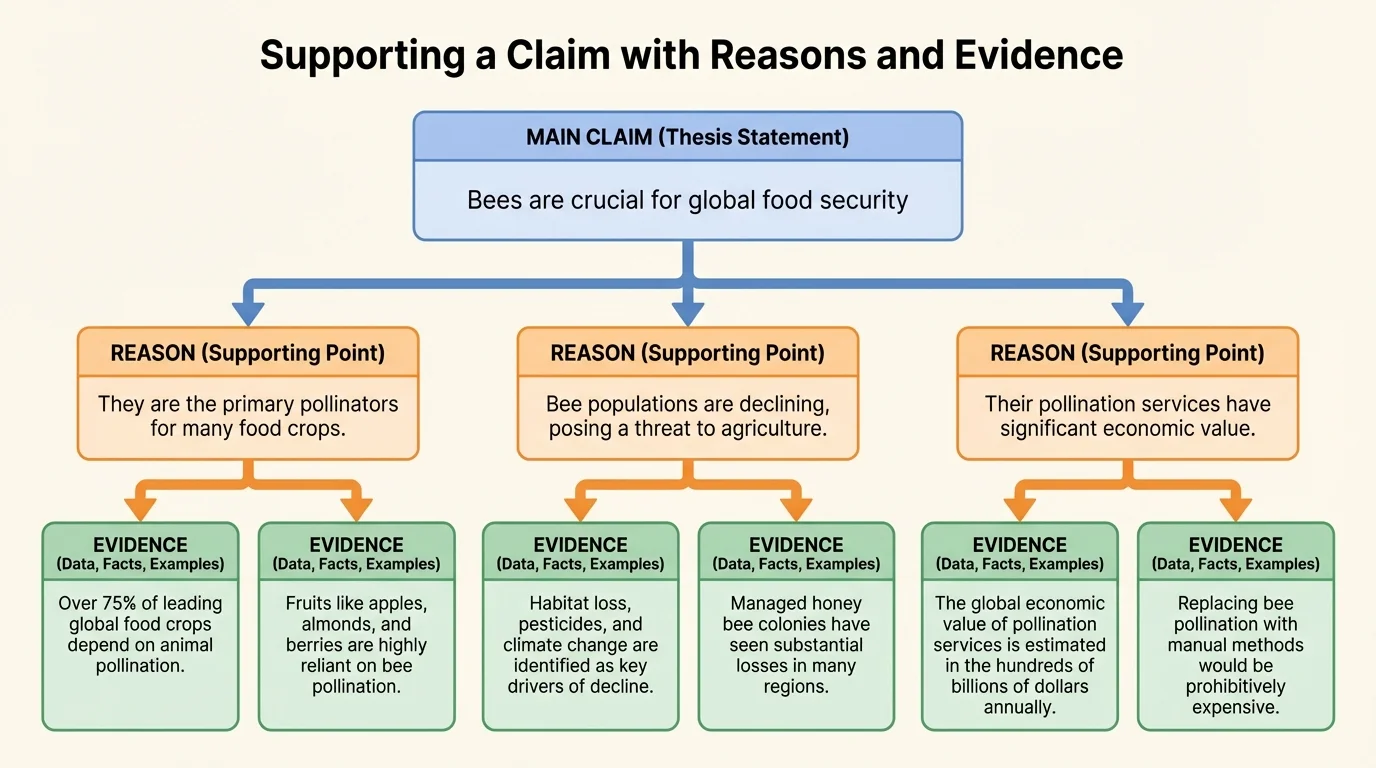
Sometimes a speaker does not say a claim in exactly one short sentence. The listener may need to figure it out by paying attention to repeated ideas. If the speaker keeps returning to one message, that repeated idea is probably an important claim.
Claim means a statement a speaker wants the audience to accept as true or important.
Reason means an explanation of why the claim makes sense.
Evidence means the facts, examples, observations, or details that help support the claim.
In discussions, speakers may share opinions, but not every opinion is well supported. That is why listeners should always notice not only what a speaker says, but also how the speaker tries to support it.
A reason tells why the claim should be believed. [Figure 2] shows this difference clearly: reasons explain, while evidence provides proof or examples that make the claim more convincing.
Suppose a speaker says, "Students should drink more water during the day." One reason might be, "Water helps your body stay healthy and focused." Evidence might include an example such as, "After exercise, drinking water helps replace what your body loses," or a fact like, "Doctors often say children need enough water to stay hydrated."
Here is another example. Claim: "Reading every day improves learning." Reason: "Daily reading builds vocabulary and understanding." Evidence: "A student who reads often sees more new words and becomes more comfortable with different kinds of texts."
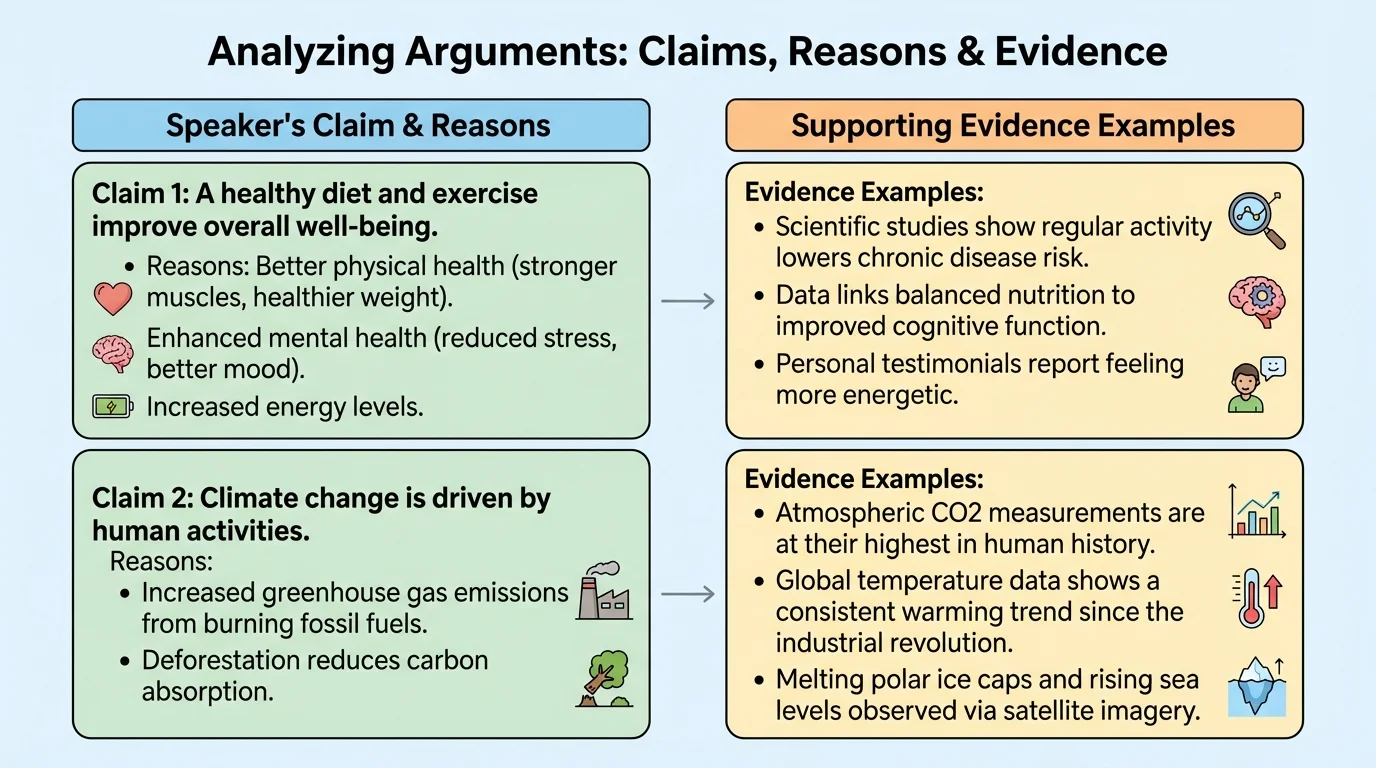
Evidence can come in different forms. It may be a fact, a statistic, an example, an observation, a quotation, or something the speaker experienced directly. In grade 5, you do not need to sort every type into a fancy category, but you should be able to say what kind of support the speaker used.
Some speakers use more than one reason for the same claim. Each reason may have its own evidence. For example, a speaker arguing for a school garden may say it helps science learning, provides food for insects, and makes the campus more beautiful. Those are three reasons supporting one claim.
Listening carefully takes practice. The process begins with noticing the topic, then tracking repeated ideas, and finally choosing the main points instead of every tiny detail.
[Figure 3] One useful strategy is to listen for signal words. Speakers often use words and phrases such as first, another reason, for example, because, this shows, and in conclusion. These clues help you follow the structure of the speech.
Repetition is another clue. If a speaker repeats an idea in different ways, that idea is probably important. If a speaker says, "Plastic waste harms animals," and later says, "Trash in oceans puts sea life in danger," the wording changes, but the point stays similar.
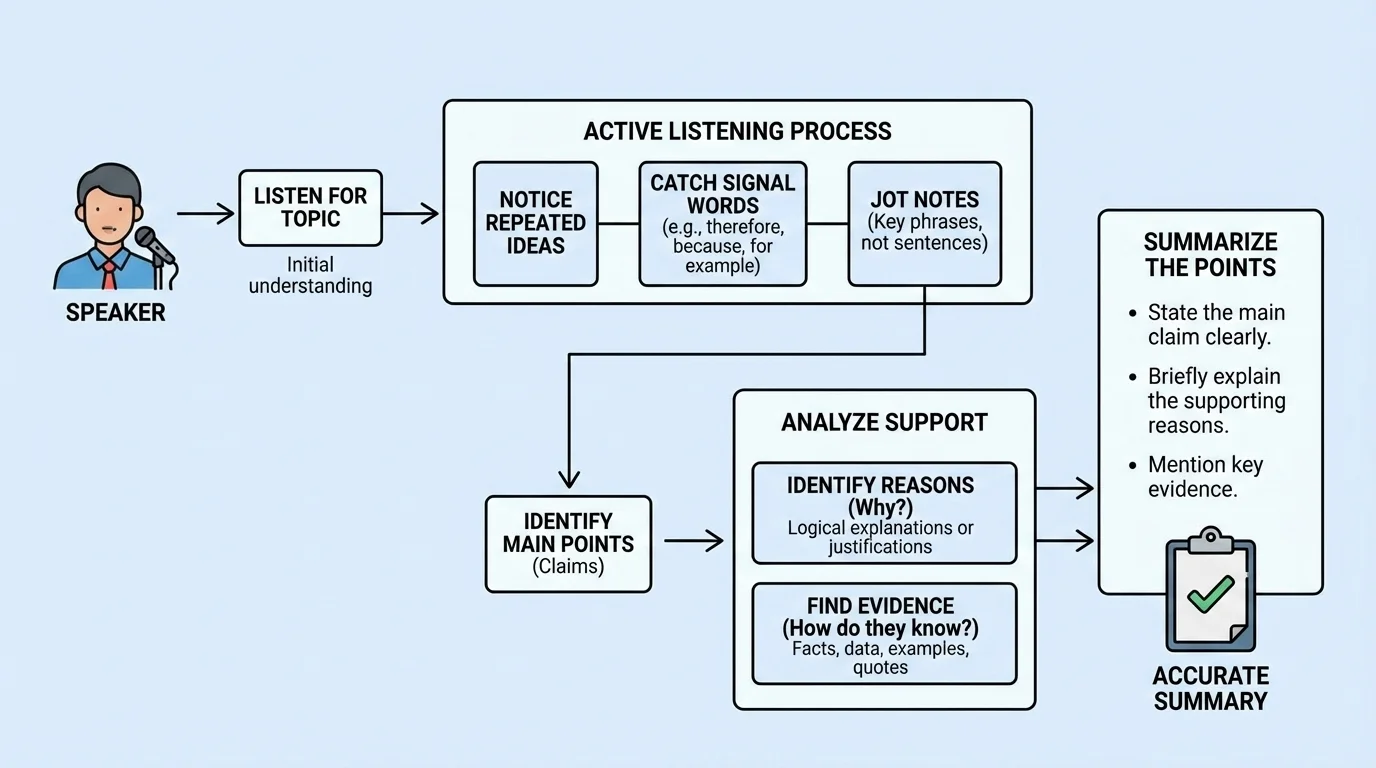
It also helps to take short notes. You do not need to write every sentence. Instead, jot down the topic, the main claims, and quick words about the reasons or evidence. A note page might say: "Claim: more recycling bins. Reason: easier to recycle. Evidence: bins near cafeteria fill quickly."
Another strategy is to ask yourself silent questions while listening: What is the speaker trying to prove? Why does the speaker believe that? What examples or facts are used? These questions keep your attention focused.
Listening for structure helps you understand spoken messages. Many speakers organize ideas in patterns such as problem-and-solution, opinion-and-support, or topic-with-several-reasons. If you hear the pattern, it becomes easier to summarize the message in order.
Not every spoken message is formal. You may hear claims in class meetings, morning announcements, news clips, videos, or partner conversations. The same listening habits still work: identify the point, listen for support, and separate big ideas from small details.
Once you have heard the claim and its support, the next step is to explain the connection clearly. A strong explanation tells both the claim and the support. It does not just list random facts.
For example, instead of saying, "The speaker talked about bees and flowers," you can say, "The speaker claimed that school gardens are helpful, and she supported that claim by explaining that gardens give bees food and help plants grow." That answer is clearer because it connects the support to the claim.
Explaining support in a spoken message
A student speaker says, "Our class should have a quiet reading corner. It would help students concentrate. Last week, several students said the room felt noisy during independent reading."
Step 1: Identify the claim.
The claim is: "Our class should have a quiet reading corner."
Step 2: Find the reason.
The reason is: "It would help students concentrate."
Step 3: Find the evidence.
The evidence is: "Last week, several students said the room felt noisy during independent reading."
Step 4: State the connection clearly.
You could explain: "The speaker supports the claim by giving a reason that a quiet reading corner would improve concentration and by using student comments as evidence that noise is a problem now."
Sentence frames can help. You might say, "The speaker claims that _____." Then add, "This claim is supported by the reason that _____." Finally, add, "The speaker uses evidence such as _____." These sentence frames help organize your thinking.
When you explain support, be accurate. Do not add your own opinion unless someone asks for it. First, show that you understand the speaker's message exactly as it was presented.
Not all support is equally strong. Some reasons are clear and thoughtful, while others are too simple or unrelated. Some evidence is specific and believable, while other evidence is vague.
For example, if a speaker says, "The playground needs more shade," and supports the claim by saying, "Many students stand near walls to escape the sun during lunch," that support is fairly strong because it is specific and connected. But if the speaker says only, "Shade is nice," the support is weaker because it does not explain enough.
Good evidence is often specific. Compare these two statements: "A lot of kids like art" and "During the last art club meeting, every chair was full, and more students asked to join." The second statement paints a clearer picture. Specific support helps listeners understand why the claim makes sense.
Many speeches become easier to follow when the speaker uses the same claim-and-support pattern several times. Once your ear notices the pattern, you can predict what kind of information will come next.
Strong support usually pairs a clear reason with evidence that truly matches it. If the reason and evidence do not connect, the speech may sound confusing or unconvincing.
Some speakers make several points in one talk. A summary should include the most important ones in the order the speaker presents them. The note layout in [Figure 4] shows how numbering claims can help you keep the speaker's ideas organized.
Suppose a principal gives a short speech about improving the school day. The principal says students need safer hallways, cleaner shared spaces, and clearer schedules for assemblies. A good summary would mention all three major points, not just the one you liked best.
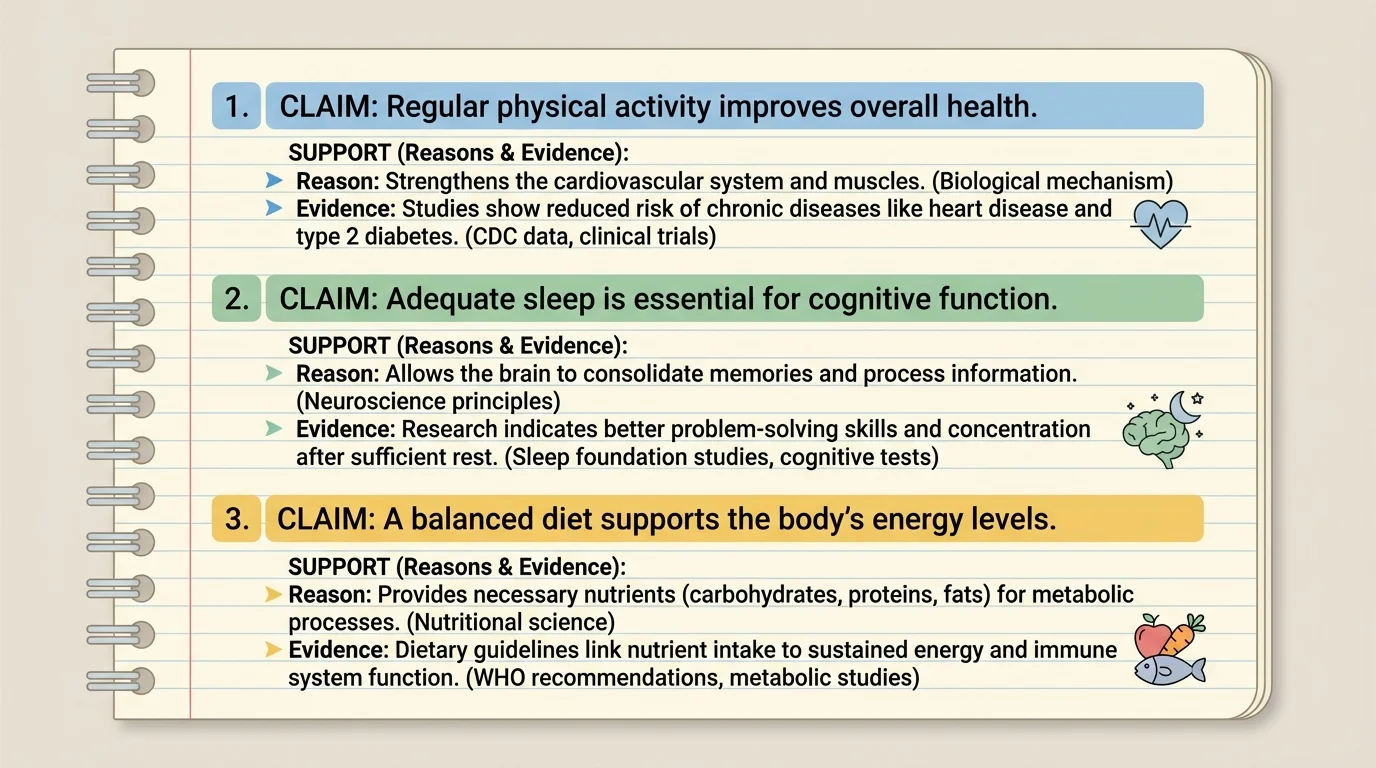
Here is an example of a spoken-message summary: "The principal explained three ways to improve the school day. First, she said hallways should be safer and supported that point by mentioning crowded passing times. Next, she said shared spaces should stay cleaner and gave examples of litter in common areas. Finally, she said assembly schedules should be clearer so classes know where to go and when to arrive."
Notice what makes this summary strong. It includes the main points, follows the order of the speech, and explains the support briefly. It does not copy every sentence. It also does not wander into the listener's personal opinion.
Later, when you compare two speakers or respond in a discussion, the organized pattern remains useful because it helps you remember which support belongs to which claim.
In a classroom discussion, students are both listeners and speakers. That means you need to understand someone else's claim before responding. If a classmate says, "We should do science projects in pairs," a helpful response might be, "You think pairs work better because students can share materials and check each other's ideas." This shows you listened carefully.
Good collaboration depends on accurate listening. If you misunderstand a classmate's point, your response may not fit. Summarizing another person's claim before replying can make discussions more respectful and more productive.
This skill is also useful when people disagree. You can say, "I heard your claim that longer recess helps students focus, and your reason is that movement gives the brain a break." Then you may respond with your own thinking. First understanding, then responding, is a smart discussion habit.
"Listen to understand, not just to answer."
Teachers, coaches, family members, and teammates all appreciate listeners who can restate important points accurately. It shows attention, respect, and strong communication skills.
One common mistake is trying to remember every detail. A summary should be shorter than the full speech. Focus on the biggest points and the most important support.
Another mistake is mixing up a claim with a reason. Remember: the claim is the big idea the speaker wants you to accept. The reason explains why the claim makes sense. Evidence proves or supports the reason.
A third mistake is adding your own opinion too soon. If the speaker says the cafeteria should serve more fruit, and you reply, "I like pizza better," you have not yet shown that you understood the speaker's claim or support. First summarize what was said. Then share your own view if needed.
Some students also repeat exact words from the speaker without really understanding them. Instead, try to put the ideas into your own words. That shows real understanding.
You can use this skill far beyond school. When you watch a video, listen to a news report, hear a coach explain a game plan, or talk with a family member, you can ask: What is the main claim? What reasons are given? What evidence supports those reasons?
For example, if a weather reporter says a storm may be coming, the claim might be that people should prepare. The reasons could include strong wind and heavy rain, while the evidence might be radar images, past storm patterns, or current measurements. Even outside class, listeners need to sort claims from support.
In group projects, this skill helps teams make decisions. If one student says the group should make a poster instead of a slideshow, everyone can listen for the reasons and evidence before choosing. That leads to fairer and smarter decisions.
| What to Listen For | What It Means | Example |
|---|---|---|
| Claim | The speaker's main point | "We should start a recycling program." |
| Reason | Why the claim makes sense | "It would reduce waste at school." |
| Evidence | Facts, examples, or observations that support the reason | "Trash cans near lunch tables fill with bottles every day." |
| Summary | A short retelling of the main ideas | "The speaker wants a recycling program and supports it by explaining that school waste could be reduced." |
Table 1. A comparison of claim, reason, evidence, and summary in spoken messages.
As shown earlier in [Figure 1], every strong spoken message has a structure: a main claim with support beneath it. When you notice that structure, spoken information becomes easier to understand, discuss, and remember.
