Have you ever noticed that you do not talk exactly the same way to a best friend, a teacher, and the principal? The message might be similar, but the words, tone, and style can change a lot. Strong speakers know that speaking is not just about saying words. It is about choosing the right way to speak for the situation. That skill helps people share ideas clearly, explain information, persuade others, and show respect.
When you adapt your speech, you change it to fit the context, the task, and the audience. Context means the situation in which speaking takes place. A context might be a class discussion, a student council speech, a science presentation, or a conversation with a coach. The task is what you are trying to do. Are you giving an opinion? Are you trying to persuade? Are you explaining facts? The audience is the group of people listening.
A speaker makes many choices. You might choose simple words for younger students, respectful words for adults, or energetic words for a team before a game. You might sound casual during lunch with friends but more careful during a class presentation. These choices do not change the main idea. They help the message fit the moment.
Suppose you want a longer recess. To a friend, you might say, "We really need more time outside." To a teacher during a class meeting, you might say, "I believe a slightly longer recess would help students refocus and learn better afterward." Both sentences share a similar idea, but one is more casual and one is more formal. A thoughtful speaker knows which one works best.
Audience is the person or group listening to you. Purpose is your reason for speaking. Formal English is a careful, complete, and respectful way of speaking that fits important tasks and situations.
Good speakers also pay attention to setting. Speaking in front of the whole class is different from talking in a small group. Speaking at a school assembly is different from chatting on the playground. The more important or public the situation is, the more important it becomes to speak clearly and thoughtfully.
Many speaking tasks in school fit into three main groups: sharing an opinion, persuading, and explaining or giving information. These tasks can overlap, but each one has a slightly different goal.
When you share an opinion, you tell what you think or believe. For example, you might say that a certain book should be added to the classroom library. Your opinion should still include reasons, not just feelings. A strong opinion sounds more powerful when it is supported with examples or evidence.
When you persuade, you try to convince others to agree with you or take action. A persuasive speech often includes clear reasons, facts, and examples. For example, if you want the school to start a recycling project, you might explain how recycling helps reduce waste and keeps the campus cleaner.
When you explain or provide information, your main goal is to help listeners understand something. You might explain how a volcano forms, how to stay safe online, or how your class garden grows vegetables. In this kind of speaking, clarity matters most. Your words should be accurate, organized, and easy to follow.
Different tasks need different speaking choices. Opinion speaking focuses on what you think and why. Persuasive speaking focuses on changing minds or encouraging action. Informational speaking focuses on teaching or clarifying. Knowing your task helps you choose the best tone, details, and examples.
Sometimes one talk includes more than one task. For example, you might explain the problem of litter at school and then persuade listeners to help solve it. Skilled speakers know their main goal and shape their speech around it.
[Figure 1] Formal English is especially useful when you are speaking in important school situations. Formal English uses complete sentences, respectful words, and a serious tone. It helps your audience understand that you are prepared and thoughtful. It is often the best choice for speeches, presentations, reports, ceremonies, and conversations with adults in official settings.
Informal speech is more relaxed. It is common when talking with close friends or family members. Informal speech is not wrong. It simply fits different situations. Problems happen when a speaker uses very casual language in a setting that calls for more care and respect.
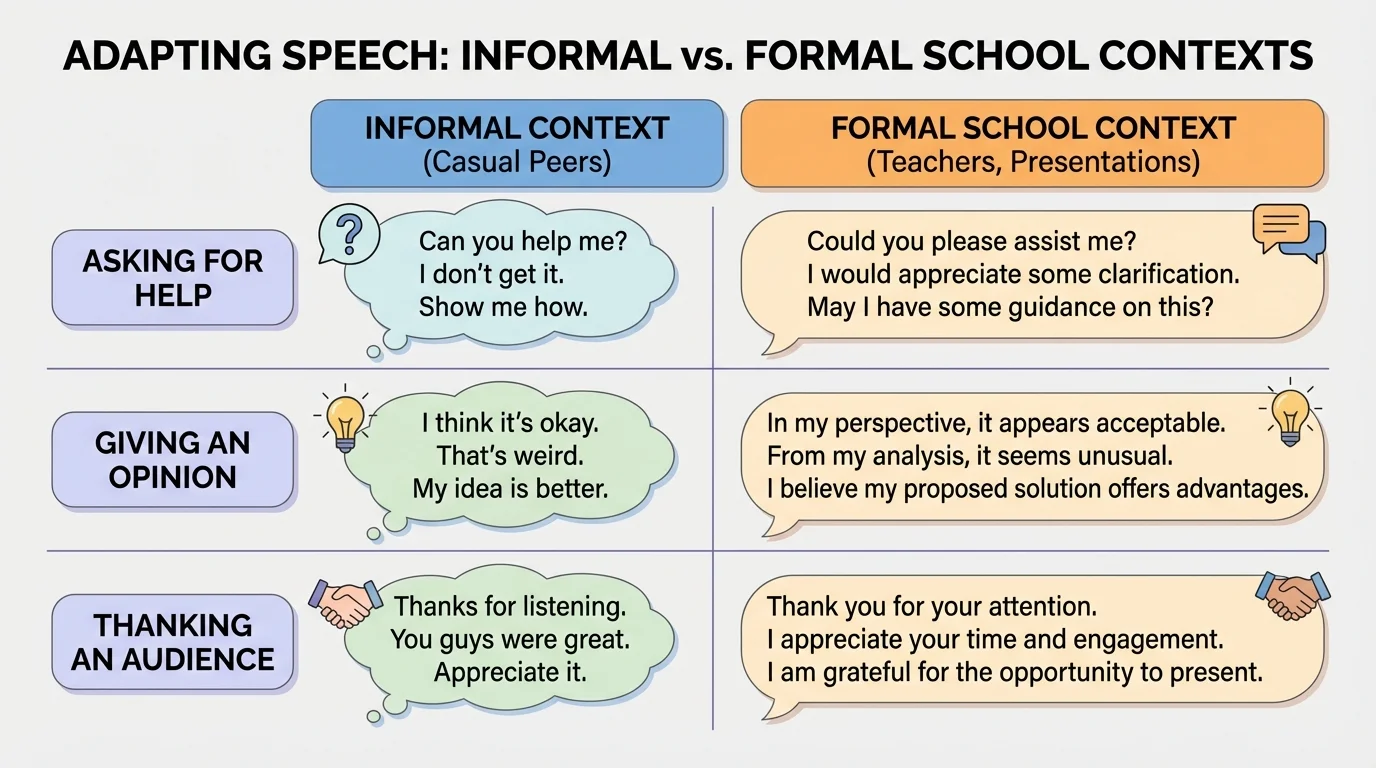
Here are some ways speech changes when you use formal English:
| Informal style | Formal style |
|---|---|
| "Hey, I wanna say something." | "I would like to share an idea." |
| "That rule is dumb." | "I do not think that rule is effective." |
| "Can you guys listen?" | "Please listen carefully." |
| "Thanks for hearing me out." | "Thank you for your attention." |
Table 1. A comparison of informal and formal ways to express similar ideas in school settings.
Formal English also avoids slang, mumbled shortcuts, and unfinished thoughts. Instead of saying "gonna," a speaker can say "going to." Instead of saying "kids should just chill more," a speaker might say "students need more time to relax and reset." The formal version sounds clearer and stronger in an academic setting.
Using formal English does not mean sounding stiff or robotic. It means sounding clear, respectful, and appropriate. Even in formal speaking, your voice can still sound warm and natural. As the phrase examples in [Figure 1] make clear, the goal is not to remove personality. The goal is to make language match the task.
Many great speakers change their speaking style on purpose. A person might sound casual in an interview, formal in a ceremony, and highly persuasive in a debate, all on the same day.
A helpful question to ask yourself is: What will sound most clear and respectful for these listeners right now? That question helps you choose whether your speech should be more formal or more casual.
Your audience shapes your speech in important ways. If you are speaking to classmates, you may already share background knowledge. If you are speaking to younger students, you may need simpler words and more examples. If you are speaking to teachers or community members, you may need a more formal tone and more complete explanations.
Think about what your listeners already know. If your audience knows little about the topic, explain important details. If they already know the basics, spend more time on your main point. Good speakers do not try to impress people with difficult words. They try to help people understand.
Audience also affects the examples you choose. If you are explaining teamwork to classmates, you might use examples from recess games, music groups, or class projects. If you are speaking to adults about school needs, you might use examples about learning time, safety, or student success. The idea stays the same, but the examples change to fit the listeners.
Audience example
A student wants to explain why the school garden matters.
Step 1: Speaking to younger students
"The garden helps us grow vegetables and learn how plants live. It is like an outdoor classroom."
Step 2: Speaking to teachers
"The school garden supports science learning by giving students hands-on experience with plant growth, observation, and responsibility."
Step 3: Speaking to community members
"The school garden connects students with nature and supports learning in science, health, and teamwork."
The topic is the same, but the wording changes to fit the audience.
Respect matters too. Even when you disagree, your words should remain polite. A respectful speaker says, "I understand that some people feel differently, but I believe..." instead of using rude or insulting language. Respect keeps listeners open to your ideas.
A well-organized speech is easier to understand. Even a short response in class sounds stronger when it follows a simple structure. Listeners can follow your thinking more easily when your ideas arrive in a clear order.
[Figure 2] Most speeches and presentations work well with three main parts: an opening, a middle, and a conclusion. The opening tells the topic and grabs attention. The middle gives reasons, facts, examples, or steps. The conclusion reminds listeners of the main point and leaves them with something important to remember.
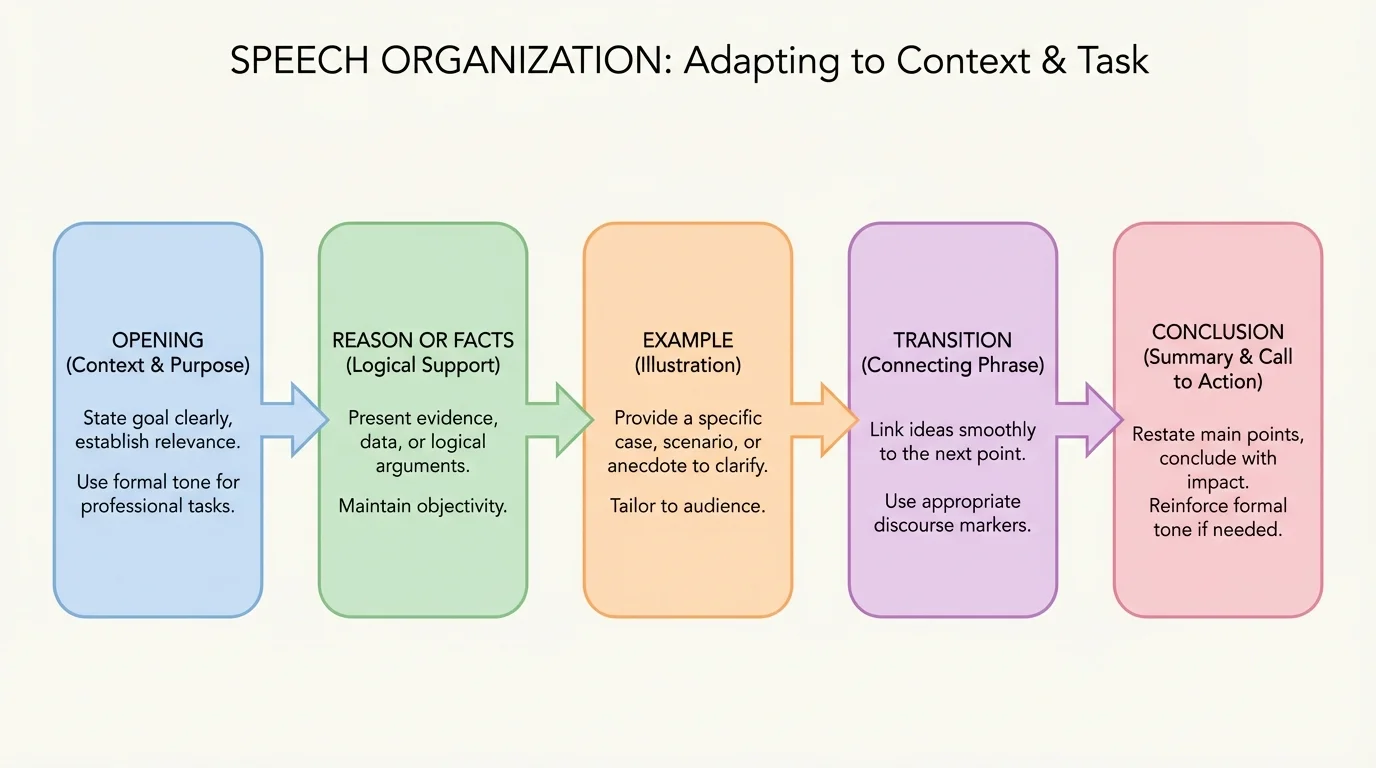
Transitions help connect ideas. These are words and phrases such as "first," "next," "for example," "because of this," and "finally." Transitions act like bridges. Without them, a speech can sound jumpy. With them, the talk feels smooth and easy to follow.
When sharing an opinion, a simple structure might be: state the opinion, give reasons, give an example, and restate the opinion. When persuading, you might explain the problem, provide evidence, offer a solution, and call for action. When explaining information, you might define the topic, describe key parts, and give examples.
The structure in [Figure 2] also helps speakers avoid rambling. If you know your order before you speak, you are less likely to repeat yourself or forget an important point. Planning does not mean memorizing every word. It means knowing where your speech is going.
Complete sentences, strong main ideas, and supporting details are writing skills that also help with speaking. Clear speaking often grows from the same habits as clear writing.
Short notes can help you stay organized. A speaker might write only a few key words for each part instead of reading a whole paragraph. This helps the speech sound natural rather than as if it were being read aloud.
Words matter, but delivery matters too. The way you speak can change how your message feels to the audience through posture, eye contact, and calm gestures. A strong message can be lost if a speaker whispers, rushes, or stares at the floor.
[Figure 3] Voice includes volume, tone, and expression. You should speak loudly enough for everyone to hear, but not so loudly that it sounds like shouting. Tone is the feeling in your voice. An informative talk should sound clear and confident. A persuasive talk may sound more energetic. An opinion speech may sound thoughtful and firm.
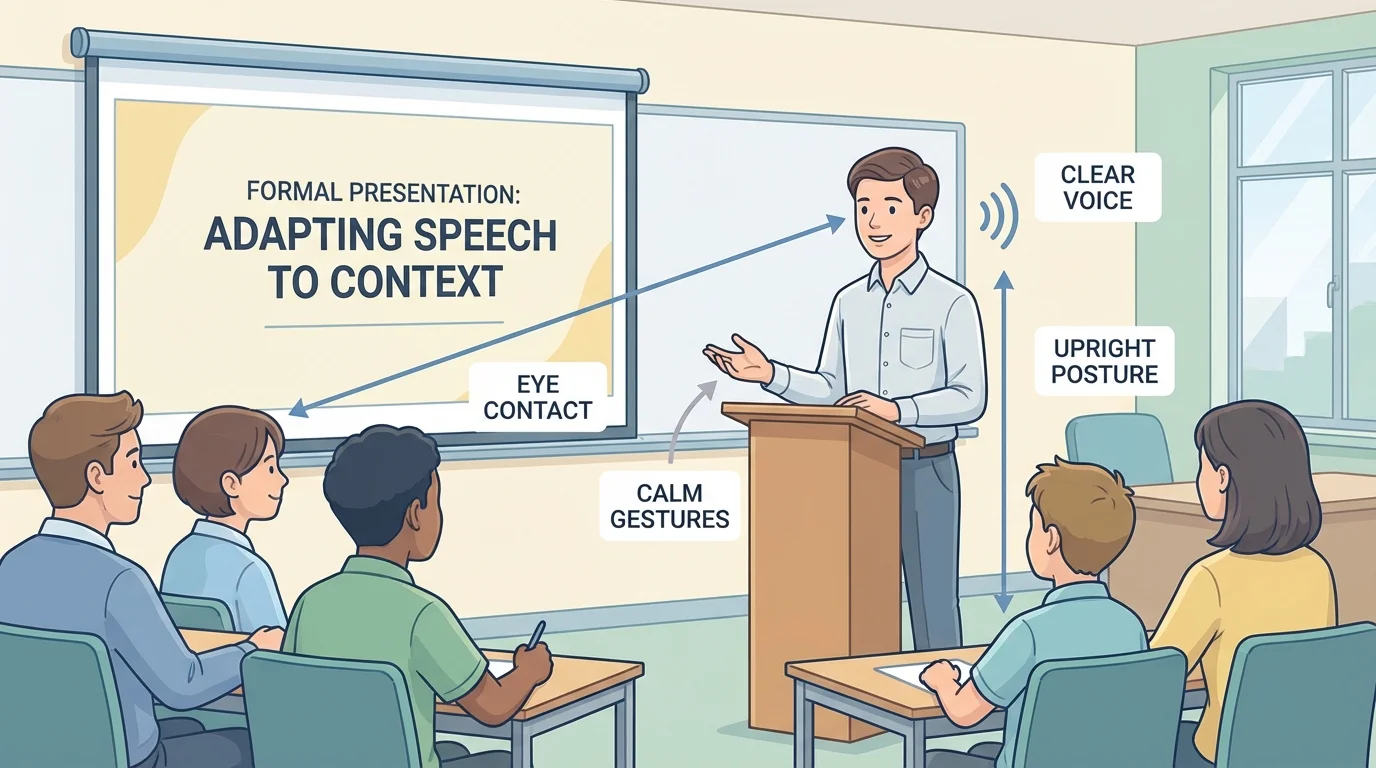
Pace means how fast or slow you speak. If you speak too quickly, listeners may miss key ideas. If you speak too slowly, they may lose focus. A steady pace gives people time to think. Pausing at important moments can also make your message stronger.
Body language includes posture, facial expression, eye contact, and gestures. Standing upright shows confidence. Looking at the audience shows connection. Calm hand gestures can help explain ideas. Too much movement, however, can distract listeners. The balanced speaking posture in [Figure 3] shows how a speaker can look prepared without appearing stiff.
Listening is part of speaking success too. If someone asks a question or shares a different opinion, listen carefully before answering. Good speakers do not simply wait for their turn to talk. They pay attention and respond thoughtfully.
Speaking and listening work together. In discussions, speeches with questions, or group presentations, strong communication includes both clear speaking and respectful listening. A speaker who listens well can adjust explanations, answer concerns, and respond to the audience more effectively.
Practicing out loud helps with delivery. A speech that sounds fine in your head may need changes when spoken. Reading your notes aloud can help you notice where to slow down, where to pause, and which words sound most natural.
Adapting speech matters in many real situations at school and beyond. During a class presentation, formal English is usually the best choice. In a small group discussion, your speech may be a little less formal, but it should still stay clear and respectful. In a debate, you need strong reasons, evidence, and a calm tone, even when you disagree.
Suppose you are making a morning announcement. Because many people are listening, your words should be clear, organized, and formal. You might say, "Good morning. The food drive begins on Monday. Please bring canned goods to your homeroom class." This sounds clear and respectful.
Now suppose you are talking with your team during a game break. You still want to be clear, but the tone may be more informal and energetic: "Let's keep passing and stay ready on defense." This fits the moment better than a highly formal speech would.
One message, three situations
The main idea is that students should clean up after lunch.
Step 1: Talking to a friend
"Let's throw our trash away before we go."
Step 2: Speaking to the class
"Everyone should clean up after lunch so the cafeteria stays neat for the next group."
Step 3: Speaking at a student meeting
"I encourage students to clean up after lunch because it keeps our cafeteria cleaner, safer, and more welcoming."
The message stays similar, but the speech changes with the audience and setting.
When asking for help from an adult, formal English is usually a smart choice. Saying, "Could you please explain that direction again?" sounds more respectful and clearer than "I don't get it." The goal is not to sound fancy. The goal is to communicate well.
One common mistake is using the same style for every situation. A student may speak too casually in a presentation, or too formally in a quick team conversation. Another mistake is forgetting the audience. If listeners look confused, the speaker may need simpler words, better examples, or a slower pace.
Another mistake is giving opinions without support. Saying "I think this is better" is not enough for most academic speaking tasks. A stronger version would be, "I think this is better because it saves time, helps students stay organized, and is easier to use." Reasons make speech more convincing.
Some speakers also use filler words too often, such as "um," "like," or "you know." Nearly everyone uses fillers sometimes, but too many can weaken a speech. Pausing briefly is often better than filling every quiet moment with extra words.
"Say what you mean, and match it to the moment."
A smart fix is to ask yourself three questions before speaking: Who is listening? What is my goal? How formal should I sound? Those questions help you choose the best words, tone, and structure.
A flexible speaker can adjust without losing the main message. That is a powerful skill in school, at home, and in the community. It helps when answering questions, presenting projects, solving problems in a group, and standing up for an idea.
You do not need the exact same voice in every situation. Instead, you need the ability to make thoughtful choices. Sometimes that means being formal and polished. Sometimes it means being warm and conversational. Strong speakers know that good communication is not one-size-fits-all.
As you grow as a speaker, pay attention to what works. Notice when listeners seem interested, confused, persuaded, or informed. Then adjust. That is what skilled communicators do: they match their speech to the task, the audience, and the situation.
