Have you ever had someone say, "It was fun," and then stop there? That tells you almost nothing. Was it fun because a baseball game went into extra innings, because a puppy licked ice cream off a cone, or because a thunderstorm ended just in time for fireworks? Writers make readers care by giving them details they can picture. The right words turn a plain sentence into a living scene.
When you write a narrative, you want your reader to do more than understand the basic event. You want the reader to experience it. Precise language helps your reader step into the story. Instead of reading about "a good day," the reader can feel the warm sun, hear the bounce of a basketball, and notice sweat sliding down a player's forehead.
A narrative becomes stronger when the writer chooses details on purpose. Those details should help show what happened, where it happened, and how it felt. As [Figure 1] shows, there is a big difference between a sentence that gives a blurry idea and one that creates a clear picture in the reader's mind.
Concrete words name things that can be clearly pictured or sensed, such as pine needles, muddy boots, or whispered. Sensory details are words and phrases that appeal to the five senses: sight, sound, smell, taste, and touch. Precise writing uses exact language instead of broad or unclear words.
Think about these two sentences: "We had a nice picnic," and "We spread a red blanket under the oak tree and bit into cold watermelon while bees buzzed near the lemonade." The second sentence is stronger because it gives concrete details. It helps the reader picture the event instead of guessing.
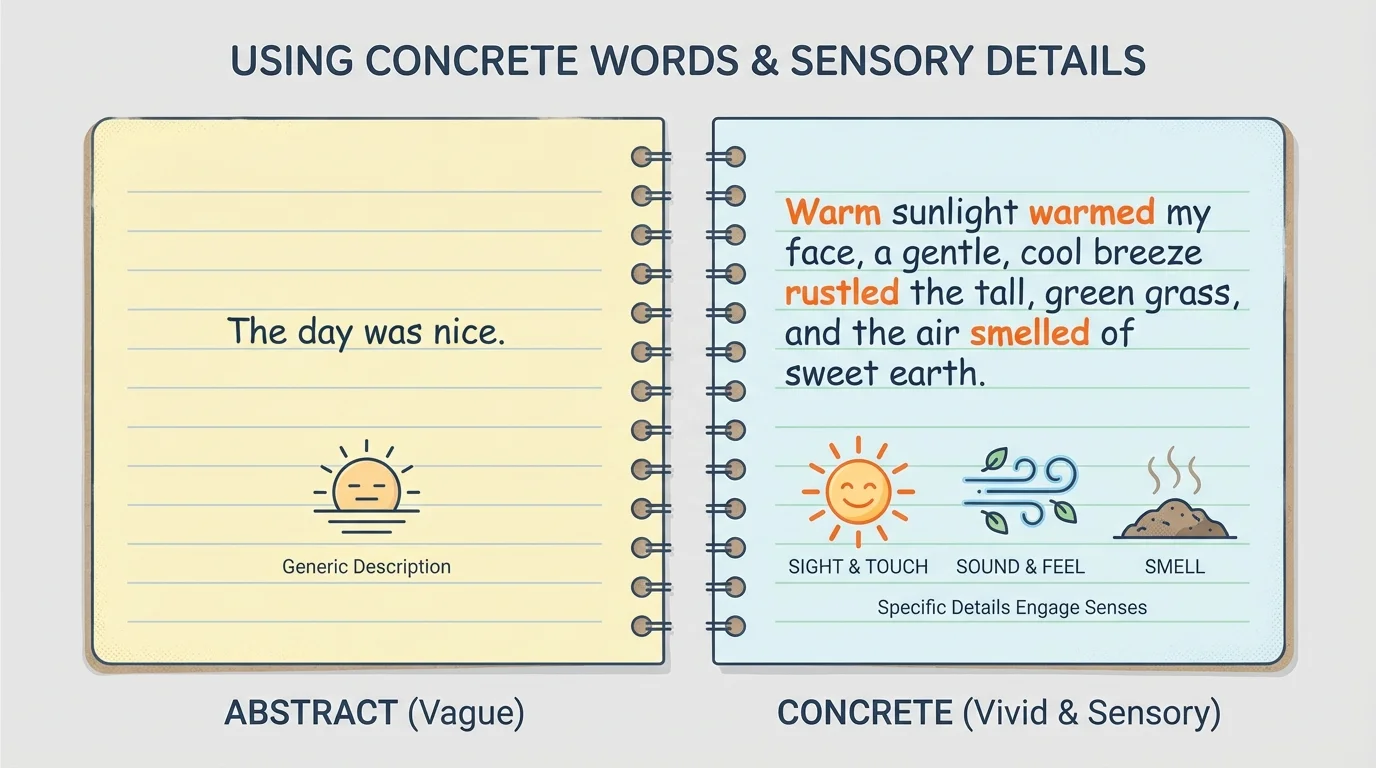
Concrete language names things that are specific and easy to imagine. Words like chair, thunder, and peppermint are concrete. Words like thing, nice, and stuff are vague. Vague words are not always wrong, but if you use too many of them, your writing sounds flat.
Sensory details help readers build a mental picture. A reader cannot actually smell cookies or hear rain while reading, but good description can make it feel that way. Writers often add sensory details when describing a setting, an important action, or a character's experience.
Concrete writing is not about adding random details. Good details are connected to the event. If a story is about losing a soccer game, useful details might include the sting of cold air, the whistle blast, the muddy field, and the silence on the bus ride home. Those details support the mood and the action.
Earlier, [Figure 1] shows how a plain statement can become vivid when a writer chooses exact nouns and verbs. This same idea works in every part of a narrative, from the opening setting to the final moment.
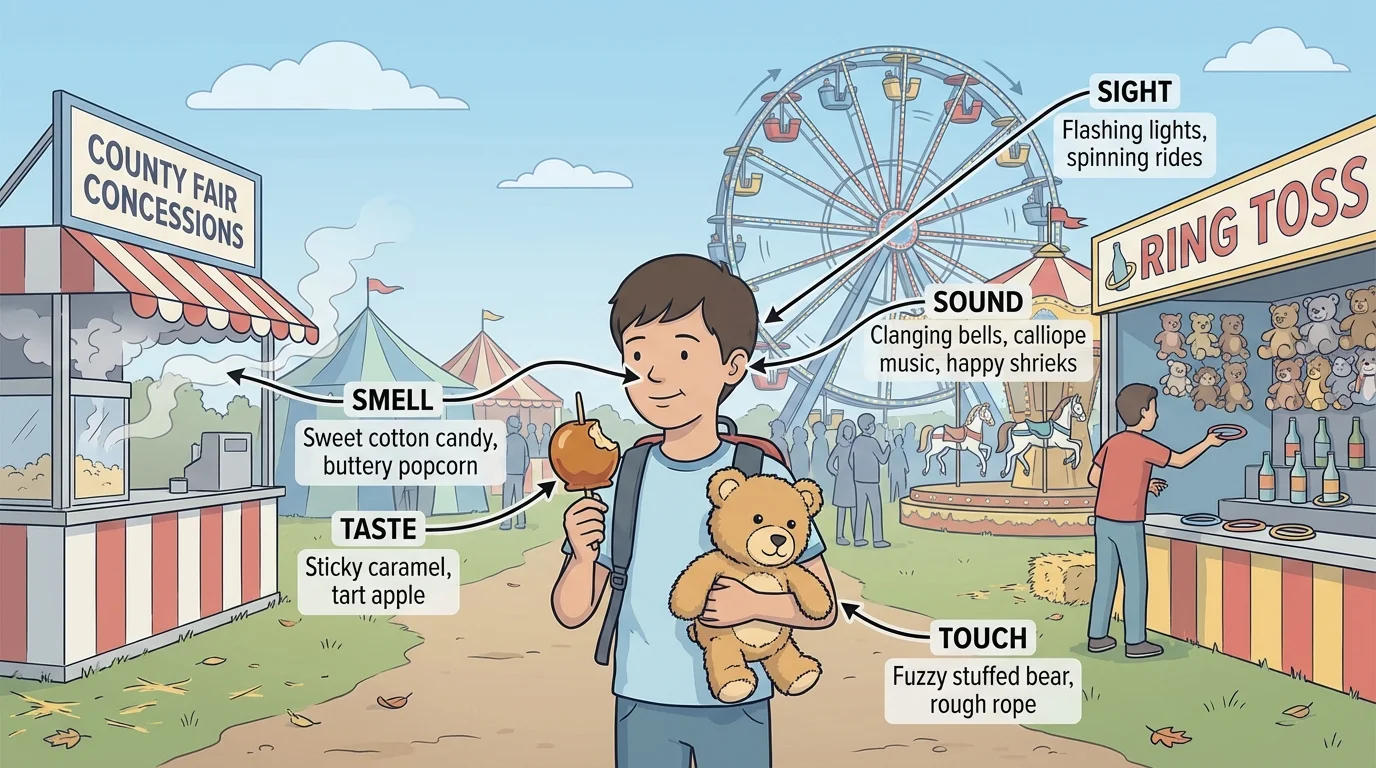
A single event becomes richer when you notice more than what you can see, as [Figure 2] illustrates. Many students remember to describe sight, but strong writers often include sound, smell, touch, and sometimes taste too. These details help a scene feel real.
Sight includes color, shape, size, motion, and light. Instead of saying "the room was messy," you might write, "socks drooped from the dresser drawer, comic books covered the carpet, and a flashlight blinked beneath the bed."
Sound can reveal action and mood. A locker may slam, leaves may rustle, or a crowd may roar. Sound often makes events feel active and immediate.
Smell is powerful because it quickly brings a place to life. The sharp smell of chlorine tells the reader you are near a pool. The buttery smell of popcorn suggests a movie theater or fair.
Taste is useful when food matters in the scene, but it can also describe the air or emotion in a creative way. A writer might describe rainwater on lips as slightly metallic or hot cocoa as sweet and creamy.
Touch includes texture, temperature, and physical feeling. A backpack strap may dig into a shoulder. Sand may feel gritty. A metal swing chain may feel icy in the morning.
Not every scene needs all five senses. Choose the ones that matter most. If your character is sneaking through a dark basement, sound and touch may matter more than taste. If your character is at a cookout, smell and taste might be especially important.
The sense of smell is closely connected to memory. That is one reason a smell in writing can make a scene feel especially real and unforgettable.
When writers use several senses together, they build a fuller experience. At the fair scene in [Figure 2], the reader does not just learn that the place is busy. The labels connect the event to sounds, smells, textures, and sights, making the moment clearer.
Precise writing depends on word choice. Strong description often begins with specific nouns and lively verbs. Adjectives can help too, but they work best when the noun and verb are already strong.
Compare these sentences:
"The animal went across the yard."
"The raccoon shuffled across the wet grass."
The second sentence is stronger because raccoon is more exact than animal, and shuffled is more exact than went. The phrase wet grass adds a touch detail.
Here is another comparison:
"She said something loudly."
"She shouted, 'Watch out!' from the top step."
The second sentence is clearer because it names the action more exactly. A strong verb often does the work of several weaker words.
Good writers also choose specific adjectives and phrases. Instead of "a pretty bird," try "a blue jay with a sharp crest." Instead of "a bad storm," try "a storm that snapped branches and rattled the windows."
Strong words do more work
One exact word is often better than a pile of weak words. A sentence like "The old, nice, big dog walked slowly" is less vivid than "The shaggy mastiff lumbered forward." Specific nouns and verbs make writing sharper and easier to picture.
Be careful not to stuff every sentence with too many describing words. Writing should be vivid, but it should also be clear. Choose a few strong details instead of a long string of adjectives.
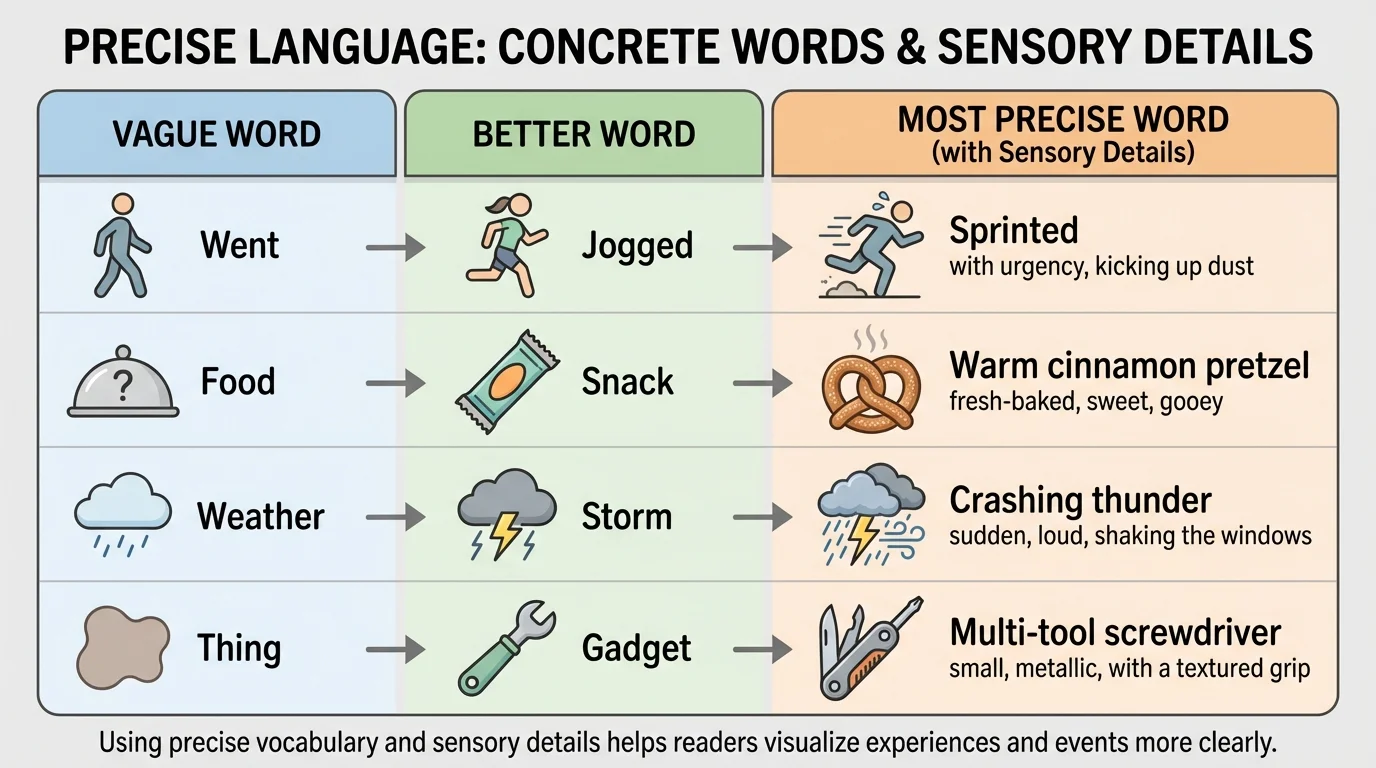
One useful revision skill is moving from broad language to exact language. General words give the basic idea. Specific words make the idea come alive.
| General | More Specific | Most Precise for a Scene |
|---|---|---|
| food | snack | warm cinnamon pretzel |
| went | ran | sprinted |
| bird | hawk | red-tailed hawk |
| noise | sound | the clatter of trays |
| tree | pine | towering pine dripping with rain |
Table 1. A comparison showing how broad words can be revised into more exact language.
As [Figure 3] shows, suppose you wrote, "We ate food after the game." That sentence is not wrong, but it is very general. A more precise version could be, "We tore into greasy pepperoni pizza after the game." Now the reader knows more about the moment.
Revising from vague to precise
Original sentence: "I was nervous before my turn."
Step 1: Add a physical detail.
"I was nervous before my turn, and my hands felt sweaty."
Step 2: Replace vague words with more exact ones.
"Before my solo, my sweaty hands slipped on the trumpet valves."
Step 3: Add a sound or sight detail to deepen the moment.
"Before my solo, my sweaty hands slipped on the trumpet valves while the auditorium fell silent."
The final version gives a clearer picture of the event and the feeling.
Specific details can also show emotion without directly naming it. Instead of writing "I was scared," you might write, "My knees knocked under the table when the lights went out." The reader understands the feeling through the detail.
That is one reason the choices in [Figure 3] matter. Better word choice does not just decorate a sentence. It makes the experience more precise and believable.
Precise details work best when they follow the order of events. In narrative writing, readers need to know what happened first, next, then, and finally. Transition words help guide them through the scene.
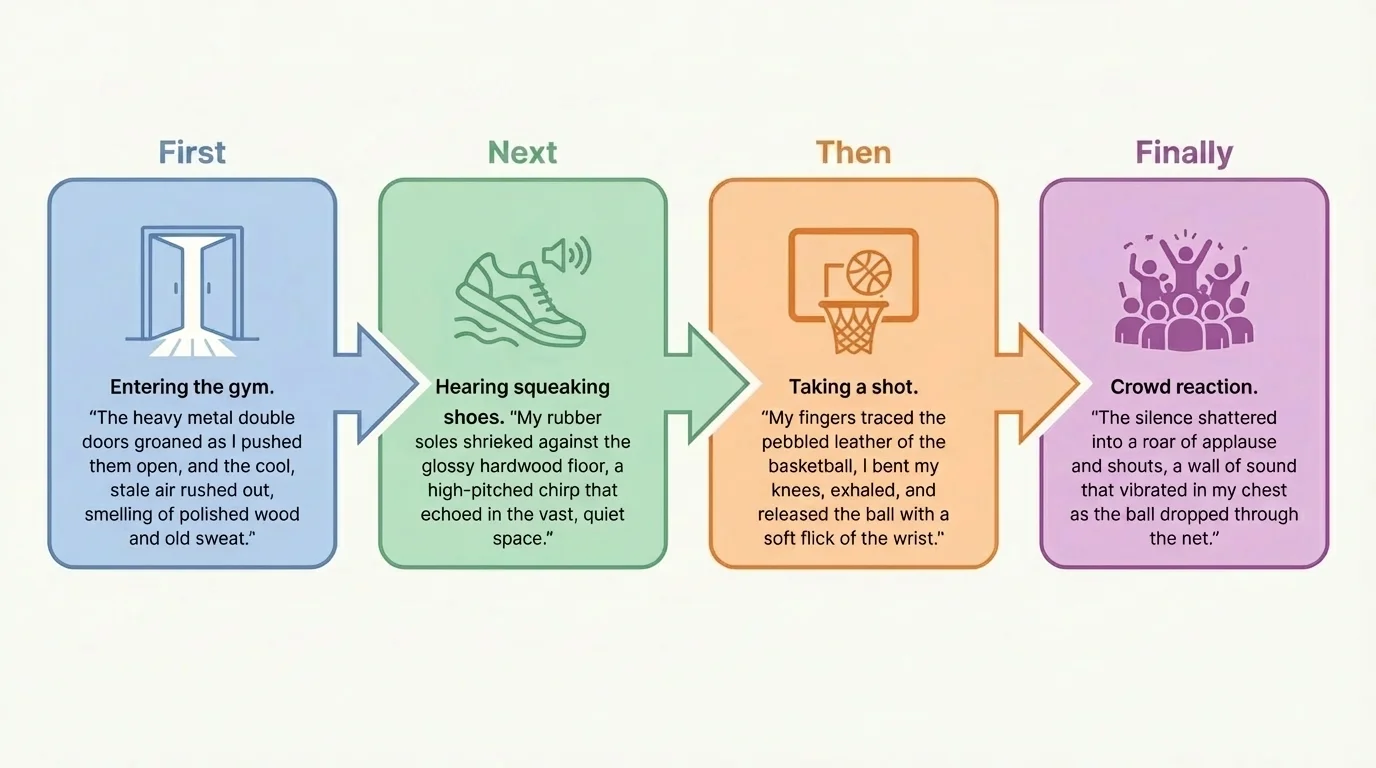
As [Figure 4] shows, common transition words include first, next, then, after that, meanwhile, and finally. These words do not replace details, but they help connect the details into a clear sequence.
Read this short example: "First, Maya tightened her shoelaces at center court. Next, the referee's whistle sliced through the gym. Then, Maya dribbled past one defender and launched the ball. Finally, the net snapped, and her teammates leaped from the bench." The details and transitions work together to show action clearly.
Notice that the sentence order matches the event order. This helps the reader stay inside the moment. If the details were scrambled, the scene would feel confusing.
Transitions can also help move between places and times. For example: "Later that afternoon," "A few minutes earlier," or "By sunset." These phrases are especially helpful in longer narratives.
The event sequence in [Figure 4] shows that even exciting details need structure. Without a clear order, a reader may know what happened but still struggle to follow how it happened.
Writers need balance. Too few details make a story vague. Too many details can slow it down. The goal is to choose the details that matter most.
If you are writing about a surprise birthday party, you do not need to describe every plate, every chair, and every balloon in the room. But you might describe the flicker of candles, the smell of frosting, and the moment everyone shouted. Those details help the event feel important.
A useful question to ask is: Which details help my reader understand this moment better? If a detail strengthens the mood, action, setting, or character, it probably belongs. If it distracts from the main event, you may leave it out.
Readers need both what happened and what it felt like. Earlier writing lessons may have focused on beginning, middle, and end. This skill adds depth by helping each part of the story feel real.
Important moments usually deserve more detail than unimportant ones. A writer may slow down and zoom in on the winning goal, the creak of a mysterious door, or the instant a secret is revealed. Less important moments can be told more quickly.
Good writing is often revised writing. Even skilled authors begin with plain or unfinished sentences and improve them later. Revision means rereading your work and making it clearer, stronger, and more vivid.
When you revise for precision, look for words like nice, bad, thing, went, stuff, and really. These words are often signs that you can be more exact. Replace them with stronger nouns, verbs, or phrases.
You can also check whether your details match the mood of the scene. If a character is excited, the description may include quick movement, bright color, and energetic sound. If a character is worried, the description may focus on shaky hands, quiet pauses, or a dry throat.
Revision example
Draft: "The storm was bad and we were scared."
Step 1: Make the storm more concrete.
"The storm slammed into the house."
Step 2: Show fear through sensory detail.
"The storm slammed into the house, and the windows rattled."
Step 3: Add an exact action from the people in the scene.
"The storm slammed into the house, the windows rattled, and my brother and I ducked under the kitchen table."
The revision shows both the event and the feeling more precisely.
Another revision strategy is to read your writing aloud. Your ears can help you notice where a sentence sounds dull, confusing, or repetitive.
One common mistake is using too many weak describing words. A phrase like "the very, very big, really amazing, super scary dog" is less effective than "the growling Doberman." Precision is stronger than exaggeration.
Another mistake is adding details that do not fit the scene. If the important moment is a tense spelling bee, the reader probably does not need a long description of the school parking lot unless it matters to the story.
A third mistake is being unclear about who is doing what. In action scenes, exact nouns and verbs are important. Instead of writing "They went over there and did it," name the people and the action clearly.
"The right word may be effective, but no word was ever as effective as a rightly timed pause."
— Mark Twain
This quote reminds us that every word matters. In narrative writing, the right detail at the right moment can say more than a long explanation.
Let's look at how concrete details can shape different parts of a narrative.
Setting: "The campsite was in the woods" becomes "The campsite sat between tall pines, and the smoke from our fire curled into the cold evening air."
Action: "He opened the present" becomes "He tore the silver paper and froze when the game controller slid into his hands."
Emotion: "She felt disappointed" becomes "She stared at the empty stage, twisting the corner of her program until it ripped."
These examples show that strong description often works best when it focuses on one clear image or action. The reader learns about the experience through what happens and what can be sensed.
The same skill can be used in real experiences and imagined ones. If you write about a science fair, a family trip, a lost pet, a championship game, or a made-up adventure in a hidden cave, concrete details help the reader enter the world of the story.
Notice how several tools work together: exact words, sensory details, and clear sequence. That is why the scene order in [Figure 4] remains useful even when the story becomes more descriptive. Strong narratives are both vivid and organized.
When you choose precise details, you respect your reader. You do not force the reader to guess what the event looked, sounded, or felt like. You guide the reader with language that is clear, specific, and memorable.
