Have you ever read a story that was exciting all the way through, but the ending felt rushed, confusing, or just plain strange? A strong story ending is a little like the last note in a song. If it fits, it feels satisfying. If it does not fit, the whole piece can feel off. Writers do not just stop a narrative. They create a conclusion that grows naturally from what the characters experienced and what happened along the way.
A conclusion is the part of a narrative that brings the story to a close. It gives readers a sense that the events are finished, or at least that an important part of the character's journey has reached a meaningful stopping point. Readers want to know: What changed? What did the character learn? How was the problem resolved? How does the character feel now?
A strong ending does more than say, "The end." It helps readers look back at the story and understand why the events mattered. In a well-written narrative, the ending connects to the beginning, middle, and important choices made by the characters. That connection makes the conclusion feel earned, not random.
Conclusion is the ending of a narrative that wraps up the action and shows the result of the events or experiences.
Narrated events are the actions and experiences told in a story.
Sequence of events is the order in which things happen in a narrative.
Think of a story as a path. The beginning starts the walk. The middle includes the turns, obstacles, and discoveries. The conclusion is where that path leads. If the path goes through a forest, over a bridge, and up a hill, it would not make sense to suddenly end underwater with no explanation. In the same way, a conclusion must match the journey that came before it.
A conclusion follows from the narrated experiences or events when it makes sense based on what the character did, saw, felt, and learned. The ending should not appear from nowhere. It should grow from the story's details.
For example, suppose a story is about a student who is nervous about trying out for the school play. The student practices every day, forgets some lines during rehearsal, gets help from a friend, and becomes more confident. A fitting conclusion might show the student stepping onstage and feeling proud, whether or not they get the biggest part. That ending follows from the events because the story has been about courage, effort, and growth.
A weak ending for that same story might be: "Then a movie director walked in and made her a famous star." That ending is surprising, but it does not grow from the events the reader followed. It feels disconnected.
A conclusion answers the story's biggest question. In many narratives, readers are waiting to see what happens to the problem, challenge, or feeling introduced earlier. The ending should respond to that question. If the story asks whether a character will overcome fear, the conclusion should show the result of that struggle. If the story asks whether two friends will make peace, the conclusion should show where the friendship stands.
Sometimes the answer is happy. Sometimes it is thoughtful, bittersweet, or funny. What matters most is that it fits the events and the character's journey.
A strong conclusion usually has several important qualities. First, it is connected to the story events. Second, it is clear, so readers understand what happened. Third, it shows some kind of result, such as a solved problem, a changed feeling, or a new understanding. Fourth, it matches the story's tone and mood.
Good endings often reveal character development. This means readers can see how a character has changed. Maybe the character becomes braver, kinder, more honest, or more patient. The events of the story should help cause that change.
Sensory and descriptive details can also make a conclusion stronger. Instead of ending with a plain sentence like "I was happy," a writer might say, "As the final whistle blew, I laughed so hard my cheeks hurt, and the cold evening air felt bright and sharp in my lungs." That ending helps readers feel the moment.
A strong conclusion also avoids adding too many new ideas. The ending is not the place to begin a whole new story. It is the place to complete the one already being told.
Many readers remember the ending of a story more clearly than the middle because the conclusion is the final impression the writer leaves behind.
This is why writers often revise endings carefully. A small change in the last few sentences can make the entire narrative feel stronger.
There is not just one correct kind of ending. Writers can use different approaches as long as the conclusion grows from the events in the story.
One common type is a resolution ending. In this kind of conclusion, the main problem is solved. If a character loses a dog and spends the story searching the neighborhood, the conclusion might show the dog scratching at the back gate or a neighbor returning it.
Another type is a lesson-learned ending. The problem may be solved, but the most important part is what the character understands now. A student who tried to do everything alone might realize that asking for help is a strength, not a weakness.
A third type is an emotional-change ending. The conclusion shows how the character feels differently because of the events. A child who was afraid of the lake at the beginning of the story may end by stepping into the water calmly, noticing the cool ripples around their ankles.
A fourth type is a forward-looking ending. This does not start a whole new plot. Instead, it hints at what may come next. For example: "As we packed the last box, Grandma smiled and handed me the rusty garden key. 'You'll need this in spring,' she said." The story feels complete, but the future is gently suggested.
A fifth type is a circular ending. This kind of conclusion connects back to something from the beginning. If the story starts with a character saying, "I never win anything," the ending might return to that idea with a change: "I did not win first prize, but as I carried home my painting, I knew I had won something better than a ribbon."
Writers create logical endings by paying attention to cause and effect, as [Figure 1] illustrates in a story chain that moves from problem to action to result. Each important event should lead to the next one. By the time readers reach the conclusion, they should be able to say, "Yes, this makes sense because of what happened earlier."
Start by asking a few questions about the narrative. What was the main challenge? What choices did the character make? What changed because of those choices? What feeling or idea should the reader carry away at the end? The answers help shape a conclusion that belongs to this story and no other.
Suppose a story includes these events: Maya enters a bike race, practices on steep hills, falls once and scrapes her knee, wants to quit, accepts coaching from her older brother, and finishes the race. A fitting conclusion might be: "When Maya crossed the finish line, she was not first, but the medal around her neck felt warm from the sun, and for the first time all week, she stood tall instead of looking at the ground." This follows from the events because the story has built toward perseverance and confidence.
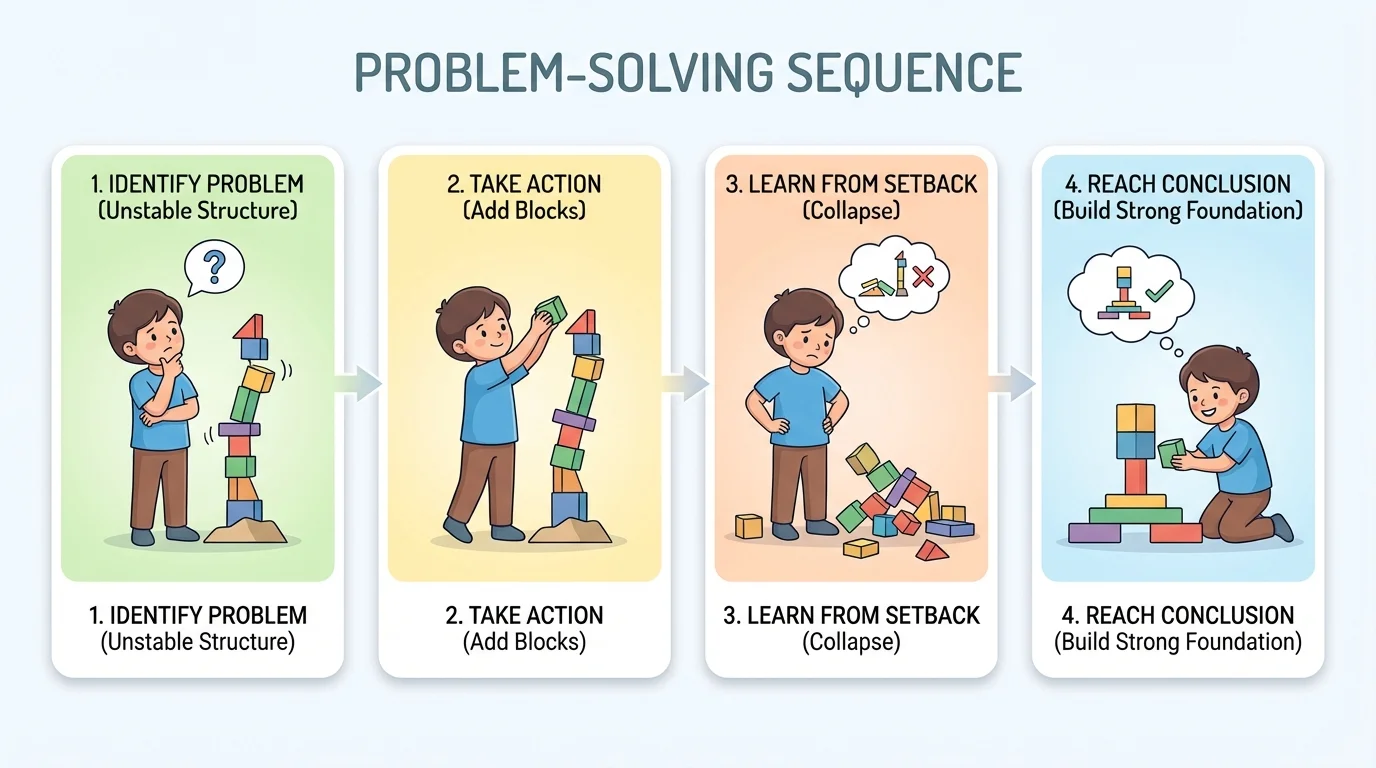
If the same story ended with "Maya decided she actually hated bikes and moved away the next day," readers would feel confused unless the earlier events clearly led there. The conclusion must match the path of the narrative.
This does not mean endings must be predictable. A conclusion can still surprise readers. The surprise just needs to make sense. For example, maybe Maya's brother enters the race too, and at the end she discovers he slowed down to cheer for her. That can be surprising and still fit the story if their relationship was important throughout.
Tracing an ending from events
Story events: Luis forgets his science presentation at home, feels panicked, takes a deep breath, remembers the facts, and gives the talk without his poster.
Step 1: Identify the main problem.
Luis does not have the materials he planned to use.
Step 2: Notice the character's response.
He stays calm enough to think and uses what he knows.
Step 3: Build a conclusion from those events.
A strong ending would show Luis finishing proudly and realizing he can handle unexpected problems.
The conclusion fits because it grows from the experience he had during the narrative.
When you look back at earlier events, you can often see the ending waiting there, like the final piece of a puzzle.
Even a strong idea can feel awkward if the reader is not guided smoothly into it. Transition words help signal movement toward the conclusion. They show time order, change, contrast, and final results.
Writers often use words and phrases such as at last, finally, in the end, afterward, by then, as a result, and from that day on. These transitions can help the ending feel connected to the sequence of events.
| Purpose | Helpful Transition Words or Phrases |
|---|---|
| Show final action | finally, at last, in the end |
| Show result | as a result, because of that, so |
| Show time after events | afterward, later that evening, by then |
| Show lasting change | from that day on, ever since |
Table 1. Transition words and phrases that help readers move naturally into a narrative conclusion.
These words help, but they are not magic. A transition cannot fix an ending that does not make sense. "Finally" before a random event is still random. The events must connect first.
One common mistake is the abrupt ending. This happens when the story stops too quickly. For example: "I opened the door. It was my brother. We stared at each other. The end." Readers are left wondering what mattered about the moment. To fix this, add the result, feeling, or realization that comes from the event.
Another mistake is adding a completely new problem at the end. If a story is about winning back a friend's trust, the ending should not suddenly focus on escaping a thunderstorm unless that event grows naturally from the earlier action.
A third mistake is overexplaining. Some writers repeat every lesson in a long speech to the reader. A better conclusion often shows the meaning through action, dialogue, or detail. Instead of writing, "I learned that teamwork is important and people should trust each other," a writer might show two teammates smiling and passing the ball easily after a game in which they finally cooperated.
Earlier parts of a narrative should include a clear situation, believable characters, and events in sequence. The conclusion works best when it builds on those parts instead of trying to do all the work alone.
Another weak move is using "It was all a dream" when nothing earlier hints at that idea. This ending often feels like a trick because it erases the events instead of concluding them. If a dream ending is used, the story should prepare readers for it in a thoughtful way.
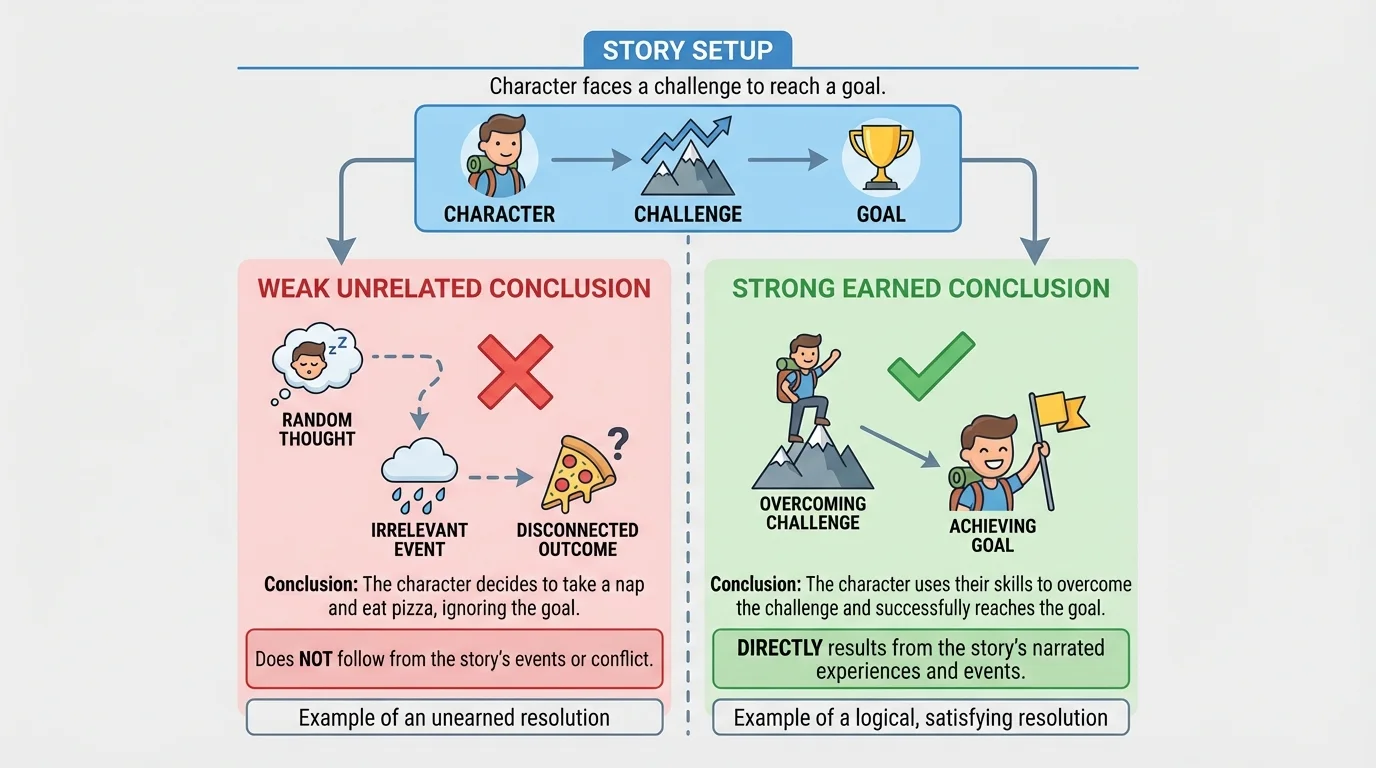
Comparing endings helps writers notice what fits a story, and [Figure 2] presents this clearly by placing a weak ending and a strong ending beside the same story setup. Let us look at a few examples.
Story setup: Nia is scared to dive from the high board. Her cousins tease her, but her aunt teaches her to breathe slowly and try one step at a time.
Weak conclusion: "Suddenly, a dolphin jumped into the pool and everyone forgot about the diving contest." This ending does not follow from the events. It changes the story instead of concluding it.
Strong conclusion: "With her hands trembling, Nia climbed the last ladder rung, looked once at her aunt below, and stepped forward. When she burst up from the blue water, her cousins were cheering, but the loudest sound in her ears was her own laugh." This ending grows from Nia's fear, effort, and courage.
Story setup: Owen tries all week to grow tomatoes for the school garden contest. Too much rain damages his plants, so he builds a small cover from scrap wood with his grandfather.
Weak conclusion: "Then Owen forgot about gardening forever." That ending ignores the effort and relationship built in the story.
Strong conclusion: "At judging time, Owen's tomato plant was not the tallest, but as Grandpa squeezed his muddy shoulder, Owen grinned at the neat wooden cover beside the pot. He had grown more than tomatoes." This ending shows both a result and a deeper meaning.
Notice how the stronger endings use descriptive details, show emotion, and connect to the main experience. The reader can feel why the ending belongs to the story. The difference becomes easier to see: one ending interrupts the story, while the other completes it.
Revising a weak ending
Weak ending: "After the spelling bee, I went home. It was fine."
Step 1: Find what is missing.
The ending does not show the result of the experience, the narrator's feelings, or why the event mattered.
Step 2: Connect the ending to earlier events.
If the narrator practiced for weeks and feared speaking in public, the conclusion should reflect that struggle.
Step 3: Rewrite with a fitting result.
"As Mom buckled my trophy into the back seat, I traced the gold letters with one finger and smiled at the quiet car window. I had missed one word, but I had finally stood at the microphone without shaking."
The revised ending follows from the experience and reveals growth.
Sometimes a conclusion is powerful because it is quiet. Not every ending needs fireworks. A small action, strong image, or changed thought can be enough.
The best conclusion also matches the story's mood. If a narrative is funny, the ending may include a playful final detail. If the story is suspenseful, the conclusion may release tension. If it is thoughtful, the ending may leave readers with a calm realization.
For example, a funny story about baking cookies for a fundraiser might end with the characters accidentally covering the kitchen in flour and laughing at their white footprints across the floor. A serious story about moving to a new town might end with the character placing one favorite book on a new shelf and realizing the room is starting to feel like home.
This is why writers should think not only about what happens, but also about how they want readers to feel at the end. The conclusion should support that feeling honestly.
"A good ending feels surprising, but once you read it, it also feels true."
That idea matters because narratives are not only about events. They are about meaning. The ending helps readers understand what the experience added up to.
When writing or revising a narrative conclusion, reread the beginning and middle first. Look for the character's main challenge, strongest emotion, and biggest change. Then make sure the ending answers those parts of the story.
Use specific details. Let readers hear the gym erupt in applause, smell the rain on the soccer field, or see the flashlight beam steady in a once-shaking hand. These details make the conclusion vivid and believable.
Keep the ending focused. You do not need to explain every future event. You only need to bring this important experience to a meaningful close.
Most of all, ask yourself one important question: Does this ending belong to this story? If the answer is yes, then the conclusion likely follows from the narrated experiences or events.
