Have you ever heard someone say, "My backpack weighs a ton" or "The classroom was a zoo"? No one thinks a backpack really weighs 2,000 pounds, and a classroom usually does not have monkeys swinging from the lights. Yet these sentences make sense to us because readers and listeners know how to look past the exact words and find the deeper meaning. That skill is called interpreting figurative language, and it helps you understand stories, poems, songs, speeches, and even everyday conversation.
Writers do not always choose plain, exact language. Sometimes they want to make an idea stronger, clearer, funnier, or more memorable. If a writer says, "The wind was strong," you understand the idea. But if the writer says, "The wind howled like a wolf," the sentence gives you more than information. It gives you a picture and even a feeling. You can almost hear the wind and sense that it feels wild or scary.
Figurative language helps writers paint pictures with words. It also helps readers connect new ideas to things they already know. When a writer compares a fast runner to a rocket, the comparison helps readers understand speed by thinking about something familiar.
Literal language means exactly what the words say. Figurative language uses words in a creative, non-literal way to suggest an idea, feeling, or image.
When you read figurative language, your job is not to say whether the words are factually true. Your job is to ask, "What is the writer helping me understand here?" That is why context matters so much. The words around the phrase, the situation in the text, and the writer's tone all help reveal the meaning.
Figurative language includes several kinds of comparisons and creative expressions. Two of the most important kinds are similes and metaphors. These both compare things, but they do it in different ways.
A comparison can help readers understand a person, place, action, or feeling. For example, if a story says, "Lena's smile was sunshine," the writer does not mean Lena's smile is a giant star in space. The writer means her smile feels warm, cheerful, and bright. That meaning comes from what we know about sunshine.
Good readers notice that figurative language often depends on context. The same image can mean different things in different situations. "He was a rock" might mean a person was strong and dependable in one story, but in another it might mean he was stiff, quiet, or hard to understand. The words around the phrase guide the meaning.
A simile compares two unlike things using words such as like or as. Similes make descriptions more vivid because they link something unfamiliar or hard to describe with something readers already know well.
Here are some similes: "quiet as a mouse," "slept like a log," and "sparkled like a diamond." In each one, the writer compares one thing to another to highlight a certain quality. A mouse suggests quietness. A log suggests very still, deep sleep. A diamond suggests brightness and shine.
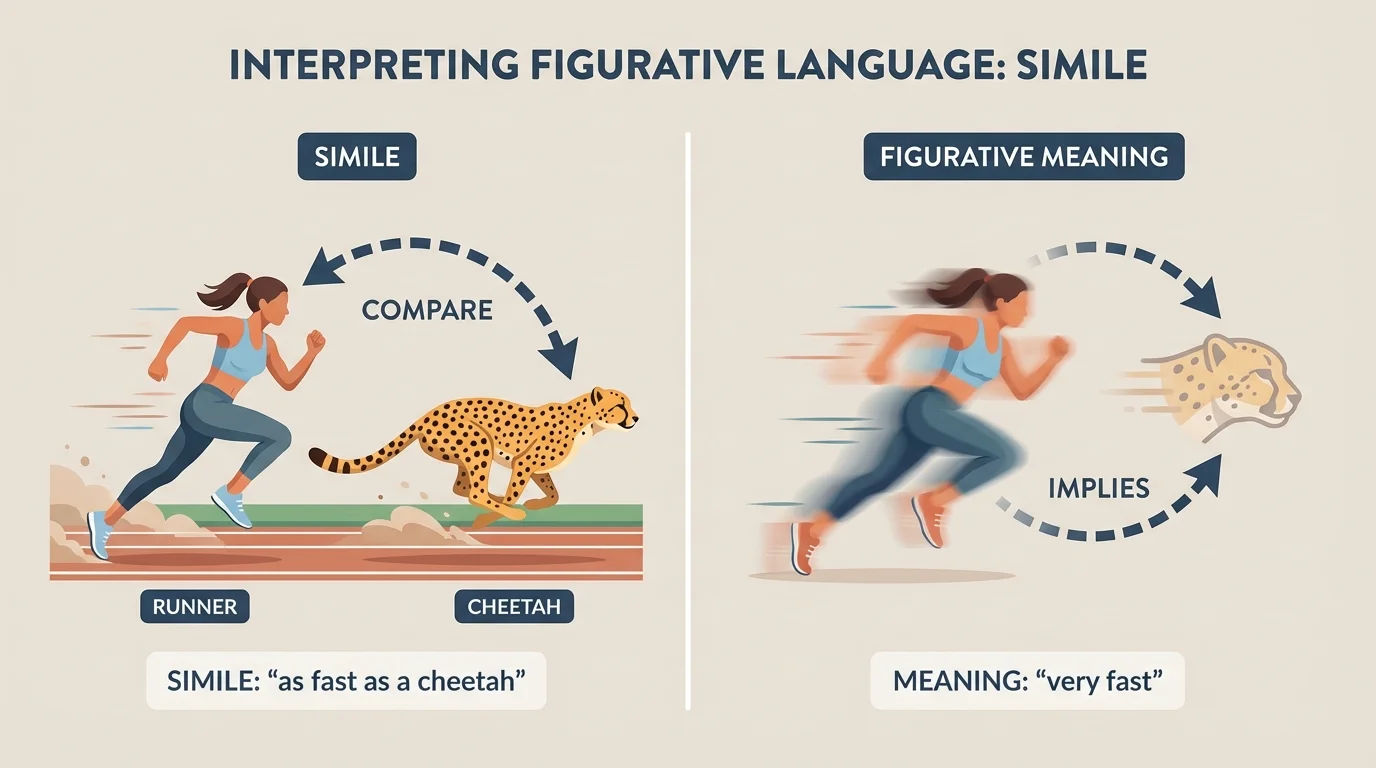
To interpret a simile, ask yourself what quality the two things share. If a story says, "Mia was as busy as a bee," think about bees. Bees move quickly and work constantly. So the simile means Mia was very busy and active.
Sometimes a simile can suggest more than one quality. "The lake was like glass" might mean the lake was smooth and still. It could also suggest the water was clear and shiny. To choose the best meaning, look at the context. If the next sentence talks about the water not moving at all, then "smooth and still" is probably the best interpretation.
Reading a simile in context
Sentence: "After the long hike, Jordan dropped onto the couch and slept like a log until morning."
Step 1: Find the comparison.
The phrase "slept like a log" is the simile.
Step 2: Think about the shared quality.
A log is still and does not move.
Step 3: Use the context.
Jordan had just finished a long hike and was tired.
Step 4: State the meaning.
The simile means Jordan slept very deeply and heavily.
Notice that you do not stop at identifying the simile. You go further and explain what it means in the sentence. That is the real work of interpretation.
A metaphor makes a direct comparison between two unlike things without using like or as. Metaphors can feel stronger than similes because they sound more direct.
For example, in the sentence "The baby is an angel," the writer does not mean the baby has wings and lives in the clouds. The metaphor suggests the baby is sweet, innocent, or well-behaved. In "Our teacher is a lighthouse," the writer means the teacher guides others and helps them find their way.
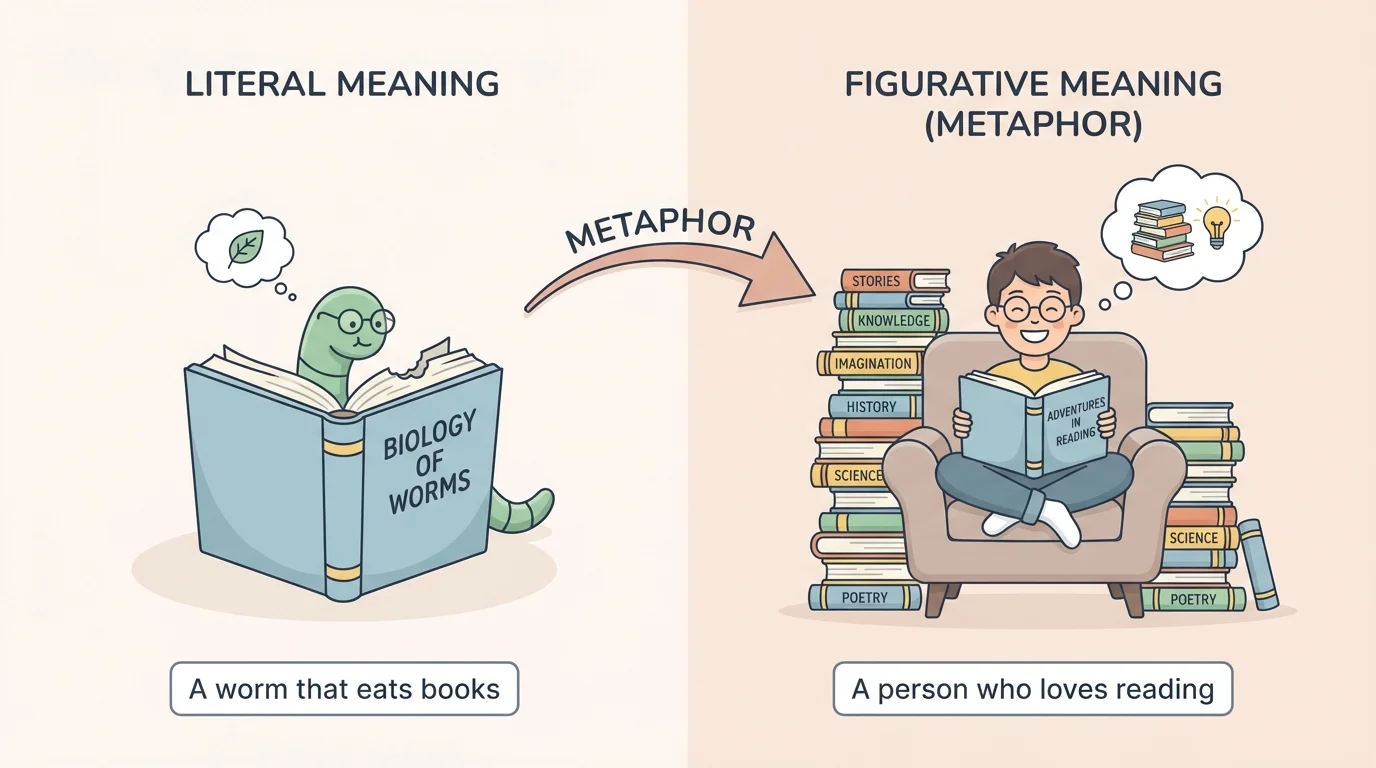
Metaphors often appear in stories and poems because they can pack a lot of meaning into just a few words. If a writer says, "Fear was a shadow following him," the metaphor suggests that fear stayed close, felt dark, and would not leave. The exact meaning depends on what else is happening in the text.
Some metaphors become so common that people hardly notice them. "Time is flying," "She has a heart of gold," and "That test was a breeze" are all metaphors. Even though they sound natural, they still create comparisons. "A heart of gold" suggests kindness and generosity. "A breeze" suggests something easy.
Simile or metaphor? Both compare unlike things, but a simile uses comparison words such as like or as, while a metaphor says one thing is another. "The snow was like a blanket" is a simile. "The snow was a blanket" is a metaphor. Both may suggest that the snow covered everything softly.
This difference matters because the wording affects the tone. A simile can feel more careful and explanatory. A metaphor can feel bolder and more powerful.
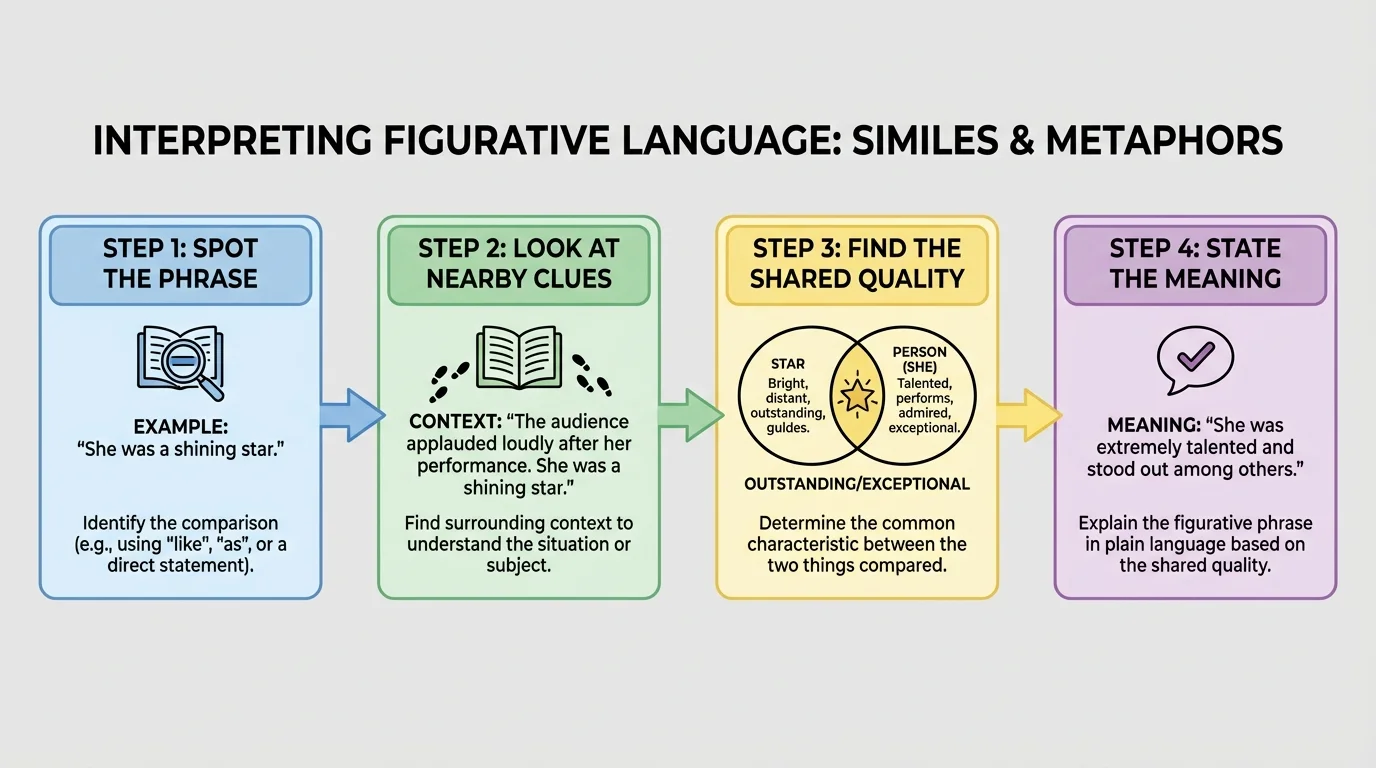
When you meet figurative language, do not guess from just one word. Use a process: spot the phrase, study the nearby clues, ask what is being compared, and then decide what the comparison means in that exact part of the text.
Start by locating the figurative phrase. Next, identify what two things are being compared. Then ask what qualities those things share. Finally, look around the phrase. What is happening in the story? What mood does the author create? What details come before and after the phrase?
Suppose you read: "When the principal walked in, the noisy cafeteria turned into a freezer." The word interpret means to explain the meaning of something. Here, you would not think actual ice appeared. You would notice the context: the cafeteria was noisy, then the principal walked in. "Turned into a freezer" means the room became suddenly quiet, stiff, or uncomfortable.
Context clues can come from action, setting, and feeling. In "Her words were thunder," the metaphor might mean her words were loud. But if the passage says everyone looked nervous after she spoke, the metaphor may also mean her words were powerful or frightening.
Sometimes the same figurative phrase has a different meaning in a different text. "He is on fire" in a basketball article usually means a player is doing extremely well. In a safety report, the same phrase would be literal and very serious. That is why readers always need context.
Using context to interpret a metaphor
Passage: "Nora stared at the blank page. The ideas in her mind were tangled knots. She sighed, then began to list her thoughts one by one."
Step 1: Identify the metaphor.
"The ideas in her mind were tangled knots."
Step 2: Think about the image.
Tangled knots are twisted and hard to sort out.
Step 3: Read the surrounding clues.
Nora is staring at a blank page and then starts listing her thoughts.
Step 4: Interpret the meaning.
The metaphor means Nora's thoughts are confused and difficult to organize.
As you become a stronger reader, you learn to connect the figurative phrase to the whole passage, not just a single sentence.
Two figurative expressions can describe almost the same thing but create different feelings. This difference in shade of meaning is called nuance. Nuance matters because authors choose words carefully.
Compare these sentences: "The hallway was a jungle" and "The hallway was a river." Both could suggest movement and crowding, but the feeling changes. "Jungle" suggests wildness, confusion, and maybe danger. "River" suggests steady flowing motion. The writer's choice shapes the reader's response.
Look at the examples in the table below.
| Figurative phrase | Likely meaning | Tone or feeling |
|---|---|---|
| "Her voice was honey." | Her voice sounded sweet and pleasant. | Warm, gentle |
| "Her voice was sandpaper." | Her voice sounded rough and harsh. | Unpleasant, sharp |
| "The test was a mountain." | The test felt difficult and big. | Overwhelming |
| "The test was a puzzle." | The test required careful thinking. | Challenging but interesting |
Table 1. Examples showing how different figurative phrases can change meaning and tone.
Writers also choose images that fit a theme. In a story about storms and conflict, a writer may compare anger to lightning, thunder, or crashing waves. In a peaceful story, the writer may compare calm feelings to sunshine, feathers, or drifting clouds. These choices are not random. They build mood and meaning together.
Some figurative language becomes part of everyday speech so often that people forget it started as a creative comparison. Phrases such as "breaking the ice" and "a piece of cake" began as figurative expressions, but now many people use them without even noticing.
When you interpret figurative language, pay attention to the emotional effect, not just the basic meaning. If a character says, "My stomach was full of jumping frogs," the idea is probably nervousness, but the image also makes the feeling seem active, jittery, and hard to control.
One common mistake is taking figurative language literally. If a poem says, "The stars danced," readers should not picture stars wearing tap shoes. Instead, they should ask what the image suggests. Maybe the stars seem to twinkle or move brightly across the sky.
Another mistake is using only the comparison word and not the full context. In "He fought like a lion," the point is probably bravery or fierceness. But in a different text, the comparison could suggest loudness or wild movement. The surrounding details help you choose the best meaning.
A third mistake is stopping too soon. Some readers say, "It's a metaphor," and think they are done. Identifying the type is only the beginning. Strong readers explain what the metaphor helps the reader understand and which clues support that interpretation.
When you infer, you use clues plus what you already know. Interpreting figurative language is a kind of inference because you combine the words on the page with your knowledge of the comparison.
This is where evidence matters. If you say a metaphor means a character is lonely, point to details that support your idea, such as the character sitting alone, staying quiet, or feeling left out.
In stories, figurative language often helps describe characters, settings, and emotions. In poems, it can create rhythm, sound, and strong images in a small number of words. In songs, it can make feelings memorable. In speeches, it can make big ideas easier to understand.
Think about these examples. In a poem, "The moon is a silver boat" may create a calm nighttime picture. In a sports article, "The team stormed the field" suggests quick, powerful movement. In conversation, "My room is a disaster zone" exaggerates to show a huge mess. Different kinds of writing use figurative language for different effects.
Earlier, the lesson showed how a simile highlights one shared quality, and that same idea helps in every kind of text. Readers look for the quality the writer wants to emphasize. Likewise, a metaphor often says much more than a literal description because it connects the subject to a strong image right away.
Even everyday sayings can be interpreted through context. If someone says, "I'm drowning in homework," the listener understands that the speaker has too much work, not that water is involved. The setting and situation make the figurative meaning clear.
When you explain figurative language, try using a clear pattern. First, name the phrase. Next, tell whether it is a simile or metaphor if needed. Then explain what is being compared and what quality they share. Finally, connect your explanation to the context of the passage.
For example, suppose a story says, "After losing the game, Carlos carried a storm cloud over his head all day." A strong interpretation would say that the metaphor compares Carlos's mood to a storm cloud. It suggests he feels gloomy, upset, and hard to cheer up. The phrase "after losing the game" supports that idea.
Building a full interpretation
Sentence: "By the time the science fair ended, Ava's legs were noodles."
Step 1: Identify the figurative language.
This is a metaphor because it says Ava's legs were noodles.
Step 2: Find the shared quality.
Noodles are soft, loose, and floppy.
Step 3: Use context clues.
The science fair has just ended, so Ava has probably been standing or moving around for a long time.
Step 4: State a strong interpretation.
The metaphor means Ava's legs felt weak and tired.
A complete explanation is stronger than a short answer because it shows your thinking. It proves that you used the words in the passage instead of guessing.
Interpretation works best as a step-by-step reading habit. You notice the phrase, study the clues, think about the comparison, and explain the meaning clearly. The more you practice this process while reading, the more naturally figurative language begins to make sense.
"A good reader looks beyond the words to the meaning the words create."
Figurative language is one of the ways authors make writing powerful. It turns ordinary sentences into vivid images, helps readers feel emotions more strongly, and allows a short phrase to carry a big idea. When you read carefully and use context, similes and metaphors become clues that open the door to deeper understanding.
