Have you ever been in a group discussion where one person clearly knew the topic, remembered important details, and helped everyone think more deeply? Strong discussions begin before anyone speaks.
A discussion is a shared conversation in which people explore a topic together. In school, discussions may be about a story, a science article, a history event, or a class problem. The goal is not just to talk. The goal is to think with other people.
Preparation matters because it helps you understand the topic before the discussion begins. If you have read the required material or studied the topic, you are more likely to follow the conversation, notice important points, and share useful ideas. You are also better able to ask strong questions. A prepared student does not need to guess what the text says. That student can refer to it with confidence.
Preparation also shows respect. When a class is asked to read a chapter or study notes before talking, everyone depends on everyone else. If only a few students are ready, the discussion stays shallow. If many students are ready, the conversation becomes richer. People can compare ideas, notice patterns, and solve problems together.
Prepared means ready because you have read, studied, thought about, and organized what you know. Evidence is information from a text, lesson, observation, or other reliable source that supports an idea. Collaborative discussion is a discussion in which people work together by listening, speaking, responding, and building understanding as a group.
Think of a sports team. Players do not wait until the game starts to learn the rules. Musicians do not step onto the stage without practicing. In the same way, students should not enter a discussion empty-handed. Good thinking needs preparation.
[Figure 1] Being prepared means more than finishing an assignment quickly. It means understanding the most important ideas and being ready to use them in conversation. When you read or study, you should notice the main idea, important details, examples, and any parts that confuse you.
Suppose your class reads an article about how wetlands help the environment. A prepared student might know that wetlands can reduce flooding, provide homes for animals, and help clean water. That student might also remember an example from the article, such as birds nesting in marshes or plant roots trapping pollution. These details make the discussion stronger.
Preparation often includes writing brief notes. Notes do not need to be long. A few clear ideas can help a lot: one main point, two supporting details, one question, and one connection to something you already know. That is enough to give you something meaningful to say.
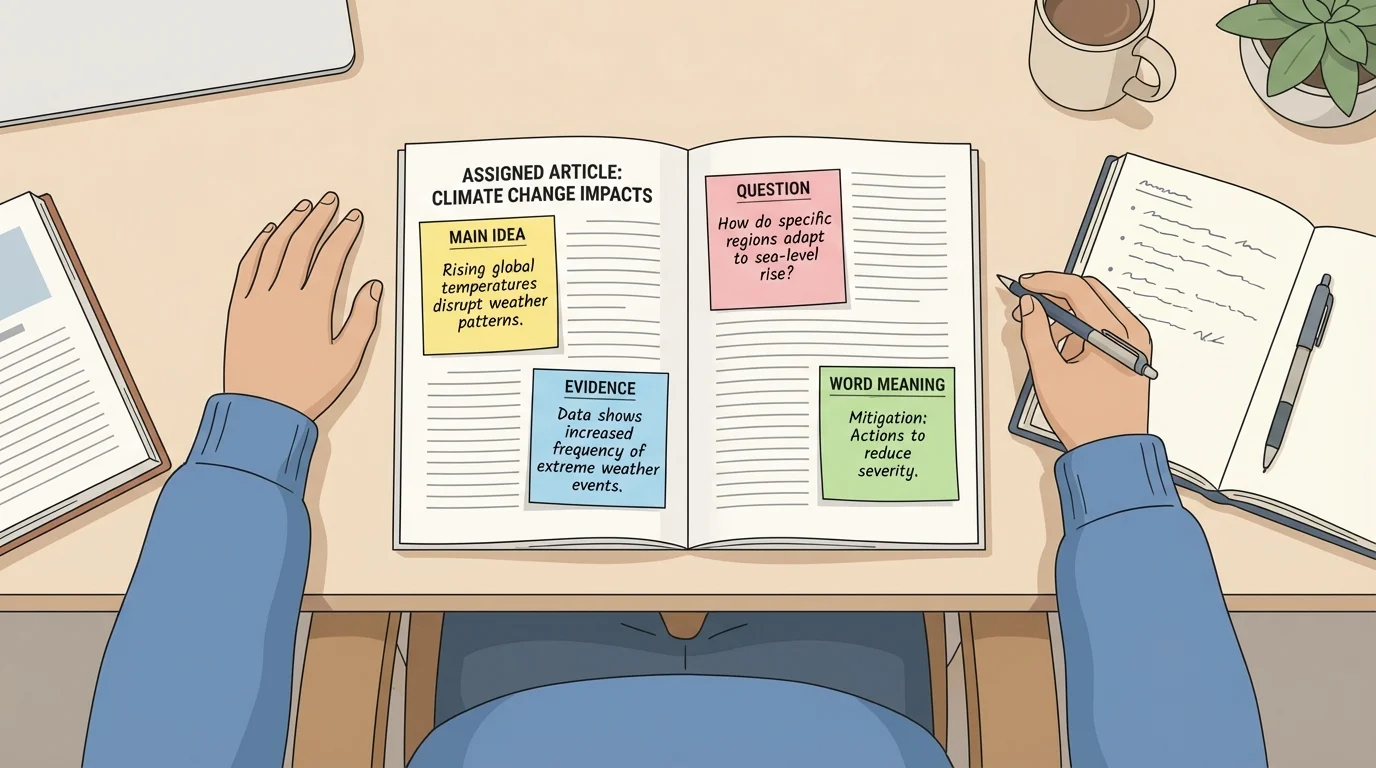
You should also pay attention to unfamiliar words. If a science article uses a technical term or a social studies text includes words you do not know, understanding those words will help you follow the conversation. Sometimes one confusing word can make a whole paragraph hard to understand.
Another part of preparation is thinking ahead. Ask yourself: What is the author mainly saying? What surprised me? What do I agree or disagree with? What question could I ask? These thoughts help you enter the discussion ready to participate instead of waiting for others to do all the thinking.
When you read closely, you already use skills such as finding the main idea, noticing details, and asking questions. Discussion preparation uses those same skills, but now you also get ready to explain your thinking out loud.
Preparation includes other information you already know too. Maybe a text about ecosystems reminds you of a nature documentary, a class experiment, or a trip to a park. Maybe a story about fairness connects to a rule at school. These connections can deepen a discussion when they truly fit the topic.
[Figure 2] Once the discussion starts, your job is to turn preparation into clear speaking. This process moves from reading and note-taking to sharing ideas supported by evidence. Instead of making a vague comment like "It was interesting," a prepared student says exactly what was interesting and why.
You can explicitly draw on your preparation by using sentence starters such as these:
These kinds of statements make it clear that your ideas come from reading or studying, not from random guessing.
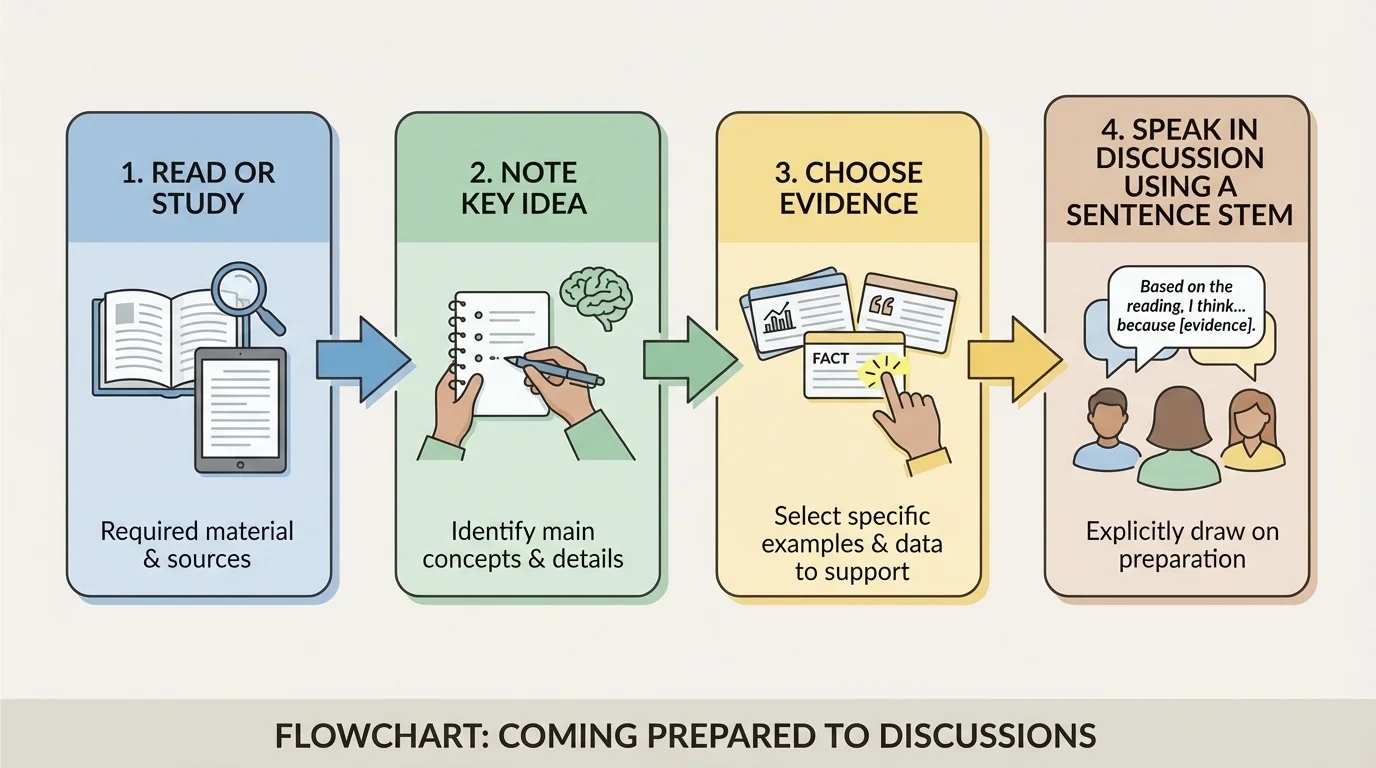
For example, if your class discusses a novel, you might say, "I think the character was brave because in chapter three she protected her friend even when she was scared." That comment is stronger than saying, "She was nice." The first comment gives a claim and support. The second comment is too general.
You can also connect the material to other knowledge. If the class is discussing weather, a student might say, "The text explains that warm ocean water can strengthen storms, and that connects to the map we studied last week about hurricane paths." This shows that the student is not only prepared with one source but is also connecting ideas across lessons.
From preparation to exploration
A discussion is not a quiz where you try to repeat facts exactly. It is a place to explore ideas. Preparation gives you the facts, examples, and questions you need so that your thinking can go deeper. When students bring prepared information into the conversation, they can compare ideas, test opinions, and understand the topic more fully.
It is important to speak clearly and stay focused. Use complete thoughts. Mention the text, article, chapter, or lesson when needed. If you are sharing an opinion, explain what supports it. Opinions in class discussions should be connected to information, not stated without support.
A strong discussion is not a line of speeches. It is a back-and-forth exchange. That means you must listen carefully while others speak. When someone shares an idea, think about how your preparation connects to it.
You can build on someone else's thinking in many ways. You might agree and add more evidence: "I agree with Mateo, and another example from the article is..." You might respectfully disagree: "I see it differently because the text also says..." You might ask a question: "What part of the chapter made you think that?" You might clarify: "Are you saying the main problem was the storm, not the shortage of food?"
This is where preparation helps again. Because you have read or studied the material, you can respond thoughtfully instead of only saying "I agree" or "That's cool." Empty comments do not move the discussion forward. Evidence-based comments do.
Look back at the note-taking idea shown in [Figure 1]. Those notes are useful not only for starting your own comment but also for answering someone else. A question written during reading may become the perfect question to ask a classmate later.
Example: Building on ideas in a science discussion
Topic: Why pollinators matter
Step 1: A classmate says, "Bees help plants grow."
Step 2: A prepared student adds, "Yes, and the article explains that when bees move pollen from flower to flower, many plants can make seeds and fruit."
Step 3: The student extends the idea by saying, "That means pollinators matter to farms too, not just wild plants."
This response builds on the first idea, uses information from the reading, and pushes the discussion further.
Respectful speaking matters too. Even when you disagree, use calm words and focus on the idea, not the person. Say "I interpreted that part differently" instead of "You're wrong." Productive discussions are thoughtful, not rude.
[Figure 3] Discussions do not all feel the same. The roles, pace, and speaking style can change depending on whether you are talking with one partner, a small group, or the whole class. Being prepared helps in every setting, but you may use your preparation in slightly different ways.
In a one-on-one discussion, there are only two people. Each person has more time to speak, and both need to listen closely. Because the group is small, it is easier to ask follow-up questions and explain your thinking in detail.
In a small-group discussion, you need to balance speaking and listening. You may not get as many turns, so it helps to be ready with one or two strong points. You should also notice if someone has not had a chance to speak yet.
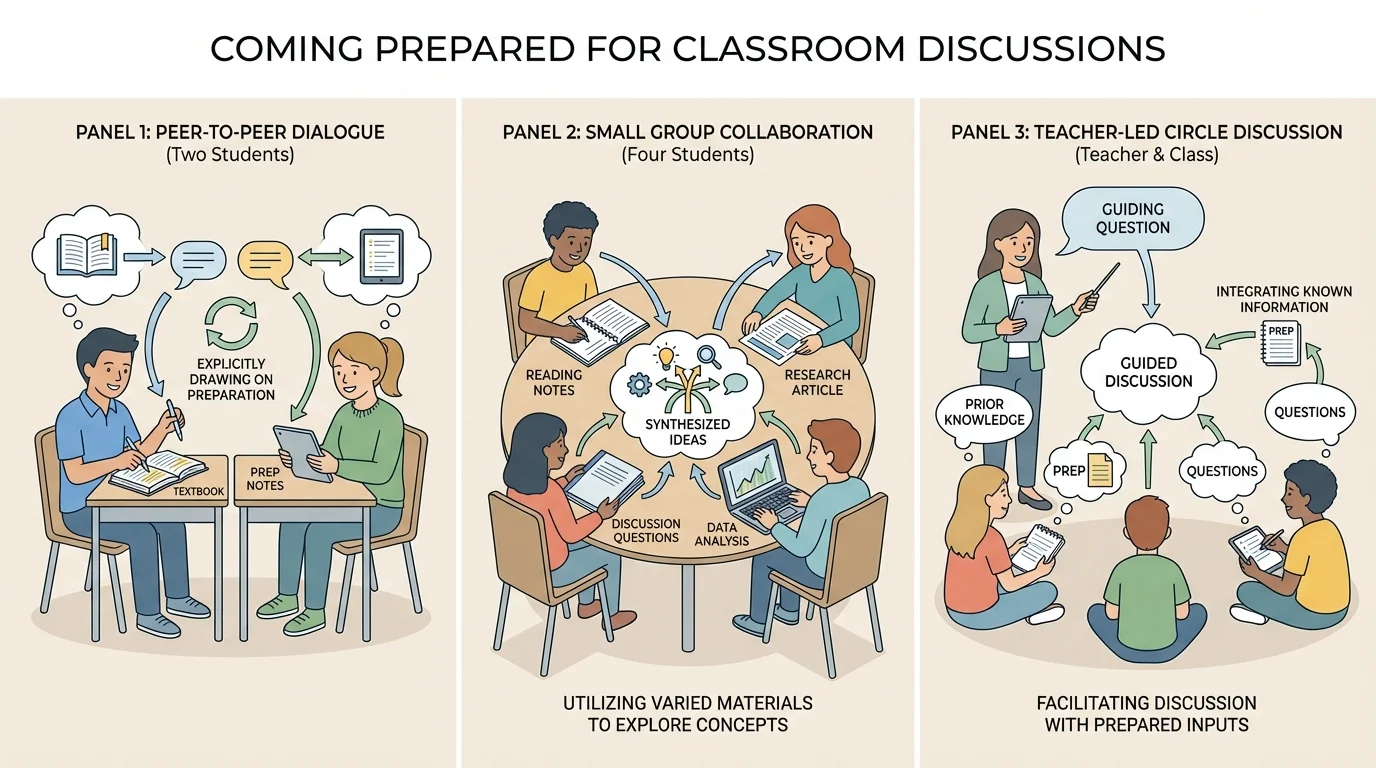
In a teacher-led discussion, the teacher may ask focused questions, call on different students, and guide the topic more directly. You still need evidence from the material, but you may need to answer more quickly and connect your ideas to the teacher's question.
| Discussion situation | What preparation helps you do | What to focus on |
|---|---|---|
| One-on-one | Explain ideas deeply | Ask and answer follow-up questions |
| Small group | Share key points clearly | Take turns and build on others' ideas |
| Teacher-led | Respond with evidence | Stay on the question and speak clearly |
Table 1. Comparison of how preparation supports different discussion situations.
Later, when you think about how to join a group conversation, [Figure 3] remains useful because it reminds you that discussion skills stay important across different classroom setups.
Before a discussion, read or study the assigned material carefully. Then gather your thoughts. Some students underline or highlight. Others jot notes in a notebook. Some make a short list of ideas they want to mention. The method can vary, but the goal is the same: be ready to contribute.
During the discussion, keep your notes nearby if allowed. Listen actively. When someone speaks, connect your prepared ideas to what you hear. Be ready to adjust. Maybe a classmate says something that changes your thinking. That is part of learning.
After the discussion, you may notice that one of your questions was answered, or that you want to reread part of the text. Good discussions often lead to more thinking. Preparation is not wasted if you do not say every note aloud. It still helped you understand the topic better.
Prepared speakers often sound more confident not because they talk more, but because they can point to exact details. A short comment with clear evidence can be more powerful than a long comment with no support.
One useful habit is to prepare three things: one idea, one piece of evidence, and one question. This keeps your notes simple and focused. If the conversation changes direction, you still have something meaningful to offer.
Sometimes students think they are prepared because they looked at the assignment for a minute. But real preparation means understanding, not just glancing. Here are some common problems.
Problem 1: Reading too quickly. If you rush, you may miss key details. Fix it by slowing down and stopping to think after each section.
Problem 2: Speaking without evidence. A comment may sound weak if it does not connect to the material. Fix it by using phrases like "The text says..." or "One example is..."
Problem 3: Going off-topic. Sometimes a connection is interesting but not really related. Fix it by asking yourself whether your comment helps the group understand the main topic.
Problem 4: Repeating what someone already said. Repetition is not always bad, but discussions grow when students add something new. Fix it by agreeing and then extending the idea with another detail, question, or example.
Problem 5: Forgetting to listen. If you only wait for your turn, you miss chances to build on others' ideas. Fix it by paying attention and responding directly.
"Come ready to learn, ready to listen, and ready to add something valuable."
Notice how the speaking process in [Figure 2] helps solve these problems. When students move from reading to notes to evidence-based speaking, they are less likely to wander off-topic or speak without support.
Here are a few examples from school subjects.
Literature: The class discusses why a character makes a difficult choice. A prepared student refers to two events from the story and explains how those events influenced the decision.
Science: The class discusses animal adaptations. A prepared student mentions that the article described camouflage, migration, and body structure, then uses one example such as a polar bear's fur or a bird's beak.
Social studies: The class discusses why people moved to a new region. A prepared student uses details from the textbook about resources, jobs, land, or safety and then connects those details to a map studied earlier.
Example: A strong comment in a social studies discussion
Topic: Why settlements often formed near rivers
Step 1: State the idea clearly.
"I think rivers were important because they helped people meet basic needs."
Step 2: Add evidence from preparation.
"In the reading, we learned that rivers provided water for drinking and farming."
Step 3: Extend the idea.
"They also helped people travel and trade, so settlements near rivers could grow more easily."
This kind of comment is clear, supported, and connected to the topic.
When students prepare well, the whole class benefits. Discussions become more than a list of quick opinions. They become a way to explore ideas, test understanding, and learn together.
