Have you ever tried to convince someone to let your class have extra recess, choose a certain book, or change a school rule? You probably had an opinion, but having an opinion is only the beginning. Strong writers do more than say what they think. They introduce the topic clearly, tell the reader exactly what they believe, and organize their reasons so the writing makes sense from beginning to end.
Opinion writing is everywhere. Students write book reviews, letters, classroom responses, speeches, and essays. Adults write editorials, product reviews, and messages asking for change. In all of these, the writer has a purpose: to convince, recommend, express a point of view, or respond to a text.
Good opinion writing helps readers follow your thinking. If your ideas are mixed up, even a strong opinion can sound weak. If your opening is confusing, readers may not understand what you are writing about. If your reasons are out of order, your argument may feel messy. Strong organization makes your ideas easier to trust.
The main goal of opinion writing is to share a point of view and support it with reasons and information. A strong opinion piece answers three questions for the reader: What is the topic? What does the writer think? Why does the writer think that?
When you write, you are guiding a reader. That means you need to build a clear path. Your reader should not have to guess what your topic is, search for your opinion, or untangle scattered reasons.
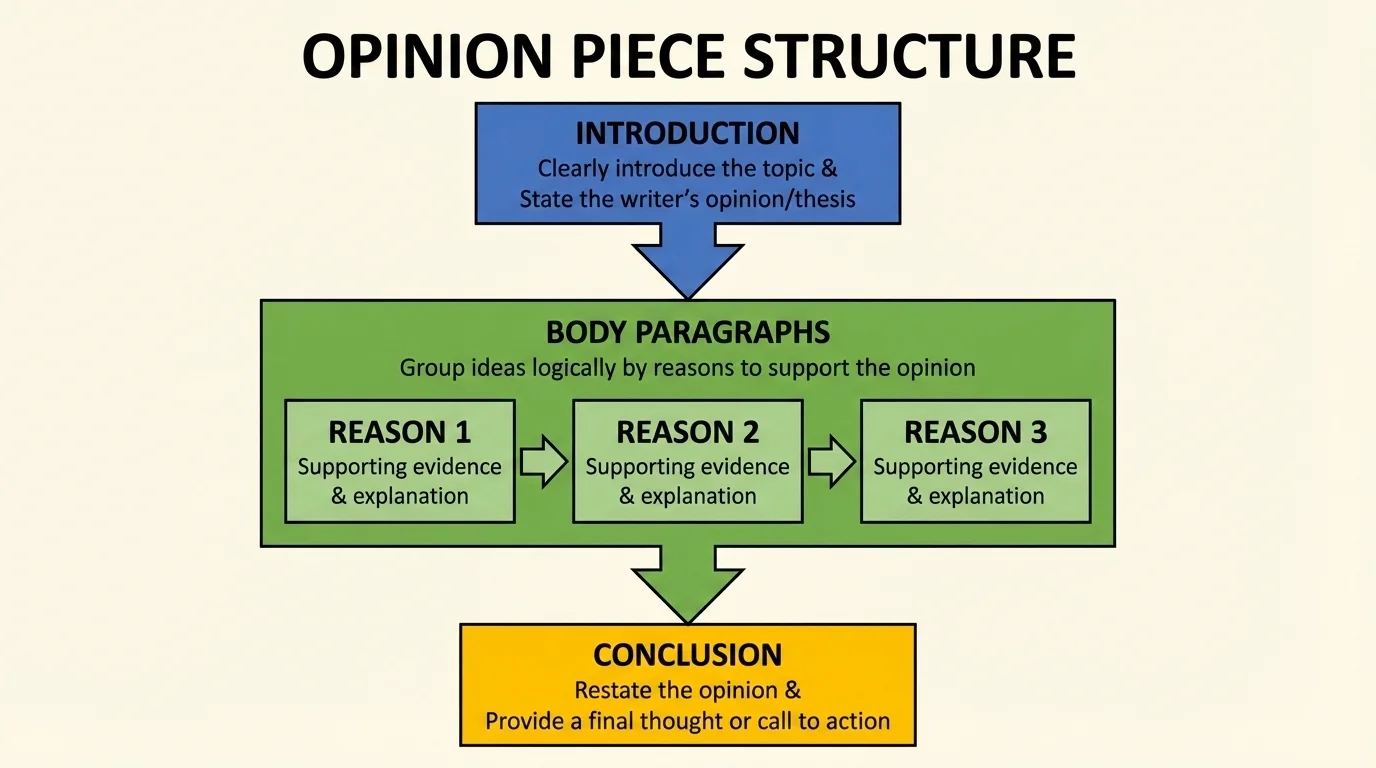
An opinion piece usually follows a clear structure, as [Figure 1] shows. First, the writer introduces the topic or text. Next, the writer states an opinion. Then, the writer organizes reasons and supporting details into body paragraphs that help prove that opinion.
This structure works because each part has a job. The introduction helps the reader understand the topic. The opinion statement tells the writer's position. The body explains and supports that position. A closing can remind the reader of the main point and leave a final thought.
Think of an opinion piece like building a tree. The trunk is your main opinion. The large branches are your reasons. The smaller branches and leaves are your examples, facts, and explanations. If the branches are scattered in the wrong places, the whole tree looks uneven. A good writer keeps each part connected.
The beginning of your opinion piece should help the reader understand what you are writing about right away. A clear introduction does not need to be long. It simply needs to give enough background so the reader is ready for your opinion.
If you are writing about a topic, name it early. For example, if you are writing about whether students should have homework on weekends, say that in the opening. If you are writing about a text, include the title and sometimes the author. For example, a clear beginning might mention the book Because of Winn-Dixie before sharing an opinion about a character or theme.
A weak introduction can confuse readers. For example, this opening is unclear: "Some things are better than others, and people should think carefully." The topic is hidden. A stronger opening is: "Students should have at least twenty minutes of reading practice instead of worksheets because reading builds vocabulary, imagination, and stamina." Now the reader knows the topic and can predict the direction of the writing.
Introduction is the beginning of a piece of writing that presents the topic and prepares the reader for the main idea. Topic is the subject the writing is about. Text means a book, article, story, poem, or other written work a writer may be responding to.
Writers can begin in different ways. They might start with a question, a surprising fact, a short description, or a direct statement. The best opening matches the purpose. A letter to the principal might sound formal and respectful. A classroom response to a novel might begin by naming the story and the character being discussed.
Once the reader knows the topic, the writer needs a clear opinion statement. This is a sentence or a pair of sentences that states what the writer believes. It should be specific enough that readers know exactly where the writer stands.
For example, "Pizza is good" is an opinion, but it is too broad for most school writing. "Our cafeteria should offer pizza on Fridays because it is a popular choice and can be made with healthier toppings" is much clearer. The second sentence gives a position and hints at reasons.
It is also important to know the difference between an opinion and a fact. A fact can be proven true or false. An opinion expresses a belief or judgment. In opinion writing, facts are still useful, but they are used to support the writer's point of view. You might say, "Students need recess because research shows movement helps focus." The opinion is that recess is needed. The research is supporting information.
Clear opinion versus unclear opinion
Step 1: Read the unclear opinion.
"I think the book was interesting."
Step 2: Notice the problem.
The reader does not know why the writer thinks that or what part of the book is being judged.
Step 3: Revise it into a stronger opinion.
"The Wild Robot is an excellent novel because the main character changes in believable ways, the setting feels vivid, and the story raises important questions about survival and kindness."
The stronger version gives a specific opinion and points toward organized reasons.
A strong opinion statement often belongs near the beginning of the piece, usually in the introduction. Readers should not have to search for it. If your main point is hidden halfway through, your writing loses power.
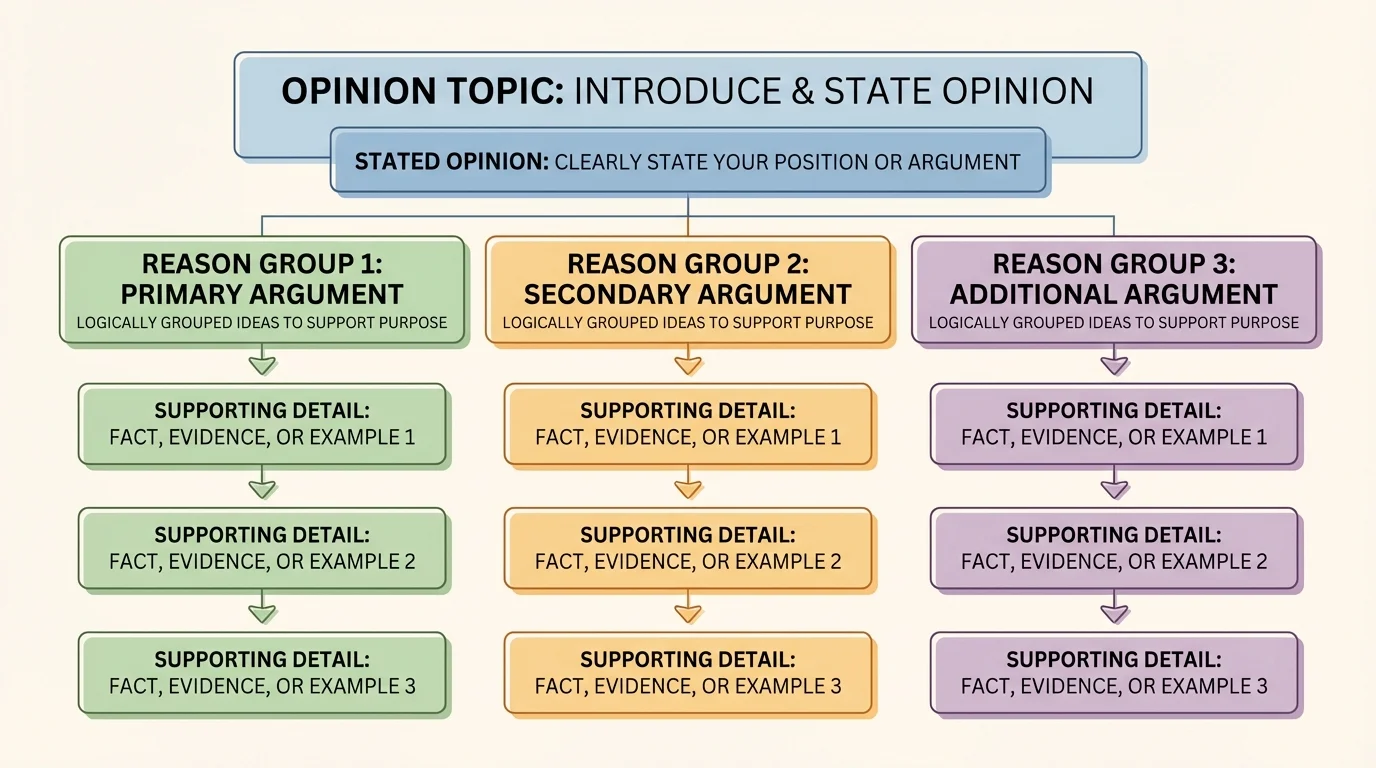
One of the most important writing skills is organizational structure, which means the way ideas are arranged. In opinion writing, the best structure groups related ideas together, as [Figure 2] illustrates. Each reason should have its own space, and the examples that support that reason should stay with it.
Suppose your opinion is that school gardens are a great idea. You might have three reasons: they teach science, they encourage healthy eating, and they build teamwork. Each of those reasons can become its own paragraph or logical group. If you mix all your details together, the reader may feel lost.
Logical grouping means keeping matching ideas together. Details about science lessons belong with the reason about science. Details about vegetables and healthy snacks belong with healthy eating. Details about students sharing jobs belong with teamwork. This kind of grouping helps the reader see how each part supports the whole opinion.
Writers can organize by importance, by categories, or by the order that makes the most sense for the audience. For example, if you are writing to convince a principal to add a school garden, you might start with learning benefits first because principals often focus on education. If you are writing for students, you might begin with the fun and teamwork parts to catch interest.
| Opinion Topic | Reason Group | Supporting Details |
|---|---|---|
| School uniforms | Save time | Students choose clothes faster in the morning; less stress before school |
| School uniforms | Reduce distraction | Less focus on fashion competition; more attention on class |
| School uniforms | Build community | Students feel part of the same school group |
Table 1. An example of grouping reasons and details for one opinion topic.
Notice that each detail fits its reason group. That is what makes the structure logical. As with the grouped boxes in [Figure 2], the writing becomes easier to follow when every detail has a clear place.
After the introduction, the body paragraphs do most of the work. A body paragraph usually begins with a reason that supports the opinion. Then the writer adds examples, facts, details from the text, or explanations.
A good pattern is simple: state the reason, give support, and explain how the support helps prove the opinion. This explanation matters. If a writer gives an example but never explains it, the reader may not understand why it is important.
For example, if your opinion is that the character Charlotte is brave in Charlotte's Web, one body paragraph might focus on how she uses her words to help Wilbur. You would mention specific moments from the story, then explain how those actions show bravery rather than just kindness.
Paragraphs are easier to read when each one stays focused on one main idea. If a paragraph starts with one reason and ends with a different reason, it usually needs revision.
Strong support can include different kinds of information. In a response to a text, support often comes from story events, character actions, dialogue, or themes. In an opinion essay about a real-world topic, support may come from observations, facts, examples, or common experiences the audience will understand.
Transitions are words and phrases that help readers move from one idea to the next. They act like bridges between sentences and paragraphs. They do not create strong ideas by themselves, but they make the structure easier to follow.
Some transitions introduce reasons: first, one reason, another reason, also. Some show examples: for example, for instance, such as. Some connect ideas to the opinion: because of this, this shows, therefore. Some help close the piece: in conclusion, for these reasons.
Transitions should sound natural. A paragraph packed with too many transition words can feel stiff. The goal is not to sprinkle transition words everywhere. The goal is to help the reader move smoothly through your thinking.
Professional writers often revise transitions many times. A single word like however or therefore can change how a reader understands the relationship between two ideas.
When transitions match the structure, the writing feels stronger. If your ideas are grouped by reasons, your transitions can signal each new reason. If your writing compares two viewpoints, your transitions can show contrast.
Writers do not always write for the same people. The audience is the person or group who will read the writing. Your purpose and audience affect the examples you choose, the tone you use, and sometimes even the order of your reasons.
If you are writing to classmates about the best recess activity, your tone can be lively and friendly. If you are writing to the principal about a school policy, your tone should be respectful and more formal. In both cases, you still need a clear topic, a strong opinion, and organized reasons.
For example, a student writing to a principal might say, "Our school should add more shaded benches to the playground because they would improve comfort, safety, and outdoor learning." The same student who is talking to classmates might focus more on comfort and social time. The opinion may stay similar, but the support changes depending on what matters most to the reader.
Purpose shapes structure because writers choose and arrange ideas based on what will best reach the reader. If your purpose is to persuade, begin with strong reasons your audience will care about most. If your purpose is to respond to a text, organize around the parts of the text that best prove your opinion.
Thinking about audience helps you decide what background information to include. A reader who already knows the book may need less plot summary. A reader who knows little about the topic may need more explanation in the introduction.
One common mistake is starting too broadly. An introduction like "There are many things in the world that people care about" does not help the reader much. A better start names the topic quickly.
Another mistake is having an opinion that is too weak or too hidden. If the reader cannot tell what the writer believes, the piece does not work as opinion writing. Make sure your opinion appears clearly near the beginning.
A third mistake is mixing reasons together. A paragraph about school lunches should not jump from nutrition to cafeteria noise to recycling and then back to nutrition without clear organization. Keep each paragraph focused.
Writers also sometimes include details that do not support the opinion. Even interesting facts can distract if they do not help prove the main point. Every sentence should have a job.
Fixing a mixed-up paragraph
Weak version: "School gardens are good because plants grow outside, students like being with friends, and science can be fun. Tomatoes are red. People also need exercise. Gardens can help lunches."
Step 1: Find the main reason for the paragraph.
This paragraph seems to be mostly about learning and health, but the ideas are mixed.
Step 2: Choose one reason for this paragraph.
The writer decides to focus on healthy eating.
Step 3: Keep only matching details and revise.
"One reason school gardens are valuable is that they encourage healthy eating. When students help grow vegetables like tomatoes and lettuce, they become more interested in trying fresh foods. Gardens can also connect to school lunches by showing where healthy ingredients come from."
The revised paragraph is more focused because all of the details support one reason.
Careful revision helps writers notice these problems. Reading your work aloud can also help. If a paragraph sounds jumpy, the ideas may need better grouping.
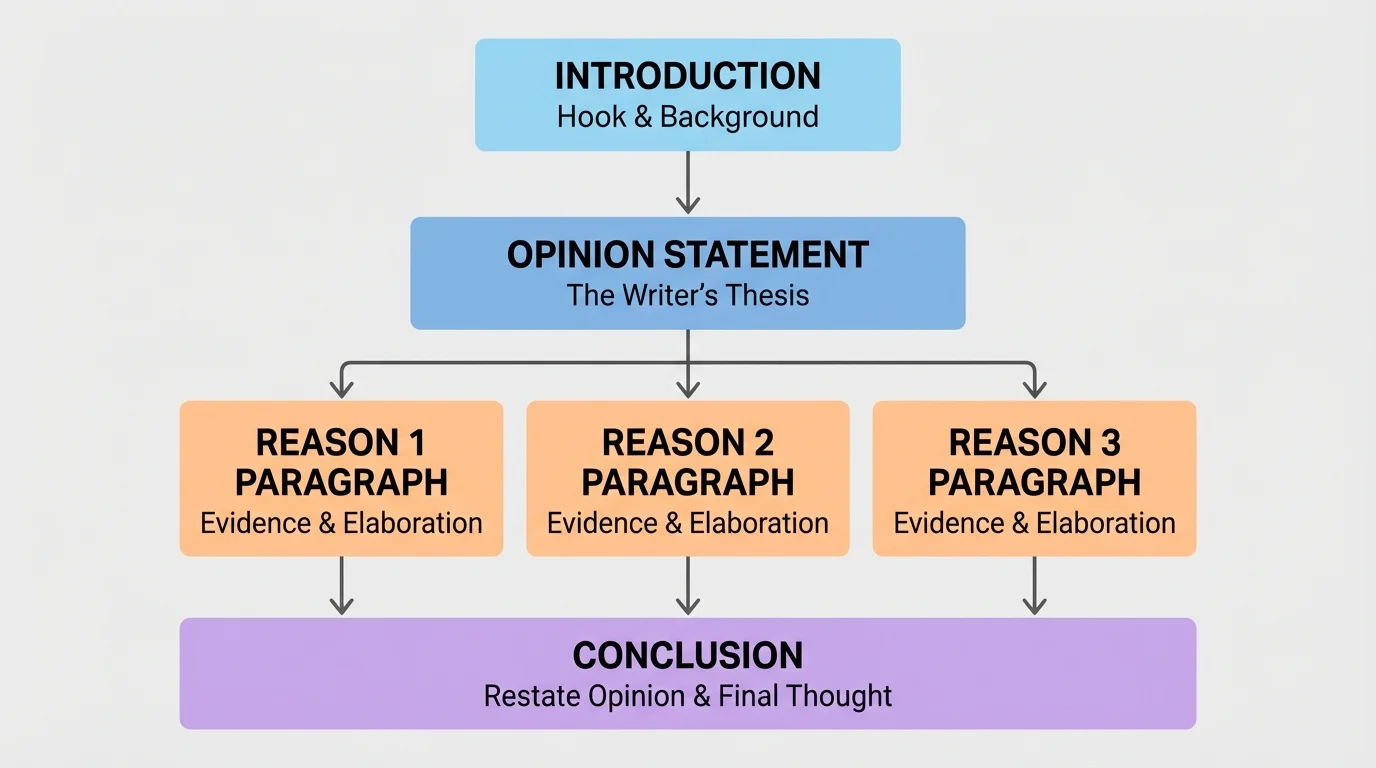
A complete model helps you see how all the parts work together, and [Figure 3] shows that structure as a labeled map. Read this example and notice how the topic is introduced, the opinion is stated, and the reasons are grouped.
Model: "Many schools are searching for ways to make learning more active and meaningful. Our school should create a small garden area because it would improve science learning, encourage healthier food choices, and give students chances to work together. First, a garden would turn science into something students can observe directly. Instead of only reading about roots, soil, and pollinators, students could study them in real life. Next, a garden would support healthier eating. Students are often more willing to taste vegetables when they have helped grow them. Finally, a garden would build teamwork. Students would need to share tools, divide jobs, and care for living things together. For these reasons, a school garden would be a smart addition to our campus."
This model works because the opening sets up the issue clearly. The opinion appears early. The body groups ideas into three reasons: science learning, healthy eating, and teamwork. The conclusion reminds the reader of the writer's position.
If this were expanded into a longer essay, each reason could become its own paragraph. The labels make it easier to notice how each part supports the writer's purpose.
The same structure can work for writing about a text. For example, if your opinion is that a character is responsible, your introduction names the text, your opinion states the judgment, and your body paragraphs group examples from the story that prove the point.
Good writers revise to make their ideas clearer. Revision is not only about fixing spelling or punctuation. It is also about checking whether the writing does its job.
When revising, ask yourself: Did I introduce the topic or text clearly? Is my opinion easy to find? Are my reasons grouped logically? Do my details actually support those reasons? Would my audience understand why this matters?
You can also check whether your structure matches your purpose. If your purpose is to persuade, your strongest reason may need to come first. If your purpose is to respond to a story, your reasons should connect closely to events, characters, or themes in the text.
Strong writing is clear, organized, and purposeful. Readers should be able to follow your ideas from the first sentence to the last without confusion. When your topic is introduced well, your opinion is stated clearly, and your reasons are grouped logically, your writing becomes much more powerful.
