Have you ever tried to read something that seemed to jump all over the place? One sentence talks about sharks, the next talks about oceans in general, and then suddenly it explains pollution with no warning. Even if the facts are correct, the writing feels confusing. Strong informational writing does the opposite. It helps the reader follow the ideas step by step, almost like walking on a clear trail instead of wandering through a maze.
When you write to inform, you are teaching your reader. That means your job is not just to collect facts. Your job is to present those facts in a way that is clear, focused, and easy to understand. Good informative writing introduces the topic, gives a general observation, narrows to a focus, and then groups related information so the reader can learn without getting lost.
Writers use many tools to make this happen. They build organized paragraphs, add headings, choose exact words, and sometimes include charts, illustrations, or multimedia. All of these features work together to help the reader understand a well-developed topic.
Informational writing appears everywhere: science articles, websites about animals, history textbooks, game guides, museum signs, and even instruction manuals. In each case, the reader wants to learn something. If the writer is clear, the reader learns quickly. If the writer is disorganized, the reader may stop reading or misunderstand the information.
A strong informational piece usually answers three important questions for the reader: What is this about? What should I pay attention to? and How do these details fit together? When writers answer those questions well, their writing feels trustworthy and useful.
Informative/explanatory writing is writing that teaches readers about a topic by explaining ideas, facts, details, and examples clearly. A focus is the specific part of the topic the writer chooses to emphasize. Organization is the way the writer arranges information so related ideas stay together.
Think of a nonfiction book about space. A reader does not want random facts scattered across the page. The reader wants a path: perhaps first an introduction to the solar system, then planets grouped by type, then details about each planet. That kind of order helps information stick in the mind.
Every strong piece begins with a topic, but a topic alone is often too big. Writers must guide readers from the big idea to the exact subject they will explain. As [Figure 1] shows, a writer often starts broad, gives a general observation, and then narrows the writing to a focused part of the topic.
A general observation is a broad statement that helps introduce the topic. It gives readers a starting point. For example, if the topic is rainforests, a general observation might be: "Rainforests are some of the most diverse ecosystems on Earth." That sentence opens the door. It tells the reader the subject matters and gives a big-picture idea.
After the general observation, the writer should present a clear focus. Instead of trying to explain every possible fact about rainforests, the writer may narrow the focus to layers of the rainforest, animals that live there, or why rainforests are important to Earth's climate. A focused statement might say: "This report explains how the different layers of the rainforest provide homes for many kinds of animals." Now the reader knows exactly what to expect.
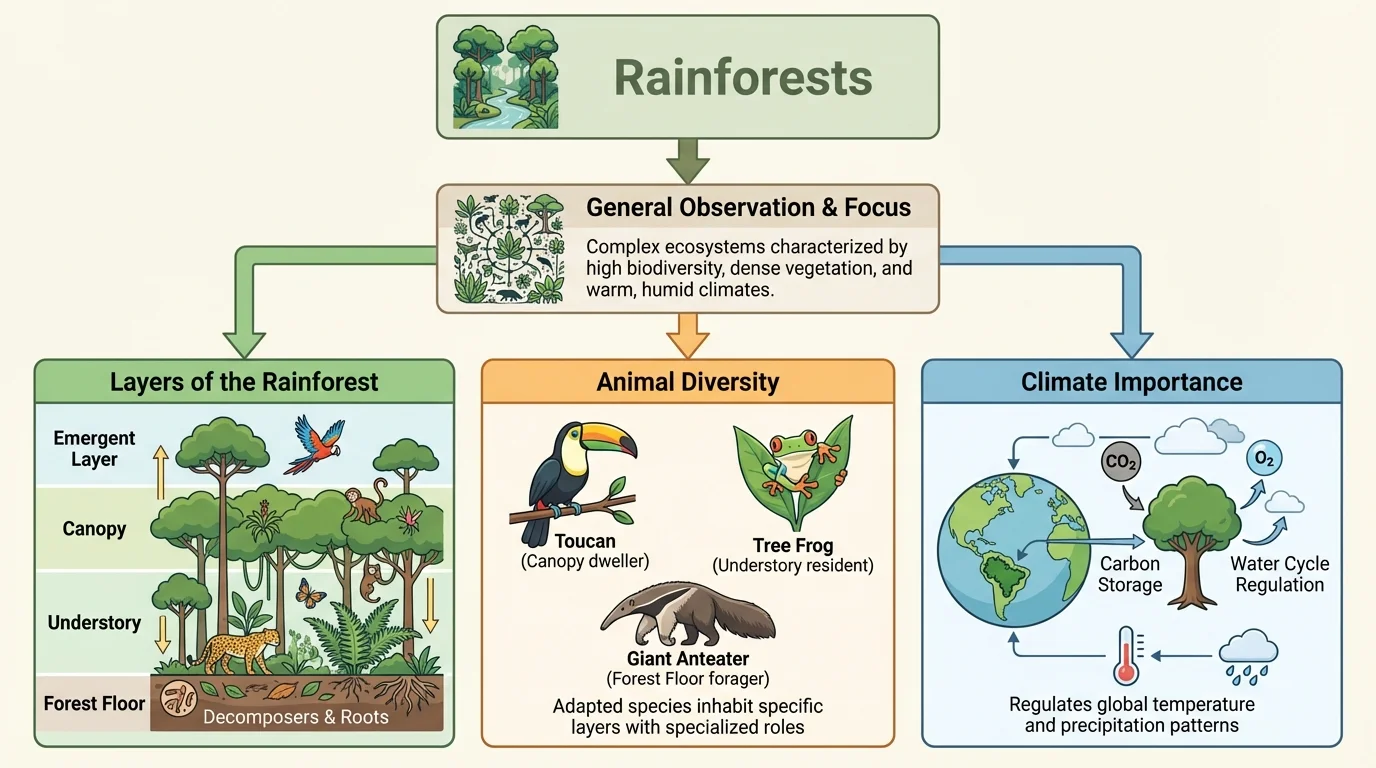
Notice what happened in that example. The topic was broad, but the focus became specific. This is important because a piece that tries to explain everything often explains nothing well. A clear focus helps the writer choose which facts belong and which facts should be left out.
Here is another example. A broad topic is volcanoes. A general observation could be: "Volcanoes are powerful landforms that can change Earth's surface." A stronger focus could be: "This article explains how volcanoes form and what happens during an eruption." That focus tells the reader the main idea and points toward the sections that will follow.
Example: Broad topic to clear focus
Step 1: Start with the broad topic.
Topic: Weather
Step 2: Add a general observation.
"Weather changes from day to day and affects how people live."
Step 3: Narrow to a focus.
"This piece explains how hurricanes form and why they can be dangerous."
The final focus is much clearer than simply saying the writing is about weather.
A clear beginning helps every part of the piece that comes after it. If your focus is how hurricanes form, then details about snowstorms probably do not belong. The focus acts like a filter that helps you decide what information to include.
Once the topic and focus are clear, the next job is to arrange the information. Readers learn best when related ideas stay together, as [Figure 2] illustrates through categories that sort details before drafting begins. Good organization means that facts about one part of the topic are grouped in the same section or paragraph instead of being mixed with unrelated details.
Writers often organize information by categories. For example, if you are writing about bees, your categories might be body parts, jobs in the hive, pollination, and threats to bee populations. Each category becomes its own section or paragraph. This makes the writing easier to follow because the reader can learn one part at a time.
Another way to organize is by sequence, especially when you are explaining a process. If you are writing about the water cycle, it makes sense to explain evaporation, condensation, precipitation, and collection in order. Sequence works well when events happen in steps.
Writers can also organize by cause and effect, compare and contrast, or problem and solution. A piece about plastic pollution might explain what causes the problem, what effects it has on oceans and animals, and what solutions people are trying. The key is to choose the structure that best fits the topic and helps the reader understand it.
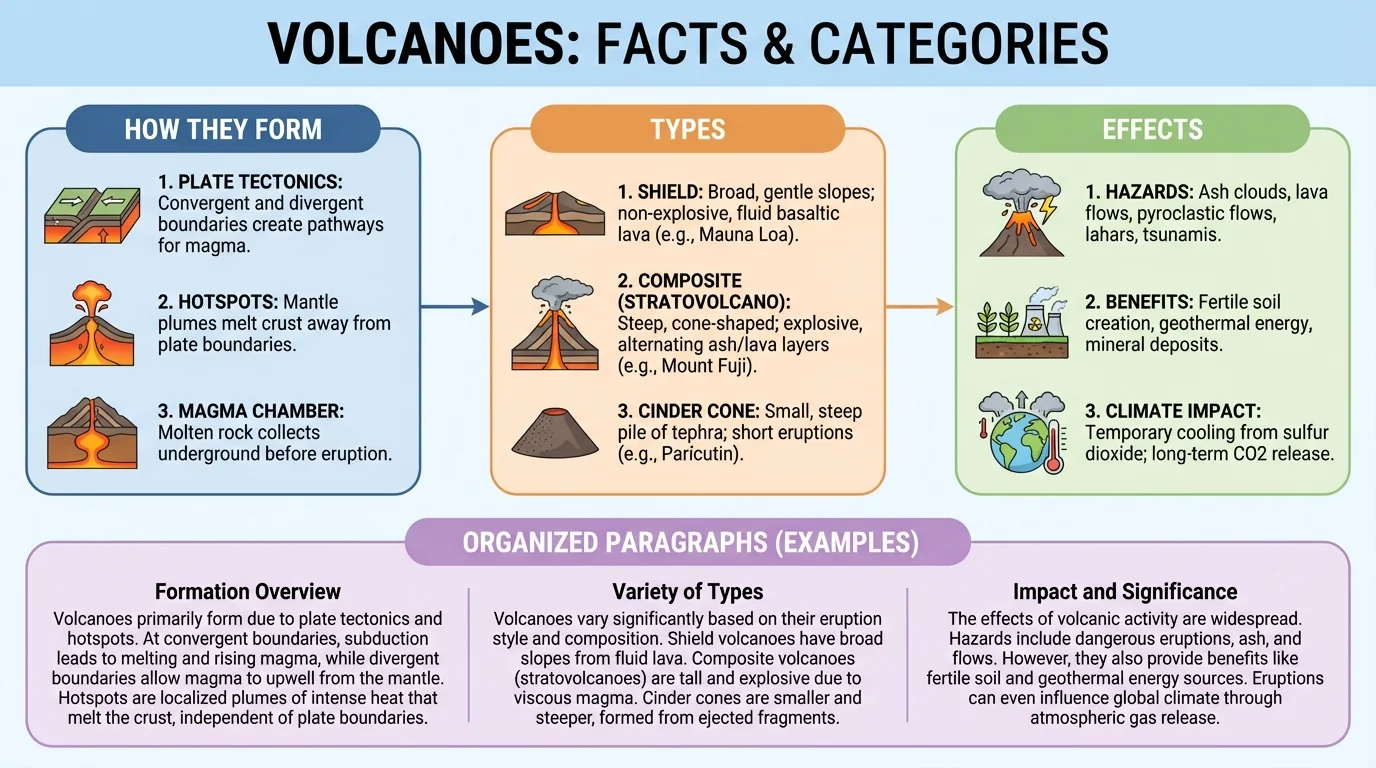
Paragraphs are part of this organization. Each paragraph should usually center on one main idea. If a paragraph begins about volcano formation but ends with a discussion of emergency shelters, the ideas are not grouped well. That is a sign the writer should separate the information into different paragraphs or sections.
Transitions help connect those groups of information. Words and phrases such as another important feature, for example, because of this, and in contrast show readers how one idea links to the next. Organization is not only about where information goes; it is also about how smoothly the reader moves between ideas.
The categories in [Figure 2] remind us that strong writers often sort their notes before drafting. That sorting step saves time because it reveals where each fact belongs.
As [Figure 3] shows, informational writers do more than write sentences and paragraphs. They also use text features to guide the reader through the information. Text features are parts of a text that help organize or explain information.
One important text feature is the heading. Headings tell the reader what each section is about. A heading like How Bees Help Plants prepares the reader for information about pollination. Subheadings break the section into even smaller, useful parts.
Other helpful text features include bullet lists, captions, bold words, diagrams, labels, tables, and side notes. These features do not replace strong writing, but they support it. A reader can quickly spot the important sections and understand how ideas are grouped.
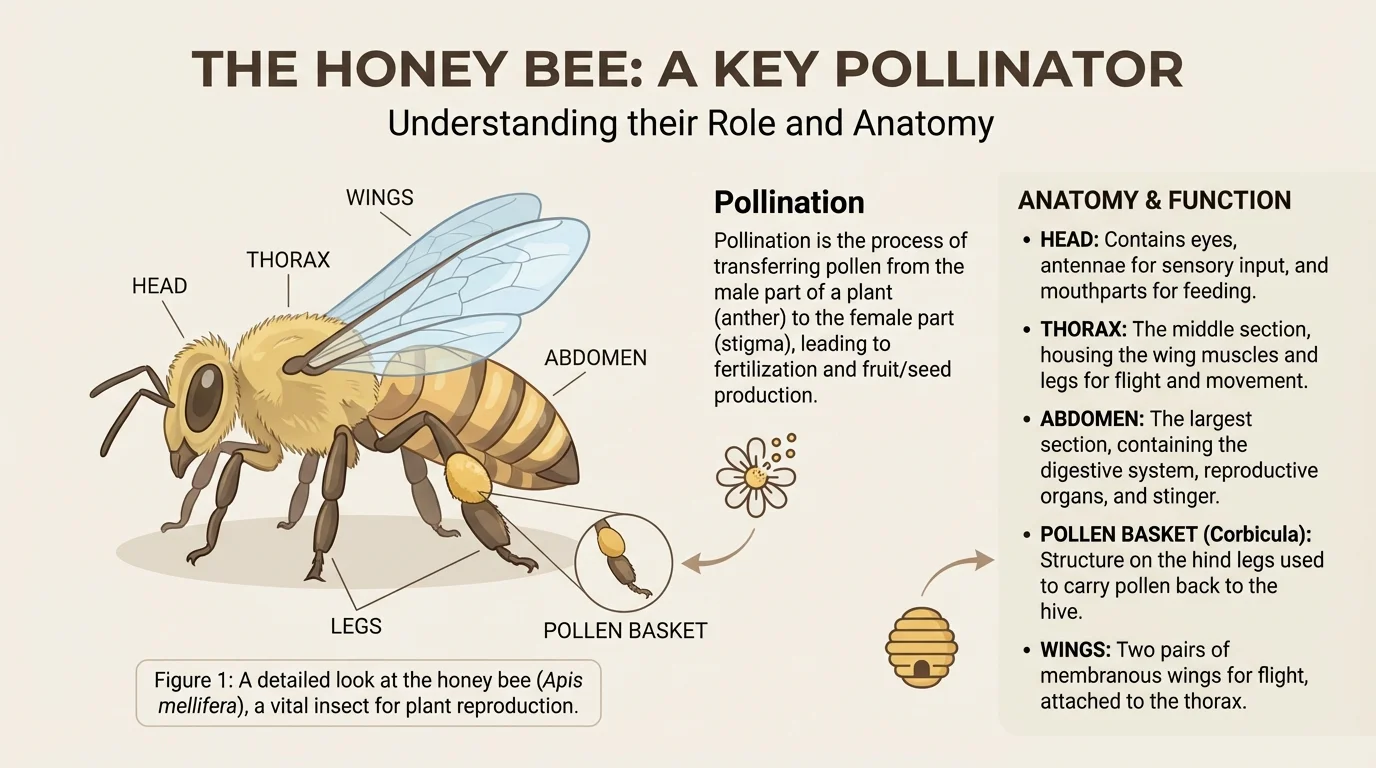
Suppose you are writing about animal adaptations. A heading called Camouflage tells the reader that the next section is about blending in. A caption under a photo can explain what the picture teaches. A bold word such as predator can highlight an important term. These features make the page more useful, especially when the reader wants to review one part quickly.
Tables are especially useful when readers need to compare information side by side. Look at the table below.
| Text Feature | What It Does | Example Use |
|---|---|---|
| Heading | Names a section | "Kinds of Renewable Energy" |
| Subheading | Breaks a section into smaller parts | "Solar Power" under a larger energy section |
| Caption | Explains an illustration or photo | Tells what a diagram of a plant root shows |
| Bold word | Highlights an important term | Habitat |
| Bullet list | Presents several related points clearly | Steps in recycling paper |
| Table | Compares details in rows and columns | Comparing planets by size and temperature |
Table 1. Common text features and how each one helps readers understand information.
As the layout in [Figure 3] makes clear, text features work best when they match the information. A heading helps organize sections, but a table helps compare data. A caption helps explain an image, but a bullet list helps present several related points quickly.
Readers often decide where to begin on a page by looking first at headings, bold words, and captions. Strong text features act like signposts that tell the reader where important information can be found.
Using text features well shows that the writer is thinking about the reader's experience. Good writers ask, "What will help someone understand this most easily?" Then they choose features that fit the purpose.
Clear organization is powerful, but word choice matters too. Informational writing should use precise language, which means words that say exactly what the writer means. Instead of writing "a big storm," a more precise phrase might be "a hurricane with strong winds and heavy rain." Precise language reduces confusion.
Writers also use domain-specific vocabulary. These are words used in a particular subject area. In science, words such as evaporation, mammal, and erosion are domain-specific. In geography, words such as climate, region, and resources are domain-specific. These words help explain the topic accurately.
However, precise and domain-specific words should still be understandable. Writers often introduce the special word and then explain it in simpler language. For example: "Pollination is the process that moves pollen from one flower to another, helping plants make seeds." The special term is there, but the sentence also teaches what it means.
Exact words build trust. When a writer uses precise language, the reader can picture the idea more clearly and learn more accurately. Vague words such as stuff, things, or a lot can make writing sound weak because they do not tell enough. Exact nouns, verbs, and adjectives make informative writing stronger.
Compare these two sentences: "Animals do things to stay safe." "Some animals use camouflage, venom, or speed to avoid predators." The second sentence is stronger because it names the methods clearly. Precise language helps the reader learn specific facts instead of guessing.
This kind of word choice also supports organization. If your sections use exact terms, the reader can understand the difference between them more easily. That is one reason strong headings and precise vocabulary often work together.
Sometimes words alone are not the easiest way to teach a topic. Useful visuals and multimedia can make information clearer, and [Figure 4] illustrates how a written explanation becomes stronger when it is paired with the right kind of support. Illustrations, diagrams, charts, audio, or short videos should always help the reader understand a specific idea.
An illustration can show parts of a plant, layers of the Earth, or the life cycle of a butterfly. A chart can compare temperatures in different climates. A short video can help explain a process that changes over time, such as how a volcano erupts or how a machine works. Multimedia is useful when motion, sound, or change over time matters.
But visuals should not be added just because they look interesting. They should have a clear job. If you include a diagram of the water cycle, the diagram should match the explanation in the text. The labels and caption should support the same focus the writing has already introduced.
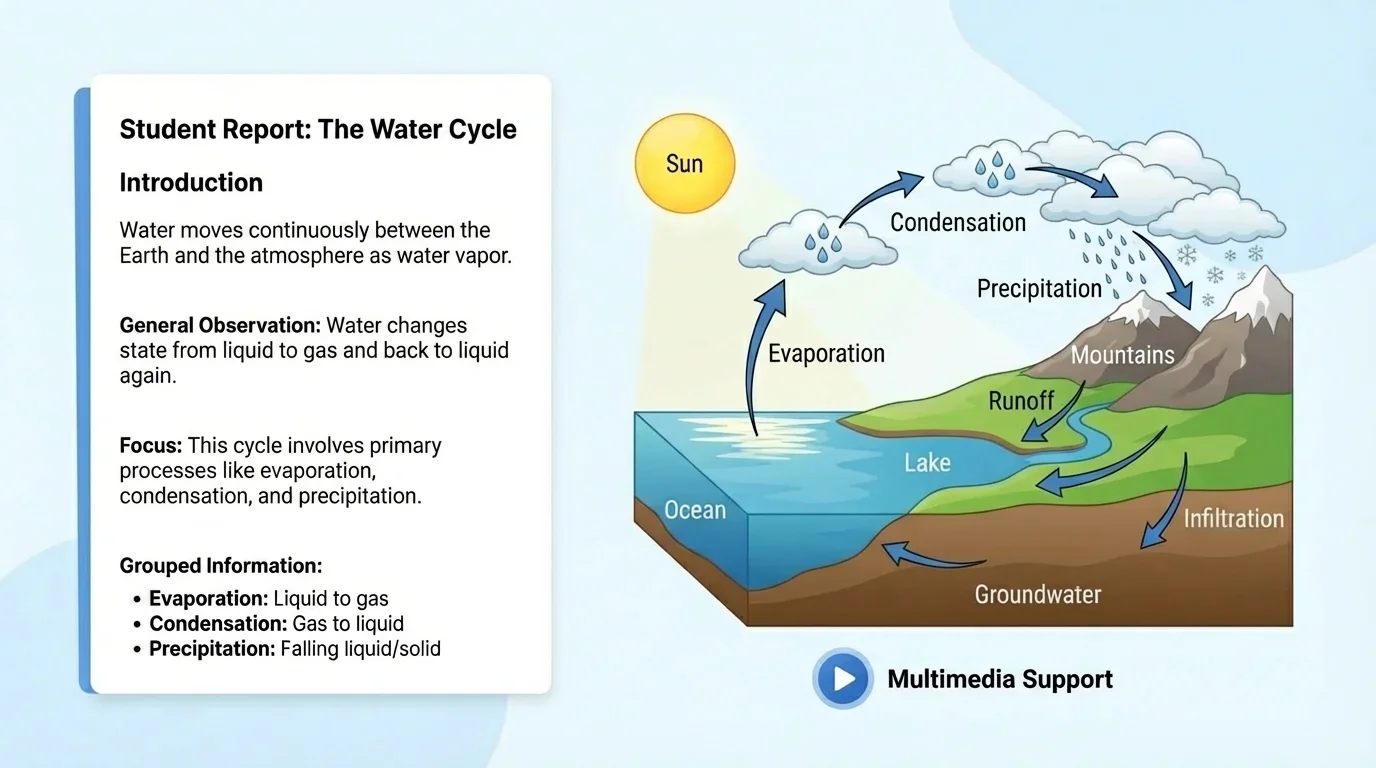
For example, if you are writing about the water cycle, a labeled diagram can help the reader see where water moves in nature. That visual support makes the sequence easier to understand than a paragraph alone might. This is especially true for readers who learn well through images.
If a piece explains how something changes step by step, a diagram or multimedia element can be powerful. The water-cycle support in [Figure 4] works because it is directly tied to the written explanation. The visual is not random decoration. It teaches.
Captions matter here too. A good caption tells what the illustration shows and why it matters. Without a caption, a reader may see the picture but miss the point.
Even when a whole piece is organized well, each paragraph must also be clear. A strong informational paragraph usually begins with a topic sentence that tells the paragraph's main idea. After that, the writer adds facts, details, definitions, or examples that support the topic sentence.
Here is a model pattern for an informational paragraph: begin with the main point, add supporting details, explain those details if needed, and end with a sentence that wraps up the idea or leads to the next paragraph. This pattern helps readers follow the writer's thinking.
Example: One clear paragraph
Topic: Why bees are important
Step 1: Topic sentence
"Bees are important because they help many plants reproduce."
Step 2: Supporting detail
"When bees move from flower to flower, they carry pollen."
Step 3: Explanation
"This process, called pollination, helps plants make fruits and seeds."
Step 4: Closing sentence
"Without bees, many crops and wild plants would struggle to grow."
Every sentence supports the same main idea, so the paragraph stays focused.
Notice that the paragraph does not suddenly switch to how honey tastes or where bees live in winter. Those could be good ideas, but they belong in different paragraphs unless the focus connects them directly.
When writers group related details inside each paragraph, the whole piece becomes stronger. This is the same idea we saw earlier with categories in [Figure 2]: information makes more sense when each part stays with related details.
Good writing often begins long before the first draft. Writers collect facts, ask questions, and take notes. Then they sort the notes into groups based on the focus of the piece. This is where headings and categories begin to take shape.
Suppose a student is writing about sea turtles. The notes might include body features, life cycle, habitats, threats, and conservation efforts. Those note groups can become sections. A writer who plans this way is less likely to repeat ideas or place them in confusing spots.
Before learning this skill, you may already have practiced writing paragraphs with main ideas and details. Informational writing builds on that earlier knowledge by extending it to whole sections, text features, and carefully chosen vocabulary.
During drafting, the writer turns each note group into connected sentences and paragraphs. During revision, the writer checks whether the introduction clearly gives the topic and focus, whether each section stays on one part of the topic, and whether the text features truly help the reader.
Revision is where many strong pieces are made. A writer may realize that two paragraphs belong under one heading, or that a table would explain a comparison better than a long paragraph. The writer may also notice vague words and replace them with more precise terms.
One common problem is an introduction that names a topic but does not provide a focus. If a report begins with "Dogs are interesting animals," the reader still does not know what the piece will explain. A stronger beginning would narrow the purpose: "This report explains how service dogs are trained to help people."
Another problem is mixing unrelated ideas in one section. A paragraph about volcano eruptions should not suddenly shift to mountain climbing safety unless the focus of the piece includes that connection. When ideas get mixed, the writer should sort them into separate groups.
Writers also sometimes use headings that are too broad or too unclear. A heading such as More Information does not help much. A heading such as How Volcanoes Form is much more useful because it tells the reader exactly what that section covers.
Weak word choice can also blur meaning. If a writer says "plants need stuff from bees," the reader learns very little. If the writer says "many flowering plants need pollination from bees," the meaning becomes more exact and more scientific.
"Clear writing is clear thinking made visible."
Finally, some writers add illustrations or multimedia that do not connect to the main explanation. A picture of a rainforest is not automatically useful unless it helps explain the focus of the piece. The best visuals, like the organized supports we saw in [Figure 4], directly strengthen understanding.
Strong informative/explanatory writing is built with choices: clear beginning, focused topic, logical groups, helpful text features, exact words, and visuals that teach. When these parts work together, the writing does more than share facts. It helps the reader truly understand the topic.
