Have you ever heard two people say the same idea in completely different ways? One person might say, "I am not going," while another says, "I ain't goin'," and a poet might write, "I shall not walk that road." All three can mean nearly the same thing, but they sound different because English has many varieties. Writers use those varieties on purpose. In stories, dramas, and poems, language helps us learn who is speaking, where they are from, how they feel, and what kind of text we are reading.
English is not just one single way of speaking and writing. People change their language depending on where they live, who they are talking to, and why they are communicating. A child talking to a friend may sound very different from a judge in a courtroom, a grandparent telling a family story, or a poet writing about the moon. These are all forms of English, but they are not all the same kind.
When we compare varieties of English, we look for both similarities and differences. We ask questions like these: Are the words formal or casual? Do the speakers use grammar that sounds regional or local? Does the writer choose short, natural speech or carefully shaped poetic lines? Is the meaning clear from context, or do we need to study the words more closely?
Variety of English means a form of English used by a particular group, place, or situation.
Dialect is a variety of language connected to a region or group. It may have its own pronunciation, grammar, and vocabulary.
Register is the level or style of language used for a particular purpose or audience, such as formal, informal, or poetic language.
Context is the surrounding words, situation, or background that helps a reader understand meaning.
Convention is a usual rule or pattern in language, such as punctuation, grammar, or spelling.
Knowing these ideas helps us become stronger readers. Instead of thinking a different kind of English is "wrong," we learn to notice how it works. Good readers pay attention to the writer's choices and ask what those choices add to the text.
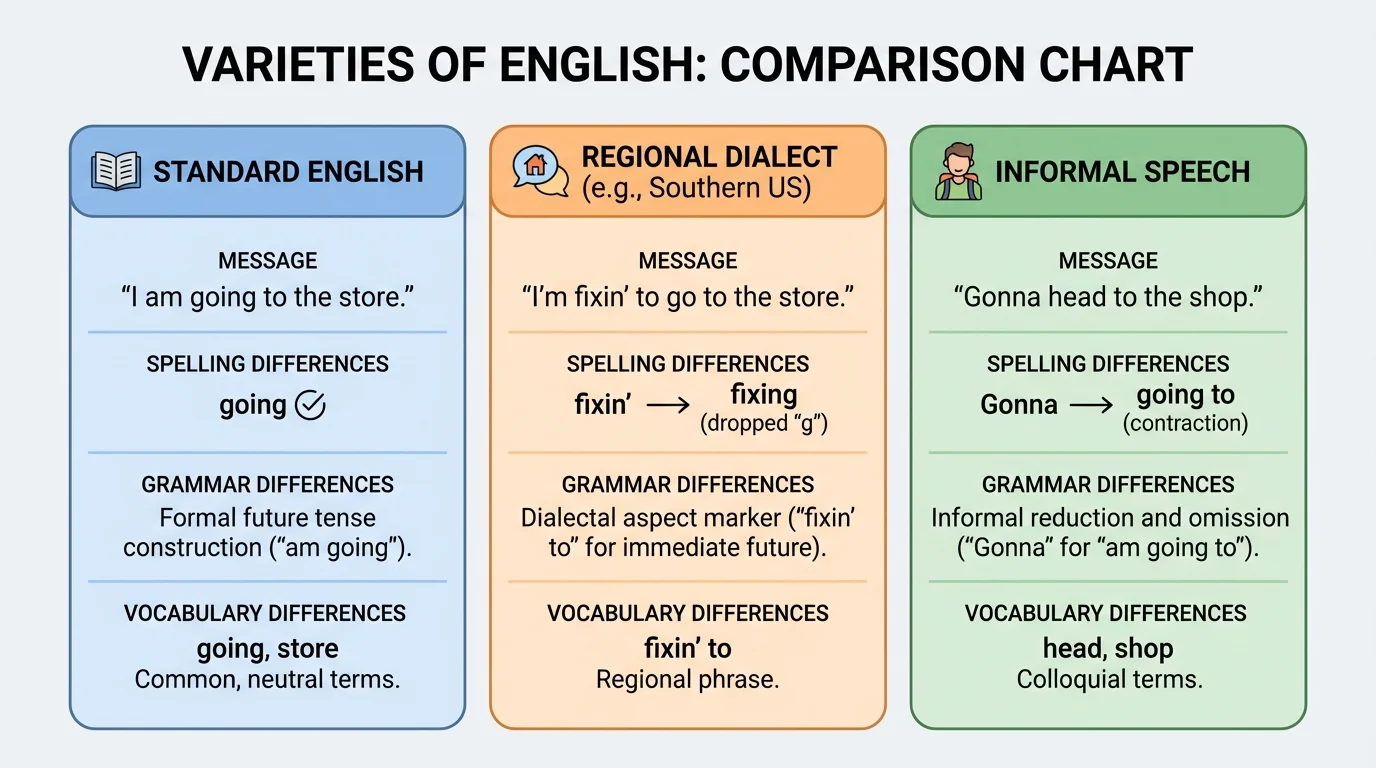
One important kind of variety is dialect. In literature, dialect can appear in a character's speech, in the narrator's voice, or in both. It may change spelling, grammar, and vocabulary, as [Figure 1] shows, and those changes often help readers hear the speaker more clearly in their minds. A writer may use dialect to show that a character comes from a certain place, belongs to a certain community, or speaks in a way that feels natural and real.
For example, a writer might use a line like, "You all better hurry," to suggest one regional way of speaking. Another writer might write, "We were fixing to leave," to show a local expression. A third might write, "I dinnae ken," in a text influenced by Scottish speech. These lines do not all follow the same patterns as standard written English, but they still communicate meaning.
Dialect can affect several parts of language. Vocabulary may change, such as "pail" instead of "bucket." Grammar may change, such as "He done told me" instead of "He already told me." Spelling in writing may hint at pronunciation, such as "goin'" instead of "going." Readers should notice these features carefully and ask what they reveal about the speaker.
At the same time, readers need to be thoughtful and respectful. A dialect is not a mistake. It is a language variety with patterns of its own. Writers should use dialect carefully so that characters feel real rather than mocked. Readers should avoid assuming that a speaker is less intelligent just because the speaker uses a different dialect.
Sometimes dialect makes reading harder. A poem or story might include unfamiliar spellings or unusual sentence patterns. This is where close reading helps. You can slow down, read aloud softly, and compare the unfamiliar line to standard English. You can also look for nearby clues that explain the meaning. Later, when you compare dialect and register again in other texts, the differences in [Figure 1] help you notice whether the writer changed vocabulary, grammar, or both.
Many famous writers use dialect to make voices sound authentic. Mark Twain, Zora Neale Hurston, and many playwrights and poets choose language patterns that help readers hear different communities and regions.
Dialects can also show time. A historical drama may use older forms of English, while a modern story may use current expressions. That means variety in English can be connected not only to place and group, but also to history.
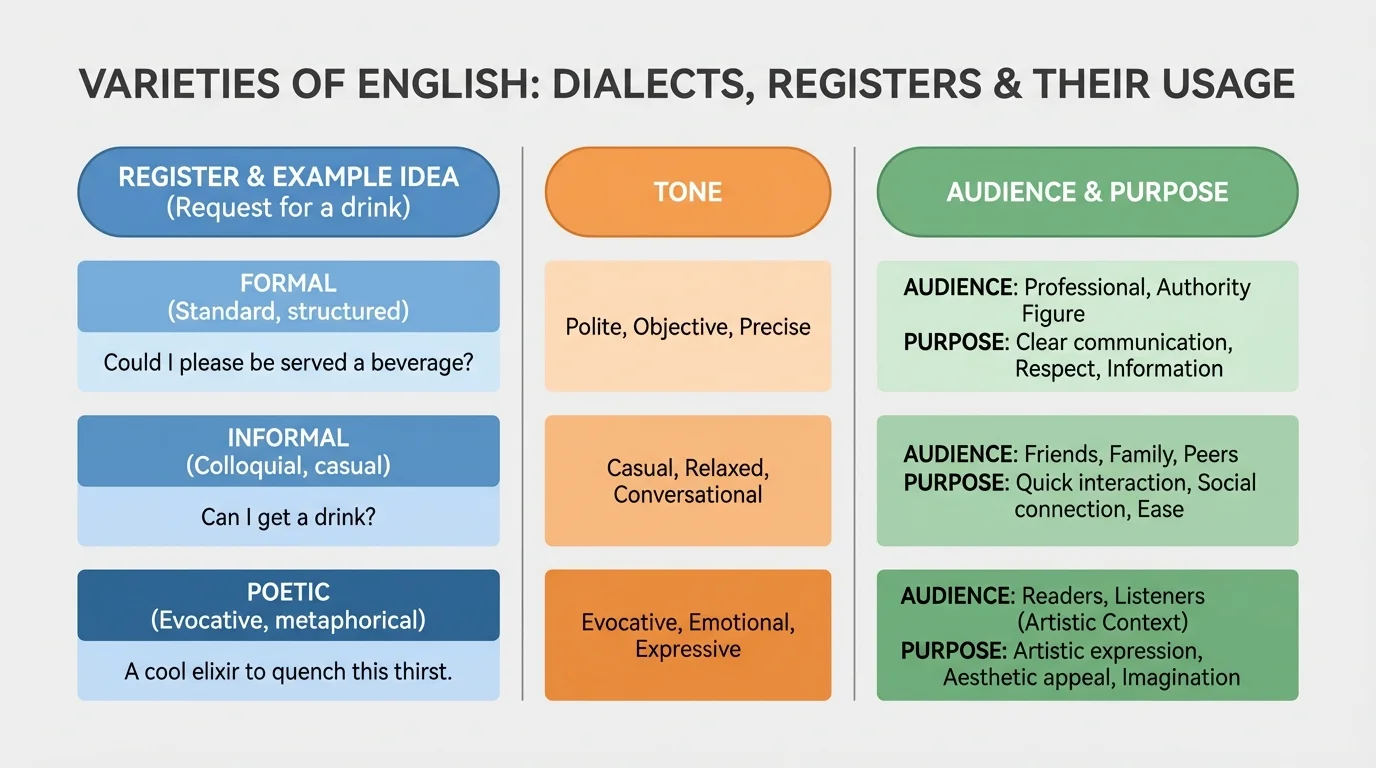
Another important kind of variety is register. Register changes depending on purpose and audience, as [Figure 2] illustrates. You probably already use different registers every day. You might speak one way with a friend, another way with a teacher, and another way when writing a report.
A formal register often uses complete sentences, precise word choice, and careful grammar. A principal might say, "Students are expected to arrive on time." An informal register sounds more relaxed and conversational, like "Don't be late." A poetic register may use imagery, rhythm, and unusual word order, such as "Let no footfall greet the tardy dawn."
Register matters in literature because it shapes tone. If a drama includes very formal speeches, the scene may feel serious or important. If a story uses casual language in dialogue, the characters may feel friendly, young, or realistic. If a poem uses elevated or musical language, the reader may pay attention to sound, feeling, and image as much as to plain meaning.
Writers can even switch registers inside one text. In a novel, the narrator may sound calm and standard, but the characters may speak informally. In a play, one character may use formal speech to sound powerful, while another uses slang to sound natural or rebellious. In a poem, the language may move from simple to grand as emotions become stronger.
When you compare texts, ask not only what is being said, but also how it is being said. The chart in [Figure 2] helps show that the same idea can sound official, casual, or artistic depending on the writer's goal. That change in style is often just as important as the message itself.
Dialect and register are not the same. Dialect is tied to a group or region and may show special vocabulary or grammar patterns. Register is tied to situation and purpose and may become more formal, informal, or poetic. A character can speak in a regional dialect and still shift between formal and informal register depending on the moment.
This is why readers should not confuse the two. For example, a character may have a Southern dialect but use a formal register during an important speech. Another character may speak standard English but in a very informal register with friends.
The kind of text, or genre, also affects language. Stories, dramas, and poems each have special ways of using English, as [Figure 3] shows. When you compare them, you begin to notice patterns.
In a story, English often includes narration and description. The narrator may tell what characters do, think, and feel. A story can mix standard narration with dialect in dialogue. For example, the narrator might write, "The evening air grew cold," while a character says, "Better grab your coat."
In a drama, most of the language comes through speech. Because plays are meant to be performed, dialogue often sounds closer to real conversation. Dramas may use dialect strongly because actors speak the lines aloud. Word choice, pauses, and patterns of speech help reveal personality and conflict.
In a poem, language is often more compressed. Poets may use fewer words but make each word work harder. They may repeat sounds, bend normal word order, or choose unusual images. A poem may sound formal, musical, or mysterious. Sometimes a poem uses dialect to keep a voice authentic; other times it uses a more general poetic style.
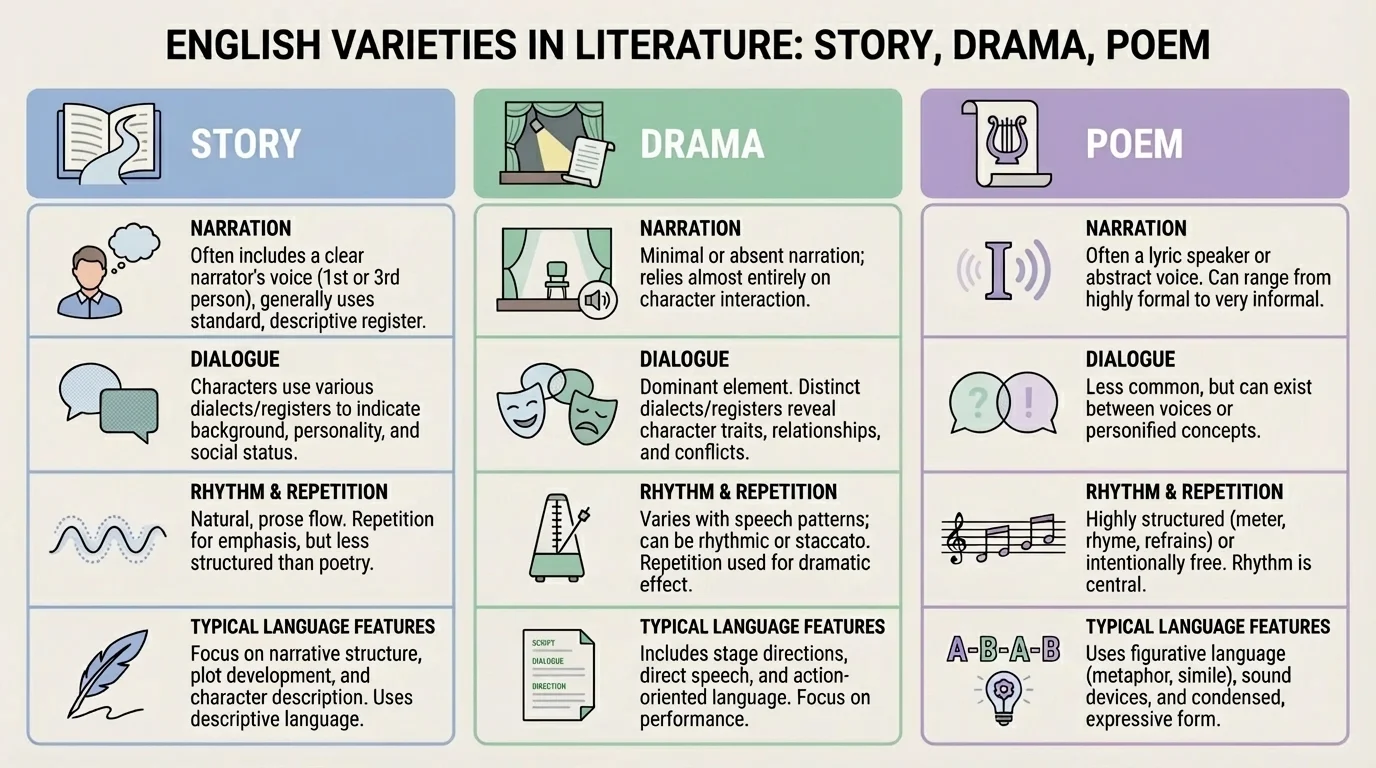
These genres can overlap. A story can include poetic description. A drama can contain formal speeches. A poem can tell a story. But the main language patterns are still useful for comparison. Looking back at the genre features in [Figure 3] can help you decide why a line sounds the way it does.
| Text Type | Common Language Features | What the Reader Notices |
|---|---|---|
| Story | Narration, description, dialogue | Who tells the events and how characters speak |
| Drama | Mostly spoken dialogue, stage directions | How speech sounds aloud and reveals character |
| Poem | Rhythm, imagery, repetition, short lines | Sound, feeling, and layered meaning |
Table 1. Comparison of language features commonly found in stories, dramas, and poems.
When readers compare genres, they should pay attention to sentence length, word choice, sound, and structure. A long descriptive sentence may fit a story, while a quick back-and-forth exchange fits a drama. A short, powerful line may belong in a poem.
Sometimes a variety of English includes words you do not know. Instead of giving up, you can use several tools. One tool is morphology, which means studying word parts like prefixes, suffixes, and roots. Another tool is context, which means using nearby words and ideas to infer meaning.
Suppose you read the sentence, "The old fisherman was weather-beaten but cheerful." Even if you have never seen "weather-beaten" before, you can break it apart. The word "weather" relates to wind, sun, and rain. "Beaten" suggests being hit or worn down. Together, the word likely means worn by outdoor weather.
Word relationships also help. If a poem says, "The child was timid, shrinking behind her mother," the second part explains the first. "Shrinking behind her mother" suggests "timid" means shy or fearful. In stories and dramas, nearby actions often explain unusual words or dialect expressions.
Example: figuring out meaning from context and morphology
Sentence: " 'Quit your lollygagging,' the coach barked, 'and get on the field!' "
Step 1: Look at the context.
The coach is giving an order and seems impatient.
Step 2: Notice what is happening.
The players are not moving quickly.
Step 3: Infer the meaning.
Lollygagging probably means wasting time or moving too slowly.
This same strategy works with dialect. If a character says, "I reckon we ought to head home," you may not use "reckon" in your daily speech. But the context tells you it means something like "think" or "believe."
Readers should also compare unknown words to known ones. The word "carefree" contains "care" and "free," which suggests freedom from worry. The word "hopelessness" contains "hope," "less," and "ness," suggesting a state of having no hope. Morphology is especially helpful when reading poems, because poets often choose rich, layered words.
You already know that authors choose words carefully. Here, you are extending that skill by noticing how word parts, context, and language variety work together to create meaning.
As you become more confident, you will notice that understanding unfamiliar English varieties is like solving a puzzle. Each clue matters: the speaker, the setting, the sentence around the word, and the shape of the word itself.
When comparing varieties of English, it helps to look at short passages side by side. You can ask: Which passage is more formal? Which one sounds regional? Which uses imagery? Which one sounds like natural conversation?
Comparison Example 1
Passage A: "I cannot remain here any longer. The hour is too late, and my duties await me."
Passage B: "I can't stay here no more. It's late, and I gotta go."
Step 1: Compare register.
Passage A uses a more formal register. Passage B uses an informal register.
Step 2: Compare grammar and word choice.
Passage A uses "cannot" and "duties," which sound more formal. Passage B uses "can't," "no more," and "gotta," which sound casual and speech-like.
Step 3: Think about effect.
Passage A may fit a serious speech in a drama. Passage B may fit realistic dialogue in a modern story.
The passages share the same basic meaning, but the style changes the feeling. That is an important part of comparing varieties of English: meaning can stay similar even when expression changes.
Now consider a different kind of comparison.
Comparison Example 2
Passage A: "The wind moved through the trees."
Passage B: "The wind whispered through the sleeping trees."
Step 1: Compare plain and poetic language.
Passage A is simple and direct. Passage B is more poetic.
Step 2: Notice imagery.
The word "whispered" gives the wind a soft, human-like quality, and "sleeping trees" creates a picture in the reader's mind.
Step 3: Think about effect.
Passage B creates stronger mood and sound, so it may fit a poem or a descriptive story.
These comparisons show that readers should listen for the sound of language, not just decode the meaning. The sound and style give clues about genre, character, and tone.
Authors do not choose a dialect or register by accident. They choose it to build voice. Voice is the special feel of the language in a text or from a speaker. It is shaped by word choice, sentence style, rhythm, and point of view.
A writer might use dialect to make a character sound realistic. A playwright might use informal speech to make a scene feel natural on stage. A poet might use formal or musical language to make a feeling seem larger or deeper. A narrator might use standard English so readers can follow the story clearly while still hearing each character's unique speech.
Writers also use language to shape setting and mood. A mountain folktale, a courtroom drama, and a quiet nature poem would not all sound the same. If they did, each text would lose some of its power. The right variety of English helps the text fit its world.
"The way something is said can matter as much as what is said."
That idea is especially true in literature. The language itself is part of the art.
Learning to compare varieties of English also helps you in your own speaking and writing. You can choose an appropriate register for your audience. For example, a classroom presentation should sound different from a text message to a friend. That does not mean one kind of English is always better; it means each kind has a purpose.
Knowing language conventions is also important. In school writing, you are often expected to use standard spelling, punctuation, and grammar so that your ideas are clear to many readers. But when you read literature, you should be ready to notice when a writer intentionally bends those conventions to create a voice or show a dialect.
Strong readers and writers are flexible. They can understand standard English, informal speech, regional dialects, and poetic language. They know how to compare them, how to respect them, and how to use clues to understand them.
When you read a story, drama, or poem, listen closely. Ask who is speaking, why the language sounds that way, and what the writer gains by choosing that variety of English. Those questions turn reading into careful language analysis.
