Have you ever heard someone say, "Hold your horses," even though there were no horses anywhere nearby? English is full of expressions like that. They can sound funny, confusing, or even impossible if you think about them literally. But once you understand how they work, these sayings become powerful clues that help you understand stories, conversations, and even advice people give.
Readers do more than decode words. They also figure out when words are being used in a special way. Some expressions have meanings that are different from the exact definitions of the individual words. Learning to recognize those expressions helps you become a stronger reader, because books, poems, articles, and everyday speech all use them.
Figurative language uses words in a non-literal way to create a special meaning. An idiom is a common expression whose meaning is different from the exact meanings of its words. An adage is a short saying that expresses a general truth or piece of advice. A proverb is a traditional saying that teaches a lesson or shares wisdom.
When you read or hear one of these expressions, your job is to think beyond the surface. Ask yourself: Does the literal meaning make sense? If not, what idea is the speaker trying to share? Good readers pay attention to the whole situation, not just one phrase.
Literal language means exactly what it says. If someone says, "The backpack is on the chair," the meaning is direct and clear. Figurative language works differently. If someone says, "My backpack weighs a ton," the speaker probably does not mean the backpack truly weighs a ton. The speaker means it feels very heavy.
This difference matters because idioms, adages, and proverbs often appear in stories and informational texts. A character might say, "I'm all ears," to mean "I am listening carefully." A coach might say, "Practice makes perfect," to encourage steady effort. A grandparent might say, "Look before you leap," to warn someone to think first before acting.
These expressions are part of how people share feelings, advice, humor, and wisdom. They can make writing more interesting and speech more vivid. They also connect us to the way language has been used over time.
Many proverbs and adages are hundreds of years old. People still use them because the lessons in them often stay true, even when times change.
One important skill is noticing when a phrase sounds unusual. If the exact words seem strange or impossible, that is often a clue that the expression is figurative. Then you can start searching for its real meaning.
An idiom is a common expression with a meaning that cannot always be figured out by defining each word separately, as [Figure 1] illustrates. If someone says, "break the ice," they usually do not mean smashing frozen water. They mean starting a conversation or helping people feel comfortable.
Idioms are everywhere in daily life. Friends, family members, teachers, athletes, and authors all use them. Because idioms are so common, recognizing them helps you understand both books and real conversations.
Here are some common idioms and their meanings:
| Idiom | Figurative Meaning | Example in a Sentence |
|---|---|---|
| spill the beans | tell a secret | Mina spilled the beans about the surprise party. |
| hit the books | study hard | Before the test, Carlos hit the books. |
| under the weather | feeling sick | I stayed home because I felt under the weather. |
| once in a blue moon | very rarely | We only eat out once in a blue moon. |
| piece of cake | very easy | The puzzle was a piece of cake for her. |
| cost an arm and a leg | be very expensive | Those sneakers cost an arm and a leg. |
Table 1. Common idioms with their figurative meanings and sample sentences.
Notice how the exact words in these idioms do not match the intended meaning. That is why readers must stop and think. A literal interpretation would sound odd. In ordinary life, people do not really spill beans to reveal a secret, and studying does not involve physically hitting books.
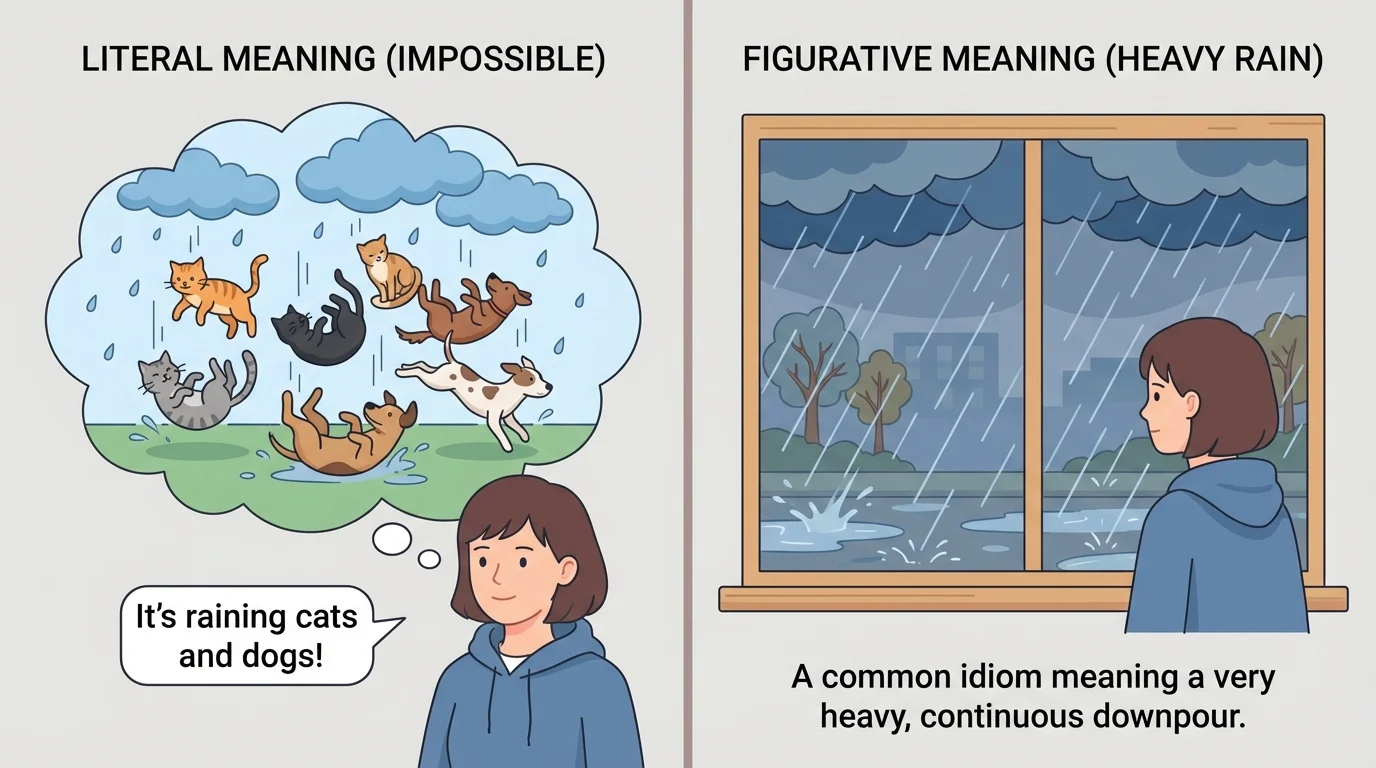
Idioms can make language colorful and lively. In dialogue, they can reveal a character's personality. In nonfiction, they can make ideas more memorable. When you encounter an unfamiliar idiom, it helps to reread the sentence and look at what is happening around it.
Explaining an idiom
Sentence: "After missing two easy goals, Jamal knew it was time to get his head in the game."
Step 1: Notice the literal meaning does not fit.
A person's head is not literally something they can place "in the game," so the phrase probably is not literal.
Step 2: Use context clues.
Jamal missed goals, so the sentence is about sports and performance.
Step 3: Infer the figurative meaning.
The idiom means to focus, pay attention, and think clearly about what you are doing.
A strong explanation tells both the meaning and the clues that helped you figure it out.
Idioms sometimes vary from place to place, and some are more common in certain families or regions. Even so, the strategy stays the same: check whether the literal meaning makes sense, then use context to infer the figurative meaning.
An adage is a short saying that expresses a general truth or practical advice. Adages are usually simple and direct. People use them because they sum up a big idea in just a few words.
Examples of adages include "Actions speak louder than words," "Better late than never," and "The early bird gets the worm." Each one shares a general truth. The first means what people do matters more than what they say. The second means it is better to do something late than not do it at all. The third suggests that people who act quickly often gain an advantage.
Adages are often used when someone wants to give advice quickly. A teacher may say, "Honesty is the best policy." A parent may remind a child, "You reap what you sow," meaning your actions lead to results. These sayings are brief, but they carry ideas people have found useful over time.
Remember that figurative language does not always mean fantasy or poetry. A simple saying in a conversation can also be figurative if its deeper meaning matters more than the exact words.
Adages often sound wise because they are broad. They do not describe only one event. Instead, they apply to many situations. That is one clue that a saying may be an adage.
A proverb is a traditional saying that teaches a lesson or shares wisdom. Proverbs are similar to adages, and sometimes the two categories overlap. Still, proverbs are often thought of as older sayings passed down over many years.
Examples of proverbs include "Don't count your chickens before they hatch," "A stitch in time saves nine," and "Two wrongs don't make a right." These expressions teach lessons. The first warns against being too sure something will happen before it actually does. The second teaches that solving a small problem early can prevent a bigger one later. The third means that doing something wrong in return does not make the situation fair or good.
Proverbs appear in stories, speeches, folktales, and conversations. Because they often teach a lesson, they can help readers understand a theme. If a story includes the proverb "Slow and steady wins the race," the story may be emphasizing patience, persistence, and careful effort.
"Actions speak louder than words."
— Common saying used as both an adage and a proverb
Writers use proverbs to connect a single moment in a text to a larger truth about life. That is why recognizing them can deepen your understanding of a character's choices or a text's message.
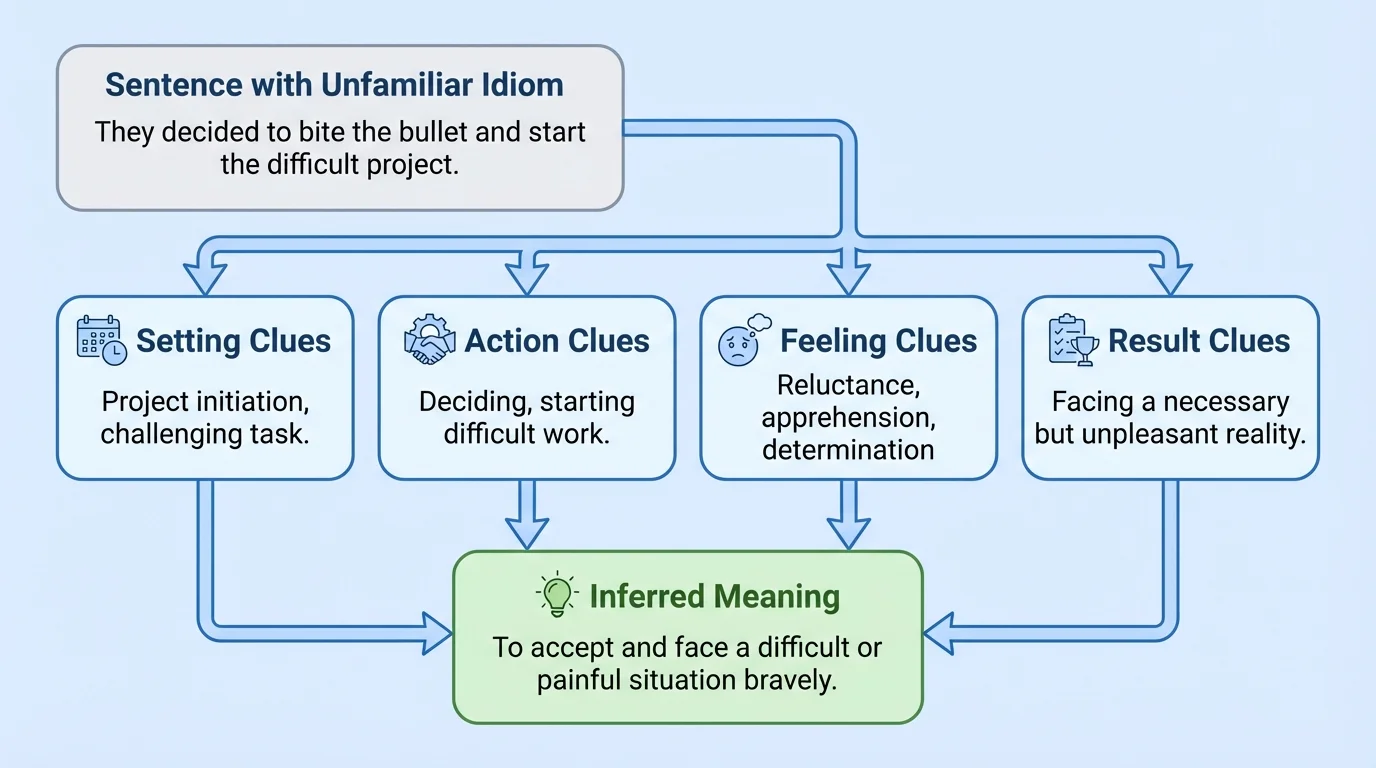
Sometimes you will know an expression right away. Other times it will be unfamiliar. In those moments, context clues help you unlock the meaning, as [Figure 2] shows through setting, actions, feelings, and results. Context clues are the words and details around a phrase that help explain it.
Look for clues in the setting. Where is the scene taking place? What is happening? In a story about a soccer game, "on the ball" probably has something to do with being alert and ready, not standing on top of a real ball.
Look for clues in actions and feelings. If a character says, "I'm at the end of my rope," and then sighs, looks frustrated, and cannot solve a problem, the phrase probably means the character feels out of patience or out of options.
Look for clues in results. If the text says, "Nina finally let the cat out of the bag, and everyone learned about the class trip," the result tells you that the expression means to reveal a secret.
You can also ask whether the phrase teaches advice or simply gives colorful meaning. If the saying teaches a life lesson, it may be an adage or proverb. If it acts more like a colorful expression in a sentence, it is probably an idiom.
How context helps
Good readers combine what the text says with what they already know. They notice when a phrase sounds impossible literally, gather clues from nearby sentences, and infer a meaning that fits the whole passage.
As with the heavy-rain example in [Figure 1], the key is asking whether the exact words make sense in the situation. If they do not, the surrounding details usually point toward the real meaning.
[Figure 3] These three types of expressions are related, but they are not identical. A clear comparison helps readers tell them apart. All three can be figurative, memorable, and meaningful. However, their jobs in language are slightly different.
Idioms usually act like colorful phrases inside everyday speaking and writing. Adages and proverbs more often express advice or wisdom. A proverb may sound more traditional, while an adage often sounds like a general truth people repeat because it has proven useful.
| Type | Main Purpose | Typical Feature | Example |
|---|---|---|---|
| Idiom | Add figurative meaning | Meaning differs from exact words | "piece of cake" |
| Adage | Share a general truth or advice | Short, wise saying | "Better late than never" |
| Proverb | Teach a life lesson | Traditional saying passed down over time | "Don't judge a book by its cover" |
Table 2. Comparison of idioms, adages, and proverbs by purpose, features, and examples.
This comparison matters because a reader may need to explain not only what a saying means, but also what kind of saying it is. If the phrase gives practical wisdom, it is more likely an adage or proverb. If it simply gives a colorful figurative meaning inside a sentence, it is more likely an idiom.
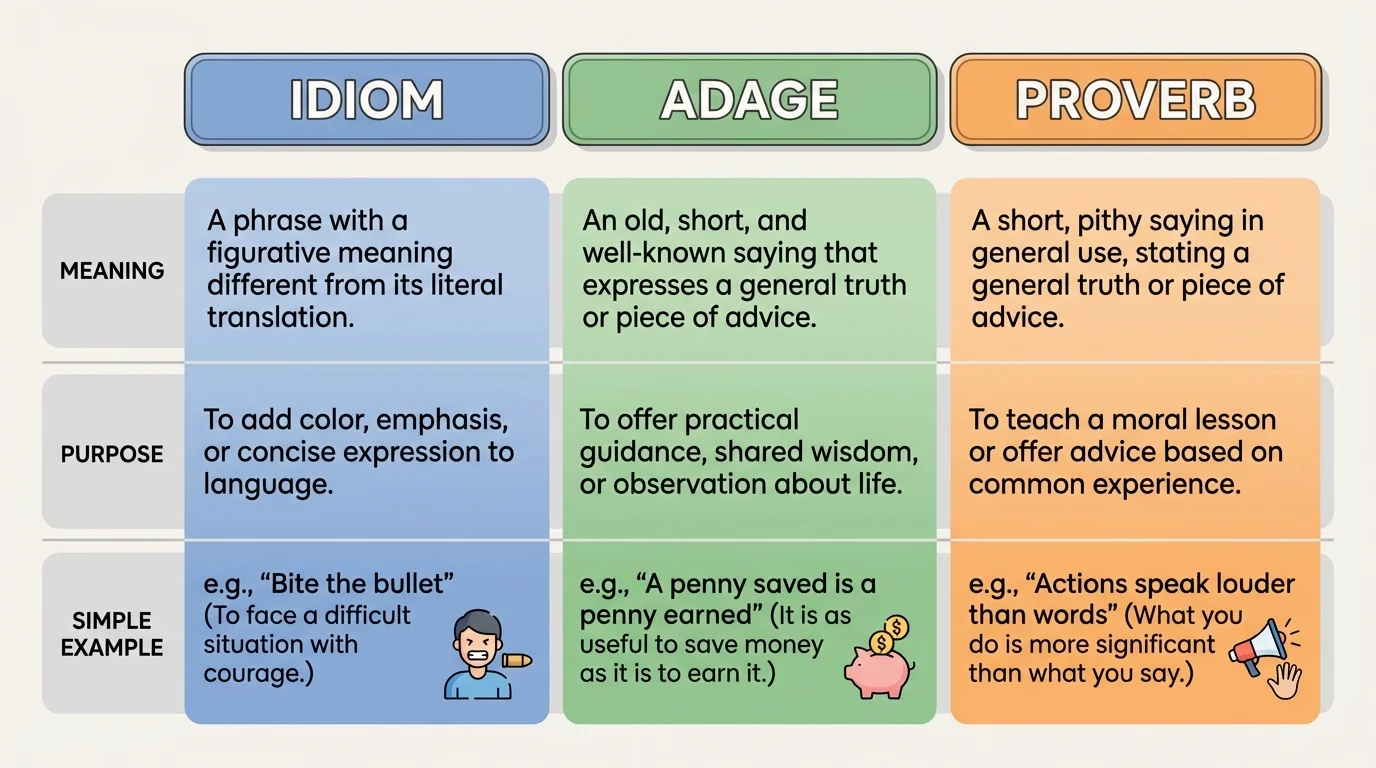
When you return to this chart later, [Figure 3] makes it easier to sort unfamiliar expressions by asking what role the saying plays in the sentence or passage.
Writers and speakers use these expressions because they are powerful. They can make language sound natural, wise, funny, or dramatic. A coach who says, "No pain, no gain," sounds more memorable than one who gives a long lecture about effort. A character who says, "I'm walking on air," sounds more expressive than one who simply says, "I feel happy."
These expressions also help build tone. Tone is the feeling or attitude in writing. An idiom can create humor or excitement. A proverb can make the tone thoughtful or serious. An adage can make a speaker sound experienced and practical.
In stories, these sayings can reveal character. A patient grandparent may use proverbs often. A joking friend may use playful idioms. In nonfiction, a writer might include an adage to make a point stick in the reader's mind.
Author's purpose example
Sentence: "Coach Rivera told the team, 'Rome wasn't built in a day,' after their first tough practice."
Step 1: Find the message.
The coach is not really talking about building a city.
Step 2: Connect it to the situation.
The team had a hard first practice, so they are still improving.
Step 3: Explain the purpose.
The proverb encourages patience. It reminds the team that good results take time and effort.
The saying adds encouragement and wisdom at the same time.
Understanding why a writer chose a saying helps you move beyond simple meaning. You begin to see how language shapes mood, message, and character.
One common mistake is taking figurative language literally. If you read "Sam has butterflies in his stomach" and picture real insects, the sentence becomes confusing. The expression really means Sam feels nervous.
Another mistake is guessing too fast without checking the context. A phrase may have one meaning in one situation and a slightly different feeling in another. Careful readers support their explanations with evidence from nearby words and events.
It is also important to remember that some sayings come from particular cultures, regions, or traditions. A phrase that is common in one place may be unfamiliar in another. When that happens, context becomes even more important.
Some expressions started with real jobs or activities long ago. Even when people no longer do those activities every day, the sayings remain in the language.
Reading carefully means being flexible. If the literal meaning does not fit, pause, reread, and search for the deeper idea the author or speaker is trying to communicate.
When you explain an idiom, adage, or proverb, try to do more than state a quick guess. A strong explanation includes three parts: the expression, its meaning, and the clues that support your idea.
For example, if you read, "Lena decided not to buy the flashy bike because all that glitters is not gold," a strong explanation would say that the proverb means something that looks good may not actually be good. The clue is that Lena chooses carefully instead of being tricked by appearance.
If you hear, "After one rehearsal, the band wasn't perfect, but practice makes perfect," your explanation should identify the saying as advice about improving through repeated effort. Because it teaches a general truth, it works as an adage and is often treated as a proverb too.
As the clue-gathering process in [Figure 2] reminds us, the best explanations are based on evidence from the text, not on random guessing. Good readers connect the saying to the situation around it.
The more you read, the more familiar these expressions become. Over time, you will notice them faster, understand them more clearly, and explain them with more confidence.
