Have you ever heard someone read a story in a flat, robot-like voice and noticed that the story suddenly seemed less interesting? The words may be correct, but the meaning feels smaller. Now think about a great storyteller, announcer, or audiobook reader. That person uses pauses, tone, and feeling to help listeners understand. Reading aloud well is not just about saying words. It is about bringing the meaning of the text to life.
When you read on-level prose and poetry orally, you are doing several important jobs at once. You are recognizing words correctly, moving at a pace that makes sense, and using your voice to show meaning. These skills are part of fluency. Strong fluency supports comprehension because when your reading sounds smooth and meaningful, your brain can focus on the ideas in the text instead of struggling with every word.
Good oral reading does not happen all at once. Many readers improve through successive readings, which means reading the same text more than one time. Each reading gives you another chance to notice new details, solve tricky words, and make your voice match the meaning more closely.
Reading aloud is useful in school, but it also matters in everyday life. People read aloud when giving speeches, performing plays, sharing poems, teaching younger children, recording videos, or telling stories at home. In all of these situations, the goal is not to rush. The goal is to communicate clearly so listeners understand both the words and the feelings behind them.
Oral reading also helps you hear the structure of language. You can notice when a sentence builds suspense, when a poem has a musical beat, or when a character sounds worried, excited, or confused. Hearing the text helps you understand it in a deeper way.
Accuracy means reading the words correctly.
Rate means reading at a speed that is neither too fast nor too slow.
Expression means using your voice to show meaning, feeling, emphasis, and punctuation.
Comprehension means understanding what the text says and means.
These parts work together. A reader who is accurate but too fast may sound rushed and confusing. A reader who is expressive but often says the wrong words can confuse listeners. A reader who is careful but extremely slow may lose the flow of the text. Strong oral reading balances all three.
Fluent reading combines several skills, as [Figure 1] shows: accuracy, rate, and expression all support understanding. If one part is missing, comprehension becomes harder because the reading may sound choppy, confusing, or emotionless.
Accuracy begins with careful word reading. This includes reading sight words correctly, noticing word endings, and pronouncing unfamiliar words by using parts of the word. For example, if you see the word unhappily, you can break it into meaningful parts: un-, happy, and -ly. Knowing those parts helps you read the word correctly and understand what it means.
Rate means reading in a natural way. A good rate sounds like thoughtful speaking. It changes depending on the text. An exciting chase scene may move more quickly. A serious or complicated paragraph may need a slower pace. Appropriate rate is not a race. Fast reading is not always fluent reading.
Expression, sometimes called prosody, includes volume, pitch, stress, phrasing, and pauses. A question usually sounds different from a command. A sentence ending with an exclamation point often needs more energy. A sad poem may need a softer tone than a cheerful one.
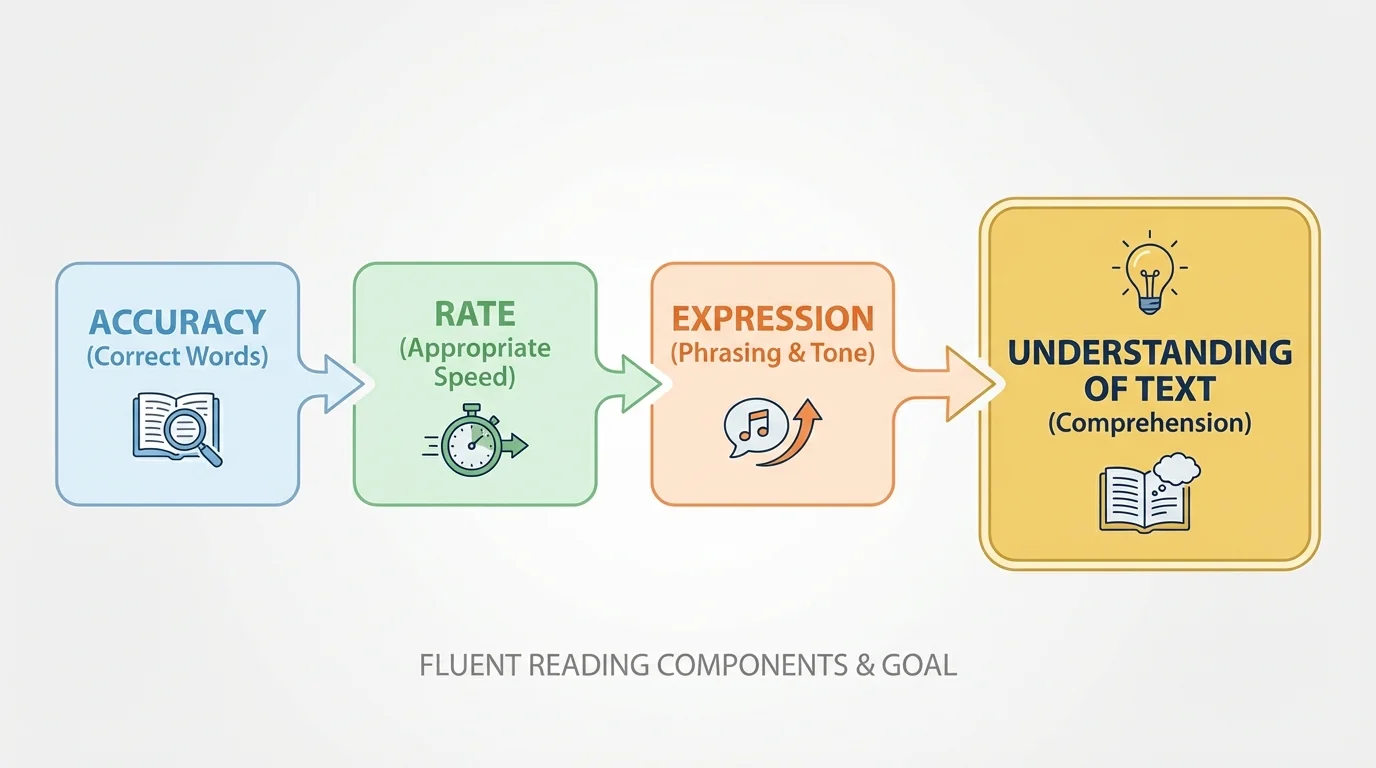
When these three parts work together, the reading sounds smooth and meaningful. Later, when you think about your own progress, [Figure 1] remains useful because it reminds you that fluency is not just one skill. It is a combination of several habits working together.
Prose is the kind of writing you see in stories, articles, and most nonfiction texts. It is organized into sentences and paragraphs, and punctuation helps guide the reader's voice, as [Figure 2] illustrates. Periods signal a full stop, commas often suggest a shorter pause, and quotation marks show when a character is speaking.
When you read prose aloud, you should think about who is speaking, what is happening, and how the ideas fit together. Suppose a story says, "Wait for me!" shouted Elena. If you read that line in a whisper with no energy, you miss the meaning. The word shouted tells you to change your voice. The punctuation also helps: the exclamation point shows strong feeling.
Paragraphs in prose often group related ideas. That means your voice should not pause randomly after every few words. Instead, you should read in meaningful phrases. For example, in the sentence "After the long storm, the sun finally broke through the clouds," it makes sense to pause briefly after storm, not after every single word. Reading in phrases helps listeners follow the meaning.
Dialogue is especially important in prose. Different characters may sound different because of their mood, age, or situation. You do not need to perform like an actor in a huge, dramatic way, but you should let the words guide your tone. A worried character may sound tense. A joyful character may sound bright and quick.
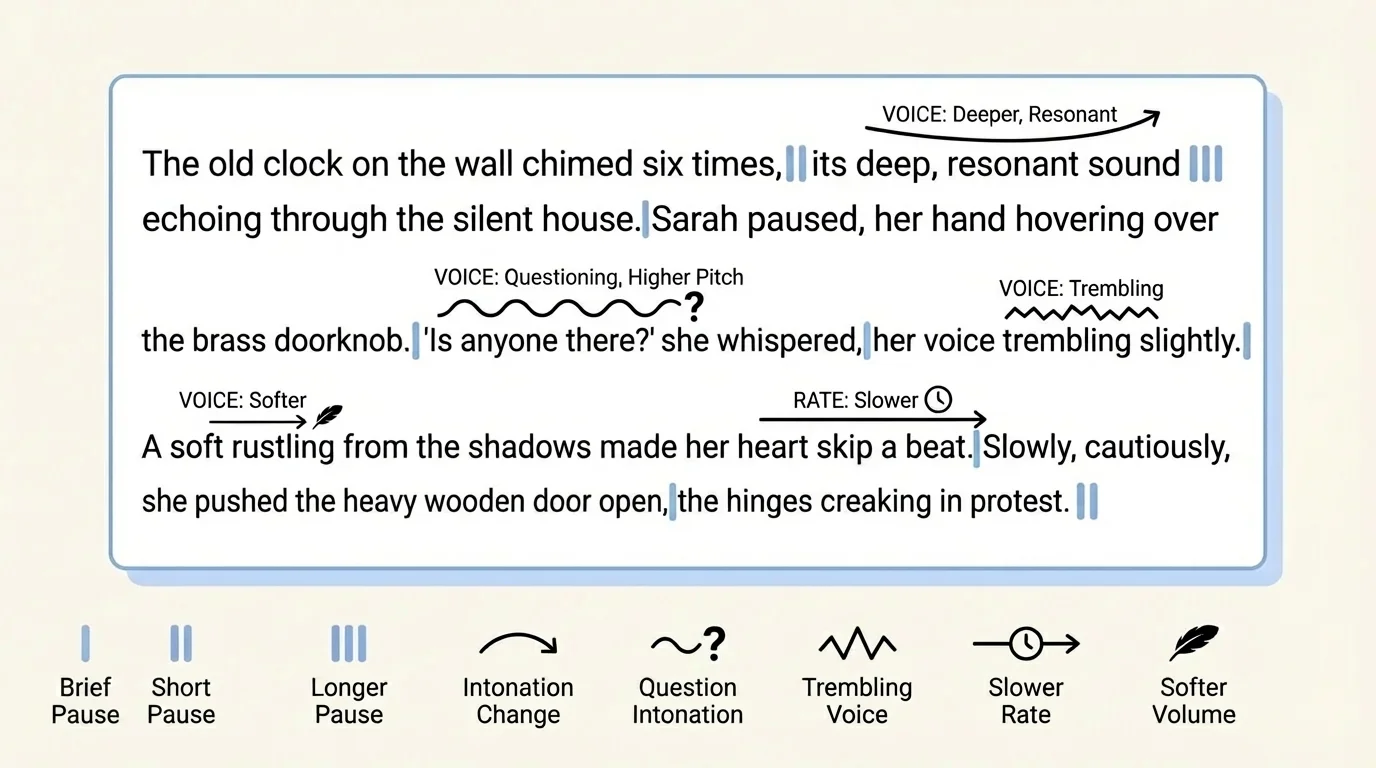
Writers also use punctuation to control timing. A dash may create a sudden stop or surprise. A colon may signal that an explanation is coming next. Parentheses may sound quieter or more tucked into the sentence. These clues matter because they help your voice match the author's meaning.
Much later, when you read a new passage, you can return mentally to [Figure 2] and remember that punctuation is not decoration. It is part of the map that guides your oral reading.
Example: Reading a prose sentence with expression
Sentence: "Are you serious?" Marcus asked, stepping back from the muddy puddle.
Step 1: Notice punctuation.
The question mark tells you the voice should rise like a real question.
Step 2: Notice the dialogue tag and action.
The words asked and stepping back suggest surprise or disbelief.
Step 3: Read in phrases.
Pause slightly after the spoken words, then continue with the rest of the sentence smoothly.
The sentence should sound curious and surprised, not flat or rushed.
Informational prose also needs expression, even though it may not have characters. If a science text explains how volcanoes erupt, your voice should still show important ideas. Key terms may need emphasis. Long explanations may need careful pacing. Reading nonfiction fluently helps listeners understand complex information.
Poetry often sounds different from prose because its lines, rhythm, and word choices are arranged with special care. The shape and sound of a poem guide oral reading, as [Figure 3] shows. In poetry, line breaks matter. A line may end where the sentence does not end, so the reader must decide whether to pause a little, keep going, or emphasize a certain word.
Poems may use repeated sounds, repeated phrases, and strong images. If a poem repeats the phrase "and the wind whispered," that repetition should sound intentional. It may create a calm, mysterious, or eerie mood. Reading every line exactly the same way can flatten the poem and hide its meaning.
Rhythm also matters. Some poems have a steady beat, almost like music. Others sound more like natural speech. You should listen for the pattern of stressed and unstressed words. This does not mean reading in a sing-song voice. It means noticing how the poem moves.
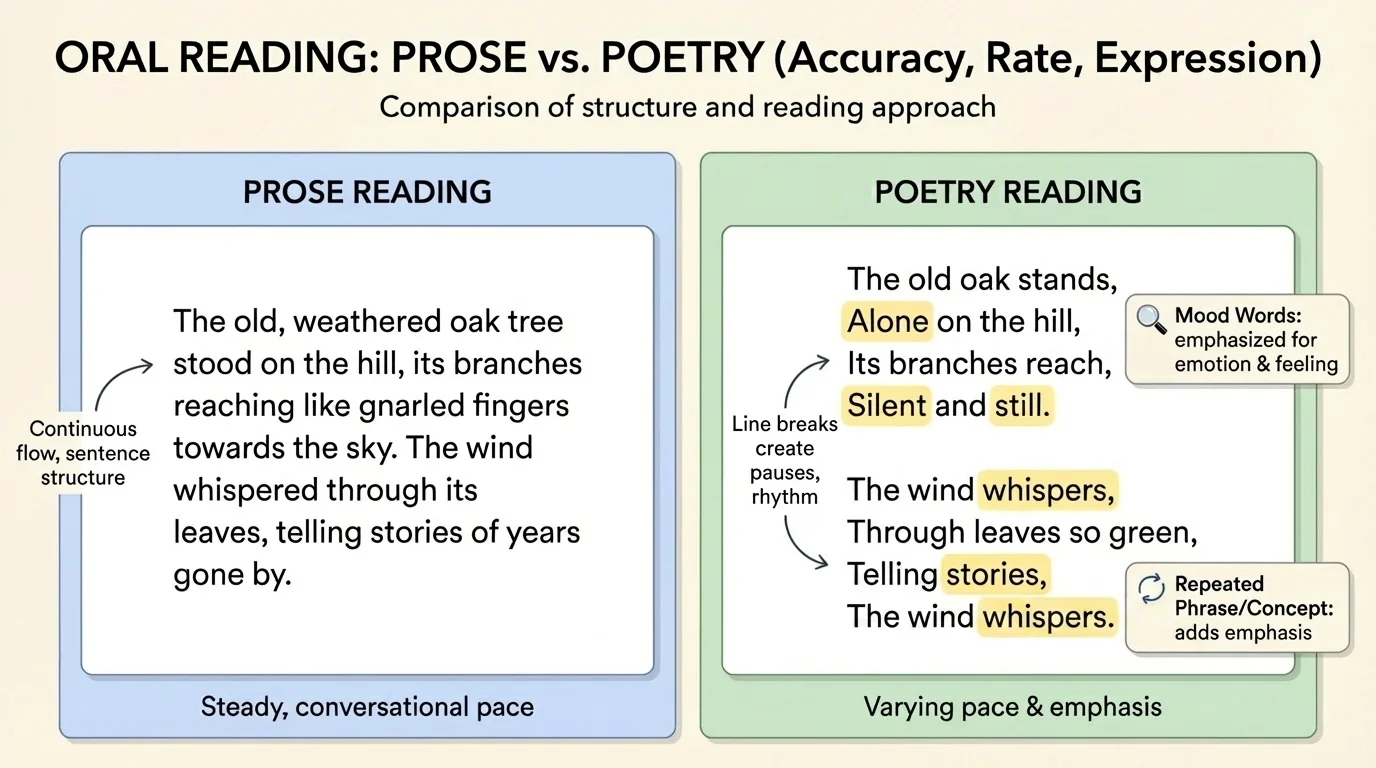
Mood is especially important in poetry. A poem about snowfall may sound peaceful and gentle. A poem about thunder may sound louder and sharper. Word choice helps you decide. If the poem includes words such as drifted, silent, and silver, your voice may become softer. If it includes words like crashed, roared, and splintered, your tone may become stronger.
Poetry also invites close attention to sound. Alliteration, rhyme, and repeated consonants or vowels can make a poem memorable. When you notice these sound patterns, you can read them in a way that lets listeners hear the music of the language. Thinking back to [Figure 3] can help you remember that the poem's layout and repeated language are part of how it should sound aloud.
Poems were often shared aloud long before many people had books of their own. In many cultures, rhythm and repetition helped listeners remember stories, songs, and important ideas.
Because poems are often shorter, even small choices matter a lot. A pause in the wrong place can change the feeling. Emphasizing the wrong word can change the meaning. Careful rereading helps you discover the best way to let the poem speak.
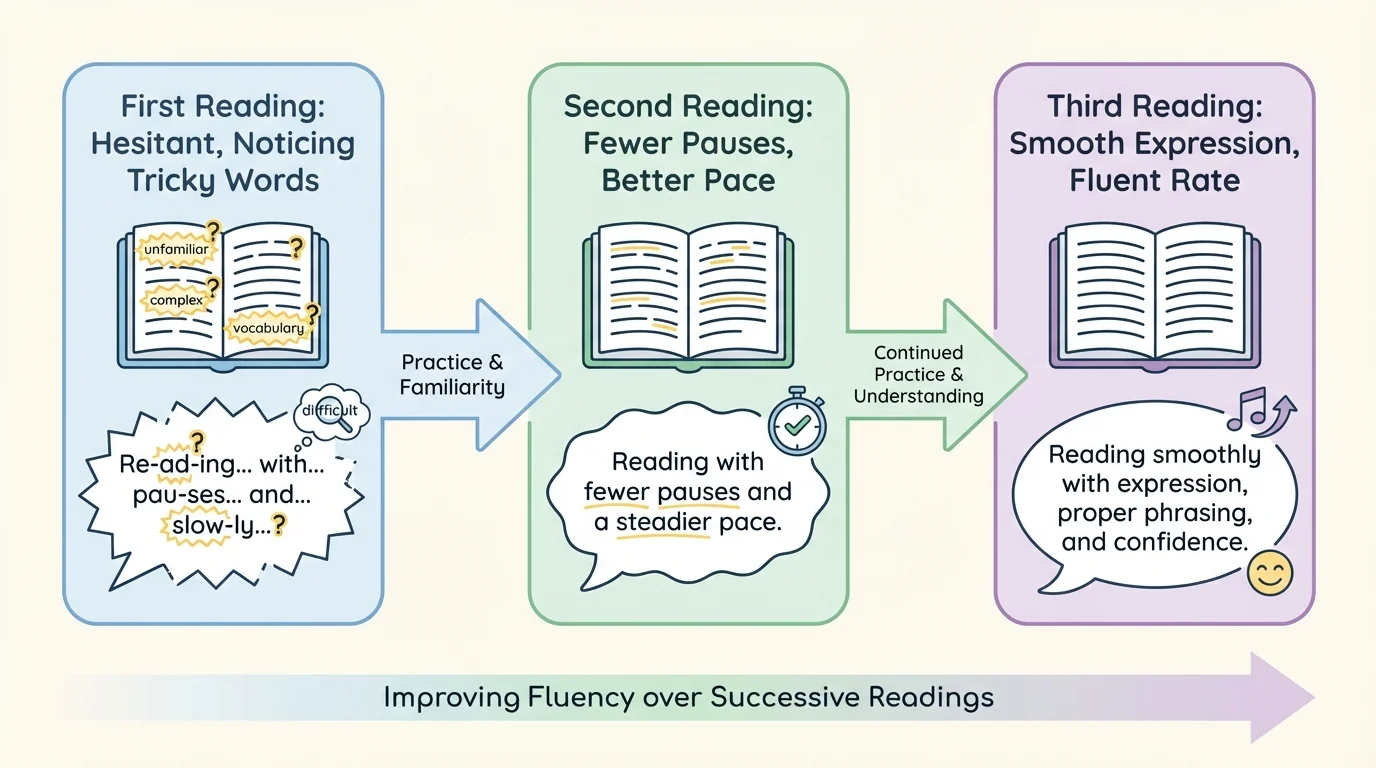
Rereading helps readers improve in clear stages, as [Figure 4] illustrates. On a first reading, you may focus mostly on saying the words. On a second reading, you begin to notice meaning more clearly. On a third reading, you often sound smoother, more confident, and more expressive.
The first reading of a passage is often where you meet challenges. You may come to an unfamiliar word, a long sentence, or a confusing shift in tone. That is normal. The purpose of rereading is not to repeat mistakes. It is to learn from the first attempt and improve the next one.
With each new reading, your brain has to work less on basic decoding. That frees more attention for phrasing, feeling, and understanding. This is one reason repeated reading is such a powerful tool for fluency. Familiarity supports confidence, and confidence helps the voice sound more natural.
Successive readings also help you notice details you missed before. Maybe a word you first skipped turns out to be important. Maybe a poem's repeated phrase creates a mood you did not hear the first time. Maybe a nonfiction passage becomes clearer once the difficult vocabulary feels more familiar.
When you think about growth over time, [Figure 4] reminds you that strong reading often develops step by step. Improvement is not always instant, but each reading can add something important.
Sometimes oral reading becomes difficult because of unfamiliar words. This is where understanding word parts and word relationships can help. Morphology is the study of meaningful word parts such as prefixes, roots, and suffixes. When you recognize these parts, you can often figure out both pronunciation and meaning.
For example, if you see the word careless, you may recognize the base word care and the suffix -less, which means "without." That helps you understand the word means "without care" or "not careful." If you understand the meaning, you are more likely to read it in a way that fits the sentence.
Prefixes can also help. In the word preview, the prefix pre- means "before." In rewrite, the prefix re- means "again." In disagree, the prefix dis- signals opposition or not. Knowing these parts makes unfamiliar words less intimidating.
You already know that context clues can help you understand unknown words. The words and sentences around a difficult word often give hints about what it means and how it should sound when read aloud.
Word relationships matter too. If you know that tiny, small, and miniature are related in meaning, you can use familiar words to help understand a harder one. If you know that joyful is related to happy, you can give the word a positive tone when reading. Understanding meaning shapes expression.
Readers also use the sentence around a word to self-correct. If someone reads, "The desert was full of soft, damp moss," the sentence may sound odd. The reader may pause and realize the word is probably forest, not desert, or another part of the sentence was misread. Fluent readers check whether the words make sense.
One helpful strategy is to look ahead in a sentence. This allows you to notice punctuation, long phrases, and dialogue before you speak. Looking ahead can prevent awkward stops in the middle of an idea.
Another strategy is phrasing, which means grouping words into meaningful chunks instead of reading one word at a time. Compare these two styles: "The / old / wooden / gate / creaked / in / the / wind" versus "The old wooden gate / creaked in the wind." The second version sounds more natural because it follows the meaning of the sentence.
Self-correction is also important. Skilled readers do not pretend errors never happen. They notice when something sounds wrong, go back, and fix it. That is a sign of strength, not weakness. If a line loses its meaning, stopping and rereading can restore understanding.
How comprehension guides oral reading
When you understand the text, you make better choices about your voice. If a character is nervous, your tone may tighten. If a nonfiction paragraph lists important steps, you may slow down slightly and emphasize sequence words such as first, next, and finally. Comprehension and expression support each other.
It is also useful to notice sentence type. Questions often rise in pitch near the end. Commands may sound firm. Exclamations may sound excited, angry, or surprised depending on the words. Statements usually sound calmer and more settled. These patterns help your reading sound natural.
Volume matters as well. A quiet secret should not sound like a stadium announcement. A dramatic warning should not sound sleepy. Still, expression should match the text without becoming distracting. The purpose is meaning, not overacting.
One of the best ways to improve is to listen carefully to your own reading. Ask yourself whether the reading makes sense, whether it sounds like real language, and whether the tone matches the text. If the answer is no, reread and adjust.
Growth in oral reading often sounds like fewer stumbles, stronger phrasing, and better attention to punctuation. It also sounds like confidence. When readers know the words and understand the text, their voices usually become steadier and more expressive.
As you become a stronger oral reader, you will notice that accurate word reading, a sensible pace, and meaningful expression help each other. Understanding supports voice, and voice supports understanding. That is true for both prose and poetry.
"Read not to sound fast, but to sound true to the meaning."
Whether you are reading a story, an article, or a poem, the goal stays the same: let listeners hear the meaning. Careful attention to words, structure, and feeling turns oral reading into communication instead of mere word calling.
