Have you ever been in a conversation where two people talked at the same time, someone changed the subject, and another person never got a chance to speak? It can quickly become confusing. A good discussion is different. It has order, respect, and purpose. When people follow shared rules and do their assigned jobs, discussions become a way to learn, solve problems, and understand ideas more deeply.
In grade 5, discussions happen all the time. You may talk with one partner about a book, work in a small group on a science question, or join a teacher-led conversation about a social studies text. In each case, you are expected to listen carefully, speak clearly, respond to others, and help the discussion move forward. That takes practice, but it is a skill that helps in school and in everyday life.
A discussion is more than just talking. It is a shared conversation in which people listen, think, and respond to one another. The goal may be to learn something new, solve a problem, make a decision, or understand a text better. Discussion rules matter because they make that sharing possible.
Rules are not there to make talking less fun. They help make talking more useful. If everyone speaks respectfully, waits their turn, and stays on the topic, more ideas can be heard. Students feel safer sharing when they know others will listen instead of interrupting or laughing at them.
Collaborative discussion is a conversation in which two or more people work together by listening, speaking, asking questions, and responding to ideas. Assigned roles are special jobs each person may have during the discussion, such as leading, taking notes, or keeping time.
Good discussions also help people think. When someone explains an idea in a new way, asks a smart question, or gives evidence from a text, everyone in the group can understand more than they could alone.
Not every discussion looks the same. In a one-on-one conversation, two people may take turns more quickly and ask each other direct questions. In a small group, students need to make space for more voices. In a teacher-led discussion, students listen not only to classmates but also to the teacher's questions and directions.
[Figure 1] A discussion can serve different purposes too. Sometimes you discuss to share opinions. Sometimes you discuss to explain facts. Sometimes you discuss to plan a project. Other times you discuss a story or article and support your ideas with details from the text. Even though the purpose changes, the need for respectful listening and clear speaking stays the same.
You already know how to raise your hand, look at a speaker, and take turns in class. Discussion skills build on those habits and add stronger listening, stronger speaking, and stronger teamwork.
When you understand the kind of discussion you are in, you can choose the best behavior for that moment. That helps you participate in a way that supports the whole group.
Good classroom conversations follow shared expectations. These rules make discussions organized and fair. One important rule is to listen actively. That means paying attention to the speaker, not just waiting for your turn to talk. Active listeners face the speaker, think about the message, and try to understand the idea.
Another key rule is to take turns. If several people speak at once, ideas get lost. Taking turns may mean raising a hand, waiting for a pause, or following the group leader's signal. A third rule is to stay on topic. If the class is discussing the causes of a historical event, talking about an unrelated video game will not help the group learn.
Students should also speak clearly and use complete ideas. It helps to explain what you mean instead of saying only, "I agree," or "That's wrong." A stronger response sounds like this: "I agree with Maya because the text says the main character changed after the storm." Clear speaking helps others respond thoughtfully.
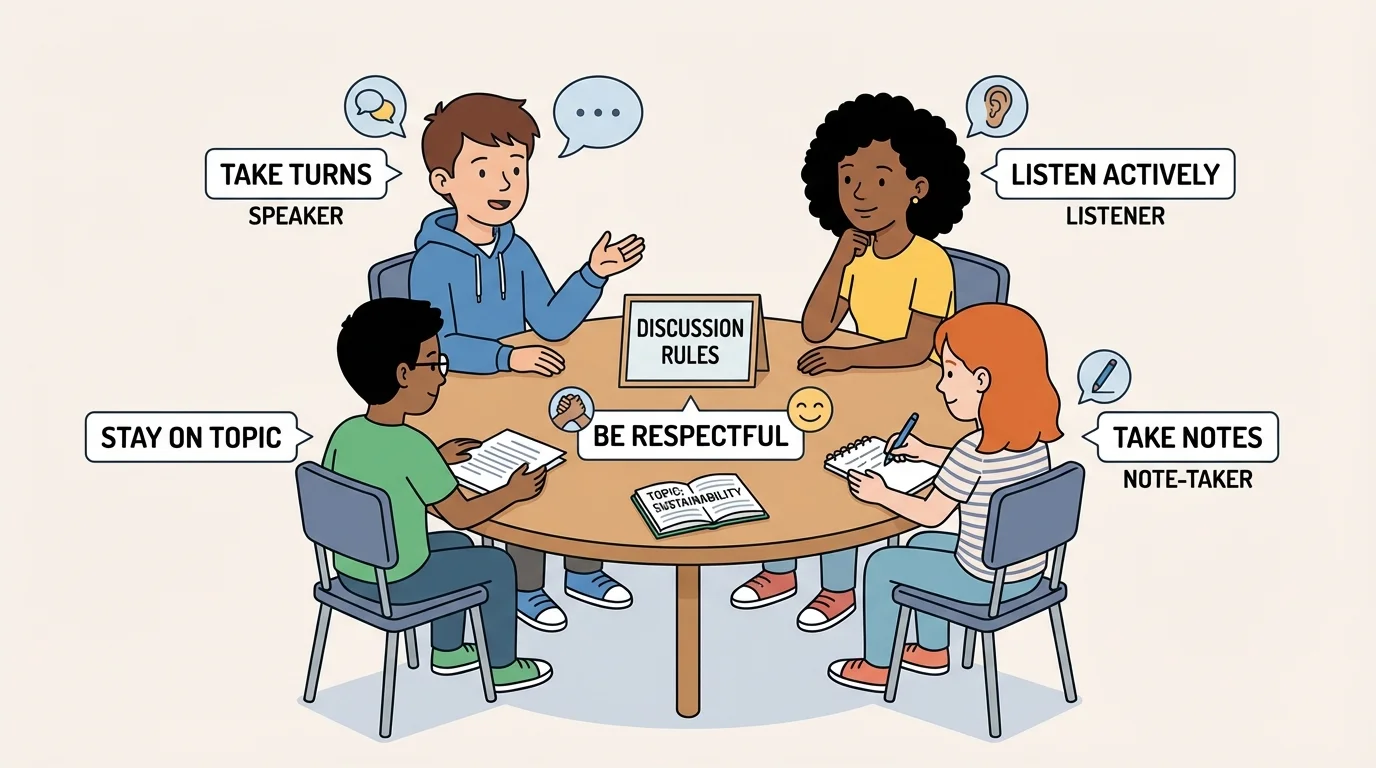
Respect is one of the most important rules of all. Respectful discussion means using kind words, letting others finish, and understanding that people may have different ideas. You do not have to agree with everyone, but you do need to treat everyone fairly.
Many discussions also ask students to use evidence. Evidence is information that supports an idea. In reading discussions, evidence often comes from the text. In science, it may come from observations. In social studies, it may come from facts, dates, or sources. Evidence makes your ideas stronger because it shows why you think what you think.
| Rule | What It Looks Like | Why It Helps |
|---|---|---|
| Listen actively | Eyes on the speaker, thinking about the message | Helps you understand and respond well |
| Take turns | Wait for a pause or signal before speaking | Makes sure everyone can be heard |
| Stay on topic | Comments connect to the question or text | Keeps the discussion focused |
| Speak clearly | Use complete sentences and examples | Makes ideas easier to understand |
| Be respectful | Use polite words and disagree kindly | Creates a safe learning space |
| Use evidence | Refer to facts, notes, or text details | Supports your thinking |
Table 1. Common discussion rules, what students do to follow them, and why each rule matters.
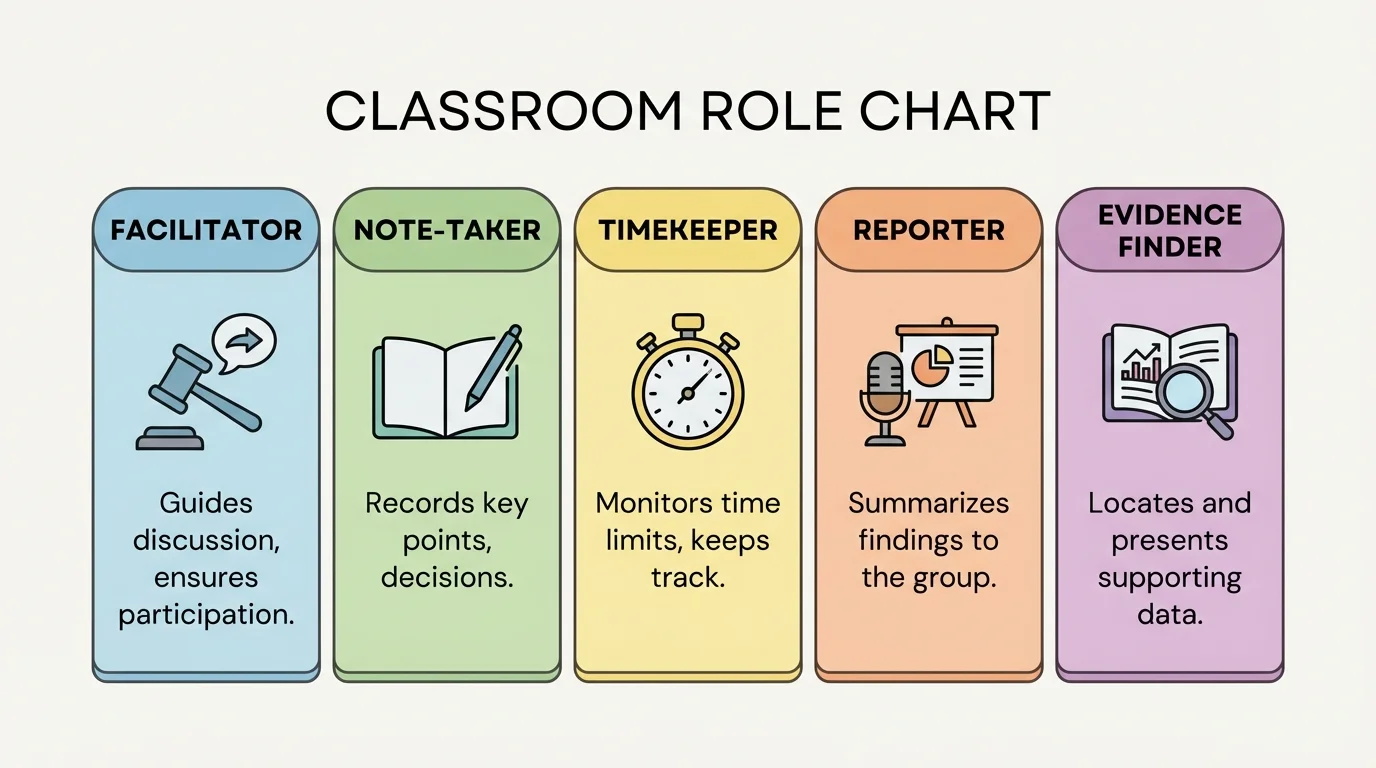
[Figure 2] In many classroom discussions, students are given a role. Each role has a purpose, and each person helps the group in a different way. Roles make group work smoother because one student does not have to do everything.
One common role is the facilitator. The facilitator helps the group get started, reminds members of the question, and invites others to speak. This student is not the "boss" of the group. Instead, the facilitator helps everyone participate. Another role is the note-taker, who writes down main ideas, important facts, or group decisions so nothing important is forgotten.
A timekeeper watches the clock and helps the group use time wisely. A reporter or speaker shares the group's ideas with the class. Sometimes there is also an evidence finder, who looks back at the text, chart, or notes to locate proof that supports the group's thinking.
Doing your role well means being responsible from the beginning to the end of the discussion. If you are the note-taker, you should not wait until the end to write down what everyone said. If you are the facilitator, you should not do all the talking. Carrying out a role means understanding your job and performing it in a way that helps the whole group succeed.
Roles and teamwork
Assigned roles work best when students remember that every job supports the same goal: learning together. A good facilitator needs good listeners. A reporter needs accurate notes. An evidence finder helps everyone make stronger claims. Even when roles are different, all students are equally important to the discussion.
Sometimes students switch roles in different discussions. That is helpful because it builds many skills. A student who usually speaks may learn to listen more carefully as a note-taker. A quiet student may grow more confident when serving as the reporter.
Strong discussions are not a set of separate speeches. They are connected conversations. To build on someone else's idea, first listen carefully. Then respond in a way that shows you understood. You might agree, add a detail, ask a question, or offer a different view politely.
Useful sentence starters can help. For example: "I agree with you because...," "I want to add that...," "Can you explain what you mean by...?" and "I see it differently because...." These kinds of responses keep the conversation moving and show respect.
Example of building on ideas in a book discussion
A class is discussing why a character left home in a story.
Step 1: One student shares an idea.
"I think the character left because she wanted freedom."
Step 2: Another student builds on it.
"I want to add that she also felt misunderstood by her family."
Step 3: A third student asks for evidence.
"What part of the story shows that?"
Step 4: The speaker supports the claim.
"On the page where she packs her bag, she says no one listens to her."
This is a strong discussion because students respond to one another, stay on topic, and use evidence.
Asking questions is also part of building on ideas. Questions can help clarify meaning, invite deeper thinking, or encourage a quiet classmate to speak. Good questions sound like, "What makes you think that?" or "How does that connect to the article?"
Clarify means to make something easier to understand. In discussions, clarification may happen when someone restates an idea, gives an example, or explains a confusing part more clearly.
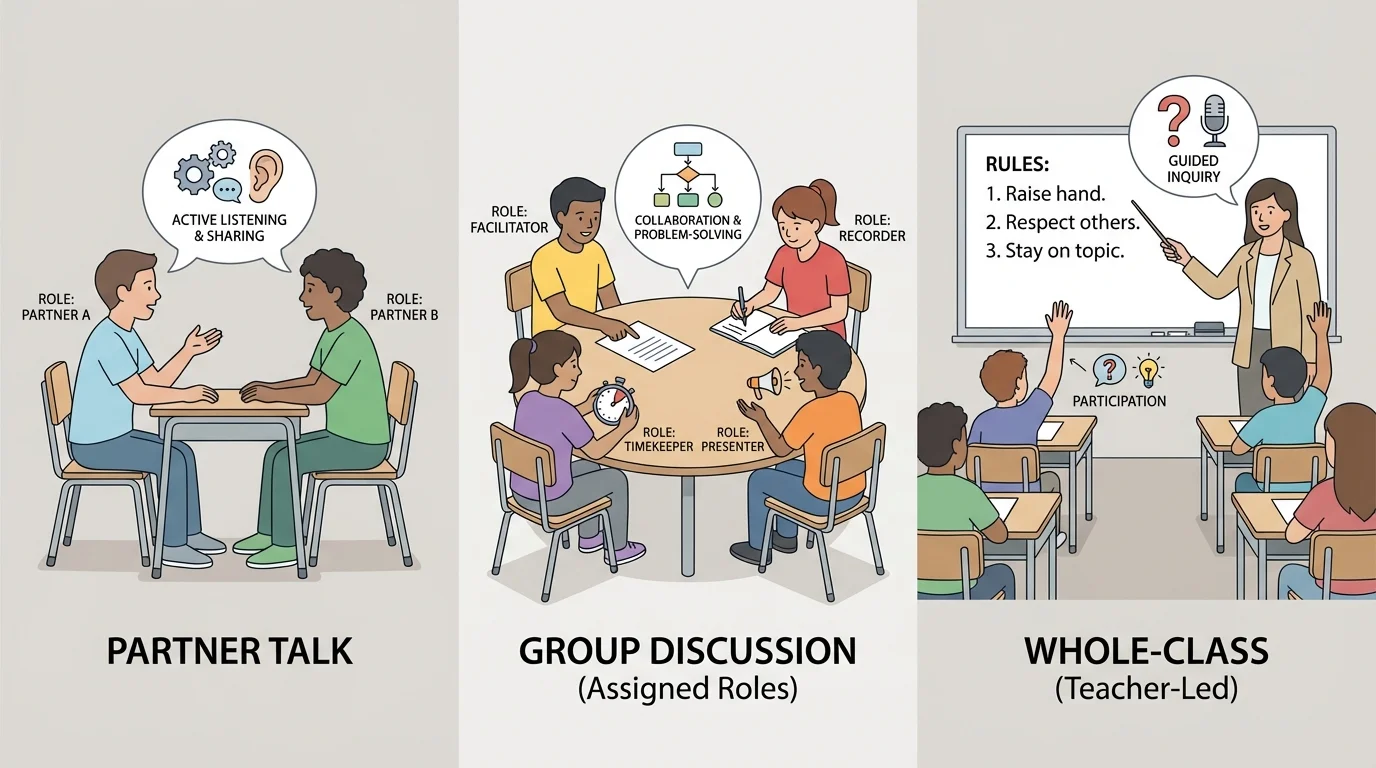
[Figure 3] The way you participate can change depending on the setting. In a one-on-one discussion, you should listen closely to your partner and respond directly to what that person says. Since there are only two people, both need to contribute about equally.
In a small-group discussion, balance becomes even more important. A few students may want to speak often, while others may need encouragement. Students should make room for different voices by inviting quieter members in with comments such as, "What do you think?" Small-group work also makes assigned roles especially useful.
In a teacher-led discussion, the teacher may ask questions, guide the topic, and help students connect ideas. Students still need to listen to classmates, not only to the teacher. When a classmate speaks, your job is to think about that idea so you can respond thoughtfully.
Across all these different situations, the same main habits matter: listen, think, speak clearly, stay respectful, and support ideas. The classroom arrangement changes, but the core skills do not.
Looking back at [Figure 1], you can see that respectful body language matters too. Facing the group, not distracting others, and showing attention with your expression help communicate that you value the speaker's ideas.
Discussions do not always go perfectly. Sometimes one person interrupts. Sometimes the group gets off topic. Sometimes no one speaks at all. Good discussion skills include knowing what to do when problems happen.
If someone interrupts, a respectful response might be, "I'd like to finish my idea," or the facilitator may remind the group to take turns. If the conversation drifts away from the main question, the facilitator or teacher can bring it back by saying, "Let's connect this to our topic."
Example of fixing an off-topic discussion
A group is supposed to discuss how weather affects plants, but the students begin talking about weekend plans.
Step 1: Notice the problem.
The discussion no longer connects to the science question.
Step 2: Use a discussion rule.
The facilitator says, "Let's get back to how sunlight and rain affect growth."
Step 3: Rejoin with evidence.
A student replies, "Our notes say plants need water to make food and stay healthy."
The group gets back on track by staying calm, respectful, and focused.
If one person talks too much, others may not have time to share. In that case, the group can use turn-taking strategies, a talking object, or a reminder that each voice matters. If the group is too quiet, a good starter question can help: "What detail from the text stood out to you most?"
Misunderstandings can happen too. When that happens, students should ask for clarification instead of making a quick judgment. This is where careful listening and polite questions are especially important.
Good participation starts before anyone speaks. Students should come prepared by reading the text, reviewing notes, and thinking about possible ideas or questions. If your class is discussing an article, it helps to mark important parts ahead of time. That way, you can find evidence quickly when you need it.
During the discussion, keep track of what others say. The note-taker may write key points, but everyone can mentally organize ideas. You may notice that one classmate gives strong evidence while another asks thoughtful questions. Paying attention helps you respond in meaningful ways.
After the discussion, it is useful to reflect. Did you stay on topic? Did you listen well? Did you carry out your role? Did you help build the conversation? Reflection helps you improve the next time. This is true whether you were a facilitator, a reporter, or simply a thoughtful participant.
Many adults use discussion roles in meetings without calling them by classroom names. A team leader acts like a facilitator, one person often takes notes, and another gives the final report. The skills you practice now are useful in the real world.
Thinking back to [Figure 2], you can see why roles make preparation easier. When students know their jobs ahead of time, they can gather the right notes, questions, or evidence before the discussion begins.
Discussion skills are not only for school. On a sports team, players must listen to one another and follow roles during strategy talks. In a family conversation, people solve problems better when they take turns and speak respectfully. In student council or class meetings, clear speaking and active listening help groups make decisions.
These skills also matter when people disagree. Respectful disagreement is a sign of maturity. It means you can have your own opinion while still listening to someone else. That is an important part of being a good classmate, teammate, and citizen.
"Listen to understand, not just to reply."
As [Figure 3] shows, discussions can look different from one setting to another, but the same habits support success in each one. When students follow agreed-upon rules and carry out assigned roles, they create conversations where learning can happen for everyone.
