Have you ever tried to convince someone of something and realized that just saying "because I think so" was not enough? Strong writers know a secret: a good opinion is not powerful by itself. It becomes convincing when it is followed by clear reasons, and those reasons become even stronger when they are backed up with facts and details. When a writer puts ideas in the right order, the reader can follow the thinking step by step.
Opinion writing appears everywhere. Students write letters to principals, reviews of books, responses to articles, and essays about school issues. Adults write opinion columns, product reviews, and community messages. In all of these forms, the writer needs to do more than share a feeling. The writer needs to build a case.
An opinion piece tells what the writer believes about a topic or a text. It may answer a question such as "Should recess be longer?" or "Which character made the best choice?" But the opinion itself is only the starting point.
Opinion is what a writer thinks or believes. A reason tells why the writer believes it. Facts and details are pieces of information that support the reason. Together, these parts help readers understand and evaluate the writer's point of view.
Think of opinion writing like building a bridge. The opinion is one side of the bridge, and the reader is standing on the other side. Reasons and evidence help the writer connect the two sides. Without them, the reader may not cross over.
For example, a student might write, "Our school should add more recycling bins." That is an opinion. A reason might be, "More bins would make recycling easier for students." A supporting fact or detail might be, "Right now, the cafeteria has one recycling bin, so students often throw bottles away in the trash because the line is moving quickly." The more specific the support, the more believable the writing becomes.
A reason is strong when it clearly connects to the opinion and helps prove it. A weak reason may be too general, too personal, or not closely related to the topic.
Compare these two reasons for the opinion "School uniforms are helpful."
Weak reason: "Uniforms are nice."
Strong reason: "Uniforms can reduce arguments about what students should wear because everyone follows the same dress expectations."
The stronger reason gives a clear explanation. It answers the reader's silent question: Why should I agree?
Strong reasons are relevant, clear, and supportable. A reason should match the opinion, be easy to understand, and be something the writer can support with real information. If a writer cannot explain or prove the reason, it is probably not strong enough.
Strong reasons also avoid repeating the same idea in different words. Suppose a writer says, "Pets should be allowed in some classrooms because animals are fun," and then adds, "Pets should be allowed because they are enjoyable." Those are almost the same reason. A better writer would add a new idea, such as "Class pets can help students learn responsibility."
Writers should also be careful with reasons based only on personal preference. "I like it" may be true, but it usually does not persuade many readers. Readers are more convinced by reasons that connect to fairness, safety, learning, usefulness, or evidence from real life.
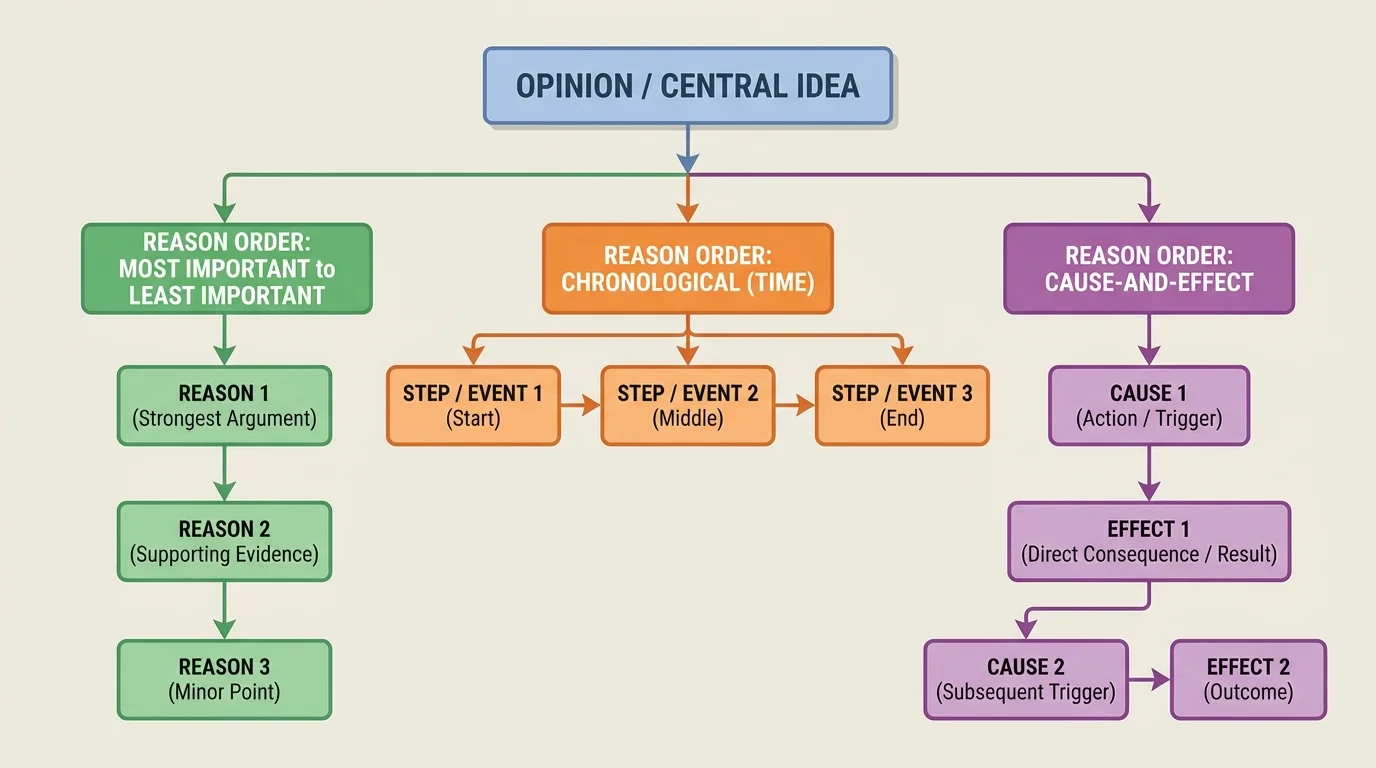
Once a writer has chosen strong reasons, the next job is to place them in a logical order. Logical order means arranging ideas in a way that makes sense to the reader. As [Figure 1] illustrates, writers can organize reasons in different patterns depending on their topic and purpose.
One common way is to put reasons from most important to least important. This works well when a writer wants to lead with the strongest point. Another way is to organize by time order, especially when explaining a process or change. A third way is to use cause and effect, where one reason leads naturally to the next idea.
Suppose the opinion is "Our class should grow a garden." Here are three different logical orders. By importance: first, the garden would support science learning; second, it would provide healthy food; third, it would beautify the school. By time: first, students prepare the soil; next, they plant seeds; later, they observe growth and harvest vegetables. By cause and effect: because students care for plants, they observe changes, and that leads to better understanding of plant life cycles.
A random order can confuse readers. If a writer suddenly jumps from cost to safety to a story about a cousin and then back to cost, the argument feels scattered. Logical order helps the writing feel steady and thoughtful.
Sometimes writers save their strongest reason for last. This can create a powerful ending to the body of the piece. Whether the strongest reason comes first or last, the important thing is that the order should feel intentional, not accidental.
Every strong opinion needs evidence. Evidence includes facts, examples, observations, and information from texts. A clear piece of opinion writing connects the opinion to a reason, and then connects that reason to facts and details.
A fact is something that can be checked and proven true. A detail gives more specific information that helps explain the fact. For example, if the opinion is "Students should have more reading choice," a fact might be that students often finish books they choose for themselves. A detail might explain that in a classroom survey, many students named book choice as a reason they read more often.
As [Figure 2] shows, writers can gather evidence from several places: books, articles, class discussions, personal observations, interviews, and notes from experiments or school events. The writer should choose evidence that matches each reason instead of adding information just because it sounds interesting.
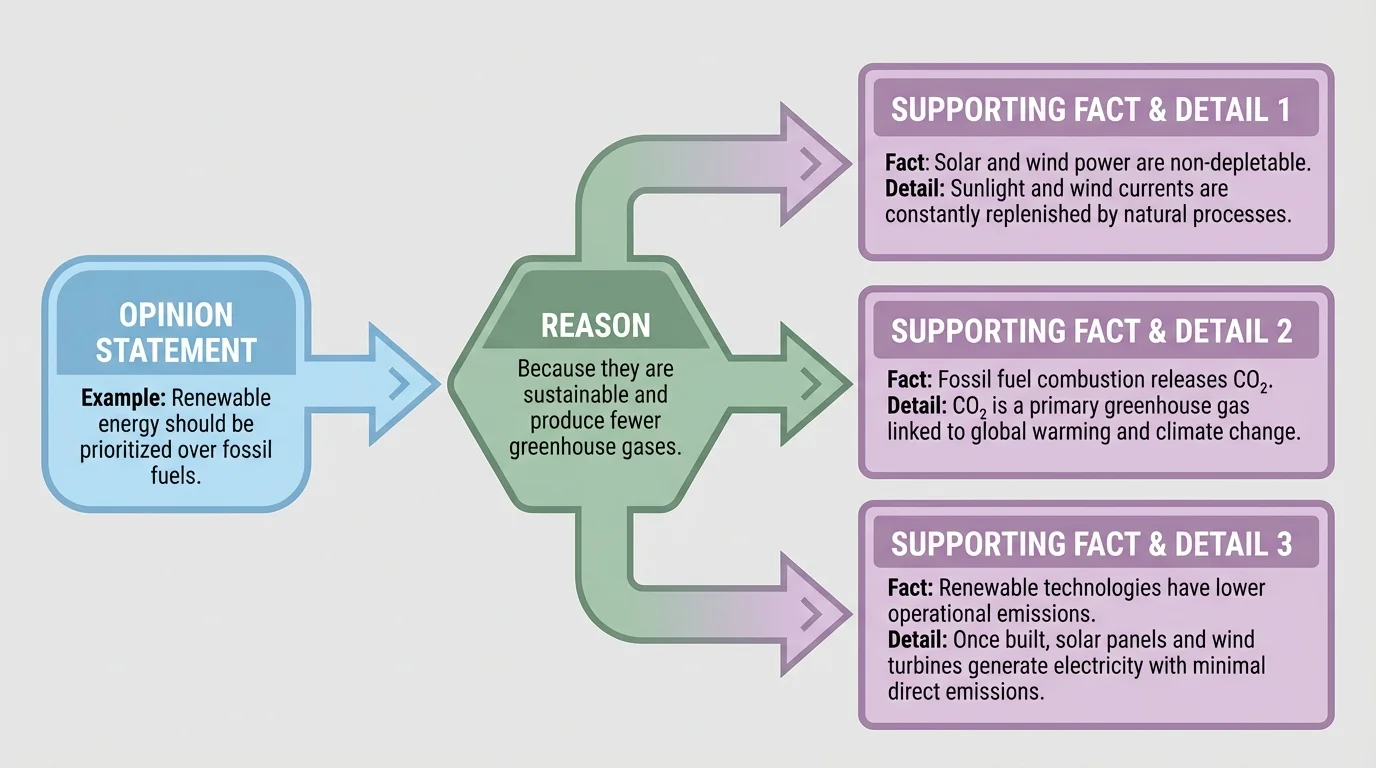
Look at this example. Opinion: "The library should stay open longer after school." Reason: "More students would have a quiet place to complete homework." Supporting fact: many students have sports practice or family responsibilities before they can work at home. Supporting detail: if the library stayed open one extra hour, students could use computers, books, and study tables before going home.
From weak support to strong support
Weak version: "The library should stay open longer because it would help students."
Step 1: Add a clearer reason.
"The library should stay open longer because students need a quiet place to work after school."
Step 2: Add a fact.
"Some students cannot work quietly at home because younger siblings, television, or other activities make concentration difficult."
Step 3: Add a detail.
"An extra hour in the library would give students access to tables, computers, and books when they need them most."
The second version is more convincing because the reason is clear and the support is specific.
Facts and details should be accurate. If a writer makes up information or exaggerates, the writing loses trust. Readers may disagree with an opinion, but they should still feel that the writer is honest and careful.
Good writers also explain how the evidence connects to the reason. Do not assume the reader will make the connection alone. After giving a fact, add a sentence that shows why it matters.
Even strong reasons can feel confusing if they are not connected well. Writers use transitions to guide readers from one idea to the next. Transitions are words and phrases such as first, next, for example, because of this, also, and finally.
Transitions are like road signs. They show whether the writer is adding a reason, giving an example, comparing ideas, or ending the piece. Without them, the writing may feel choppy.
| Purpose | Helpful transitions |
|---|---|
| To begin a reason | First, One reason, To begin with |
| To add another reason | Also, Another reason, In addition |
| To give evidence | For example, For instance, According to the text |
| To show cause and effect | Because, As a result, Therefore |
| To end | Finally, In conclusion, For these reasons |
Table 1. Transition words and phrases organized by how they help connect ideas in opinion writing.
Transitions should sound natural. If every sentence begins with first, the writing may sound repetitive. Writers should choose words that fit the relationship between ideas.
Professional writers often revise transitions many times. A piece can contain strong ideas, but if the links between ideas are weak, readers may still get lost.
We can still refer to [Figure 1] here as a reminder that organization and transitions work together. The order sets the path, and transitions help the reader travel along it smoothly.
A writer should think about the audience, which means the people who will read the writing. The same opinion may need different reasons depending on who the readers are.
Suppose the opinion is "Our school should have a later start time." If the audience is students, the writer might focus on being more awake and ready to learn. If the audience is parents, the writer might explain how enough sleep supports health and school performance. If the audience is school leaders, the writer might include reasons related to attendance, focus, and scheduling.
The purpose of the writing matters too. A review, a letter, and a classroom essay may all express opinions, but they are written for different reasons. A book review may aim to recommend or not recommend a text. A letter may aim to change a rule. A classroom essay may aim to show careful thinking about a topic or reading.
When you write about a text, your reasons should come from the text itself. You might refer to a character's actions, the author's message, or important events. Personal opinions still need support from what you have read.
Strong writers choose reasons that the audience will care about. A reason that matters to one group may not matter as much to another group. That is why writers do not simply list thoughts as they come. They make choices.
One common mistake is giving a reason without support. A writer might say, "Field trips are valuable because they are educational," and then move on. That reason needs evidence. What do students learn? How is the learning different from classroom learning? Specific support improves the point.
Another mistake is adding details that do not connect to the opinion. These are called off-topic details. If the opinion is about recycling bins and the writer spends several sentences describing lunch choices, the reader may wonder what happened to the main point.
A third mistake is placing reasons in a confusing order. If a writer begins with a small point, jumps to the conclusion, then returns to a new reason, the piece loses flow. This is why planning matters.
Writers also sometimes confuse facts with opinions. "Pizza is the best lunch" is an opinion. "The cafeteria serves pizza on Fridays" is a fact if it can be checked and proven. Readers need to know which is which.
Revision strengthens reasoning. Good writers often move sentences, replace weak reasons, cut repeated ideas, and add stronger evidence. Revising is not just correcting spelling. It is improving how ideas work together.
When checking your writing, ask: Does each reason support my opinion? Does each reason have facts or details? Is the order easy to follow? If the answer to any of these is no, revision is needed.
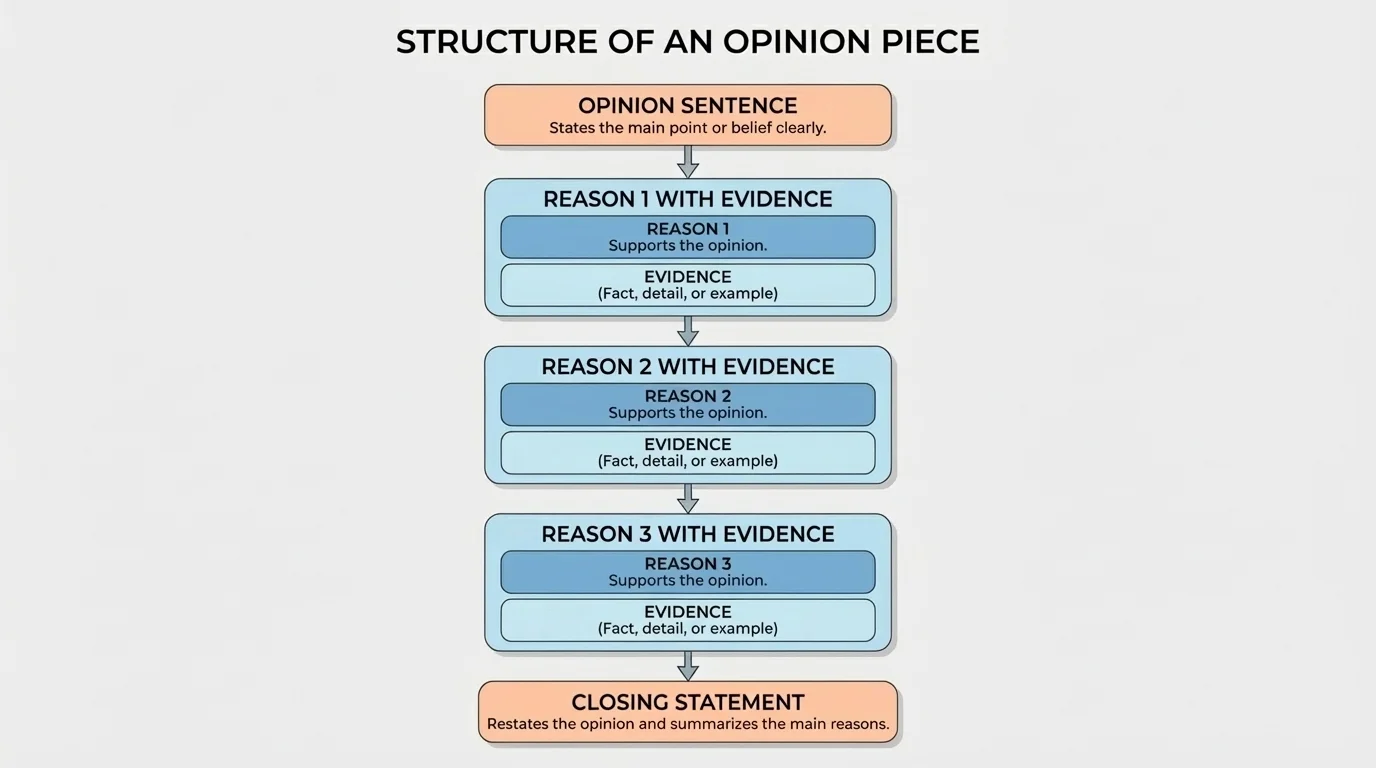
A complete model helps show how all the parts fit together in the structure of an organized opinion piece. Notice how the opinion stays clear, the reasons are ordered, and each one includes support.
Here is a model, shown in [Figure 3]:
"Our school should create a weekly reading club during lunch. First, a reading club would help students discover books they might not choose alone. When students hear classmates talk about exciting stories, they often become curious about new genres and authors. For example, a student who usually reads only sports books might decide to try a mystery after hearing a friend's recommendation. Another reason is that a reading club would build a stronger community. Students from different classes could meet, talk, and share ideas in a calm setting. These conversations can help students make new friends through a shared interest. Finally, a reading club would strengthen reading habits. A regular meeting each week gives students a reason to keep reading and finish books. For these reasons, a lunch reading club would be a useful and enjoyable addition to our school."
This model uses three reasons. They are organized from learning benefit to community benefit to habit-building benefit. That order works because each reason adds something new. The writer does not repeat the same point.
The support includes examples and explanations, not just bare claims. We can look back at [Figure 2] and see the same pattern: opinion, reason, then facts or details that make the reason believable.
Revision helps turn a draft into clear, convincing writing. A writer may begin with a good opinion but still need to rearrange reasons, add stronger details, or replace unclear words.
One helpful strategy is to underline the opinion, number the reasons, and circle the evidence. If a numbered reason has no evidence, that part needs work. If two numbered reasons say nearly the same thing, one may need to be changed or removed.
Another strategy is to read the piece aloud. Ears often notice confusion faster than eyes. If the writing sounds jumpy or repetitive, the order may need to change. This is another place where [Figure 3] is useful, because it reminds us that an effective opinion piece has clear parts that work together.
"Say what you think, and show why it makes sense."
Writers do not need dozens of reasons. In fact, a few strong reasons supported by real facts and details are usually much better than many weak reasons. Clear thinking, careful order, and strong support make opinion writing powerful.
