A weak piece of writing is like a sandwich with only bread. It has a topic, but not much else. Strong informative writing fills that topic with facts, details, examples, and explanations so the reader learns something real. When writers develop a topic well, they do more than mention it—they help readers understand it clearly and remember it.
Informative writing teaches. It explains a subject, answers questions, and gives the reader trustworthy information. A writer might explain how hurricanes form, why ancient Egypt mattered, or how recycling helps the environment. No matter the subject, the writer needs enough information to make the topic complete, clear, and interesting.
To develop a topic means to expand it thoughtfully. Instead of writing only a simple statement such as "Bats are interesting," a strong writer adds information such as what bats eat, how they use sound to move in the dark, where they live, and why they help ecosystems. Development turns a plain idea into a rich explanation.
A topic is often broad at first. For example, "weather" is a broad topic. A clearer focus might be "how tornadoes form" or "how meteorologists predict storms." Once the focus is clear, the writer chooses information that belongs with that focus. This helps the writing stay organized and prevents it from wandering into unrelated ideas.
Topic development is the process of building a subject with information that helps readers understand it. Good topic development includes relevant facts, definitions, examples, details, and explanations that match the writer's main focus.
Writers do not develop a topic by adding random sentences. They develop it by adding the right sentences. Every detail should help answer the reader's question: "What do I need to know about this topic?"
Writers often support one idea with several kinds of information, as [Figure 1] shows. A well-developed topic may include facts, definitions, concrete details, quotations, statistics, and examples. Each kind of information helps the reader in a slightly different way.
A fact is something that can be proven true. For example, "The Amazon rainforest is located in South America" is a fact. Facts make writing reliable because they are based on real information, not guesses or opinions.
A definition explains the meaning of a word or idea. In a science report, a writer might define evaporation as the process in which liquid water changes into water vapor. Definitions are especially useful when the reader may not know an important word yet.
Concrete details are specific pieces of information that help the reader picture or understand something clearly. Instead of saying "The desert is hot," a writer could say, "Some desert temperatures rise above 100°F."
A quotation gives the exact words spoken or written by a person or source. For example, a report about inventions might include a scientist's statement about why curiosity matters. Quotations can add authority and voice, but they should be used carefully and fit the topic.
Statistics are number facts, such as measurements, percentages, or counts. If a writer says, "More than 8 million tons of plastic enter the ocean each year," that statistic helps the reader understand the size of the problem. Statistics should be accurate and meaningful, not added just to sound impressive.
An example shows what an idea looks like in real life. If the topic is animal camouflage, a writer might explain how a snowshoe hare's white winter fur helps it blend into snow. Examples make abstract ideas easier to understand.
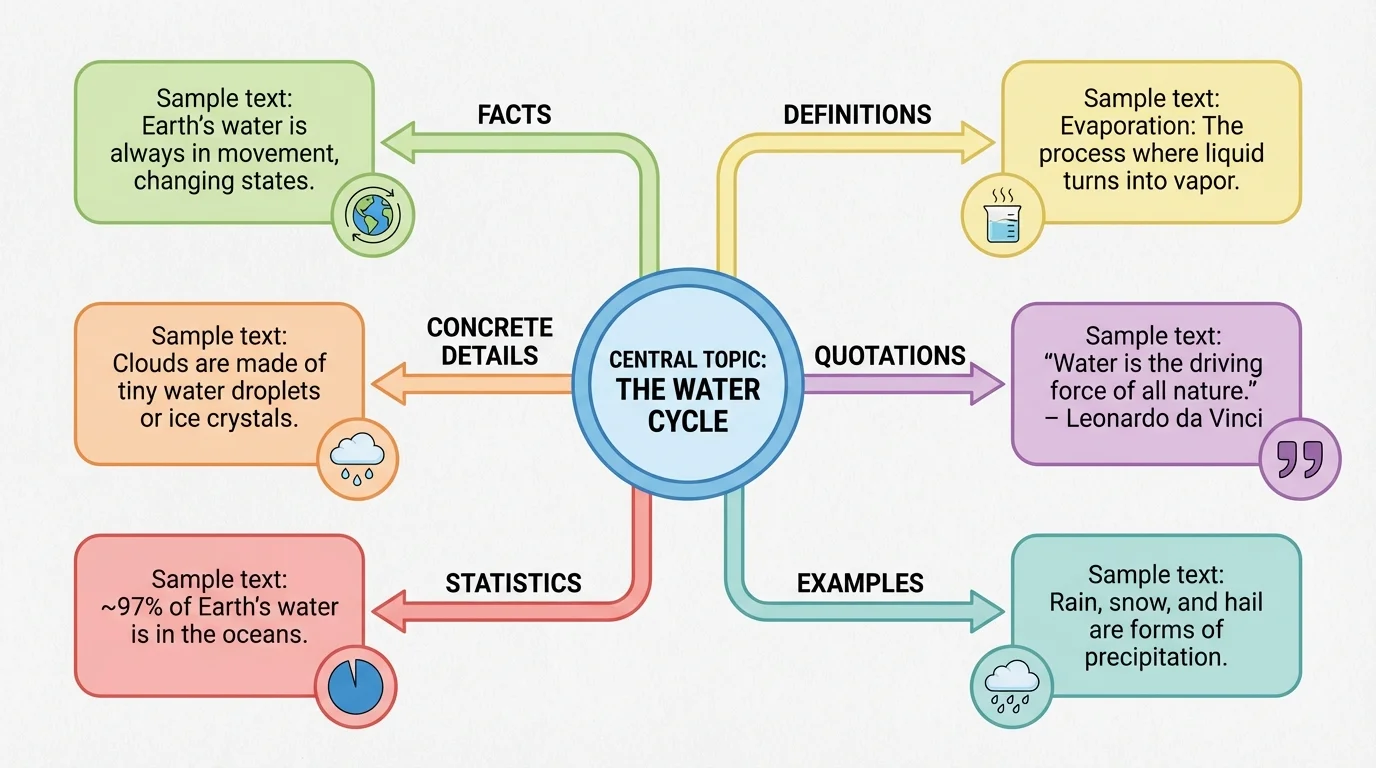
Each type of information has a job. Facts build truth. Definitions explain words. Concrete details paint a picture. Quotations bring in another voice. Statistics show size or amount. Examples connect ideas to real situations. Strong writing often combines several of these instead of relying on only one.
Professional writers for magazines, textbooks, and websites often revise by asking, "Do I have enough evidence here?" Even skilled authors know that a topic becomes clearer when it is supported by strong details.
Suppose a student is writing about honeybees. One sentence could define pollination. Another could give the fact that bees help many crops grow. A statistic might show how much of the food supply depends on pollinators. A concrete detail could describe pollen sticking to a bee's fuzzy body. Together, these details create a fuller explanation than one sentence alone.
Not every interesting detail belongs in every piece of writing. If the topic is "how penguins stay warm," details about penguins' swimming speed may be interesting, but they are not the main focus unless the writer connects them clearly. Good writers choose information that matches the topic and purpose.
This means using a relevant detail. A relevant detail directly supports the main idea. An irrelevant detail may be true, but it distracts the reader. Imagine reading an article about volcano safety that suddenly includes three sentences about the history of pizza. That would not help the explanation.
One useful way to check relevance is to ask, "Does this detail teach the reader something important about my topic?" If the answer is no, the detail probably does not belong. Strong development is not about adding the most information possible. It is about adding the most useful information.
From broad to focused
Writers often start with a broad subject and narrow it. "Oceans" is broad. "How coral reefs support sea life" is focused. When the focus becomes narrower, it becomes easier to choose details that belong together and to explain the topic deeply instead of lightly.
Related information should also be grouped together. If one paragraph explains what a fossil is, the next paragraph might explain how fossils form, and another might explain what fossils teach scientists. Grouping related ideas helps the reader follow the writing step by step.
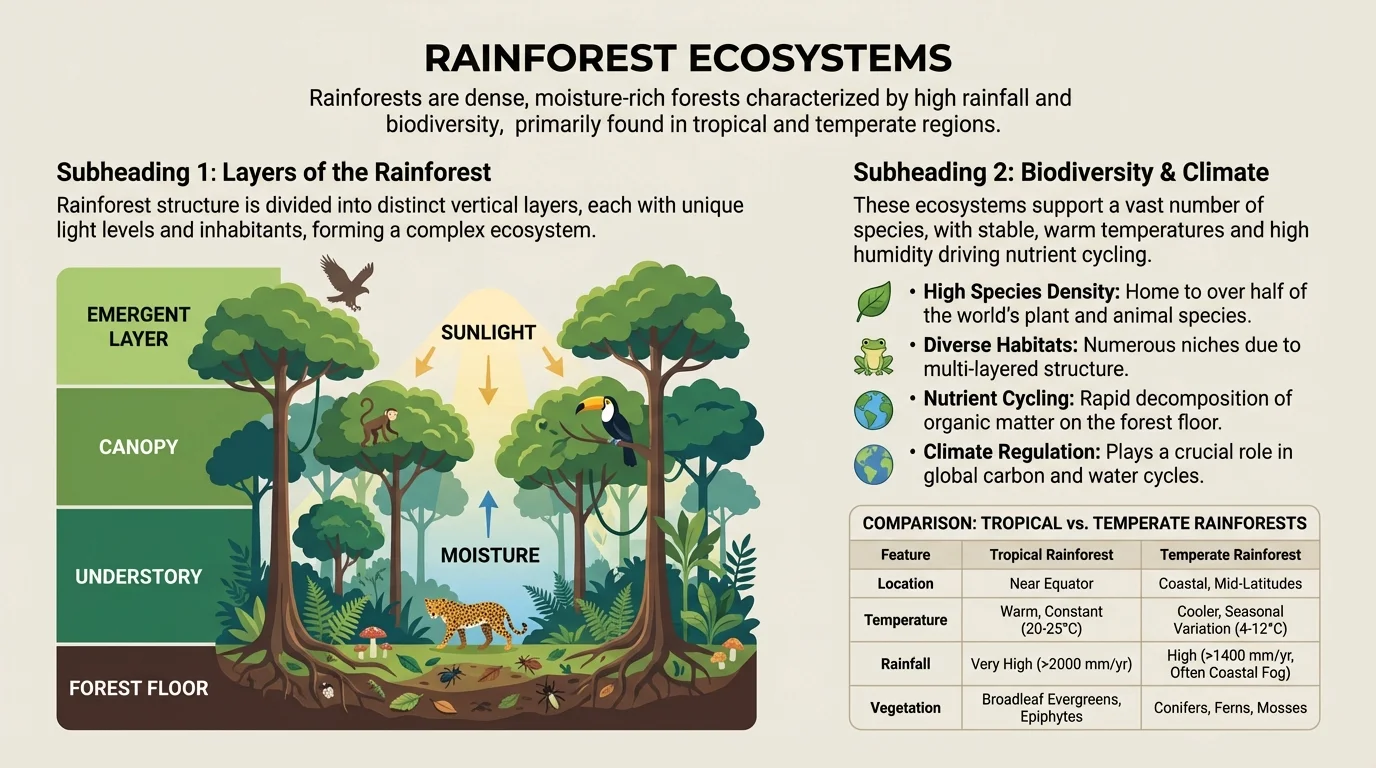
Good organization makes topic development easier to follow, and [Figure 2] illustrates how text features guide a reader through related information. In informative writing, writers often use headings, subheadings, paragraphs, lists, charts, tables, captions, and bold words. These features are not decorations. They help sort information into clear parts.
A heading tells what a section is about. A subheading breaks a large topic into smaller pieces. For example, a report on earthquakes might include sections called "What Causes Earthquakes," "How Scientists Measure Them," and "Staying Safe." This helps readers find information quickly.
Lists can group steps or examples. Tables can compare related information side by side. Short paragraphs keep ideas from becoming crowded. Bold words can point out important terms. These text features work together so readers can learn a lot without getting lost.
Here is a simple comparison of text features and what they do:
| Text feature | How it helps |
|---|---|
| Heading | Names the main section |
| Subheading | Breaks the topic into parts |
| List | Groups items or steps clearly |
| Table | Shows comparisons quickly |
| Bold word | Highlights an important term |
| Caption | Explains an image or figure |
Table 1. This table shows common text features and the job each one does in informative writing.
When the writing is well organized, readers can see how ideas connect. Later, when you return to the structure shown in [Figure 2], notice that each feature groups related information instead of mixing everything together in one long block.
Strong writers choose precise words. Precise language says exactly what the writer means. Instead of saying "a thing happened to the rock," a writer could say "the rock eroded." Instead of "the animal moved fast," a writer could write "the cheetah sprinted." Precise words make writing clearer and more powerful.
Informative writing also uses domain-specific vocabulary. These are words used in a certain subject. In science, words like habitat, predator, and photosynthesis are domain-specific. In geography, words like climate, region, and continent are domain-specific. These words help writers sound accurate because they match the topic.
However, precise and subject-specific words should still be understandable. If a writer uses a difficult word, it should be explained through context or a definition. That way, the writing teaches rather than confuses.
"The difference between the almost right word and the right word is really a large matter."
— Mark Twain
This idea matters in school subjects and in real life. A doctor, engineer, meteorologist, and zookeeper all use exact language because exact language prevents mistakes. Student writers do not need to sound like experts in every field, but they should choose words that are specific and accurate.
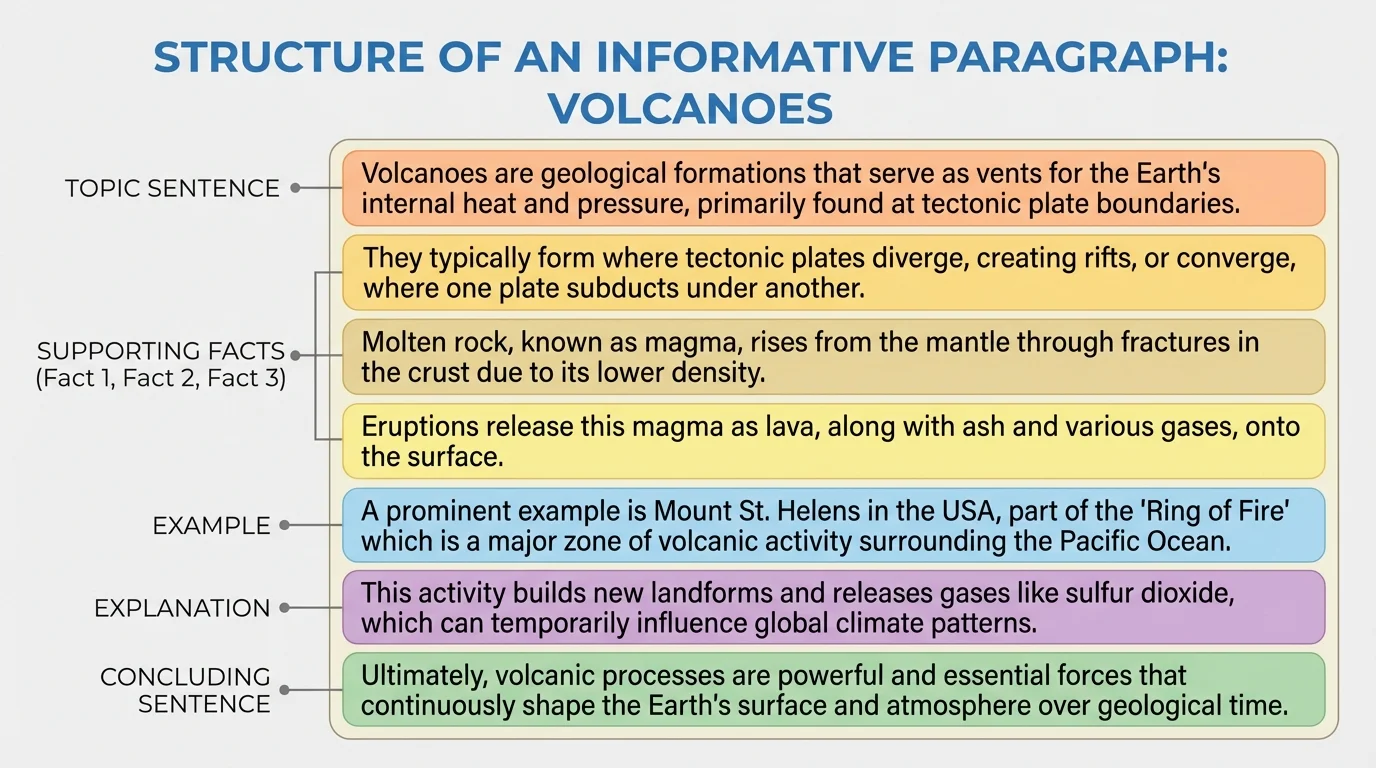
A strong paragraph has parts that work together, as [Figure 3] shows. It usually begins with a clear topic sentence, continues with supporting facts and details, explains those details, and ends in a way that completes the idea. This structure helps the reader understand one chunk of information at a time.
The topic sentence tells the main idea of the paragraph. The supporting sentences add facts, examples, or descriptions. The explanation tells why those details matter. A concluding sentence can wrap up the paragraph or lead smoothly to the next idea.
Notice that strong paragraphs do not simply pile up details. They connect them. The writer shows how each detail supports the main point.
Example: Building a paragraph about volcanoes
Step 1: Start with a clear topic sentence.
Volcanoes change Earth's surface by releasing melted rock, gas, and ash.
Step 2: Add facts and concrete details.
When a volcano erupts, lava can flow over the ground and harden into new rock. Ash can rise high into the sky and cover nearby land.
Step 3: Add an example or explanation.
For example, volcanic islands can form when repeated eruptions build layers of rock above the ocean's surface. This shows that volcanoes do not only destroy land; they can also create it.
Step 4: End with a sentence that completes the idea.
Because of this, volcanoes are powerful forces that shape the planet in many ways.
The paragraph above works because every sentence supports the same idea. None of the sentences suddenly switch to an unrelated topic like tornadoes or dinosaurs. That unity is one sign of good development.
Let's look at how one topic can be developed using several kinds of support. Suppose the focus is sea turtles.
A weak version might say, "Sea turtles are important animals." That is a start, but it leaves the reader with questions. Important how? Where do they live? Why should anyone care?
A stronger version might say: "Sea turtles play an important role in ocean ecosystems. According to marine scientists, sea turtles help keep seagrass beds healthy by grazing on them. Healthy seagrass beds provide food and shelter for many sea creatures. Sea turtles also travel long distances between feeding and nesting areas, showing how connected ocean habitats are. For example, a female sea turtle returns to shore to lay eggs, linking life on land with life in the sea."
This stronger version includes facts, a reference to experts, a concrete detail about seagrass beds, and an example of nesting behavior. It teaches the reader more. It also stays focused on one main idea: the importance of sea turtles in their environment.
Writers can use the same strategy in almost any subject. A report on the American Revolution, a science article on the water cycle, or an explanation of basketball defense all become stronger when the writer supports the topic with carefully chosen information.
Readers understand writing best when ideas are clear, connected, and specific. Sentences should build on one another rather than repeat the same point in slightly different words.
That is why the paragraph structure shown earlier in [Figure 3] remains useful even when the topic changes. Whether the subject is planets, poetry, or plant cells, the writer still needs a main point, supporting information, and explanation.
One common mistake is being too vague. A sentence like "Sharks are cool animals" expresses a feeling, but it does not teach much. A stronger sentence might say, "Sharks have several rows of teeth, and some species can detect electrical signals from other animals." The second sentence gives actual information.
Another mistake is repetition. If three sentences all say that recycling is helpful, but none explain how it is helpful, the writing will feel empty. Repetition can make a paragraph longer without making it stronger.
Some writers also include off-topic information. If the topic is "how bridges are built," a long side note about vacation destinations does not belong. Staying focused helps every part of the writing work together.
A final mistake is using words that are too general. Words like nice, bad, stuff, things, and a lot do not explain much. Precise language gives the reader a sharper picture. Instead of "a lot of rain," a writer might say "weeks of heavy rainfall." Instead of "things in the soil," a writer might say "minerals and decayed plant material."
Revision example
Weak sentence: Polar bears are good at living in cold places.
Stronger sentence: Polar bears survive Arctic temperatures because their thick fur and a layer of body fat help trap heat.
The stronger sentence develops the idea with specific details and a clear explanation.
If you compare this stronger sentence to the categories in [Figure 1], you can see that it uses concrete details and explanation instead of a vague opinion. That is what makes it more informative.
Topic development is not only for school assignments. People use it whenever they need to explain something clearly. Journalists develop topics so readers understand events. Scientists develop topics so others can understand discoveries. Instruction writers develop topics so people can follow directions safely.
Even outside of careers, people use these skills every day. A friend explaining the rules of a game, a student giving a presentation, or a person writing a review all need clear details and examples. The better the explanation, the easier it is for others to understand.
When writers develop a topic well, they show respect for the reader. They do not make the reader guess. They provide the facts, details, definitions, quotations, examples, and precise language needed to make the subject clear.
