One tiny word can change a whole sentence. Think about the word bright. It can describe a shining flashlight, a smart student, or a cheerful color. Readers do not understand words by memorizing definitions alone. They also look at how words connect to other words. When you know whether words are similar, opposite, or spelled the same but mean different things, you become a stronger reader and writer.
Good readers act like detectives. They notice clues around a word and compare it to words they already know. If a sentence says a path was narrow, and later calls it thin, the second word helps explain the first. If a character is described as timid, and the sentence says she was not bold, the opposite idea helps too. Word relationships are powerful because they help you understand words in context and also build vocabulary knowledge you can use in new situations.
Word relationships help readers in at least three important ways. First, they help you figure out unfamiliar words while reading. Second, they help you understand that words with close meanings are not always exactly the same. Third, they help you avoid confusion when one spelling can have more than one meaning.
These skills matter everywhere. In novels, they help you understand characters and setting. In science, they help you learn new academic vocabulary. In social studies, they help you understand precise terms. Even in conversations, advertisements, and song lyrics, knowing how words connect helps you understand what someone really means.
Context means the words, sentences, and ideas around a word. Context gives clues, but readers often understand a word best when they combine context with word relationships.
When you combine these tools, you do more than guess. You test an idea. You ask, "Does this meaning fit with the nearby words? Does it match a synonym? Does an antonym clue point me in the opposite direction?" That kind of thinking builds deep understanding.
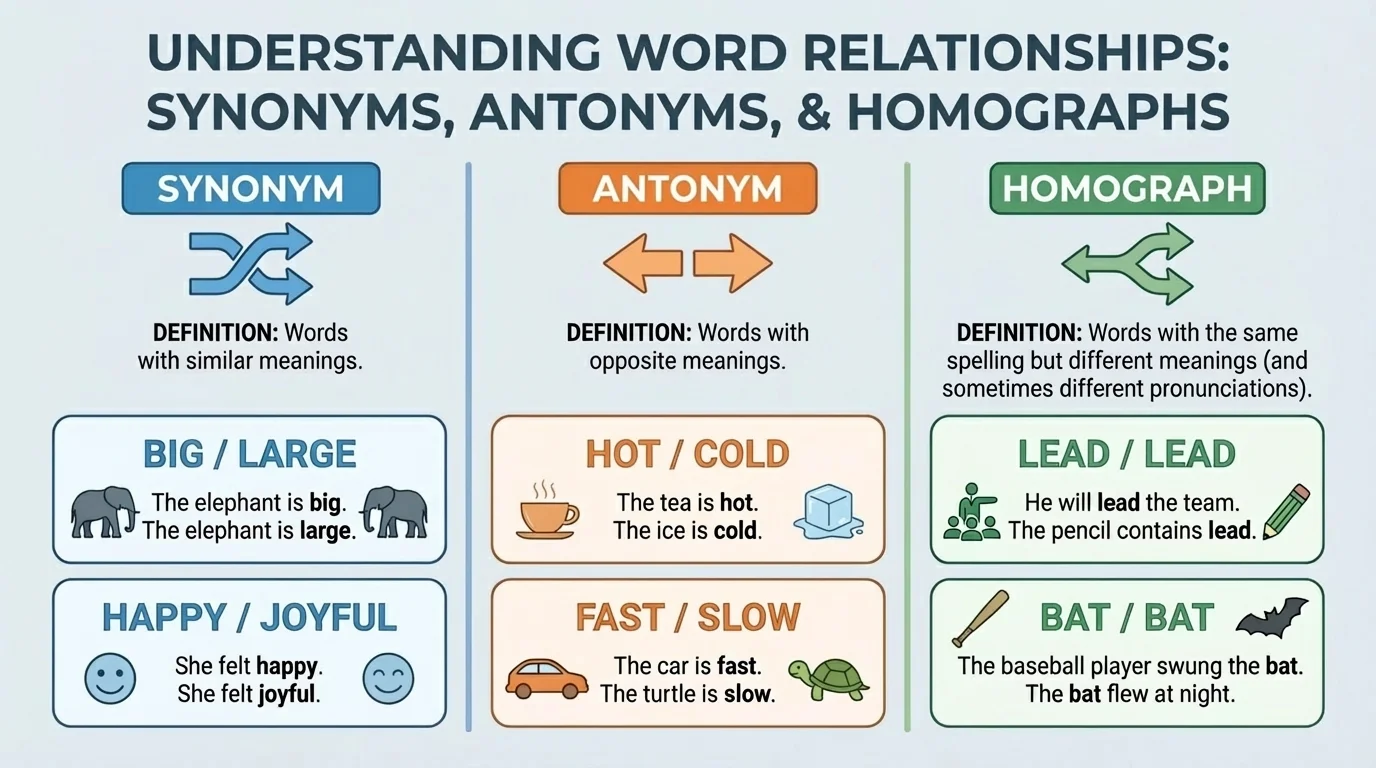
Readers can sort many word relationships into clear groups, as [Figure 1] shows. Three especially important kinds are synonyms, antonyms, and homographs. Each one helps in a different way.
Synonyms are words with the same or almost the same meaning. Antonyms are words with opposite meanings. Homographs are words that are spelled the same but have different meanings. Sometimes homographs are pronounced the same, and sometimes they are not.
These three relationships do not solve every vocabulary puzzle, but they give readers a strong starting point. If you can ask, "Is this word similar to another word, opposite from another word, or one of several meanings of the same spelling?" you are already thinking like a skilled reader.
A word can also have a nuance, which is a small difference in feeling or strength. That means two synonyms may be close in meaning but not perfectly interchangeable. A word may sound gentle, strong, formal, playful, positive, or negative. Learning word relationships includes paying attention to these differences.
Synonyms are words with the same or nearly the same meaning.
Antonyms are words with opposite meanings.
Homographs are words that share the same spelling but have different meanings.
Nuance is a small difference in meaning, feeling, or strength between words.
For example, walk and stroll are related, but they do not create exactly the same picture. Walk is general. Stroll suggests a relaxed, easy kind of walking. Understanding relationships means noticing both the connection and the difference.
Synonyms help you understand a word by linking it to one you already know. If a passage says, "The cave was enormous, huge enough to hold several buses," the familiar word huge tells you that enormous means very large.
Sometimes a writer uses a synonym on purpose to avoid repeating the same word too many times. A text may say children in one sentence and kids in the next. A report might say storm and later use tempest or weather event, depending on the style and tone.
Synonyms can appear side by side or in nearby sentences. Look at these examples:
"The puppy was tiny, a small ball of fur curled in the basket." Here, small helps explain tiny.
"Jada felt furious. She was so angry that she had to count to ten." Here, angry helps explain furious, but it also suggests that furious is even stronger than ordinary anger.
Using a synonym clue
Read the sentence: "The desert was arid, dry and dusty for miles."
Step 1: Find the unfamiliar word.
The unfamiliar word is arid.
Step 2: Look for a nearby word with a similar meaning.
The words dry and dusty describe the desert and act as synonym clues.
Step 3: Test the meaning in the sentence.
If arid means very dry, the sentence makes sense.
Arid means very dry.
Synonyms are helpful, but remember that many are only near synonyms. Glad, happy, joyful, and thrilled are related, but they are not equal in strength. Choosing the best synonym depends on the exact meaning the writer wants.
Antonyms help readers by showing contrast. If you know one word, its opposite can help explain another. For example, in the sentence "Unlike his generous sister, Leo was stingy with his allowance," the contrast tells you that stingy means the opposite of generous.
Writers often use signal words to show antonyms. Watch for words and phrases such as but, however, unlike, instead of, on the other hand, and in contrast. These words often announce that one idea will oppose another.
Consider these examples:
"The north side of the mountain was steep, but the south side was gentle and easy to climb." The contrast helps you understand that steep is the opposite of a gentle slope.
"At first the room looked chaotic, not neat and organized at all." Here, the phrase not neat and organized gives an opposite clue.
How antonym clues work
An antonym clue does not always give the exact dictionary definition. Instead, it narrows the meaning by pushing you in the opposite direction. If a word is the opposite of silent, you know it must relate to sound or noise. Then context helps you decide whether it means loud, talkative, or something else.
Antonyms also help outside of reading. When you learn that ancient is the opposite of modern, or that victory contrasts with defeat, you build stronger word knowledge that stays with you the next time you read those words.
Some words create a different challenge. A context clue may tell you that the word itself is familiar, but the meaning is not the one you expected. That often happens with homographs.
Look at the word bat. In one sentence, "A bat flew out of the cave at dusk," it means an animal. In another, "He swung the bat and hit the ball," it means sports equipment. The spelling is the same, but the meaning changes completely.
Here are more examples of homographs:
Homographs show why context matters so much. If you read only the word by itself, you may choose the wrong meaning. But in a full sentence, the surrounding words point you in the right direction.
Some homographs even change pronunciation. For example, tear can mean a drop from the eye, or it can mean to rip something. The spelling stays the same, but the way you say it depends on the meaning.
Using context with a homograph
Read these two sentences: "Please close the window." "The wind is getting stronger."
Step 1: Notice that the letter pattern looks the same.
Both words use the letters w-i-n-d.
Step 2: Use nearby words to test meaning.
In the first sentence, close the window refers to something in a room or building. In the second sentence, is getting stronger connects to moving air.
Step 3: Choose the meaning that fits each place.
The second sentence uses the weather meaning of wind.
Context keeps readers from confusing words that look alike or have multiple meanings.
As you become a better reader, you start expecting multiple meanings. Instead of thinking, "I know this word already," you learn to ask, "Which meaning fits here?"
Words often travel in groups, but each word has its own strength and feeling. That difference in meaning or tone is called nuance, and [Figure 2] illustrates how words can grow stronger or more specific along a scale.
For example, the words look, stare, and glare all involve using your eyes. But look is general. Stare means to look for a long time, often without looking away. Glare adds an angry feeling. These are not interchangeable even though they are related.
The same idea works with feeling words. Content, happy, joyful, and thrilled all describe positive emotions, but each one suggests a different level of excitement. A writer chooses one carefully to create the right effect.
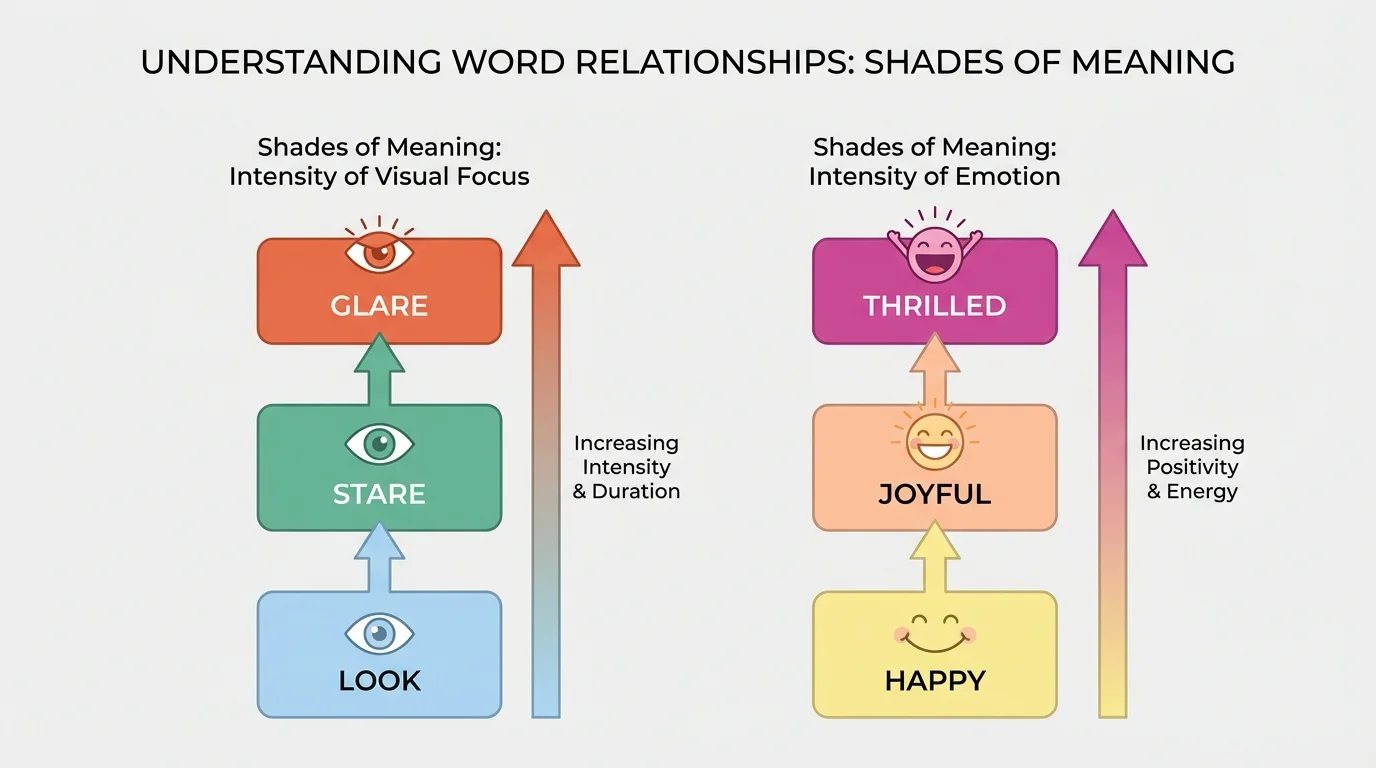
Shades of meaning matter because precise words help readers picture exactly what is happening. If a story says a character whispered, that is very different from saying the character shouted. If a text describes rain as drizzling, that creates a different image from pouring.
Writers depend on nuance to set mood and tone. Readers depend on nuance to understand those choices. Later, when you write your own sentences, this skill helps you choose better words instead of using the same simple ones over and over.
English has many synonym groups because words entered the language from different places over time. That is one reason we have related words like ask, question, and inquire, each with a slightly different tone.
The idea of nuance also helps when you compare dictionary definitions. Two words may share part of a definition but still sound different in real use. Knowing that difference is part of truly knowing the word.
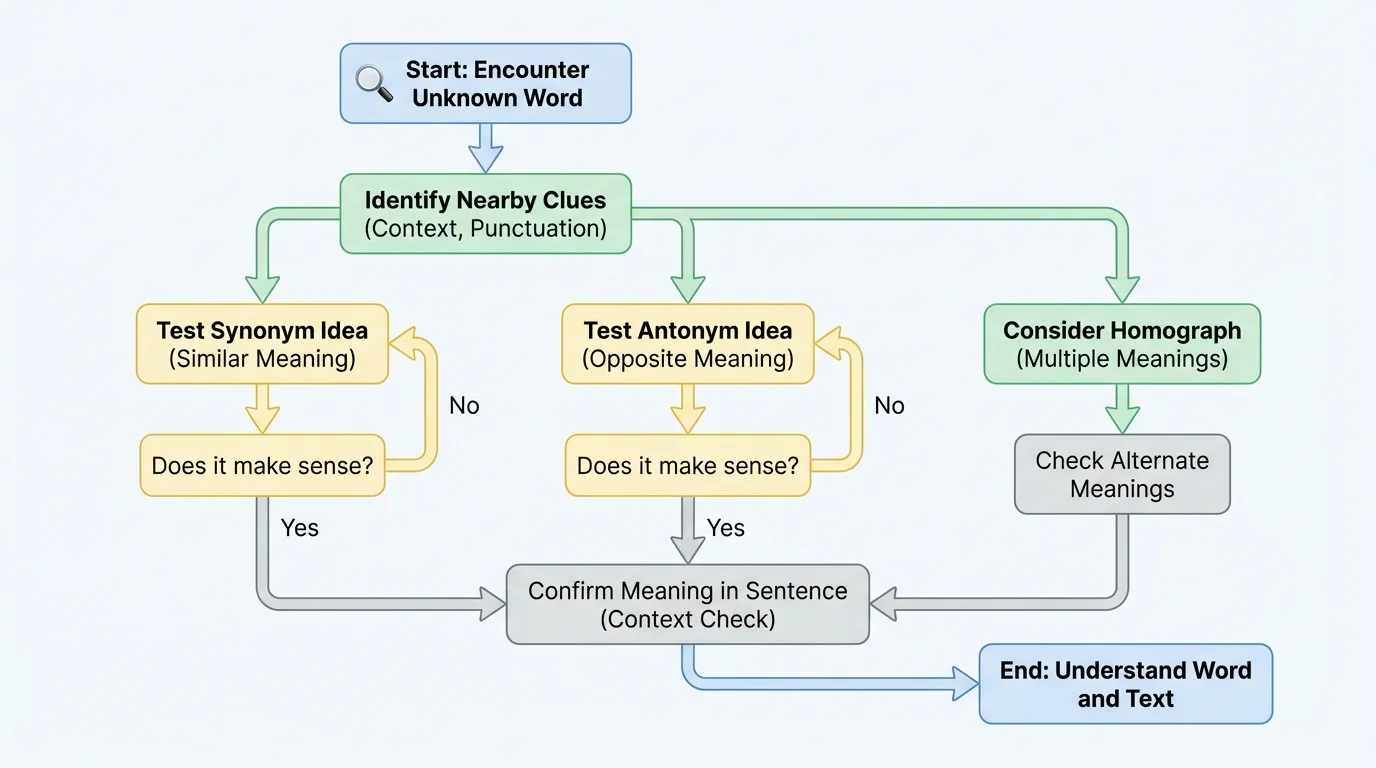
Strong readers use a sequence of thinking steps, and [Figure 3] lays out that process clearly. They do not stop after spotting one clue. They look at the sentence, the nearby words, the mood of the passage, and any familiar related words.
A helpful process is this: identify the unfamiliar word, reread the sentence, look for synonym clues, look for antonym clues, ask whether the word might be a homograph, and then test a possible meaning in the sentence. If the sentence still makes sense, your meaning is probably close.
Suppose you read, "Mila was reluctant to jump into the icy lake, but her friends were eager." You might not know reluctant, but the antonym clue eager tells you it means not willing or unsure about doing it.
Now consider this sentence: "After the long hike, the campers were famished, so they ate every crumb of bread." There is no direct synonym or antonym, but the result gives a clue. People who eat every crumb are very hungry. If you also know the word hungry, you can connect it as a near synonym and infer that famished means extremely hungry.
Here is another example: "The principal praised Nia for her diligent work. Her careful effort showed in every part of the project." The phrase careful effort acts like a synonym clue and helps you understand that diligent means hardworking and careful.
Combining clues to figure out meaning
Read the sentence: "The fox was cunning; unlike the other animals, it planned clever tricks to get food."
Step 1: Identify clue words.
The signal word unlike shows contrast, and the phrase planned clever tricks gives more information.
Step 2: Connect the clues to a known word.
Clever is a near synonym clue.
Step 3: Test the meaning.
If cunning means clever in a sneaky way, the sentence fits.
Cunning means clever, often in a tricky or sneaky way.
When readers combine context and relationships, they become much more accurate. The flow from clue to tested meaning in [Figure 3] works for difficult words in stories, textbooks, and articles.
One common mistake is assuming every synonym means exactly the same thing. That is not true. House and home are close, but home often includes feelings of belonging. Thin and skinny may describe similar shapes, but they can sound different in tone.
Another mistake is choosing the first meaning you know for a homograph. If you read the word spring, do not rush. It could mean a season, a coil, or a leap. Context decides. The same careful thinking we used with word types in [Figure 1] helps you pause and classify what kind of word puzzle you are facing.
A smart strategy is to replace the unfamiliar word with a possible synonym and reread the sentence. If the sentence still makes sense, that is a good sign. Another strategy is to look for contrast words such as but and however. If you suspect a homograph, scan the rest of the sentence for details connected to one meaning more than another.
Why "good enough" meaning matters first
When you meet an unfamiliar word, you do not always need a perfect dictionary definition right away. First, aim for a meaning that is accurate enough to understand the sentence. Then, as you read more, your understanding becomes more exact and nuanced.
This is how vocabulary grows over time. You may first learn that enormous means big. Later you learn it means extremely big. Later still, you compare it to gigantic, massive, and immense and notice subtle differences.
Word relationships are not just a school exercise. They help you read chapter books, websites, articles, and instructions more confidently. In science, if a text says a material is fragile and then explains it is easily broken, a synonym clue helps you learn an important term. In social studies, if a leader is called tyrannical and the passage contrasts that with fair, the antonym clue helps you understand the author's meaning.
These skills also improve writing. When you know many related words, you can choose the best one for your idea. Instead of writing that a character was sad, you might choose gloomy, upset, heartbroken, or disappointed, depending on the exact feeling. The scale of meaning shown earlier in [Figure 2] reminds us that word choice creates stronger pictures and clearer emotions.
Listening and speaking improve too. If someone uses a word you do not know, you can listen for a synonym, an opposite idea, or a clue from the rest of the sentence. That keeps you from getting stuck and helps you follow the conversation.
| Word relationship | What it tells you | Example | How it helps |
|---|---|---|---|
| Synonym | Similar meaning | tiny and small | Connects an unfamiliar word to a familiar one |
| Antonym | Opposite meaning | generous and stingy | Shows meaning through contrast |
| Homograph | Same spelling, different meaning | bark of a dog, bark of a tree | Reminds readers to use context carefully |
| Nuance | Small difference in strength or feeling | happy, joyful, thrilled | Helps readers choose the most precise meaning |
Table 1. A comparison of major word relationships and how each one helps readers understand meaning.
As your reading becomes more advanced, the words become more precise. But the basic habits stay the same: notice relationships, use context, test a meaning, and stay alert for more than one possibility. That is how skilled readers unlock unfamiliar language.
