Have you ever been in a class discussion where someone says something so interesting that everyone starts thinking harder? That is not an accident. Strong discussions happen when people ask clear questions, listen carefully, and respond in ways that help ideas grow. A great discussion is a little like building with blocks: one person sets down an idea, another adds to it, and someone else connects it to something new. When people do this well, the whole class learns more.
Discussion is not just about talking. It is also about listening, thinking, and choosing words that move the conversation forward. In grade 5, you are expected to take part in discussions with partners, small groups, and the whole class. That means you need to know how to ask thoughtful questions, how to answer in a useful way, and how to build on what others say instead of starting over each time.
Good discussion skills help in school, but they also help in everyday life. When you talk with a teammate about game strategy, ask a family member for more information, or work with classmates on a project, you are using discussion skills. A strong speaker does more than wait for a turn. A strong speaker helps everyone understand the topic better.
When people ask specific questions and respond thoughtfully, discussions become clearer. Confusing ideas get explained. New examples appear. Different opinions can be compared. Problems get solved faster because people are not just talking randomly. They are building understanding together.
Discussion as teamwork
A collaborative discussion is a conversation in which people work together to understand a topic, text, question, or problem. Each person brings ideas, but the group's job is to connect those ideas, examine them, and improve them.
That is why discussion is a skill. Like dribbling a basketball or practicing a musical instrument, it improves when you learn the right moves and use them with purpose.
A specific question is a question that is clear, focused, and connected to the topic. A specific question helps the other person know exactly what you are asking. It does not wander all over the topic. It points to one idea that needs more explanation, evidence, or detail.
[Figure 1] Compare these two questions about a story: "What about the story?" and "Why do you think the main character decided to leave home even though it was dangerous?" The first question is too broad. The second question is specific because it points to a particular character, action, and reason. A listener can answer it more clearly.
Specific questions often begin with words such as why, how, what evidence, which part, or can you explain. These question starters invite thinking instead of one-word answers. For example, instead of asking "Did you like the article?" you might ask "Which fact in the article surprised you most, and why?" That makes the discussion richer.
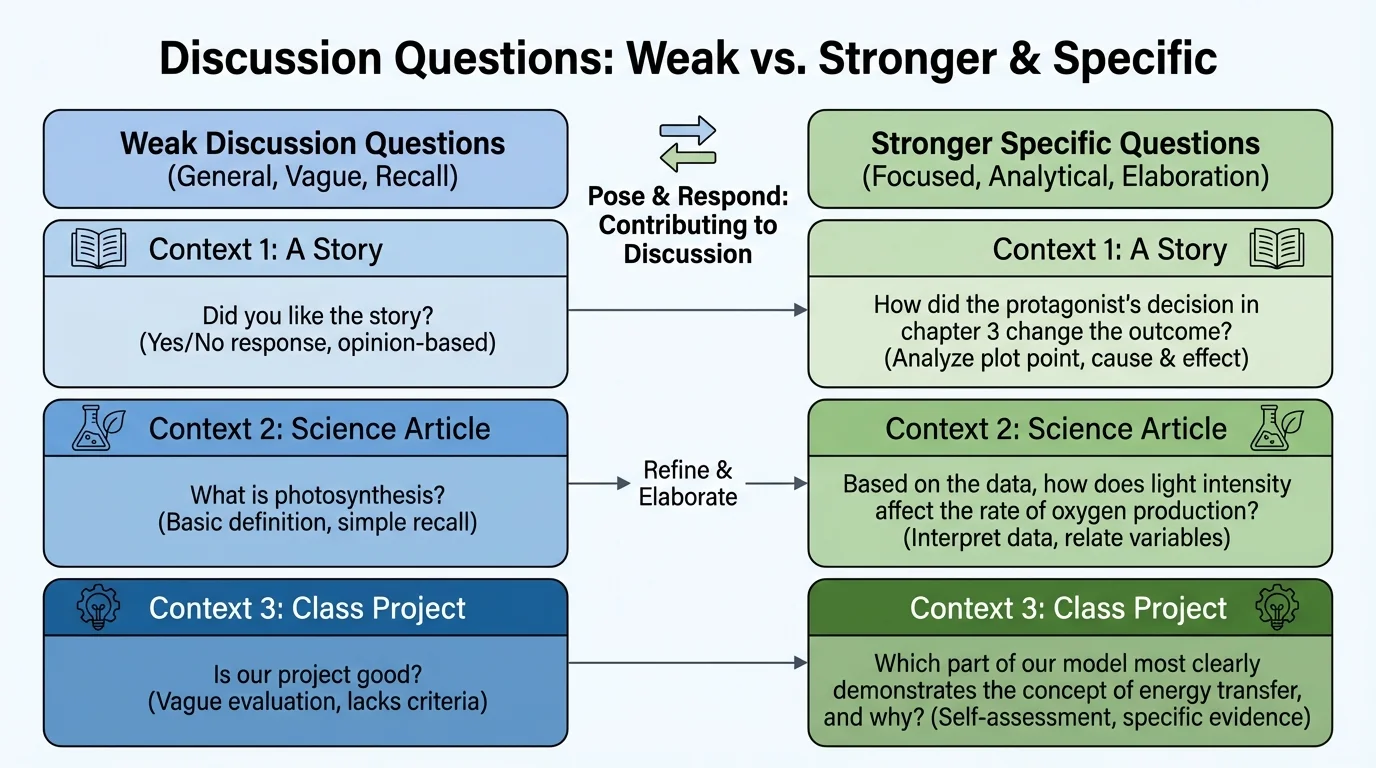
Specific questions can do different jobs in a discussion. Some questions ask for clarification. For example: "Can you explain what you mean by 'unfair'?" Some ask for evidence: "What part of the text supports your idea?" Some ask for a connection: "How does your idea relate to what Maya just said?" Some ask for deeper thinking: "What might happen if the character made the opposite choice?"
Notice that each question helps the speaker or the group go further. A question should not just fill silence. It should help the group understand something better.
Examples of stronger questions
Step 1: Start with a topic.
Topic: a class discussion about recycling.
Step 2: Notice a weak question.
Weak question: "What about recycling?"
Step 3: Make it more specific.
Stronger questions: "How does recycling help reduce trash in our town?" or "What evidence shows that recycling programs really make a difference?"
The stronger questions guide the discussion toward useful information and ideas.
Sometimes the best question comes from careful listening. If a classmate says, "I think the inventor was brave," you can ask, "What action showed bravery the most?" That question grows directly from the other person's remark, which is exactly what good collaboration does.
Once someone has shared an idea, the next speaker has an important job. A useful comment does more than say "I agree" or "That's cool." It adds meaning. Good comments can add information, explain a reason, connect ideas, ask for clarity, or respectfully challenge a point.
[Figure 2] Here are some powerful ways to respond:
Add on. You can extend an idea: "I want to add that the setting also affects the character's choice." This keeps the same idea moving forward.
Clarify. You can help make an idea clearer: "Do you mean that the storm caused the delay, or that the road was already dangerous?"
Agree with a reason. Instead of saying only "I agree," explain why: "I agree that the solution is fair because each person shares the work equally."
Disagree respectfully. Discussions are not only for agreement. You can disagree politely: "I see it differently because the author gives stronger evidence for the second point."
Connect ideas. You can link one speaker's thought to another's: "That connects to what Jordan said about saving water at home."
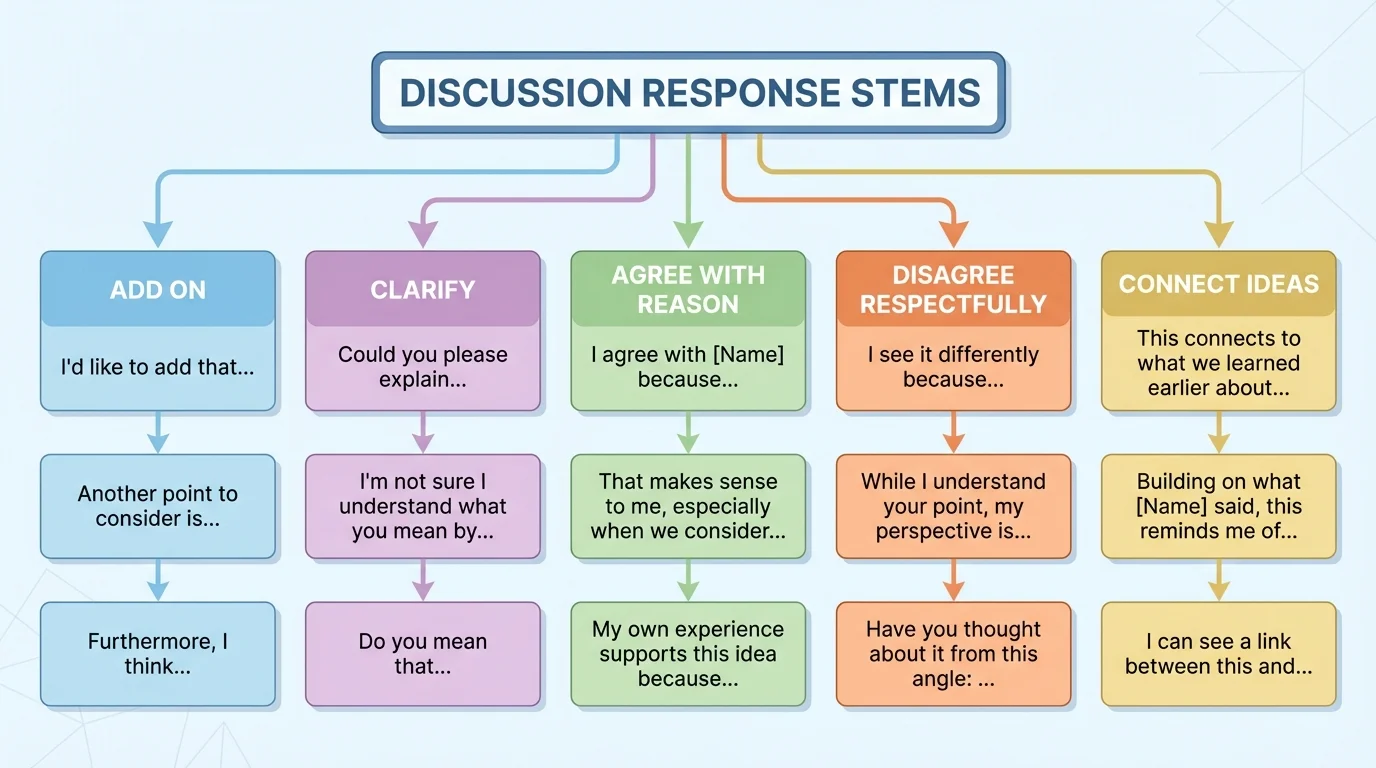
These kinds of responses keep a discussion alive. If everyone only repeats opinions, the discussion stays flat. If students explain, connect, and question ideas, the discussion becomes deeper and more interesting.
Helpful sentence starters can make responding easier. Here are some examples:
| Purpose | Sentence Starter |
|---|---|
| Add an idea | "I would like to add..." |
| Give a reason | "I think that because..." |
| Connect to someone else | "That relates to what ___ said..." |
| Ask for clarification | "Can you explain what you mean by...?" |
| Respectfully disagree | "I understand your point, but I think..." |
Table 1. Sentence starters that help students respond productively in a discussion.
Using sentence starters does not mean your speaking is fake. It means you are learning structures that help your ideas come out clearly. Athletes practice movements until they feel natural. Speakers can do the same with discussion language.
To elaborate means to add more detail, explanation, or evidence. In discussions, elaborating on someone else's remark means you do not leave the idea alone. You help it grow. You might give an example, explain a cause, show a connection, or point out a detail from a text.
Suppose one student says, "The animal adapted to its environment." A weak response is "Yeah." A stronger response is "I agree, and one example is its thick fur, which helps it survive in cold weather." That second response elaborates because it gives a clear example.
Elaboration can happen in several ways. You can add an example: "For instance, the character lies two times before telling the truth." You can add evidence from a text: "On page 14, the author says the river had dried up." You can explain a cause and effect relationship: "Because the team practiced more, they worked together better during the game." You can also compare ideas: "Unlike the first solution, this one saves both time and water."
Evidence is information that supports an idea. In a discussion, evidence can come from a text, an experiment, an observation, or a real example.
Elaboration is adding details, examples, reasons, or evidence to make an idea clearer and stronger.
When you elaborate well, you show that you are listening closely. You also show that you can think beyond your first thought. This is one of the most valuable parts of discussion because it turns simple statements into strong, supported ideas.
Earlier, [Figure 1] showed that strong questions are focused. Elaboration works with those questions. A specific question invites a more detailed answer, and a detailed answer gives the next speaker something meaningful to build on.
Building on a classmate's idea
Speaker 1 says: "I think school gardens are useful."
Step 1: Repeat the key idea in your own words.
"You're saying school gardens help the school community."
Step 2: Add a detail, example, or reason.
"I want to add that gardens can also teach science because students observe how plants grow."
Step 3: Extend the thinking with a question or connection.
"Could a garden also help the cafeteria by providing vegetables?"
This response does not simply repeat. It listens, adds, and expands.
A good elaboration stays connected to the topic. If the discussion is about weather patterns, and someone suddenly starts talking about a vacation story with no clear link, the discussion can drift away from the goal. Strong speakers keep the thread of the conversation in mind.
Discussion is not only about the words you choose. It also includes your behavior. Good listeners show that they are paying attention through posture, eye contact, waiting for a turn, and note-taking. These behaviors make others feel respected and make the discussion run more smoothly.
[Figure 3] Helpful behaviors include facing the speaker, making eye contact when appropriate, waiting until someone finishes, speaking clearly, and using a voice that others can hear without shouting. Nodding, taking notes, or briefly summarizing what someone said can also show active listening.
Interrupting is one of the fastest ways to weaken a discussion. When you interrupt, you may cause someone to lose their idea, and you miss a chance to understand their full point. Waiting your turn helps everyone feel safe sharing.
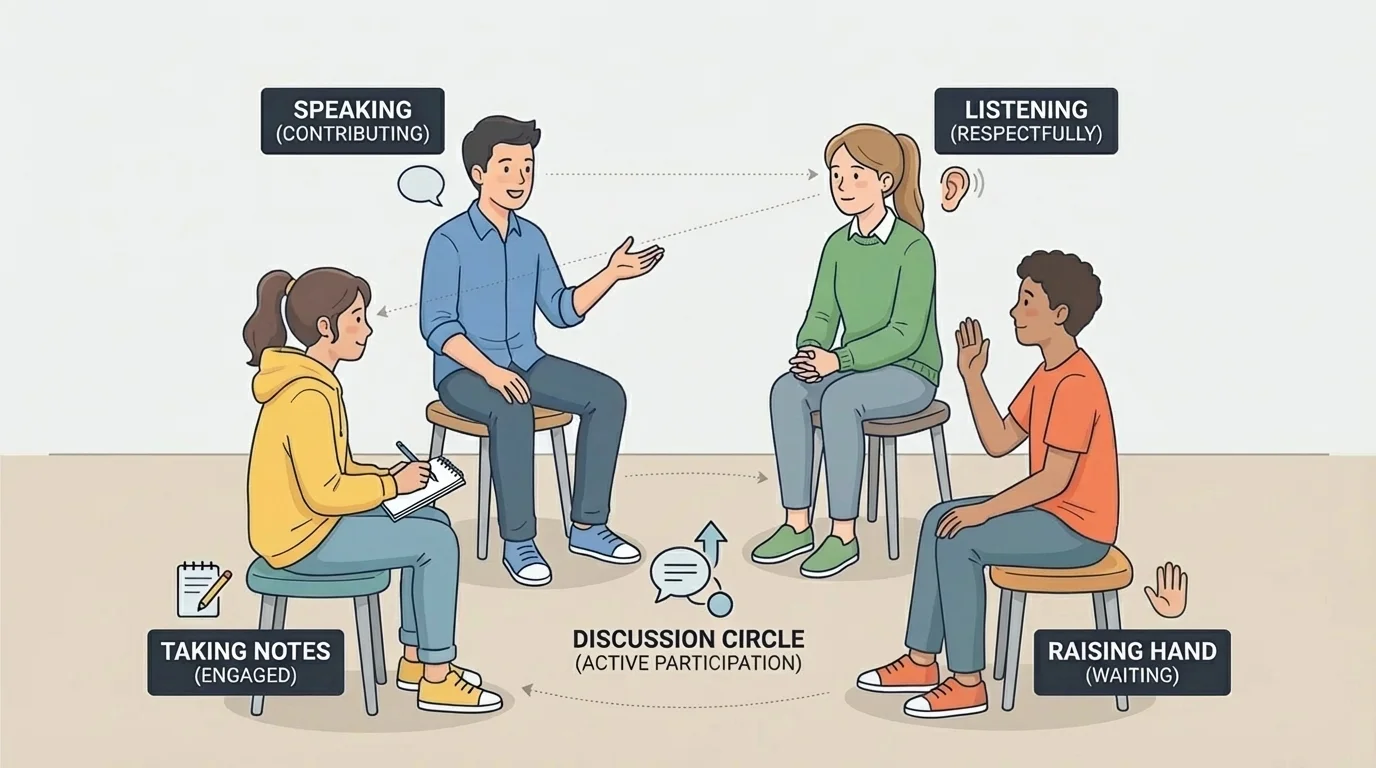
Respectful language matters too. Instead of saying, "That makes no sense," you can say, "I'm not sure I understand that idea yet. Can you explain it another way?" Instead of saying, "You're wrong," you can say, "I see the evidence differently." The second kind of language keeps the discussion focused on ideas instead of making it personal.
In many jobs, adults spend a large part of their day listening, asking questions, and discussing ideas with others. Strong discussion skills are useful far beyond the classroom.
Body language can support your words. Slouching, looking away all the time, or whispering can make it seem as if you are not engaged. Sitting up, tracking the speaker, and speaking with confidence show that you are ready to participate.
A discussion can look different depending on the situation. In a collaborative discussion with one partner, each person usually has more chances to speak. That means you need to listen carefully and respond directly to the other person's exact idea.
In a small group, the challenge changes. You need to make room for several people, remember what others have said, and connect ideas across the group. In this setting, comments like "That matches what Lena said earlier" or "Can we go back to Amir's question?" are especially useful.
In a teacher-led discussion, you may speak less often, but your comments still need to be clear and specific. The teacher may ask follow-up questions or invite students to compare ideas. This is a good time to refer to evidence, summarize earlier points, or answer a classmate's question in a complete way.
Even though these situations are different, the same core skills matter in all of them: listen closely, ask focused questions, respond thoughtfully, and build on others' ideas.
Sometimes discussions become unhelpful because students make choices that block understanding. One problem is asking questions that are too vague. Another is giving comments that are too short to help. A third problem is going off-topic.
Here are some better choices:
| Problem | Better Choice |
|---|---|
| "What?" | "Can you explain what evidence changed your mind?" |
| "I agree." | "I agree because the author gives two strong examples." |
| Interrupting | Wait, listen fully, then respond to the full idea. |
| Changing the subject | Connect your idea clearly to the topic being discussed. |
| Repeating the same point | Add a new reason, example, or question. |
Table 2. Common discussion problems and stronger choices students can make.
Another common problem is pretending to listen while actually planning your next statement. Real listening means your response fits what was just said. Later, when you think about active participation again, [Figure 3] remains useful because it shows that listening can be seen as well as heard.
Remember that complete sentences, clear speaking, and topic focus are important in all oral communication. Discussion adds one more layer: you must connect your ideas to the ideas of others.
Students sometimes think they need to sound fancy to be effective. That is not true. Clear, respectful, and specific language is more powerful than complicated words used in a confusing way.
These skills matter in many real situations. On a sports team, a player might ask, "How should we adjust our defense when the other team spreads out?" That is a specific question. A teammate might respond, "We should cover the wings more closely because they are making quick passes." That response adds a reason.
In a science group, one student might say, "Our plant grew less in the shade." Another could elaborate by saying, "That may be because it received less sunlight for photosynthesis." In a book club, someone might ask, "What part of the chapter showed that the character was changing?" That question invites evidence and deeper thinking.
At home, discussion skills can help solve problems. Instead of saying, "This is unfair," a more useful comment is, "I think the chores should be divided differently because one task takes much longer than the others." Specific speaking often leads to better solutions.
"Good discussions do not happen when everyone says more. They happen when everyone listens better and thinks more carefully."
The more you practice these habits, the more natural they become. Asking specific questions, making useful comments, and elaborating on others' ideas are not just school tasks. They are ways of showing respect, curiosity, and strong thinking.
