Have you ever read a sentence that sounded fine at first, but then your brain suddenly said, "Wait, that does not make sense"? That moment is not a reading failure. It is actually the sign of a growing reader. Strong readers do more than say words aloud. They pay attention to whether the words fit. When something sounds wrong, looks wrong, or makes the meaning confusing, they stop and fix it.
Reading is not just calling out words one after another. Reading is making meaning. Sometimes a word is hard to pronounce. Sometimes a word is familiar, but it does not make sense in that sentence. Sometimes a reader guesses too quickly and says the wrong word. Good readers learn to use the words around the tricky part to check their thinking. This is called using context clues to confirm or self-correct.
When readers confirm a word, they check that the word they said matches the letters on the page and makes sense in the sentence. When readers self-correct, they notice a mistake and fix it on their own. Both skills are important because they help readers understand what they read, not just finish the page.
Readers get stuck for many reasons. A word may be long, unfamiliar, or spelled in a tricky way. A sentence may include new information or an unusual phrase. A reader may move too quickly and skip part of a word. For example, a student might read "desert" when the word is actually "dessert." Those words look similar, but they mean very different things. The sentence around the word helps the reader decide which one makes sense.
Sometimes the problem is not pronunciation. A reader may say the word correctly but still not understand it. In a sentence like "The puppy was reluctant to jump into the cold lake," a reader might pronounce reluctant correctly but still need context to understand that it means unwilling or hesitant. The nearby words "cold lake" and "jump" help show why the puppy might not want to go in.
Context is the group of words, sentences, and ideas around a word that help explain its meaning.
Confirm means to check that a word recognition or idea is correct.
Self-correct means to notice a mistake while reading and fix it independently.
Reread means to read a word, sentence, or section again in order to understand it better.
These reading moves matter in every subject. In a novel, they help readers understand characters and events. In science, they help readers make sense of precise language. In social studies, they help readers understand new terms and important details. Even when reading game instructions or a recipe, using context helps a reader avoid mistakes.
Context is like the neighborhood around a word. A single house tells you something, but the whole neighborhood tells you much more. In reading, the words before and after a difficult word often give hints about its meaning. Sometimes the author explains the word directly. Sometimes the author gives an example. Sometimes the clue is more subtle, and the reader must infer the meaning.
Suppose you read: "The canyon was enormous. Its massive walls towered above us." Even if you do not know the word enormous, the phrase "massive walls towered above us" suggests that it means very large. You used the surrounding words to build meaning.
Context clues are powerful, but they are strongest when readers also pay attention to the letters in the word. If a student sees "enormous" and says "exciting," the sentence meaning may still seem positive, but the word does not match the letters. Good readers use both print and meaning together.
Your brain does not read by using only one clue at a time. Skilled readers quickly combine letters, sounds, sentence meaning, and what they already know about the topic.
That is why reading is both careful and active. A reader looks at the word, thinks about what is happening in the sentence, and asks, "Does this word look right, sound right, and make sense?" Those three checks work together all the time.
Authors leave different kinds of clues in sentences and paragraphs, and readers can learn to spot these patterns, as [Figure 1] illustrates. When you know the common types of clues, you can search for them on purpose instead of just guessing.
One kind is a definition clue. The author explains the word directly. For example: "A habitat is the natural home of a plant or animal." The meaning of "habitat" is given right in the sentence.
Another kind is a synonym clue. A nearby word has a similar meaning. For example: "The path was narrow, so slim that only one hiker could pass." The word "slim" helps explain "narrow." An antonym clue uses an opposite idea. For example: "Unlike his timid brother, Marcos was bold during the presentation." The opposite of "timid" helps explain "bold."
A fourth kind is an example clue. The author gives examples that point to the meaning. For example: "Celestial bodies, such as stars, planets, and moons, filled the night sky." The examples help explain "celestial bodies." A fifth kind is an inference clue. The author does not define the word directly, but the reader can figure it out by thinking carefully. In "Jada glanced at the dark clouds and grabbed her umbrella," we can infer that rain is probably coming.
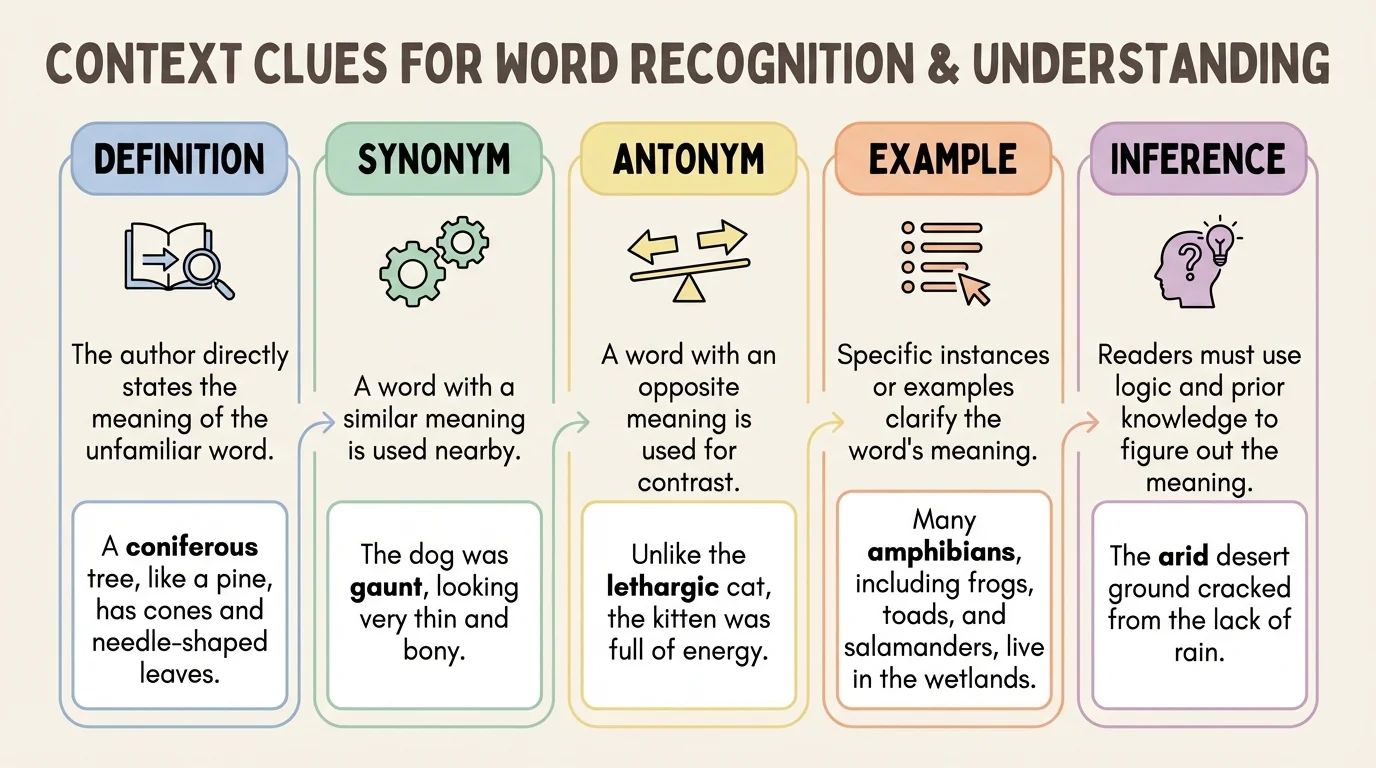
These clue types often work together. In a longer paragraph, a reader may find an example in one sentence, a synonym in another, and an overall idea in the whole paragraph. That is why it is smart to read beyond the difficult word instead of stopping too soon.
Later, when you meet an unknown word in a science article or story, the clue chart in [Figure 1] reminds you to ask what kind of hint the author has provided. This helps you search more accurately and avoid random guessing.
Word recognition means identifying the printed word correctly. Sometimes readers recognize words immediately. Sometimes they need to slow down and check. Confirming word recognition means making sure the word you said really matches what is on the page and fits the meaning.
Think about this sentence: "The eagle spread its wings and soared above the valley." If a reader says "soured" instead of "soared," the mistake may sound close, but the meaning becomes strange. Eagles do not become sour in the sky. The sentence meaning helps the reader realize something is wrong. Then the reader looks back at the letters and fixes the word.
Readers can ask three important questions: Does it look right? Does it sound right? Does it make sense? If the answer to any of these is no, it is time to check again. These questions help readers stay active instead of reading on with confusion.
Checking a misread word
Sentence: "After the long hike, the campers were exhausted and rested by the stream."
Step 1: Notice the problem.
If a reader says "excited" instead of "exhausted," the sentence becomes confusing. After a long hike, "excited" is possible, but "rested by the stream" suggests tiredness more strongly.
Step 2: Look carefully at the letters.
The word begins with "ex-" in both cases, but the rest of the letters differ. The printed word is "exhausted."
Step 3: Check the meaning in context.
"Long hike" and "rested" support the meaning tired, so "exhausted" fits better.
The reader confirms the correct word by using both print and context.
Sometimes a reader says a real word that still does not fit. That is why meaning matters so much. Confirming is not only about decoding the letters; it is also about making sure the sentence makes sense.
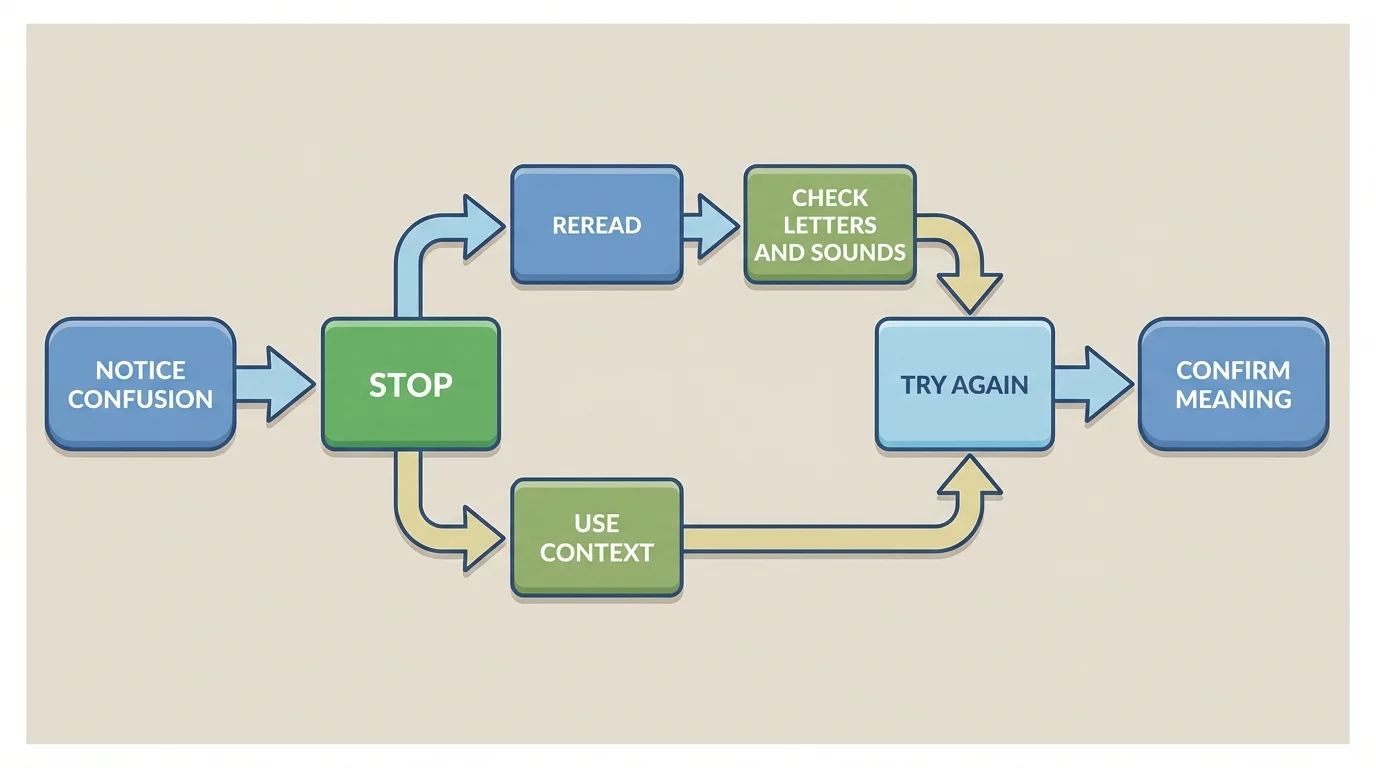
Skilled readers do not wait for someone else to tell them about mistakes. They monitor their understanding and repair it when needed, as [Figure 2] shows through a clear stop-and-fix process. This habit is one of the strongest signs that a reader is becoming independent.
Self-correcting begins with noticing. Maybe a sentence sounds odd. Maybe the meaning suddenly breaks apart. Maybe the reader realizes a word was skipped, added, or changed. That moment of noticing is powerful because it gives the reader a chance to fix the problem immediately.
After noticing, the reader stops and goes back. The reader may reread just the word, the sentence, or several sentences around it. Then the reader checks letters, sounds, word parts, and context. Finally, the reader tries the sentence again and asks whether it now makes sense.
For example, imagine reading: "The museum curator arranged the ancient artifacts." A student might stumble over curator. If the student first guesses "creator," the sentence may seem a little off. Rereading and looking at the surrounding words "museum" and "arranged" help the student realize that "curator" is the person who takes care of a museum collection.
The repair steps in [Figure 2] also work in everyday reading. If directions for a game do not make sense, rereading can reveal a missed word. If a paragraph in a textbook feels confusing, going back and reading with more attention often clears up the meaning.
Monitoring comprehension means paying attention to whether you understand as you read. Strong readers keep checking their thinking. They do not just move their eyes across the page; they notice when understanding becomes weak and then use strategies to rebuild it.
Self-correcting is not a sign that you are a poor reader. It is a sign that you are an alert reader. Everyone makes mistakes while reading sometimes. What matters is catching them and fixing them.
Some students think rereading means they are slow. Actually, rereading is a strategy used by strong readers of all ages. Athletes watch plays again. Musicians repeat hard parts. Readers reread because understanding matters more than rushing.
Rereading can help in several ways. It can help you hear the sentence more smoothly. It can give you another chance to notice punctuation. It can help you connect a confusing word to ideas in earlier sentences. It can also help you confirm a meaning you guessed from context.
If one sentence is confusing, reread that sentence first. If the sentence depends on earlier information, reread the sentence before it too. If a whole paragraph is unclear, go back to the beginning of the paragraph. The amount of rereading should match the size of the problem.
Using rereading to clear up meaning
Paragraph: "Mina tied the seedlings to short sticks. By afternoon, the garden looked much tidier, and the tomato plants stood upright."
Step 1: Read the unfamiliar word.
A reader may not know "seedlings."
Step 2: Reread the whole paragraph.
The words "garden," "tomato plants," and "stood upright" suggest that seedlings are young plants.
Step 3: Confirm the meaning.
The reader decides that "seedlings" are small, developing plants, which fits the paragraph.
Rereading helps the reader move from uncertainty to understanding.
Rereading is especially useful when the text contains important information, such as test directions, safety steps, or key facts in science and social studies. Missing one word in those situations can change the meaning a lot.
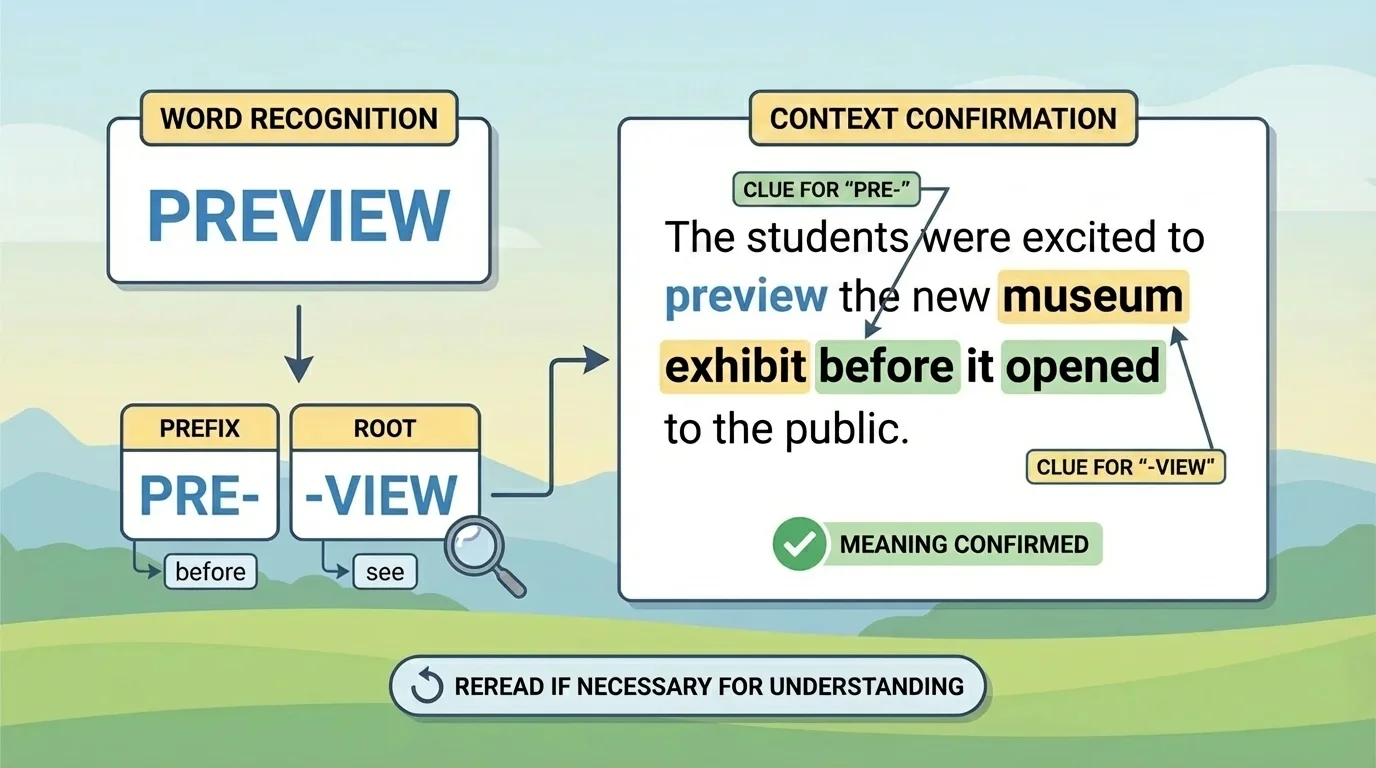
Readers do not have to rely on only one strategy. They can combine context with morphology, the study of meaningful word parts, as [Figure 3] shows with a word broken into parts and checked against a sentence. This makes word solving much stronger.
For example, in the word prefix "preview," the part "pre-" means before, and "view" relates to seeing. So "preview" means seeing something before the main event. If the sentence says, "We watched a preview of the movie before it came out," the context confirms that meaning.
Readers can also use suffix clues. In "careless," the suffix "-less" means without. So "careless" means without care. If the sentence says, "His careless mistake changed the answer," the context supports the idea that the mistake happened because he was not careful.
Word relationships help too. Synonyms are words with similar meanings. Antonyms are words with opposite meanings. If a sentence says, "The surface was rough, not smooth at all," the antonym clue helps define "rough." If a paragraph says, "The rescue was quick and rapid," the synonym clue helps confirm "rapid."
As we see again in [Figure 3], the best readers test a possible meaning in two ways: they break apart the word if they can, and then they check whether that meaning fits the sentence and larger passage. One strategy gives a clue; the other confirms it.
| Strategy | What the reader checks | Example |
|---|---|---|
| Context clues | Words and ideas around the unknown word | "The arid land was dry and dusty." |
| Prefix | Meaning at the beginning of a word | "replay" means play again |
| Suffix | Meaning at the end of a word | "hopeful" means full of hope |
| Synonym | Nearby word with similar meaning | "tiny, small" |
| Antonym | Nearby word with opposite meaning | "ancient, not modern" |
Table 1. Reading strategies that help readers determine and confirm word meanings.
Fluency means reading with accuracy, an appropriate speed, and expression. Fluency matters because it helps readers focus on meaning instead of struggling over every single word. But fluency does not mean racing. A fast reader who does not understand is not truly fluent.
Accurate word reading supports comprehension because the brain has more energy left to think about ideas. When readers recognize words correctly and smoothly, they can pay attention to characters, facts, arguments, and details. When a text becomes confusing, fluent readers slow down and repair their understanding.
This balance is important. If a reader goes too slowly all the time, meaning may break apart. If a reader goes too quickly, errors may slip by unnoticed. Strong fluency includes flexibility: moving smoothly when the text is clear and slowing down when the text becomes tricky.
From earlier reading work, remember that comprehension is understanding what a text says, what it means, and how its ideas connect. Accuracy and fluency support comprehension, but they do not replace it.
Think of riding a bike on a trail. On a straight path, you move smoothly. On a rocky turn, you slow down and pay close attention. Reading works in a similar way. Good readers adjust their pace to stay in control of meaning.
In fiction, context clues often come from actions, dialogue, and feelings. If a character slams a door, refuses to answer, and stomps upstairs, a word like "furious" can be understood through the character's actions. Readers should watch what characters do, say, and think.
In nonfiction, context clues may come from definitions, examples, headings, captions, or repeated explanation. A science text might say, "Evaporation is the process in which liquid water changes into water vapor." This direct explanation gives a strong clue. In social studies, a new term may be explained across several sentences rather than in one place.
In directions, one misread word can change everything. If a recipe says to "stir gently" and someone reads "stir constantly," the result may be different. This is why careful confirmation and rereading are useful in real life, not just in reading class.
Applying the strategy in different texts
Sentence from a history article: "The treaty ended the conflict and created a temporary truce between the groups."
Step 1: Look at nearby words.
"Ended the conflict" suggests peace or a pause in fighting.
Step 2: Test the meaning.
"Temporary truce" means a short stop in conflict.
Step 3: Confirm with the whole sentence.
The sentence supports the idea that a truce is an agreement to stop fighting for a time.
This shows how context helps in subjects beyond stories.
Whether the text is about volcanoes, basketball strategy, animal habitats, or computer coding, the same habits matter: notice confusion, check the print, use context, reread, and confirm meaning.
Strong reader habits grow over time. One important habit is staying mentally present. Instead of drifting through the words, active readers keep asking whether the text makes sense. Another habit is being willing to pause. Good readers do not panic when they hit a difficult word; they investigate it.
It also helps to be flexible. Sometimes context gives the answer immediately. Sometimes you need to look at a prefix or suffix. Sometimes you must reread a full paragraph. Sometimes you need all of these together. Reading is not one single move repeated forever. It is a set of smart decisions.
As readers practice these habits, they become more confident and independent. They begin to trust themselves to solve problems in the text. They understand more, remember more, and enjoy reading more because the words on the page connect clearly to ideas in their minds.
"Good readers do not just read the words. They think about whether the words make sense."
That habit of checking for meaning is the heart of confirming and self-correcting. It helps readers grow stronger in every subject and every kind of reading they do.
