Have you ever read a report that felt smooth and easy to follow, while another one felt jumpy, like the writer was changing lanes without a signal? The difference is often in the way the writer links ideas. In informative writing, facts do not belong in a random pile. They need to be grouped into categories and connected so readers can see how one idea relates to another. Strong writers guide readers with carefully chosen words, phrases, and clauses such as for example, in contrast, as a result, and especially.
When you explain a topic, you are doing more than listing information. You are showing relationships. One fact may add to another. One idea may contrast with another. A detail may give an example, show a cause, or point to an important result. Linking language acts like the bridges between parts of your writing. Without those bridges, even true information can feel confusing.
Transition words and phrases help writing flow from one thought to the next. They show readers whether the next idea will add information, explain a reason, give an example, or show a difference. When a writer uses transitions well, the reader does not have to guess how ideas fit together.
Think about a report on volcanoes. A writer might explain how volcanoes form, describe different kinds of eruptions, and then discuss how eruptions affect people and land. Those are different categories of information, but they still belong to the same topic. To keep the report clear, the writer needs to connect ideas inside each category and also connect one category to the next.
Linking ideas means connecting information so readers understand the relationship between parts of a text. Writers use words, phrases, and clauses to make these relationships clear.
Categories of information are groups of related facts about a topic. In an informative text, each category often has its own paragraph, section, or subheading.
Good linking also makes writing sound more mature. Compare these two versions: "Bats are mammals. Bats fly at night. Bats use echolocation." That version is correct, but it sounds choppy. Now read this: "Bats are mammals, and they usually fly at night. In addition, many bats use echolocation to find food." The second version is easier to read because the ideas are connected.
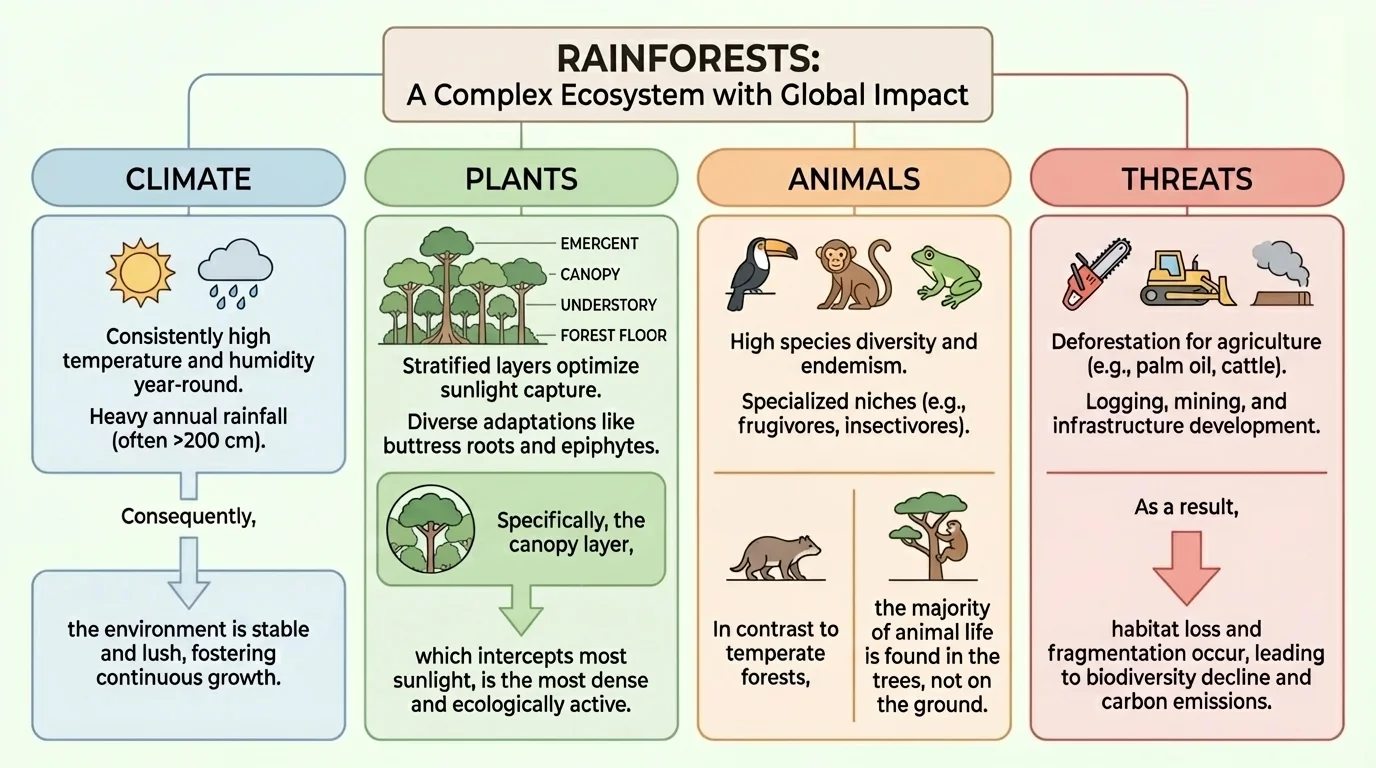
Informative texts are stronger when related details are grouped together, as shown in [Figure 1]. Instead of mixing every fact into one long paragraph, writers sort information into categories. A report about rainforests, for example, might have categories such as climate, plants, animals, and threats to the ecosystem. Each category focuses on one part of the larger topic.
This grouping helps readers in two ways. First, it makes the writing easier to follow. Second, it allows the writer to build clear connections. Inside the "plants" section, the writer can link details about tall trees, vines, and shade-loving flowers. Then the writer can connect that section to the "animals" section by explaining that many animals depend on those plants for food and shelter.
Categories are often signaled by text features such as headings, subheadings, captions, diagrams, and tables. These features do part of the organizing work, but writers still need linking language in the sentences themselves. A heading can tell you that a section is about "Desert Animals," but transitions inside the paragraph explain how the details fit together.
From earlier writing lessons, remember that a paragraph should stay focused on one main idea. Linking language does not replace a clear topic sentence. It helps support and connect the details that belong to that main idea.
Writers also think about order. They may arrange categories from general to specific, from cause to effect, or from past to present. The order matters because it affects which linking words make sense. If one section comes after another in time, a transition like later works well. If the second section shows a different point of view, on the other hand may work better.
Writers use different sizes of language to connect ideas. A single word can do the job, but sometimes a longer phrase or clause gives a clearer signal.
A transition word is one word that connects ideas, such as also, however, therefore, or finally. A phrase is a group of words that works together, such as for example, in contrast, or as a result. A clause is a group of words with a subject and a verb, such as because the soil is dry or although the storm was short. Clauses can connect ideas in a more detailed way because they explain relationships, not just signal them.
Look at how each type works in a sentence: "Owls hunt at night. Also, they have excellent hearing." Here, also is a linking word. "Owls hunt at night. For example, the barn owl searches for mice after dark." Here, for example is a linking phrase. "Owls can hunt successfully because they hear tiny sounds in the grass." That connecting part is a clause.
Different transitions signal different relationships between ideas, and [Figure 2] organizes the most common ones. Choosing the right transition matters because each one tells the reader what kind of connection to expect. If you use however, the reader expects a contrast. If you use as a result, the reader expects an effect.
Here are some major relationship types that writers often need in informative texts.
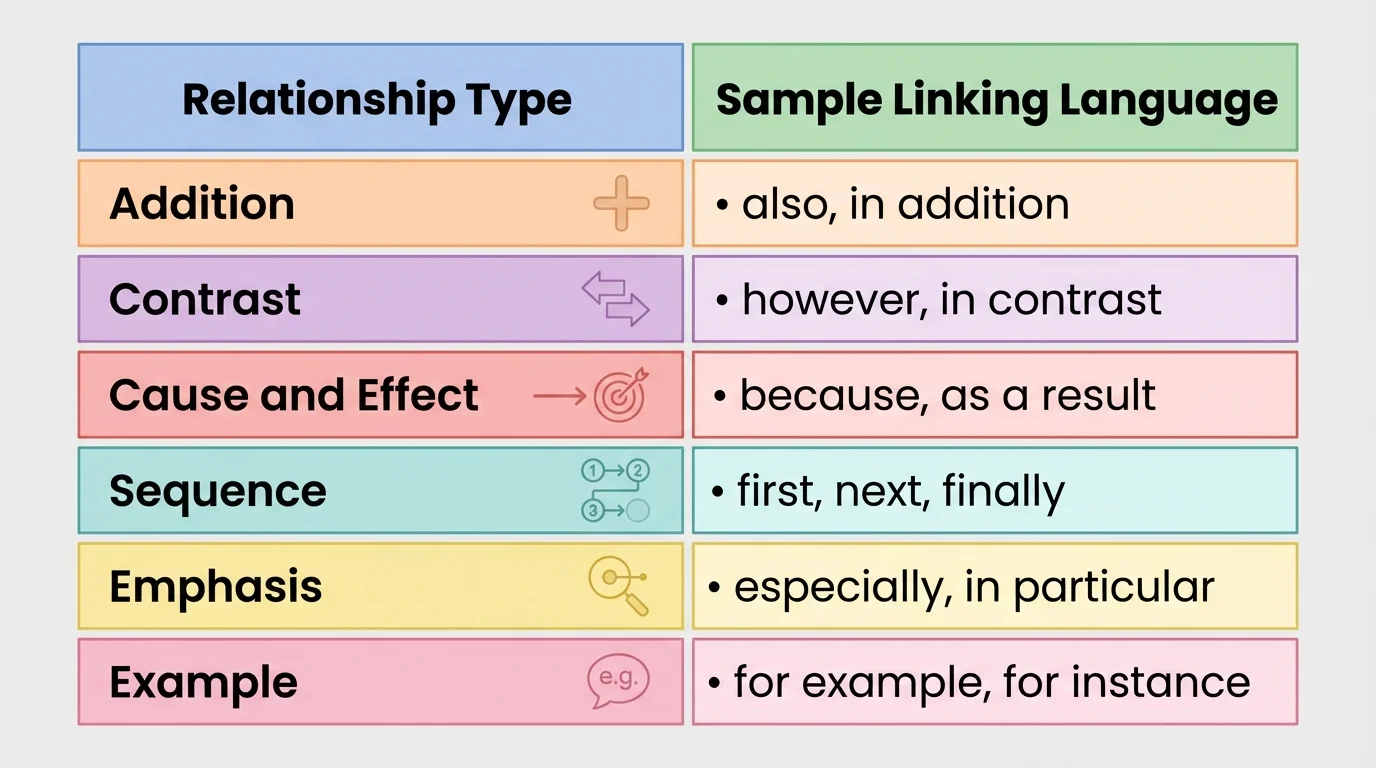
Addition: These transitions add information. Examples include also, in addition, another, and furthermore. Example: "Sea turtles spend much of their lives in the ocean. In addition, females return to land to lay eggs."
Contrast: These transitions show differences. Examples include however, in contrast, on the other hand, and although. Example: "Both frogs and toads are amphibians. However, toads usually have drier skin."
Example or illustration: These transitions introduce a specific case. Examples include for example, for instance, and such as. Example: "Many insects help plants reproduce. For example, bees carry pollen from flower to flower."
Cause and effect: These transitions show why something happens or what happens because of it. Examples include because, since, therefore, so, and as a result. Example: "The river flooded after days of heavy rain. As a result, nearby fields were covered with water."
Sequence or time: These transitions show order. Examples include first, next, then, later, and finally. Example: "First, a caterpillar hatches from an egg. Next, it eats and grows quickly."
Emphasis: These transitions point to a detail that matters most. Examples include especially, in particular, and most importantly. Example: "Rainforests are home to many species, especially insects and birds."
| Relationship | What it shows | Helpful examples |
|---|---|---|
| Addition | One more related idea | also, in addition, another |
| Contrast | A difference or opposite point | however, in contrast, although |
| Example | A specific case | for example, for instance, such as |
| Cause and effect | Why something happens or what happens next | because, therefore, as a result |
| Sequence | Order in time or steps | first, next, later, finally |
| Emphasis | The most important detail | especially, in particular, most importantly |
Table 1. Common relationships in informative writing and examples of linking language.
Notice that some words can be used in more than one way depending on the sentence. That is why writers must think about meaning, not just memorize lists. The transition should match the exact relationship between the ideas.
Professional writers for science magazines and news articles often revise transitions many times. A small change from also to in contrast can completely change how readers understand two facts.
This chart remains useful when you revise because it reminds you that transitions are not decoration. They are clues that tell readers how to think about the information.
Inside one paragraph, all the details should support the same main idea. Linking words and phrases help each sentence connect to the sentence before it. This makes the paragraph feel unified instead of scattered.
Read this paragraph: "Polar bears have thick fur and a layer of fat. These features help them stay warm in the Arctic. In addition, their large paws help them walk on ice and swim through cold water." The transition in addition tells the reader that another related detail is coming. The phrase "these features" also links back to the first sentence, showing clearly what the writer means.
Pronouns and repeated key words can help too. For example: "A cactus stores water in its stem. This adaptation helps the plant survive long dry periods." The phrase "this adaptation" connects the second sentence to the first without repeating the whole idea. That kind of connection keeps writing clear and not too repetitive.
Strong linking inside a paragraph happens when each sentence grows out of the one before it. Writers may use a transition, a pronoun like this or these, a repeated keyword, or a clause that explains a reason or result. The goal is for readers to feel that the paragraph moves forward smoothly.
Clauses are especially helpful within a paragraph because they can show exact relationships. For instance: "Mangrove trees grow well near salty water because their roots can handle harsh coastal conditions." That clause does more than connect the idea. It explains it.
When writers move from one category of information to another, they often need a bridge sentence, and [Figure 3] shows how this bridge works. A bridge sentence usually connects the old section to the new one by reminding readers of what they just learned and pointing toward what comes next.
Suppose a report is about animal survival. One section explains habitats, and the next section explains adaptations. A writer could end the habitat section like this: "Different habitats create different challenges for animals. Because of those challenges, animals develop special adaptations for finding food, staying safe, and surviving weather." That final sentence links the categories. It does not simply stop one topic and jump to the next. It shows why the next section matters.
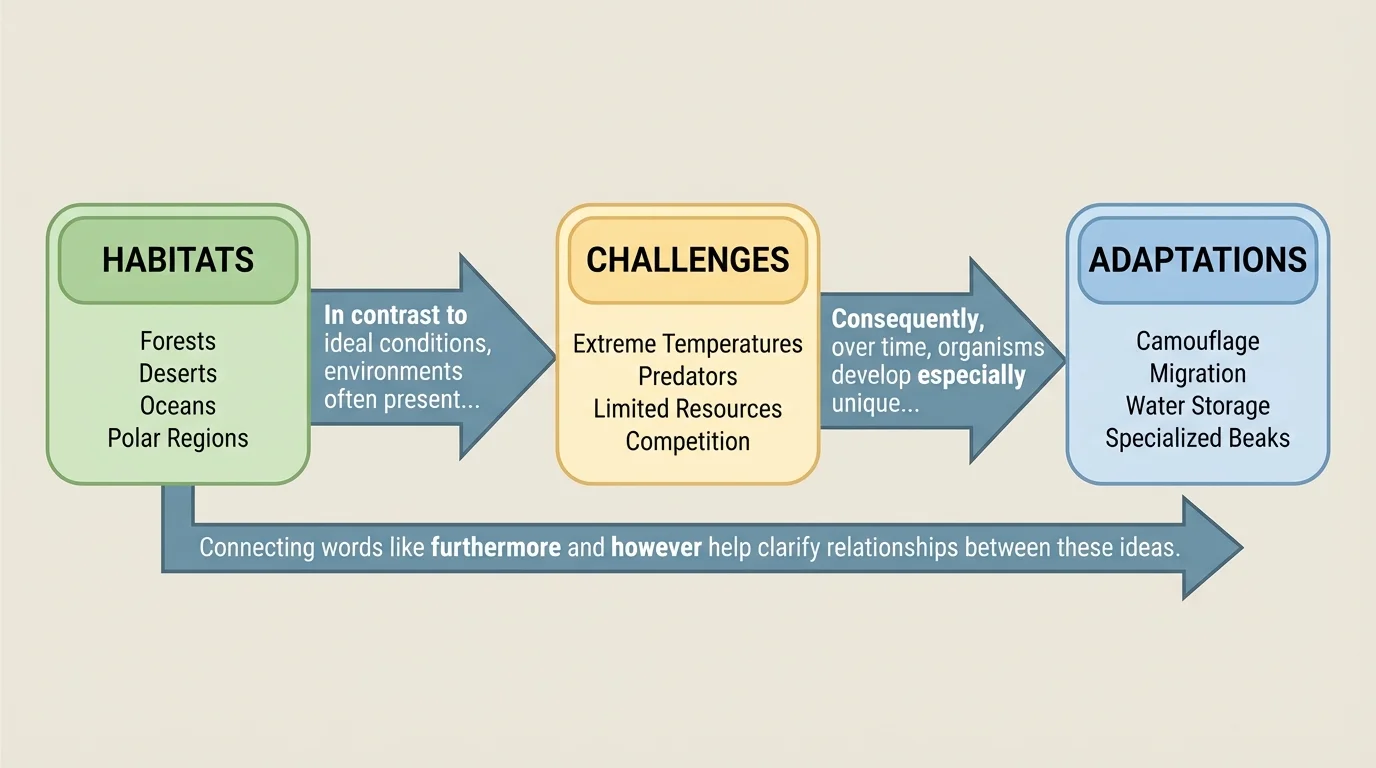
Across categories, transitions are often longer and more thoughtful. Instead of using only one word like next, writers may use a full clause such as "While weather affects where plants grow, soil type also plays an important role." This clause helps shift from a weather section to a soil section while keeping the larger topic connected.
Here is another example. A report on the water cycle may have one category about evaporation and another about condensation. The writer might connect them by saying, "After water vapor rises into cooler air, it begins to change again. At that point, condensation forms tiny droplets that can become clouds." The transition guides readers from one stage to the next.
Model bridge between categories
Topic: School gardens
Step 1: End the first category clearly.
"School gardens provide fresh vegetables and herbs for students."
Step 2: Add a sentence that points toward the next category.
"Beyond providing food, gardens also create outdoor spaces for learning."
Step 3: Begin the next category using a matching transition.
"For example, science classes can observe insects, soil, and plant growth in the garden."
The bridge works because it connects one category, food, to the next category, learning.
Later in a report, the same idea appears again. The strongest bridges do two jobs at once: they look back briefly and point ahead clearly.
Not all transitions are equally strong. Some are too vague for a specific job. For example, also is useful for addition, but it cannot show contrast or cause and effect. If the real relationship is "this happened because of that," then because or as a result is more precise.
Precision matters because informative writing aims to teach clearly. Imagine writing about recycling: "Glass can be recycled many times. Also, it does not lose much quality." That sentence is acceptable. But if your point is that the second fact explains the value of the first, this version is clearer: "Glass can be recycled many times. As a result, it remains a valuable material for reuse."
Writers also need variety. If every sentence begins with also or then, the writing feels repetitive. Good writers choose from several transitions that fit the same relationship. Instead of repeating for example over and over, they might also use for instance or such as, depending on the sentence.
"The right transition does not just connect ideas. It explains the connection."
One useful question to ask while revising is, "What is the exact relationship here?" Is the next idea adding more information, showing a difference, giving a reason, or highlighting the most important point? Once the relationship is clear, the transition becomes easier to choose.
One common mistake is using a transition that does not match the meaning. Read this: "Sharks do not have bones. For example, their skeletons are made of cartilage." The phrase for example is not the best choice here because the second sentence is not a separate example. It explains the first statement. A better version is: "Sharks do not have bones. Instead, their skeletons are made of cartilage."
Another mistake is dropping in transitions without enough connection. Example: "Clouds form from water droplets. However, some clouds are low and thick." The word however suggests a contrast, but the second idea is not clearly opposite to the first. A better version is: "Clouds form from water droplets. In addition, some clouds are low and thick."
A third mistake is overusing the same transition. Listen to this pattern: "Reptiles are cold-blooded. Also, many reptiles lay eggs. Also, they have scales." The repeated transition becomes dull. A stronger version is: "Reptiles are cold-blooded. In addition, many reptiles lay eggs. They also have scales."
Revising weak links
Step 1: Find the relationship between the ideas.
Are the sentences showing addition, contrast, example, sequence, cause and effect, or emphasis?
Step 2: Check whether the transition fits that relationship.
If the meaning is contrast, a word like however may fit. If the meaning is sequence, a word like next may fit better.
Step 3: Read the sentences aloud.
If the connection sounds forced or confusing, revise the transition or rewrite the sentence.
Sometimes the best revision is not a new transition word but a stronger sentence. For instance, "Bears hibernate. Therefore, winter is cold" does not make sense because the cause-and-effect relationship is backward. Better writing begins with clear thinking.
Text features and transitions work together to organize information, and [Figure 4] displays how a page layout helps readers follow categories. Headings tell what each section is about. Subheadings narrow the focus. Captions explain pictures. Tables show comparisons. These features create visible structure, while linking language creates connection inside the sentences.
For example, a report about weather might have the heading "Storm Types" and subheadings for hurricanes, tornadoes, and blizzards. Inside the hurricane paragraph, a writer may use for instance to give examples of storm damage. Then, to move to tornadoes, the writer may say, "In contrast, tornadoes are smaller than hurricanes but can still be extremely destructive." The heading organizes the category, and the transition links the ideas.
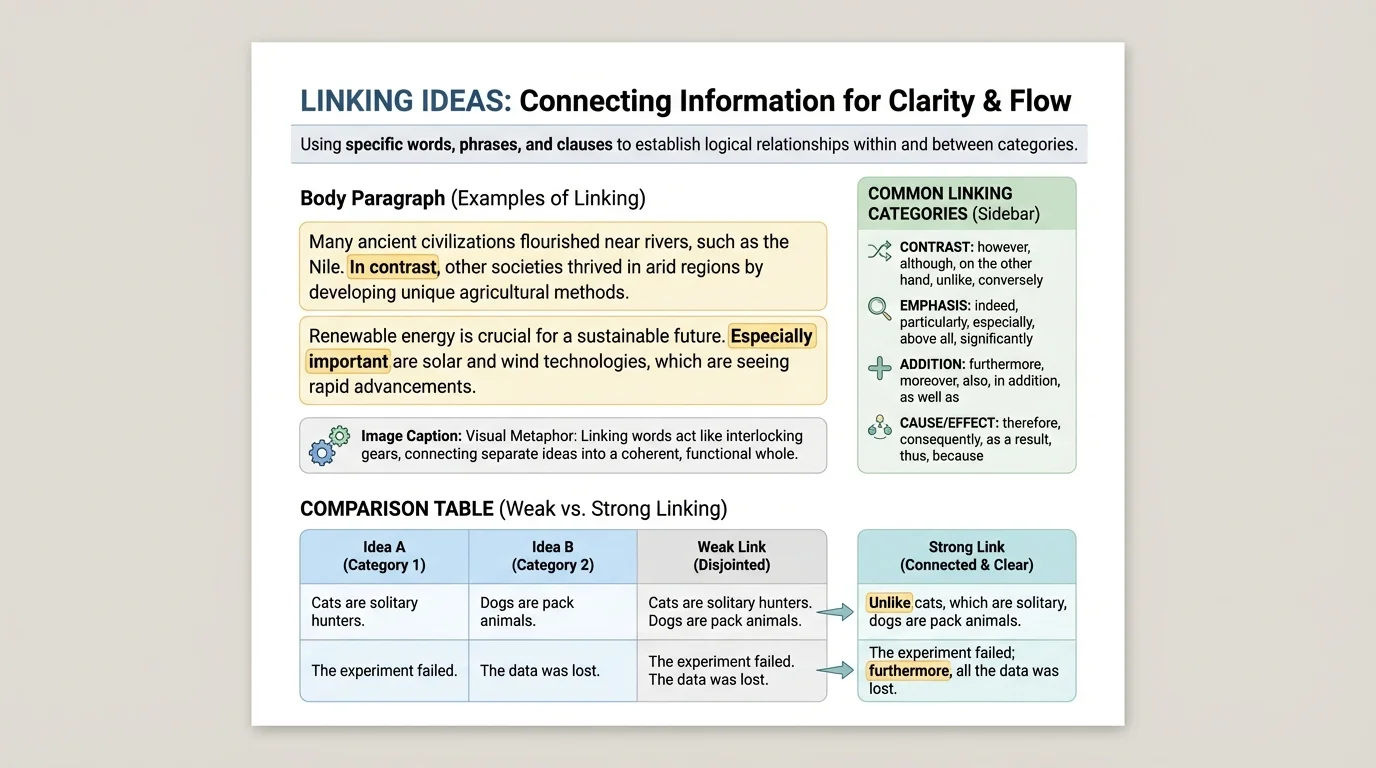
Tables can also support linked information when details need side-by-side comparison. If students compare mammals and reptiles, the table displays categories like body covering, temperature control, and reproduction. Then the paragraph can refer to those categories with transitions such as similarly or in contrast. The page design and the sentences work as a team.
Later, when a reader scans the page again, the structure makes the main categories easy to locate. That is why informative writing is not only about what facts to include, but also about how to group and connect them.
Now look at how all of these ideas can work together in a short explanation about pollinators.
"Pollinators are animals that help plants reproduce by moving pollen. Bees are among the best-known pollinators, especially because they visit many flowers in one day. Butterflies also help with pollination; however, they usually carry less pollen than bees. Pollinators are important to ecosystems. For example, many fruits and vegetables grow only when pollination occurs. Because pollinators help plants make seeds and fruit, they support food chains as well. Pollinators face several dangers, including habitat loss and pesticides. As a result, many scientists study ways to protect them."
This explanation uses categories such as what pollinators are, examples of pollinators, why they matter, and threats they face. It links ideas within categories by adding examples and reasons. It also links across categories by moving from description to importance and then to challenges.
What makes an informative explanation effective is not just having accurate facts. Effective writing has a clear focus, groups related information, uses precise language, and guides readers with transitions that match the relationship between ideas. When these parts work together, the reader learns more easily.
Writers who link ideas well sound confident and clear. They help readers notice patterns, understand causes, compare details, and follow the path of information from beginning to end. That is what turns a collection of facts into strong explanatory writing.
