Have you ever heard someone make a strong argument and then end with, "So, yeah... that's it"? Even a great opinion can lose power if it ends weakly. A strong ending is like the final note in a song or the last play in a close game. It leaves people thinking. In opinion writing, the conclusion is your last chance to remind readers what you believe and why it matters.
When you write an opinion piece, you are trying to convince someone. You present your opinion, support it with reasons, and often include facts, examples, or details. But your writing is not finished until you create a strong ending. That ending is called a concluding statement or a concluding section.
A good conclusion does more than simply stop the writing. It gives the reader a sense of completion. It helps the whole piece feel finished, organized, and meaningful. Without a conclusion, your opinion piece may seem unfinished, even if your reasons are strong.
The conclusion matters because readers often remember the ending clearly. If the ending is thoughtful and confident, the whole piece feels stronger. If the ending is confusing or rushed, readers may forget your best ideas.
Think of an opinion piece as a trip. The introduction starts the journey. The body paragraphs guide the reader through your reasons. The conclusion is where you arrive. It shows the reader where all the ideas were leading.
A conclusion also helps your voice sound confident. When you end clearly, you sound like a writer who knows exactly what they believe. That confidence can make your opinion more convincing.
Conclusion is the ending part of a piece of writing. In an opinion piece, the conclusion reminds readers of the writer's opinion and helps the writing feel complete.
Restate means to say an idea again in a new way, not to copy the exact same words.
One of the most important jobs of a conclusion is to restate the main opinion. Restating means you say your opinion again, but in a fresh way. You do not just copy your introduction word for word. Instead, you remind readers of your position using different wording.
A conclusion usually does three big things. First, it restates the writer's opinion. Second, it connects back to the main reasons. Third, it gives the reader a final thought, feeling, or action to remember.
These three jobs help the writing feel whole. If you only repeat your opinion, your ending may sound boring. If you only add a final thought, the reader may forget your main point. The strongest conclusions bring these parts together smoothly.
For example, imagine a student wrote an opinion piece saying that schools should have longer recess. A weak ending might say, "That is why I think recess should be longer." This is not wrong, but it feels plain and unfinished. A stronger ending might say, "Because recess helps students exercise, focus, and return to class ready to learn, schools should make recess longer. Students do better when they have time to move, play, and recharge."
Notice what the stronger example does. It reminds readers of the opinion, refers to the reasons, and ends with a meaningful idea. That is the real job of a conclusion.
A strong ending often has three connected parts, as [Figure 1] shows. You restate the opinion, connect it to the reasons, and close with a final idea that leaves an impression on the reader.
Part 1: Restate the opinion. This tells the reader your position one more time. Use different words from the introduction. If your introduction says, "I believe every classroom should have a quiet reading corner," your conclusion might say, "For these reasons, a reading corner belongs in every classroom."
Part 2: Remind readers of the reasons. You do not need to repeat every detail. Just briefly connect back to the strongest points. For example, you might mention comfort, focus, and love of reading.
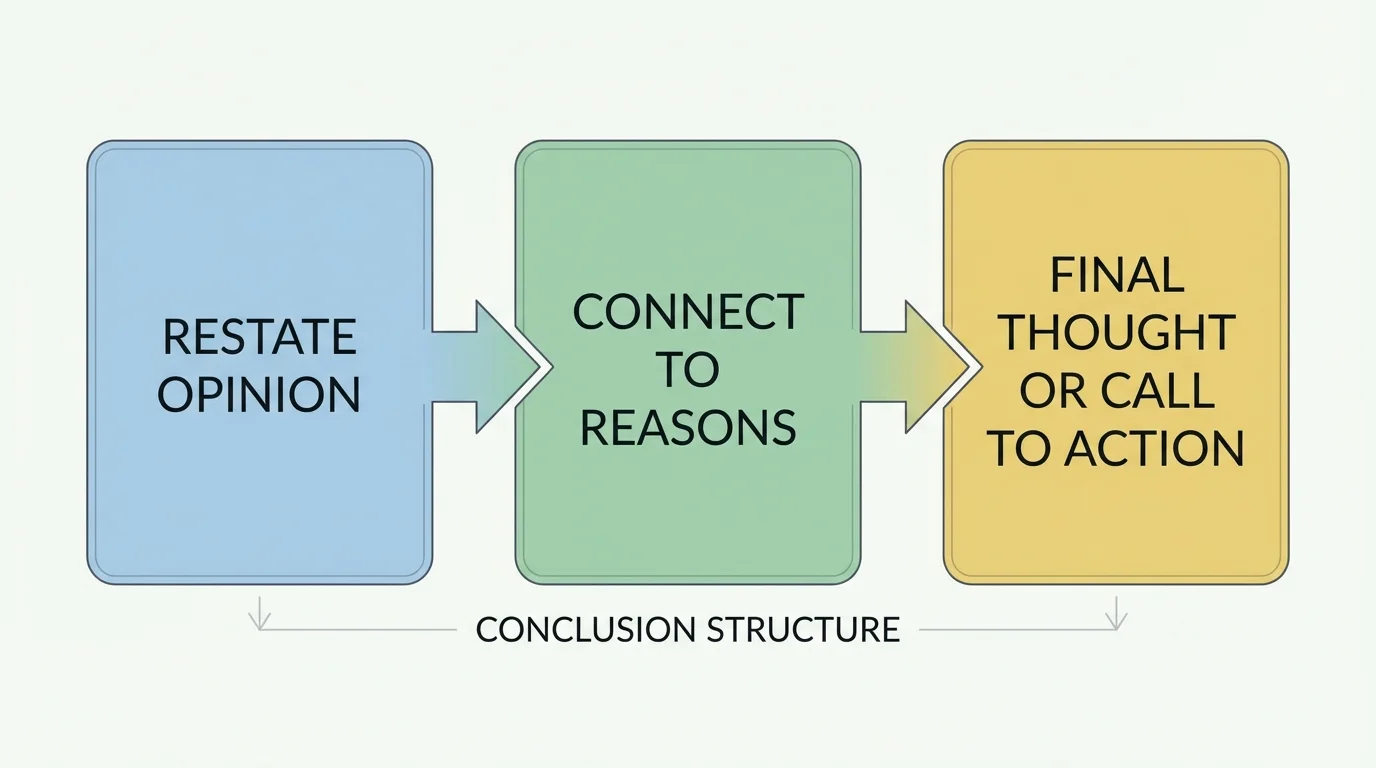
Part 3: End with a final thought. This could be a call to action, a thoughtful idea, a prediction, or a statement about why the issue matters. This part gives your conclusion energy.
When these parts work together, the ending feels complete. The reader is reminded what you believe and why it is important. Later, when you think about strong structure again, [Figure 1] remains a useful map because it shows that conclusions are not random endings. They are built on purpose.
How a conclusion creates closure
Closure means the reader feels that the writing has reached a satisfying end. In opinion writing, closure happens when the conclusion clearly returns to the main idea, ties together the reasons, and leaves the reader with something to think about. A conclusion with closure feels finished; one without closure feels cut off.
A conclusion can be one sentence or several sentences, depending on the length of the opinion piece. A short paragraph may need only one strong concluding sentence. A longer essay may need a full concluding section. What matters is not length. What matters is whether the ending completes the writer's argument.
There is not just one correct way to write a conclusion. Writers choose endings based on purpose, audience, and topic. Still, several common ending styles work especially well in opinion writing.
One strong choice is a call to action. A call to action asks the reader to do something. For example: "Our school should add more recycling bins, and students can help by using them every day." This ending fits topics where the writer wants change.
Another choice is a big idea ending. This ending explains why the opinion matters in a larger way. For example: "When schools protect recess, they protect students' health, focus, and happiness." This kind of ending helps readers see the importance of the issue.
A writer may also use a prediction. A prediction tells what may happen if readers agree or disagree. For example: "If the town builds a new park, families will have a safer and more welcoming place to gather." Predictions can make the future feel real.
Some conclusions end with a feeling or hope. This style works well when the topic is personal or community-based. For example: "Every child deserves a place where reading feels exciting, peaceful, and possible."
Another possible ending is a lesson learned or a final insight. This type helps readers understand the deeper meaning of the opinion. For example: "Sometimes a small change, like giving students more reading time, can make a big difference in learning."
Strong conclusions are not always the longest part of a piece. Sometimes one carefully written sentence is more powerful than three repetitive ones.
No matter which ending style you choose, the conclusion should still connect clearly to your opinion and reasons. A fancy ending that has nothing to do with the rest of the piece does not help. The best endings feel natural, not forced.
Some endings weaken an otherwise strong opinion piece. Knowing what to avoid can help you become a better writer.
Avoid copying the introduction exactly. Readers do not want to see the same sentence repeated word for word. Instead, restate your opinion in a fresh way.
Avoid adding brand-new reasons. The conclusion is not the place to introduce a completely new idea. If you suddenly add another reason at the end, the reader may feel confused. New reasons belong in the body paragraphs.
Avoid weak phrases that sound unsure. Expressions such as "I guess," "maybe," or "sort of" can make your opinion sound uncertain. Opinion writing should sound thoughtful and confident.
Avoid ending too suddenly. If your piece stops right after the last reason, the writing may feel incomplete. The conclusion should show that the piece is truly finished.
Avoid saying only "That is why I feel this way." This kind of ending is too general. It does not remind readers of your reasons or leave them with a strong final thought.
It helps to compare two endings for the same topic, as [Figure 2] illustrates. When readers look at a weak conclusion and a strong one side by side, they can see exactly what makes one more effective.
Topic: School uniforms
Weak conclusion: "That is why I think school uniforms are good. Those are my reasons."
This ending is short, but it does not do much. It repeats the opinion in a plain way, and it does not remind readers of the reasons. It also lacks a final thought.
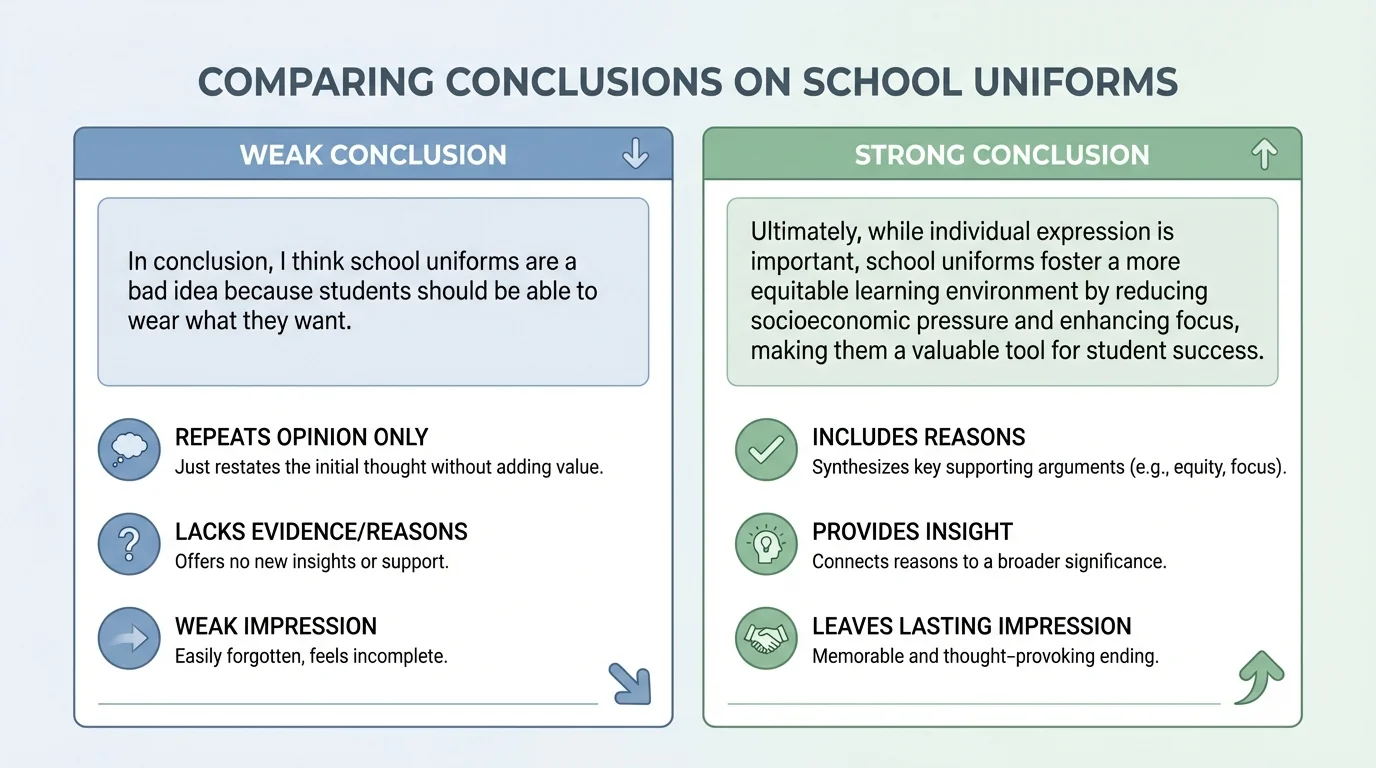
Strong conclusion: "School uniforms help students focus, save families time, and create a sense of fairness. For these reasons, uniforms can make school a better place for learning and belonging."
This stronger ending works better because it restates the opinion, refers to key reasons, and leaves readers with a meaningful idea about learning and belonging.
Example: Improving a conclusion about school lunch
Original ending: "I think school lunch should be healthier. That is my opinion."
Step 1: Restate the opinion in a stronger way.
Change it to: "Schools should serve healthier lunches to all students."
Step 2: Connect back to the reasons.
Add the main ideas: "Nutritious meals help students grow, stay energized, and focus in class."
Step 3: Finish with a final thought.
Complete the ending: "When schools offer healthier lunches, they support both student health and student learning."
The improved conclusion sounds clear, complete, and convincing.
Here is another comparison. Suppose the opinion is that students should have homework-free weekends.
Weak conclusion: "Homework-free weekends are good. I really think so."
Stronger conclusion: "Students need weekends to rest, spend time with family, and return to school ready to learn. Homework-free weekends would give students a healthier balance between school and home."
The stronger version explains why the opinion matters. Much like the comparison in [Figure 2], it moves beyond simple repetition and gives readers a fuller ending.
Your conclusion should fit your audience, which means the people who will read your writing. A conclusion written for classmates may sound different from one written to a principal, a parent group, or a community leader.
If you are writing to the principal about improving the playground, your conclusion might sound respectful and focused on change: "Adding safer equipment would help students stay active and reduce injuries, so our school should make playground updates a priority."
If you are writing for classmates, your tone may sound more shared and direct: "A better playground would give all of us a safer and more fun place to play together."
Your purpose matters too. If your goal is to persuade people to take action, use a call to action. If your goal is to help them think deeply, end with a larger idea or insight. Good writers shape the ending to fit the situation.
In opinion writing, the introduction states the opinion and the body gives reasons and supporting details. The conclusion should connect back to both so the whole piece feels unified.
The word purpose means the reason you are writing. When your purpose is clear, your conclusion becomes stronger because it knows exactly what job it needs to do.
Many students find conclusions easier when they follow a simple plan. You can think of the ending as a small set of moves.
First, ask yourself: What is my opinion? Write it again in a new way.
Next, ask: What are my strongest reasons? Mention them briefly, without repeating every detail.
Then, ask: What do I want readers to think, feel, or do after they finish reading? Use that answer to create your final sentence.
Here is a model. Suppose your opinion is that every classroom should have plants.
Introduction opinion: "I believe every classroom should have plants."
Possible conclusion: "Because plants brighten the room, help create a calm space, and teach students responsibility, every classroom should include them. A small plant can make a classroom feel more alive and welcoming."
This ending works because it follows the plan exactly. It restates the opinion, includes reasons, and ends with a thoughtful final idea.
Writers often use sentence starters to begin a conclusion, but the key is choosing one that fits naturally. Here are some useful patterns.
To restate an opinion: "For these reasons...," "Clearly...," "All in all...," "It is clear that..."
To connect to reasons: "Because...," "With benefits such as...," "By helping..., ...," "Since..."
To end with importance: "This matters because...," "In the end...," "As a result...," "That change would help..."
Sentence frames can help too. For example: "Because ___, ___, and ___, I believe ___." Another frame is: "If ___ happens, then ___ will improve." These are tools, not rules. Good writers adjust them to sound natural.
Avoid overusing the same starter in every piece. If every conclusion begins with "In conclusion," your writing may start to sound repetitive. Sometimes those words work, but often a more direct opening sounds stronger.
"The end should feel earned."
— A useful rule for writers
An earned ending feels connected to everything that came before it. It does not appear out of nowhere. It grows from the opinion and reasons you have already explained.
A memorable conclusion is usually clear, connected, and confident. Clear means the reader understands your opinion. Connected means the ending links back to your reasons. Confident means the writing sounds sure of its point of view.
You do not need dramatic words or extra-long sentences. In fact, simple and strong is often best. A clean ending can be more powerful than one that tries too hard.
When you revise your writing, pay special attention to the last sentence. Ask yourself whether it leaves the reader with a thought worth remembering. If it does, your conclusion is doing its job.
Strong opinion writing does not just begin well. It ends well too. A thoughtful conclusion helps readers understand your position, remember your reasons, and feel that your piece has truly reached its destination.
