One small word can change what a reader understands. If you write, "The animal moved fast," your reader learns a little. But if you write, "The cheetah sprinted across the grassland at top speed," your reader gets a much sharper picture. Informational writing works best when the writer chooses words with care. Exact words help readers learn, picture, and remember.
When you explain a topic, your job is not just to put facts on a page. Your job is to help a reader understand those facts clearly. That is why strong informative writing uses exact details, accurate names, and subject words that belong to the topic. These choices make writing sound knowledgeable, trustworthy, and easy to follow.
Writers make choices every time they pick a word. Some words are broad and general. Other words are narrow and exact. In informative writing, exact words are usually more helpful because they tell readers exactly what is happening, what something is called, or why it matters.
Suppose a student writes, "Plants need stuff to grow." The sentence is understandable, but it is not strong. The word "stuff" is too general. A clearer sentence would be, "Plants need sunlight, water, air, and nutrients from the soil to grow." The second sentence teaches more because it names the important parts.
Precise word choice also helps readers trust the writer. If a report about weather says "bad storm," that is less helpful than "thunderstorm," "blizzard," or "hurricane." Each of those words names a different kind of storm. Accurate writing shows that the writer understands the topic and can explain it well.
Precise language is wording that is exact, specific, and clear. It helps the reader know exactly what the writer means.
Domain-specific vocabulary is a group of words and phrases that are used in a particular subject or field, such as science, history, music, or sports.
Good informative writing does not try to sound fancy just for the sake of sounding smart. Instead, it aims to be clear. Sometimes the clearest word is simple. Sometimes the clearest word is more technical because it is the accurate term for the topic. The best writers choose the word that teaches the reader most effectively.
Precise language gives the reader a sharp, accurate picture, as [Figure 1] shows through pairs of vague and revised sentences. It often includes exact nouns, strong verbs, clear adjectives, and important details. Instead of saying "bird," a writer may say "bald eagle." Instead of "went," a writer may say "marched," "glided," or "climbed," depending on what really happened.
Precision matters because many words are close in meaning but not identical. "Warm" is not the same as "hot." "Jogged" is not the same as "sprinted." "Cabin" is not the same as "skyscraper." When a writer chooses the best match, the reader understands more with less confusion.
Writers can make language more precise by answering questions such as: What kind? How much? How many? Which one? In what way? For example, "The class studied animals" becomes "The class studied desert reptiles and how they survive in dry habitats."
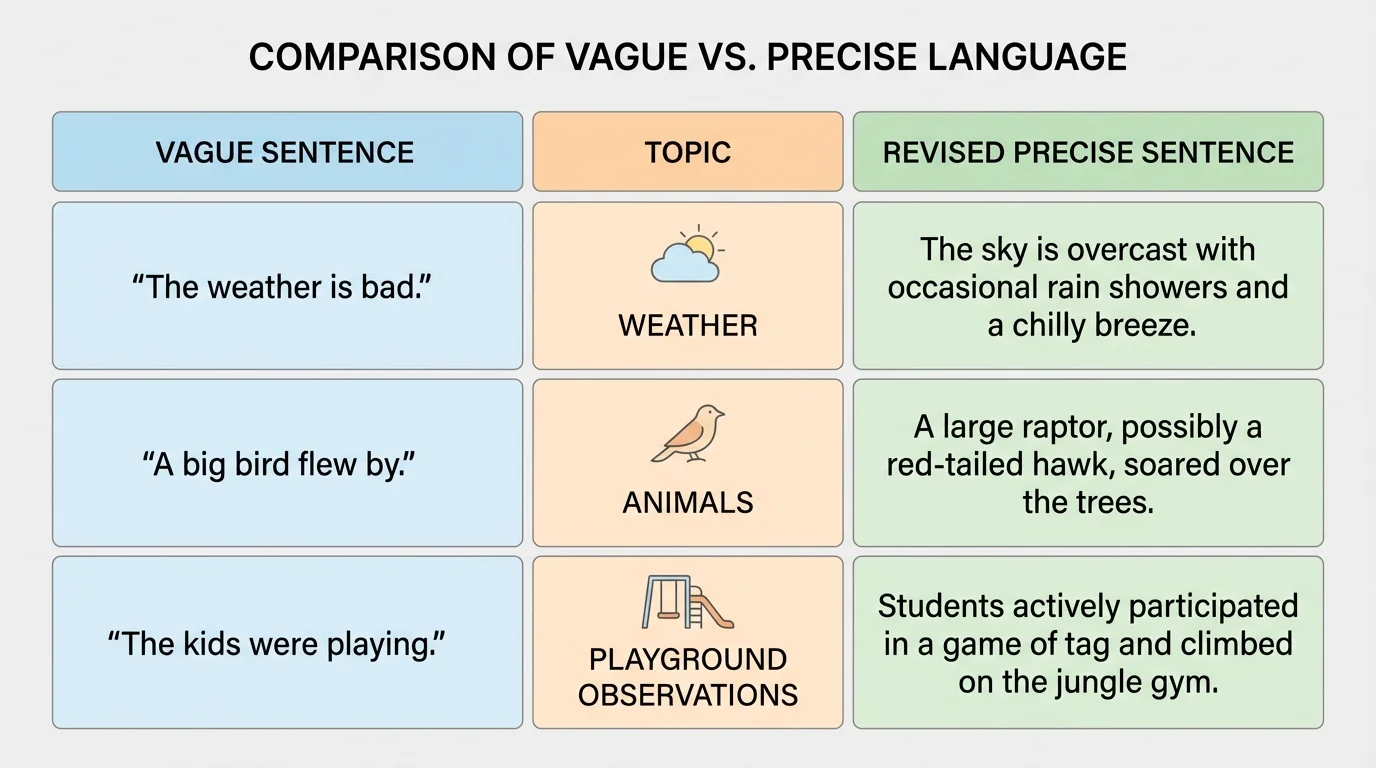
Notice that precise language does not always mean adding many words. Sometimes one exact word does the work of several vague ones. Compare "The rock was very, very big" with "The boulder was enormous." The second sentence is shorter, but it is stronger and clearer.
Precise language is especially important when explaining steps, causes, and results. If you are describing how a seed grows, saying "It changes after a while" is weak. Saying "The seed coat splits, roots push downward, and a shoot grows upward" helps the reader understand the process clearly.
Every subject has special words that belong to it. The first time a writer uses domain-specific vocabulary, the writing begins to sound more exact because those words carry meanings that general words cannot. In science, words such as habitat, evaporation, and predator name ideas that are important to that subject. In social studies, words such as colony, constitution, and migration help explain historical events and human movement.
These words are useful because they act like tools. A hammer is better than a random object when you need to pound a nail. In the same way, a domain-specific term is better than a vague everyday word when you need to explain a topic accurately.
For example, a sports report might say, "The player moved the ball to a teammate." That is clear, but a more subject-specific sentence might say, "The midfielder passed the ball to a striker near the goal." Those words belong to soccer, and they give the reader a more exact picture of what happened.
Why subject words matter
Domain-specific vocabulary helps writers be accurate, efficient, and informative. One correct term can explain an idea faster than a long general description. However, strong writers also make sure readers understand new terms by defining them or showing them in context.
If a topic is about volcanoes, words such as magma, crater, eruption, and lava belong in the writing. If a topic is about music, terms such as rhythm, tempo, melody, and chorus fit better. Matching words to the topic helps the writing stay focused and informative.
One useful way to improve writing is to compare general words with more exact ones. A general word may not be wrong, but a precise word usually teaches more.
| General Word or Phrase | More Precise Choice | Why It Is Better |
|---|---|---|
| animal | gray wolf | Names the exact creature |
| tree | oak tree | Gives a clearer image |
| bug | beetle | Uses a more accurate term |
| storm | tornado | Identifies a specific weather event |
| food | whole-grain bread | Adds useful detail |
| moved | crawled | Shows how the movement happened |
Table 1. This table compares general words with more precise choices that create clearer meaning.
Writers also improve precision by replacing weak verbs like "went," "did," and "got" with stronger verbs. For instance, "The scientist did a test" becomes "The scientist conducted an experiment." The second sentence uses a word that better fits scientific writing.
Adjectives can help too, but only when they add real meaning. "Nice," "good," and "cool" are common words, yet they often say very little. "Curved," "transparent," "ancient," and "fragile" are more specific and therefore more useful in explanatory writing.
The English language has many words with shades of meaning. That is why "whispered," "murmured," "shouted," and "announced" all tell us more than the general verb "said."
The same idea works in nonfiction writing. Choosing the best word is like focusing a camera lens. When the language becomes sharper, the reader's understanding becomes sharper too.
Strong writers think about two things at the same time: the audience and the topic. The audience is the group of people who will read the writing. A word may be correct for a topic, but if readers do not know it, the writer may need to explain it.
For example, if you are writing for other fifth graders about earthquakes, you might use the term fault. That is a correct earth science term. But you should not assume every reader knows it. You can make the term clear by writing, "A fault is a crack in Earth's crust where rocks move."
This approach does two jobs at once. It teaches the reader a new word, and it keeps the explanation accurate. Informational writing becomes strongest when it is both correct and understandable.
Writers should also avoid filling a piece with hard words just to impress people. If a simpler word explains the idea well, use it. The goal is not to sound complicated. The goal is to teach clearly.
Words are important, but organization matters too. Informative writing becomes easier to understand when related ideas are grouped together, as [Figure 2] illustrates with a page that uses headings, bold terms, and sections. These tools are called text features.
Text features include headings, subheadings, bold print, captions, tables, charts, labels, and bullet lists. They guide readers through the topic. Instead of reading one long block of text, readers can find sections quickly and see how ideas connect.
For example, a report about volcanoes might use the heading "How Volcanoes Form," followed by a subheading called "Types of Eruptions." This structure tells the reader what the next section will explain. It also keeps related information together.
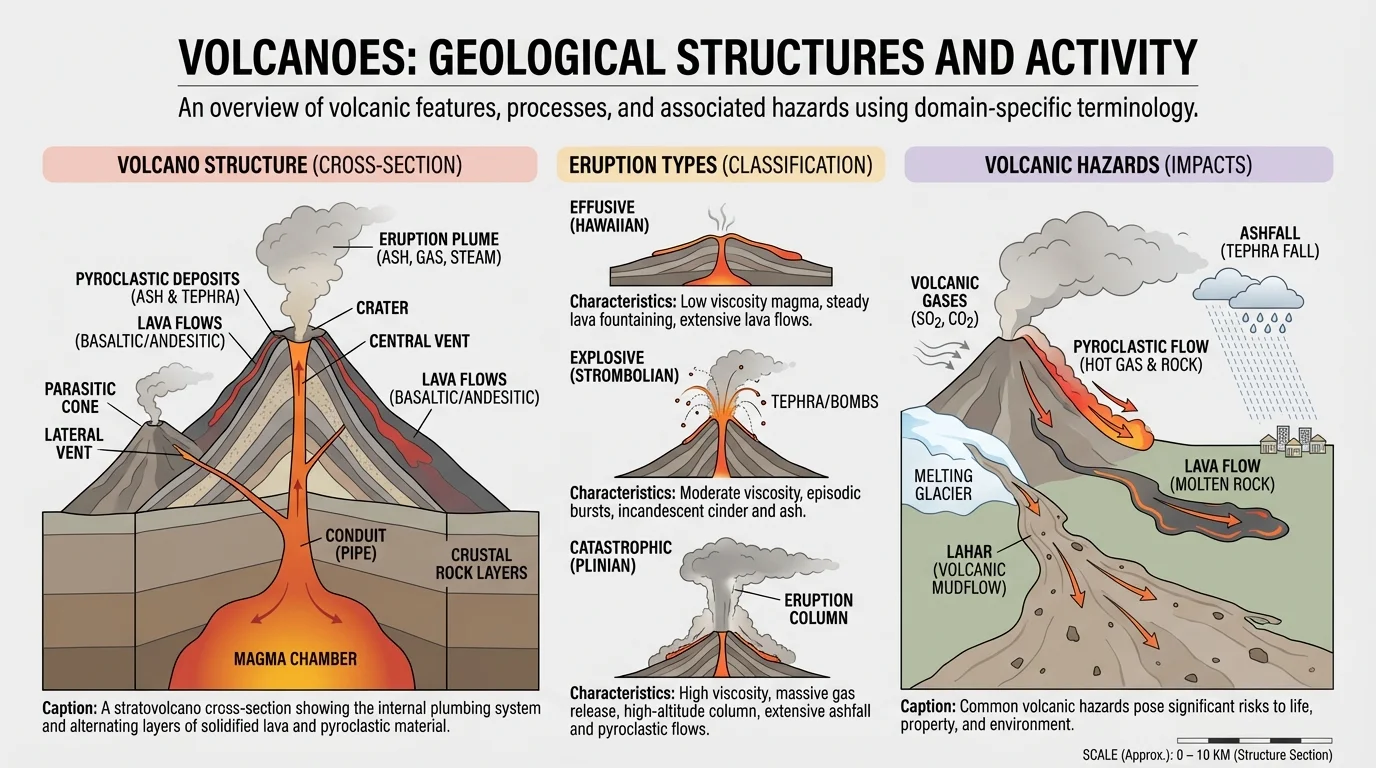
When text features and precise vocabulary work together, writing becomes much easier to follow. A heading gives the topic of a section, while exact words inside that section explain the details. Later, when a reader wants to review one part, the organized structure makes that possible.
Lists can also make information clearer. If you are explaining the parts of a habitat, it may help to list water, shelter, food, and space rather than hide all four details inside a crowded paragraph. Tables, like Table 1, are especially useful when comparing ideas side by side.
Writers often need to teach readers unfamiliar vocabulary. The best way to do this is to introduce the term and explain it right away in a natural sentence. For example: "Condensation is the process in which water vapor cools and changes into liquid water."
Another strong method is to give an example after the term. A writer might say, "Mammals are animals with hair or fur that produce milk for their young. Dogs, whales, and bats are all mammals." The examples help readers understand the category.
You can also restate the meaning in simpler words. For instance: "A legislature is a group of people who make laws. In other words, it is a lawmaking body." This lets the writer stay accurate while still helping the reader.
Example: introducing a new term clearly
Weak version: "The region has a diverse ecosystem."
Step 1: Keep the important term.
The term ecosystem is useful because it belongs to science and names a real concept.
Step 2: Explain the term in context.
Revised sentence: "The region has a diverse ecosystem, which means many living things interact with one another and with their environment."
Step 3: Add an example for clarity.
Expanded sentence: "The region has a diverse ecosystem, which means many living things interact with one another and with their environment, including fish, birds, insects, plants, and fungi."
The revised version keeps the appropriate scientific term and helps the reader understand it.
Good writers think like teachers. They know when a term is important enough to keep and when an explanation is needed so the reader does not get lost.
Each school subject has its own toolbox of words, and [Figure 3] displays how different topics call for different vocabulary choices. A science writer, a historian, and a sports reporter may all be explaining events, but they will not use the same terms because their subjects are different.
In science, instead of saying, "Water goes up and comes back down," a more informative explanation would say, "Water evaporates into the air, condenses into clouds, and returns as precipitation." Those terms are more exact and are specific to the water cycle.
In history, instead of writing, "People moved to new places," a writer might say, "Settlers migrated west in search of land and opportunity." The words settlers and migrated help explain who moved and how.
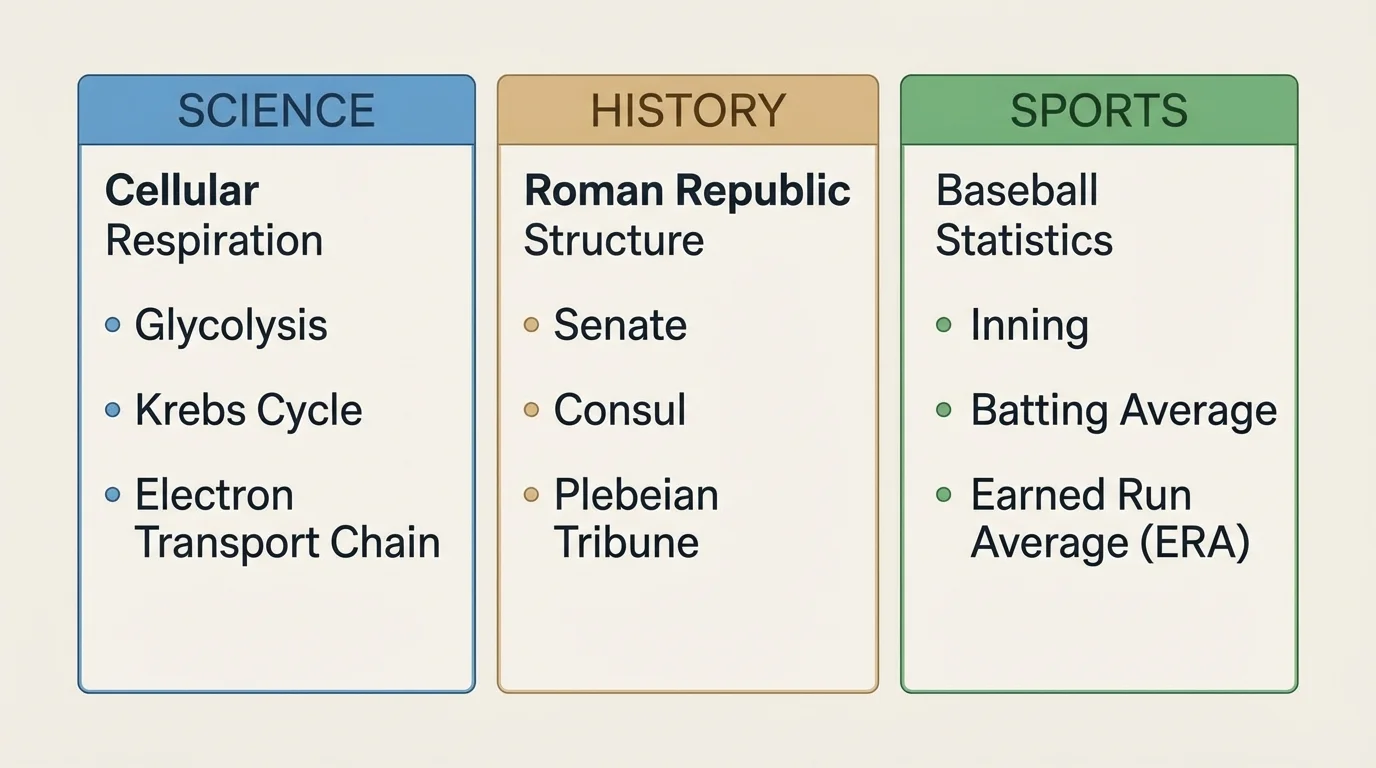
In math writing, a student might replace "the answer" with "the quotient," "the product," or "the sum," depending on the operation. In technology writing, "computer part" can become "processor," "keyboard," or "screen," depending on the exact meaning. The clearer the term, the stronger the explanation.
Even in everyday topics, precision helps. A paragraph about gardening sounds more informative when it includes words like seedling, compost, moisture, and roots. A paragraph about weather sounds stronger with forecast, temperature, humidity, and precipitation. As we saw earlier in [Figure 1], exact wording helps readers picture and understand the topic more clearly.
One common mistake is being too vague. Words like "thing," "stuff," "nice," and "a lot" do not give enough information in explanatory writing. Instead of "a lot of rain," a writer might say "heavy rainfall" or "several inches of rain."
Another mistake is using a domain-specific term incorrectly. If a writer uses a technical word, the meaning should match the topic. Accuracy matters. A science report should not use words that sound scientific but do not fit the facts.
A third mistake is overloading the writing with difficult words that are not explained. That can make the piece harder, not better. Strong writers balance accuracy with clarity. They use the right word and then support the reader with context, examples, or definitions.
When you revise a draft, look for places where a reader might ask, "What do you mean?" That question often points to a vague word, a missing detail, or an unexplained term.
Repeating the same general word again and again can also weaken writing. Instead of writing "animal" five times, a writer may use the exact species name, then related terms such as predator, mammal, or herbivore if those words fit the topic correctly.
Revision is where many writers sharpen their work. After drafting, reread each sentence and ask whether the words are exact. Could a noun be more specific? Could a verb be stronger? Is there a subject term that would explain the idea more accurately?
Here are useful revision questions:
For example, a first draft might say, "The old group made rules for the country." A revised version could say, "The delegates wrote rules for the new nation at the convention." The revision is clearer because it names who acted and what they did.
Writers also check whether their text features support understanding. A heading may need to be more specific, or a table may help compare related ideas. As shown earlier in [Figure 2], organized text features help readers move through information without confusion.
Precise language and domain-specific vocabulary are not decorations. They are tools for teaching. When you choose exact words, explain important terms, and organize related information well, your writing becomes more informative, more readable, and more powerful.
