Have you ever understood a new word without anyone teaching it to you first? That happens more often than you might think. Readers are like detectives: they look at the words around an unknown word, notice what is happening, and use those details to make a strong guess. This skill is powerful because no reader knows every word in every book. What matters is knowing how to use the context.
When you read, the words before and after an unknown word often give hints about its meaning. A character's actions, a problem and its result, or a comparison between two things can all help. Instead of stopping every time you meet a tricky word, you can use the sentence, the paragraph, and your own thinking.
This does not mean you always guess wildly. Good readers use evidence. They look for clues that fit the sentence and make sense with the topic. Then they test the meaning by rereading. If the guessed meaning works, they keep reading. If not, they revise the guess.
Context is the group of words, sentences, and ideas around a word or phrase. These surrounding details help a reader figure out meaning.
Context clue is a hint in the text that helps explain an unfamiliar word or phrase.
Multiple-meaning word is a word that can have more than one meaning, depending on how it is used.
Context clues are especially helpful in stories, articles, science texts, and social studies books. In all of these, authors often give enough information for readers to work out meaning without needing a dictionary right away.
A context clue can take many forms. Sometimes the author explains a word directly. Sometimes the clue is hidden in an action or result. Sometimes the clue comes from comparing one thing to another. Sometimes the author gives an opposite idea. The important thing is to read around the unfamiliar word, not just stare at the word itself.
You can think of context clues as puzzle pieces. One clue may help a little, but several clues together often reveal the full meaning. That is why strong readers pay attention to the whole sentence and often the whole paragraph.
One useful kind of clue is a cause-and-effect clue. This happens when the text shows that one event causes another event, and the result helps explain the unknown word. As [Figure 1] shows, a result can reveal what a word means even if the word itself is new.
Read this sentence: "After hiking up the steep mountain for six hours without a break, Lena was exhausted and could barely lift her backpack." Even if you did not know the word exhausted, the cause is hiking for six hours, and the effect is that Lena can barely lift her backpack. Those clues show that exhausted means very tired.
Here is another example: "The puppy chewed the corner of the book, so the cover was damaged." The cause is the puppy chewing the book. The effect is harm to the cover. So damaged means harmed or ruined in some way.
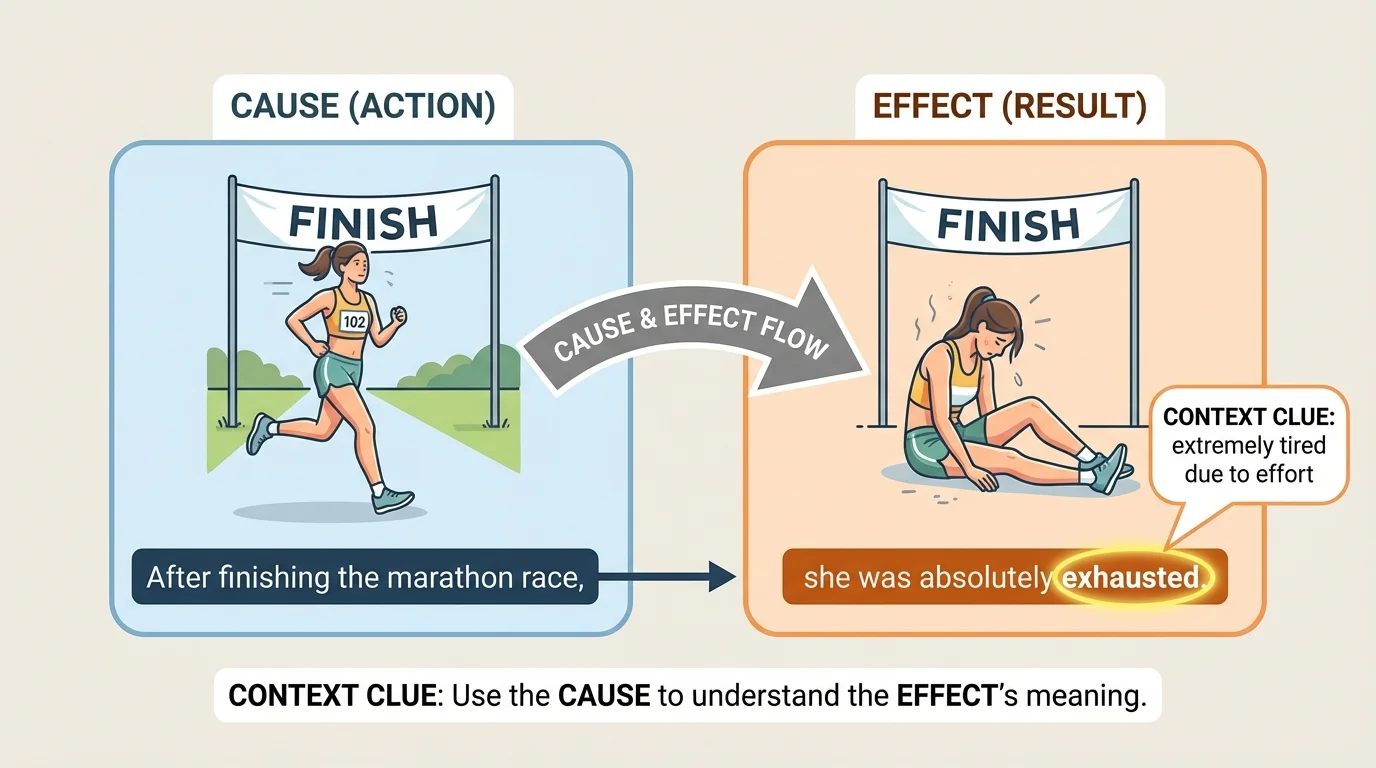
Cause-and-effect clues often include signal words such as because, so, since, as a result, therefore, and after. These words do not always appear, but when they do, they can help you notice the relationship.
Sometimes the cause appears first, and sometimes the effect appears first. For example, "The pond froze overnight because the temperature was frigid." The result is freezing. That helps you infer that frigid means extremely cold. Later, when you see another weather sentence with that word, you can check your understanding again, just as in [Figure 1], where the result helps uncover the meaning.
Using cause and effect to infer a word
Sentence: "Marcus forgot to water the plant for two weeks, and now the leaves are drooping and brown. The plant looks withered."
Step 1: Find the cause and the effect.
The cause is that Marcus forgot to water the plant. The effect is drooping, brown leaves.
Step 2: Connect the clues to the unknown word.
A plant without water becomes weak, dry, and shriveled.
Step 3: Make a meaning guess and test it.
Withered likely means dried up, weak, or shriveled. That meaning fits the sentence.
Cause-and-effect clues work well in science and history reading too. If a science text says, "The metal expanded when heated," the clue tells you that heating caused it to spread out or grow slightly larger. The surrounding idea explains the word.
Another strong strategy is using comparison and contrast clues. These clues show how two things are alike or different. Signal words such as like, similar, both, unlike, however, but, and instead often help, as [Figure 2] illustrates.
Read this sentence: "Unlike her noisy, talkative brother, Mina was reserved during the car ride." The contrast clue is clear. Her brother is noisy and talkative. Mina is the opposite. So reserved likely means quiet or not eager to talk.
Now look at a comparison example: "The baby rabbit's fur was as soft as a cloud." The comparison helps you understand that soft means smooth and gentle to the touch.
Comparison clues are not only for simple descriptive words. They also help with more complex ideas. "A cactus is similar to other desert plants because it stores water." If you did not know what stores meant, the comparison with desert plants suggests that it keeps water for later use.
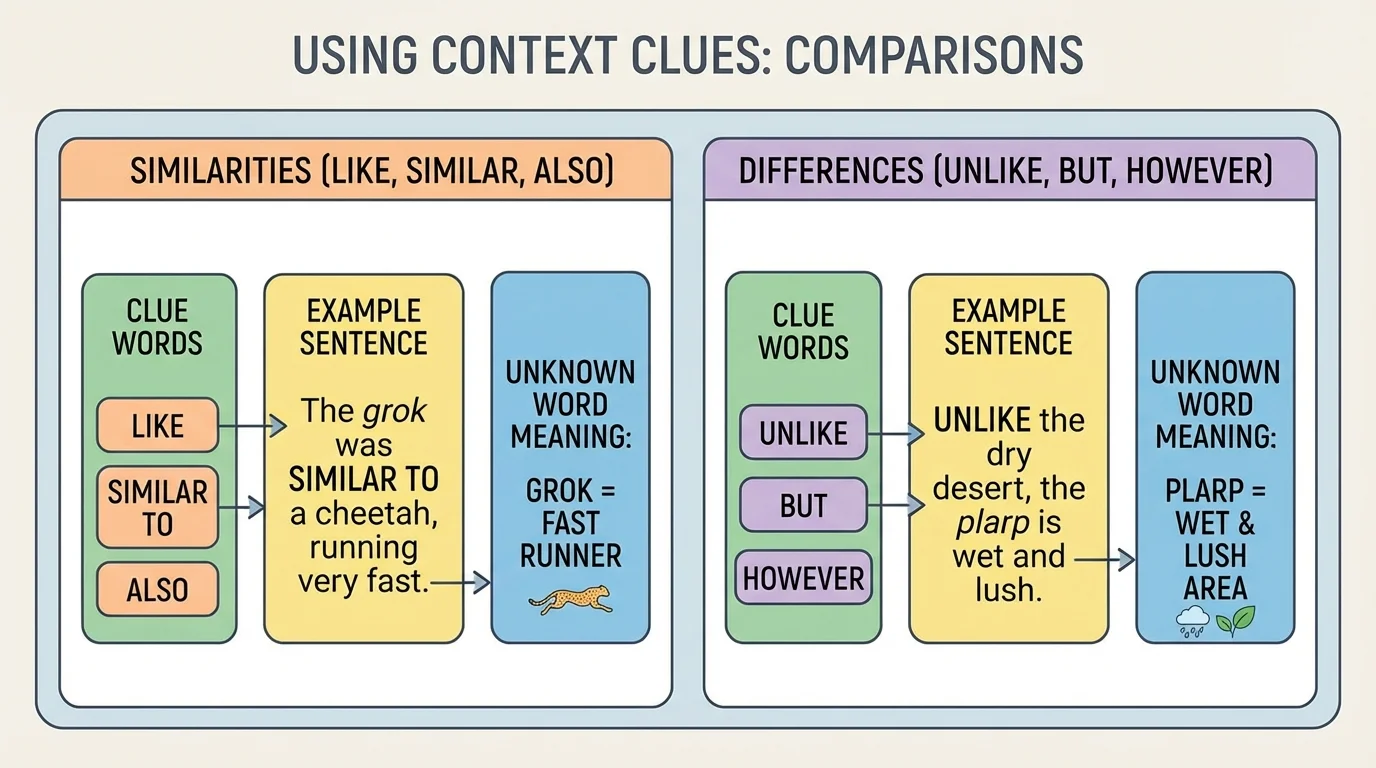
Contrast clues can be especially useful because opposites stand out. In the sentence "The first solution was temporary, but the second one was permanent," the word but signals a contrast. If you know that temporary means not lasting long, then permanent likely means lasting a long time.
When readers notice clue words and compare ideas carefully, they can solve many unknown words without stopping. That is why comparison and contrast clues, like the ones displayed in [Figure 2], are important tools for strong reading.
Cause-and-effect and comparison clues are important, but they are not the only kinds. Good readers use many clue types. Here are several common ones.
Definition clue: The author tells the meaning directly. Example: "A nocturnal animal is one that is active at night." The definition appears right in the sentence.
Restatement clue: The author says the same idea in a different way. Example: "Jamal felt uneasy, or worried, before the spelling bee." The phrase or worried restates the meaning.
Synonym clue: A nearby word means nearly the same thing. Example: "The path was narrow and tiny." The word tiny helps explain narrow.
Antonym clue: A nearby word means the opposite. Example: "The cave entrance was not visible; instead, it was hidden behind vines." The opposite clue helps define visible.
Example clue: The author gives examples that reveal the meaning. Example: "Celestial objects, such as the sun, moon, and stars, filled the night sky." The examples show that celestial relates to the sky or space.
Writers often help readers on purpose. In textbooks and articles, authors know some words may be new, so they add examples, explanations, and comparisons nearby.
Sometimes one sentence does not give enough help, but the next sentence does. That is why it is smart to read ahead a little before deciding what a word means.
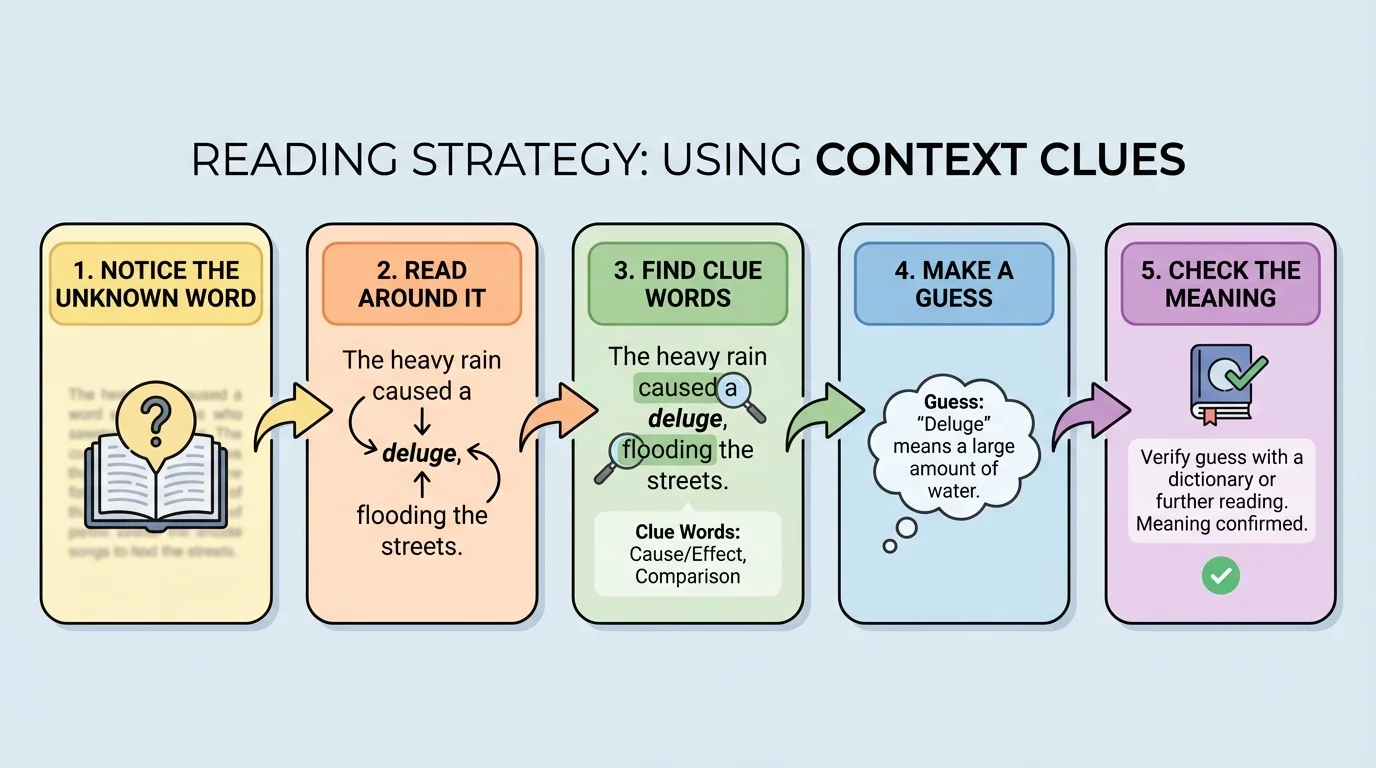
When you meet an unknown word, do not panic. Good readers follow a process instead of making a random guess. [Figure 3] lays out that process clearly.
First, read the whole sentence. Next, read the sentence before and after it. Then ask, "What is happening here?" Look for clue words, actions, results, examples, and comparisons. After that, make a meaning guess. Finally, put your guess back into the sentence and see whether it makes sense.
Step-by-step meaning detective
Sentence: "The classroom grew silent when the principal entered. His serious expression made everyone feel tense and anxious."
Step 1: Read around the word.
The classroom grew silent. The principal had a serious expression.
Step 2: Find the clue.
Those details create a worried mood.
Step 3: Make a smart guess.
Anxious likely means worried or nervous.
Step 4: Check the sentence again.
"Everyone felt tense and worried" makes sense, so the guess fits.
This method works because it uses evidence from the text. It also helps you avoid guessing from only part of a word. For example, a word may look familiar but mean something different in that sentence.
As shown in [Figure 3], the last step is always to check your guess. If the sentence sounds wrong after you replace the unknown word with your guessed meaning, go back and search for more clues.
Some words have more than one meaning. Context helps you choose the correct one. Think about the word bat. In one sentence, "The bat flew out of the cave at dusk," it means an animal. In another sentence, "Jada swung the bat and hit the ball," it means sports equipment.
The same is true for the word bright. In "The bright flashlight hurt my eyes," it means giving a lot of light. In "Tariq is a bright student," it means smart. The surrounding words tell you which meaning fits.
How context selects the right meaning
A multiple-meaning word does not have one fixed meaning in every sentence. Readers use the topic, nearby words, and the action in the sentence to decide which meaning is correct. This is one reason reading the whole sentence matters so much.
If you only look at one word by itself, you may choose the wrong meaning. Context acts like a spotlight. It shines on the meaning that belongs in that particular sentence.
Context does not only help with single words. It also helps with an unknown phrase. A phrase is a group of words that works together to express an idea.
For example, read this sentence: "When the team won the championship, the crowd went wild." The phrase went wild does not mean people turned into wild animals. The context tells you the crowd became extremely excited and noisy.
Here is another example: "After studying all week, Maya said the test was a piece of cake." The phrase a piece of cake does not mean actual cake. The context tells you she thought the test was very easy.
Sometimes writers use figurative language, which means words are used in a nonliteral way. Context helps you notice that the literal meaning does not fit. Then you can infer the intended meaning instead.
One common mistake is guessing too fast. A reader sees one clue and jumps to a meaning without checking the rest of the sentence. Strong readers slow down, gather more than one clue, and test the meaning.
Another mistake is using only the word's sound or a small part of it. While word parts can sometimes help, context is often the better guide when you are in the middle of reading. A word that looks familiar may have a different meaning than you expect.
A third mistake is choosing a meaning that does not fit the whole paragraph. A good guess should make sense with the topic, the mood, and the events. If not, revise it.
You already know that authors connect ideas in many ways. They show causes and effects, compare things, give examples, and explain details. Those same reading patterns also help you unlock word meanings.
Reading is flexible thinking. You do not need to be perfect on the first try. You need to use clues carefully and stay open to changing your guess if new information appears.
In science, you may meet words such as evaporate, organism, or habitat. In social studies, you may see words like citizen, economy, or region. In each case, context can help before you even look up the word.
For example, "During the hot afternoon, the puddle slowly evaporated until it disappeared." The context shows that evaporated means changed into vapor and went into the air. In social studies, "The fertile valley produced many crops, unlike the dry rocky land nearby." The contrast helps reveal that fertile means good for growing plants.
This skill also helps outside school. When you read game rules, recipes, instructions, news articles, or signs at a museum, context clues guide your understanding. The more you practice noticing them, the more confident and independent you become as a reader.
Strong readers do not just collect words. They learn how words behave in real sentences. They ask what caused something, what result followed, what is being compared, what examples are given, and what meaning best fits the whole passage.
