Have you ever read a sentence that seemed simple until one word changed everything? The word pitch can mean throwing a baseball, how high or low a sound is, or even setting up a tent. One small word can carry several meanings, and if you choose the wrong one, the whole sentence can fall apart. That is why strong readers do not just guess. They use reference materials to check pronunciation and to pin down the exact meaning a word has in a specific sentence.
When you read, you meet new words in stories, articles, textbooks, websites, and directions. Sometimes you can figure out part of a word's meaning from context clues or word parts, but sometimes you need a tool that gives clear, accurate information. A reference book or digital reference source can help you say a word correctly, understand what it means, and decide which meaning fits best.
Good readers are flexible. They do not use only one strategy every time. If the word is in a science chapter, they may check the book's glossary. If they need to hear how a word sounds, they may use a digital dictionary with audio. If they want a stronger word for writing, they may open a thesaurus. Knowing which tool to use is part of being a skilled reader.
Reference materials are sources people use to find information quickly and accurately. Common reference materials include a dictionary, which gives meanings and pronunciations; a glossary, which explains important words from a specific book or subject; and a thesaurus, which lists synonyms and sometimes antonyms.
These tools matter because words are not always simple. Some words have more than one meaning. Some words are pronounced in tricky ways. Some words belong to a special subject area, like science or social studies, so the meaning in that subject may be different from the meaning used in everyday speech.
A dictionary is one of the most useful tools for readers. It usually tells you how to spell a word, how to pronounce it, what part of speech it is, and what it means. Many dictionaries also include example sentences, word origins, and guide words at the top of pages.
A glossary is usually found at the back of a textbook or nonfiction book. It focuses on important words from that specific text or subject. For example, a science glossary may explain words like erosion or adaptation in ways that match what students are learning in class.
A thesaurus is different. It does not mainly define words. Instead, it helps you find words with similar meanings, called synonyms, and often words with opposite meanings, called antonyms. Writers use a thesaurus when they want to avoid repeating the same word again and again.
Reference materials can be print reference tools, such as a book you hold in your hands, or digital reference tools, such as a website or app. Both can be useful. The important thing is to use them carefully and choose trustworthy sources.
Many digital dictionaries let you hear a word spoken aloud. This is especially helpful for words whose spellings do not clearly show how they sound, such as colonel or debris.
Even though digital tools are fast, print tools are still valuable. A print dictionary can help you notice nearby words, related forms, and guide words on the page. As [Figure 1] shows, sometimes that extra searching helps you learn more than a quick tap on a screen.
A dictionary entry includes several useful parts, and strong readers look at more than just the first definition. They notice the word itself, the way it is broken into syllables, the pronunciation guide, the part of speech, and the numbered meanings.
Suppose you look up the word pronunciation. A dictionary may show a special spelling or symbols that help you say the word aloud. It may also separate the word into syllables, such as pro-nun-ci-a-tion. Some dictionaries use symbols, while others use respelling systems. Digital dictionaries may add an audio button so you can hear the word spoken.
The dictionary also tells you the part of speech. This matters because a word can act differently in a sentence. For example, record can be a noun, as in "She broke the school record," or a verb, as in "Please record the game." Sometimes the pronunciation changes too. Looking at the part of speech helps you choose the correct meaning.
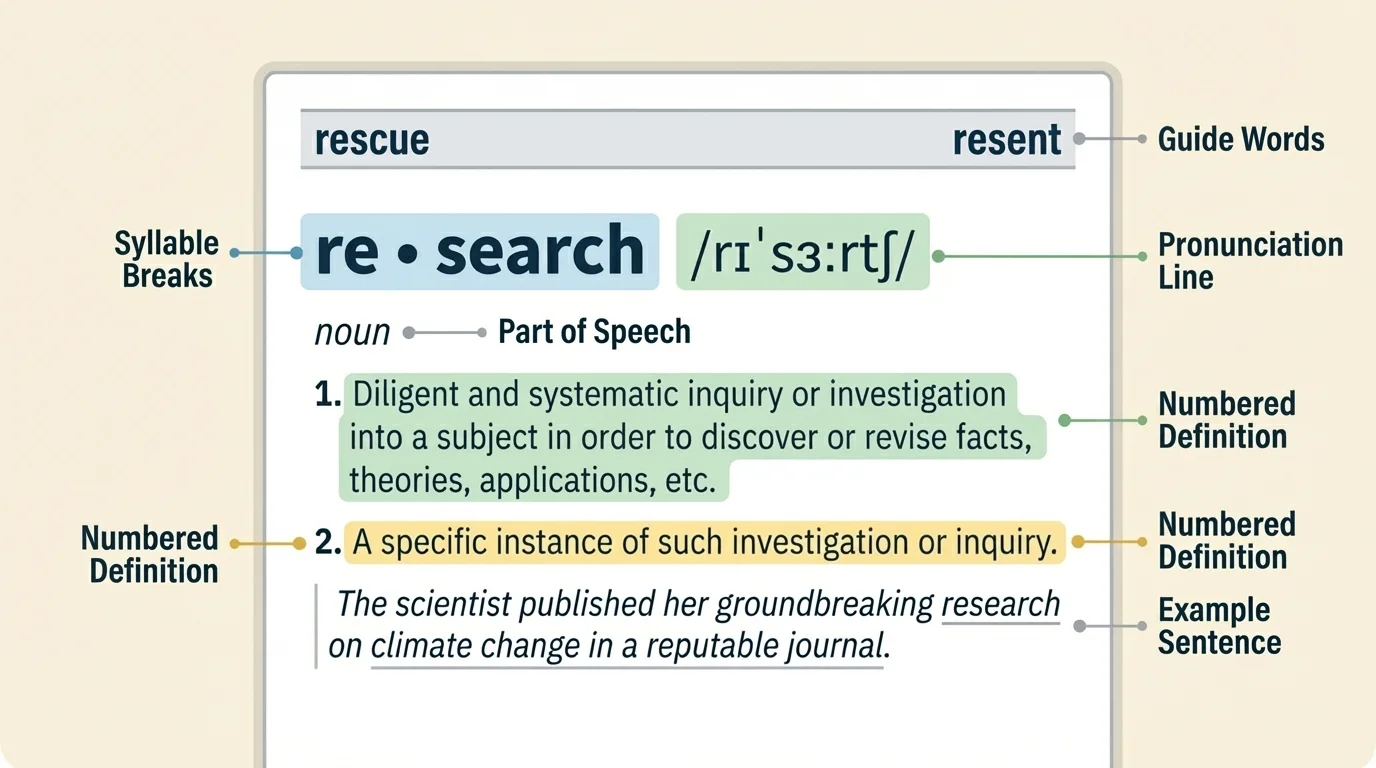
Dictionary entries often list meanings in order. The first meaning is not always the right one for your sentence. If you are reading, "The bat flew out of the cave," you should not choose the sports meaning of bat. You need the meaning that fits the sentence about an animal.
Some entries also include sample sentences. These are very useful because they show how the word is actually used. A definition can be short, but a sample sentence gives context. That makes it easier to understand the precise meaning.
Using a dictionary entry for the word "current"
A student reads: "The strong current pushed the kayak downstream."
Step 1: Look up the word and scan the definitions.
The dictionary may list meanings such as "happening now" and "a flow of water."
Step 2: Check the sentence context.
The sentence mentions a kayak and downstream, which connect to moving water.
Step 3: Choose the precise meaning.
The correct meaning is "a flow of water moving in one direction."
The context helps the reader avoid choosing the meaning "happening now."
Guide words at the top of dictionary pages can also save time. These words show the first and last entries on that page, so you can quickly tell whether the word you want is there. In a print dictionary, this helps you move efficiently through the pages.
When a word has several meanings, the sentence around the word acts like a set of clues. Context includes nearby words, the topic, and what is happening in the passage.
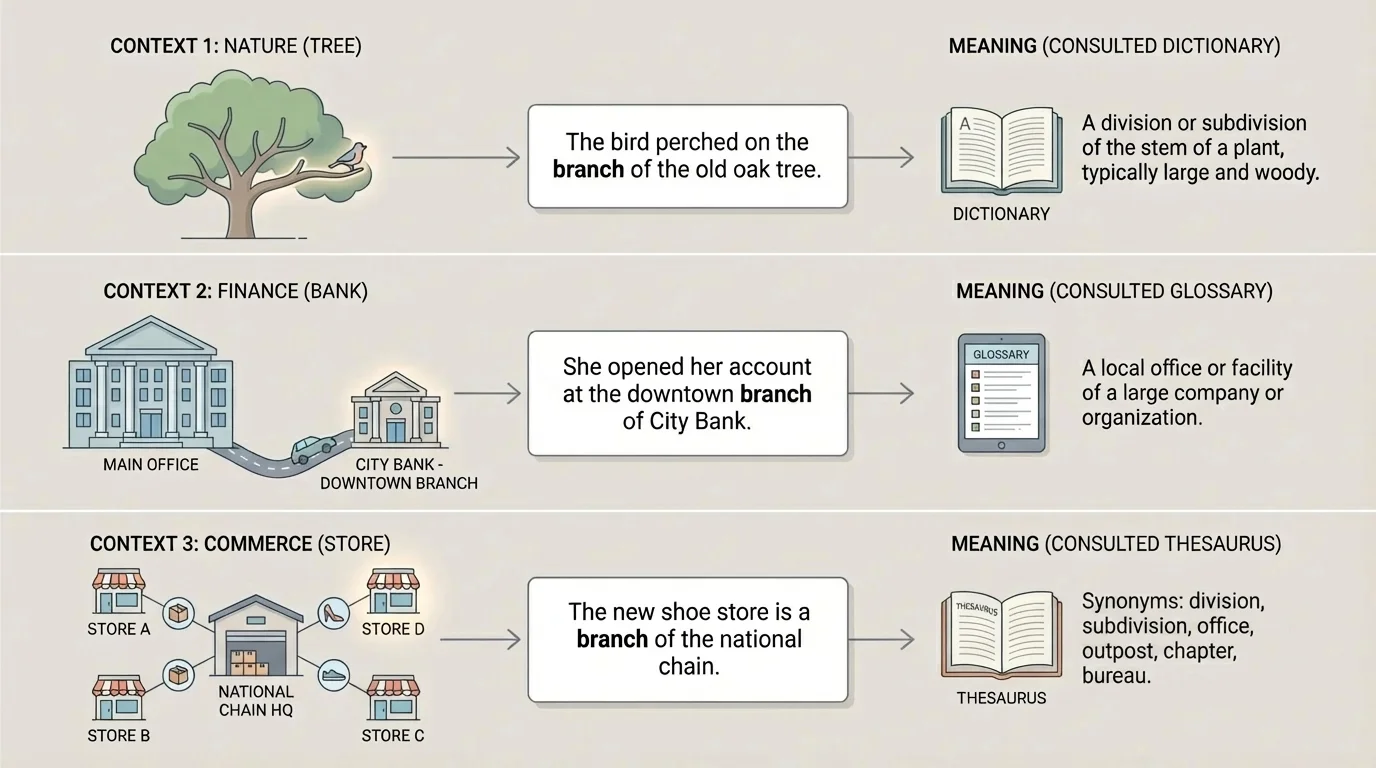
Take the multiple-meaning word branch. As [Figure 2] shows, in "The bird landed on a branch," the meaning is part of a tree. In "We visited the bank's new branch," the meaning is a local office. In "That store opened a branch across town," the meaning is another location of the same business. The word stays the same, but the context changes the meaning.
This is why readers should read the whole sentence, and sometimes the whole paragraph, before choosing a definition. One word alone may not give enough information. If the topic is weather, the word front probably does not mean the front of a line or the front of a shirt. It may mean a weather system.
Context and reference materials work together. First, use context clues to make a smart guess. Then use a dictionary or glossary to test that guess. If the definition matches the sentence, you have likely found the right meaning.
Later, when you meet another multiple-meaning word, remember the pattern: one word can connect to different ideas depending on the sentence around it. Skilled readers slow down long enough to notice those clues.
Precise meaning matters
A word's precise meaning is the exact meaning it has in a particular sentence. Knowing only a broad idea is not always enough. For example, if you know that charge means "to move" or "to ask for payment," you still need context to know whether a sentence is about electricity, money, or rushing forward.
Writers count on readers to notice these differences. If you select the wrong meaning, a passage can become confusing. Choosing the exact meaning makes your reading more accurate.
Glossaries are especially helpful in school subjects. Textbooks often teach special words that are used in a very exact way. In science, a term such as mass has a specific meaning. In everyday speech, people may say "a mass of people," but in science, mass means the amount of matter in an object. A glossary helps you learn the school meaning that matches the lesson.
In social studies, a glossary may explain words such as citizen, economy, or region. In math, a glossary might define factor, multiple, or equation. These words may appear often in the chapter, so the glossary is a fast place to check them.
Glossaries are useful because they are focused. A big dictionary gives meanings for many situations, but a glossary gives the meaning that fits the subject you are studying right now. If you are reading about ecosystems, the glossary definition of producer will help more than a general everyday meaning.
Context clues are still important even when a glossary is available. Before you look up a word, pay attention to nearby words, headings, diagrams, and the topic of the section. These clues help you understand the glossary definition more clearly.
Some books also include pronunciation help in the glossary. That can be useful for long or unusual words such as photosynthesis or legislature. If the glossary does not include pronunciation, a dictionary can help with that part.
A thesaurus is most helpful when you are writing or revising. It can help you find a synonym, but it must be used carefully. Synonyms are words with similar meanings, not always exactly the same meanings. For example, said, whispered, announced, and muttered are all connected to speaking, but each one gives a different shade of meaning.
If you use a thesaurus without checking the meaning, you can make a poor word choice. For instance, big and gigantic are related, but they are not always interchangeable. Calling a ladybug gigantic would sound strange. A thesaurus gives options, but the writer still has to choose the best fit.
That is why many good writers use a dictionary and a thesaurus together. As [Figure 3] shows, they may find a possible synonym in the thesaurus, then check the dictionary to be sure the new word means exactly what they want.
Using a thesaurus carefully
A student writes: "The movie was good." The student wants a stronger word than good.
Step 1: Check the thesaurus.
Possible synonyms might include excellent, enjoyable, interesting, and outstanding.
Step 2: Think about the exact meaning.
If the student means the movie was fun to watch, enjoyable may fit better than outstanding.
Step 3: Confirm with a dictionary if needed.
The dictionary helps the student check that the chosen synonym matches the intended idea.
The revised sentence becomes more precise: "The movie was enjoyable."
So, a thesaurus does not replace understanding. It supports understanding by helping readers and writers compare words more closely.
Different tools are useful for different jobs. Print and digital reference materials can both help with spelling, meaning, and pronunciation, but each one has strengths.
A print dictionary is dependable and easy to browse. You can see neighboring words, guide words, and the structure of the page. This can help you discover related words by accident, which is actually a great way to learn.
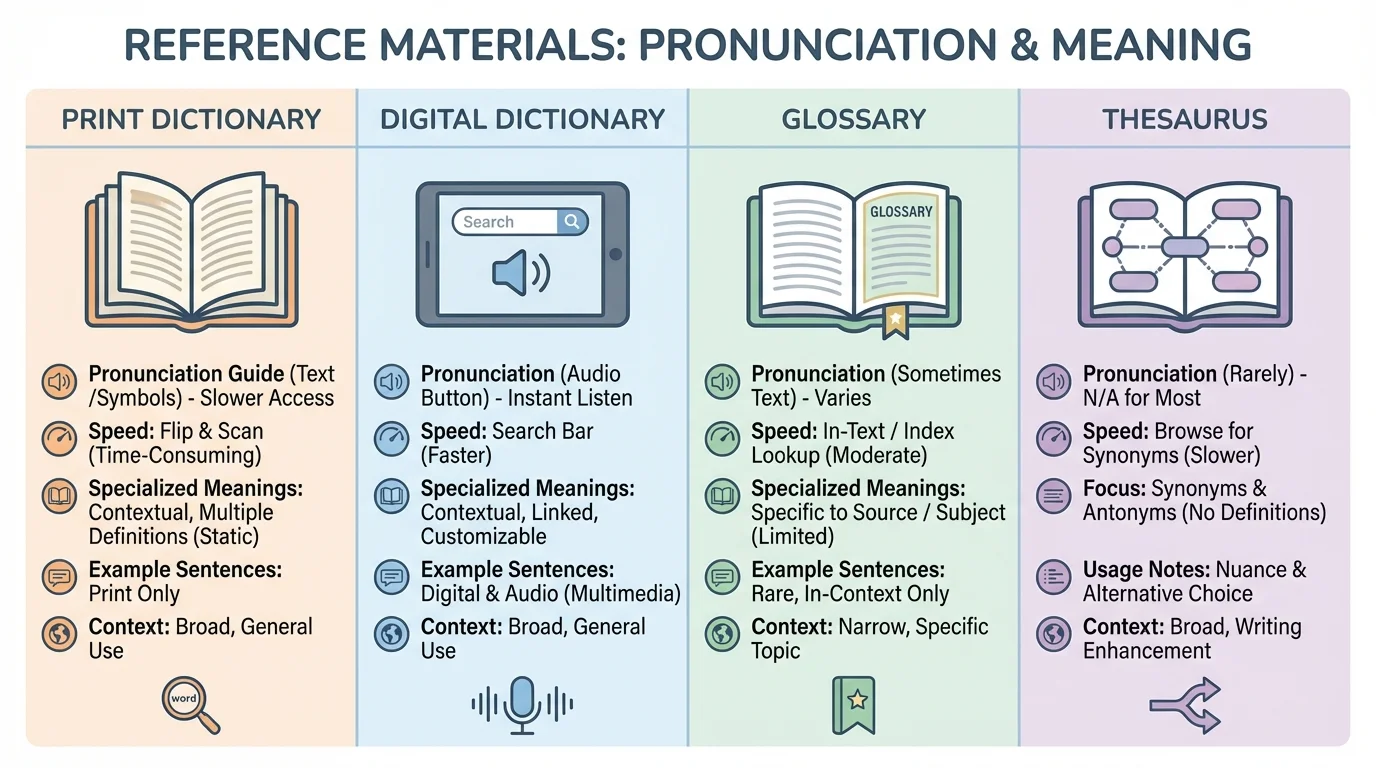
A digital dictionary is usually faster. You can type the word, hear audio pronunciation, and jump quickly between related entries. Some digital tools also include pictures, example sentences, or translation help. However, students should use reliable sources because not every website is equally accurate.
Print glossaries are handy when you are already reading a textbook. Digital glossaries can be linked right inside an online article or e-book, which saves time. A digital thesaurus can quickly suggest alternatives, but students still need to think about the shades of meaning between those choices.
| Tool | Best Use | Helpful Features |
|---|---|---|
| Dictionary | Finding meaning, spelling, pronunciation | Definitions, syllables, part of speech, examples |
| Glossary | Learning subject-specific words | Definitions tied to the book or topic |
| Thesaurus | Finding similar or opposite words | Synonyms, antonyms, word choices |
| Digital reference | Fast searching and audio support | Audio, search bar, quick links |
| Print reference | Browsing and careful page study | Guide words, page layout, nearby entries |
Table 1. Comparison of common reference tools and the kinds of help they provide.
Later, when you need to decide which tool to use first, think back to the comparison in [Figure 3]. If you need pronunciation, digital audio may help most. If you need a subject-specific definition, the glossary may be the best first stop.
Strong readers do not jump straight to one answer. They use a process. First, they notice the unknown word and decide whether it is important to understanding the text. Next, they look at context clues. Then they choose a reference tool that matches the problem they are trying to solve.
If the problem is pronunciation, a dictionary is a smart choice. If the problem is a science word from a chapter, a glossary may be faster and more exact. If the problem is choosing a better word while writing, a thesaurus can help.
After looking up the word, readers should return to the sentence and reread it. This is important. The goal is not just to collect a definition. The goal is to understand the passage better. Rereading helps you check whether the meaning and pronunciation really fit.
A flexible strategy in action
A student reads: "During migration, many birds navigate by using landmarks and the stars." The word navigate is unfamiliar.
Step 1: Use context clues.
The sentence is about migration, birds, landmarks, and stars. The word probably has something to do with finding a way.
Step 2: Choose a reference source.
A dictionary is useful because the student needs a clear meaning and possibly the pronunciation.
Step 3: Read the definition and pronunciation.
The dictionary explains that navigate means to plan or direct a route, especially while traveling.
Step 4: Reread the sentence.
Now the sentence makes sense: birds find and follow their route during migration.
This process helps the student understand the word accurately instead of guessing loosely.
Being flexible means you may use more than one strategy. Context clues and word parts are useful, but reference materials help confirm and clarify your understanding.
One common mistake is choosing the first definition without checking the sentence. Dictionaries often list several meanings, so readers need to compare the definitions with the context. Another mistake is ignoring the part of speech. A noun meaning may not fit if the word is being used as a verb.
A third mistake is using a thesaurus as if every synonym means exactly the same thing. Words can be close in meaning but still feel stronger, weaker, more formal, or more specific. Good writers pay attention to those differences.
Another mistake is skipping pronunciation. If you only recognize a word in print but cannot say it correctly, you may miss connections when you hear it spoken in class. Learning both meaning and pronunciation builds stronger vocabulary.
"The right word is not just any word that is close. It is the word that fits."
One more mistake is trusting every digital result without thinking. Reliable reference sources are edited carefully. If a definition seems odd or does not match the sentence, check another trusted source.
These skills help in every class. In reading, they help you understand characters, settings, and events. In science, they help you learn exact vocabulary. In social studies, they help you understand important ideas and historical terms. In math, they help you read problem directions and understand words such as product, difference, or estimate.
They also help outside school. You might read game instructions, recipe steps, museum signs, sports articles, or websites about animals or weather. Every time you stop to check a word carefully, you become a more accurate and independent reader.
Precise word knowledge is powerful. It helps you understand what others mean, express your own ideas more clearly, and make smarter choices as a reader and writer. Dictionaries, glossaries, and thesauruses are not just books or apps. They are tools for thinking carefully about language.
