Have you ever listened to someone who knew a lot about a topic, but you still could not follow what they were saying? Maybe they spoke too fast, looked only at the floor, or mumbled their words. Strong speaking is not just about having good ideas. It is also about helping other people hear, understand, and trust those ideas. When you use appropriate eye contact and speak clearly at an understandable pace, your message becomes much stronger.
Whenever you speak in front of others, you are doing more than saying words. You are communicating a message. That message may be an opinion, an explanation, or an attempt to persuade people. If your audience cannot follow your voice or does not feel connected to you, your message may be lost. Good speakers help listeners stay focused by using their eyes, voice, and timing well.
Think about three different situations. In one, a student explains how volcanoes form. In another, a student shares an opinion about school uniforms. In a third, a student tries to persuade the class to recycle more. In all three cases, the speaker needs clear words and a pace the audience can follow. The speaker also needs to look at the audience so listeners feel included.
Audience means the people listening to a speaker. A strong speaker pays attention to the audience, not just to the paper in front of them. Good speaking is not a performance for yourself. It is communication with other people.
Eye contact is when a speaker looks at listeners in a natural, respectful way to show attention and connection. Pace is the speed at which a person speaks. Clear speech means saying words so they are easy to hear and understand.
These skills matter in school, but they also matter outside school. People use them when giving directions, telling stories, asking for help, explaining rules in a game, or speaking at a community event. Learning them now helps you in many parts of life.
Eye contact is not the same as staring. It means looking at different listeners for short moments so they know you are speaking to them, not just reciting words into the air. Eye contact helps build connection. It can also show confidence, even when you feel a little nervous inside.
When speakers never look up, listeners may think the speaker is unsure, unprepared, or not interested. When speakers look only at one person, the rest of the room may feel left out. The goal is balance. You want your eyes to move naturally around the room.
Appropriate eye contact depends on the situation. If you are talking to one person, you will look at that person more often. If you are speaking to a class, you should look at different parts of the room. If you are answering a question, you may first look at the person who asked it and then include the whole class as you respond.
Your eyes help listeners know when an important point is coming. Many skilled speakers naturally look up before a key idea, and that small action helps the audience pay closer attention.
Eye contact can also help engagement. Engagement means active attention and interest. When listeners feel seen, they are more likely to stay involved. That is one reason teachers, coaches, and leaders often look around the room while speaking.
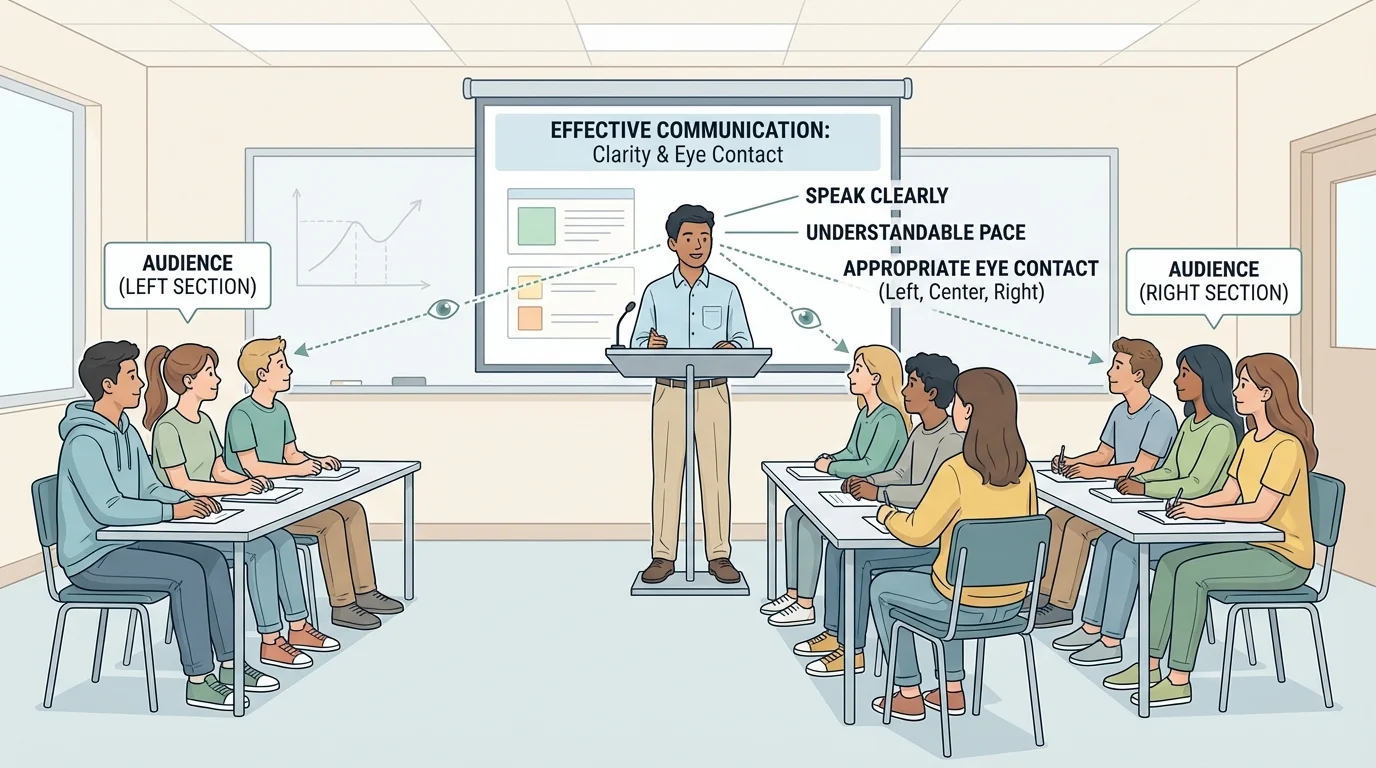
Good eye contact includes the whole room, as [Figure 1] shows. Instead of locking your eyes on one spot, sweep your gaze from one side to the other in a calm, natural way. Pause briefly on a person or small group, then shift to another part of the audience. This makes your speaking feel connected and steady.
A simple way to think about it is this: look, speak, move. You look at one part of the audience while saying a sentence or idea, then move your eyes to another part for the next idea. That pattern helps everyone feel included.
If the audience is small, you can make eye contact with each person several times. If the audience is larger, think in sections such as left, center, and right. Looking at sections helps you avoid focusing too much on one area.
There are also mistakes to avoid. One mistake is staring too long at one person, which can feel uncomfortable. Another is looking only at your teacher. A third is looking over people's heads the whole time. Even if you are nervous, try not to keep your eyes on the floor, ceiling, or screen.
Sometimes speakers use notes. Notes are helpful, but they should not become a wall between you and your listeners. Glance down quickly, find your next point, and then look back up. Your audience should hear your ideas from you, not from a page.
Later, when you are giving reasons to support an opinion, the same idea still matters. As seen in [Figure 1], eye contact helps your words feel directed and meaningful instead of distant and flat.
Pronunciation is the way words are said. Clear speakers pronounce words carefully enough that listeners can understand them. This does not mean every word must sound perfect. It means your words should not be slurred together or hidden by mumbling.
Another important part of clear speaking is volume, which is how loud or soft your voice is. If you speak too softly, people miss your message. If you shout the whole time, it may sound harsh or distracting. A good speaking volume is strong enough for the whole room to hear comfortably.
Enunciation means speaking words distinctly. For example, if a student says, "Wegonnatalkaboutourprojecttoday," the words run together. A clearer version would separate the words: "We are going to talk about our project today." The second version is easier for listeners to follow.
Clear speaking also includes finishing words. Sometimes speakers drop endings, especially when they are nervous or rushing. Saying "runnin" instead of "running" or "goin" instead of "going" may not always confuse people, but too much dropped sound can make a presentation harder to understand.
Clear speaking is a combination of several choices. A speaker needs words that are pronounced clearly, a voice loud enough for the room, and speech that is not rushed together. These parts work like teammates. If one part is weak, listeners may struggle even if the speaker knows the topic very well.
Breathing matters too. If you try to speak long stretches without breathing, your voice may fade or your words may become unclear. Good speakers take natural breaths between ideas. That helps both the speaker and the audience.
Pace is not just about being fast or slow. It also includes knowing when to pause, as [Figure 2] illustrates. An understandable pace gives listeners enough time to absorb one idea before the next one begins.
Many students speak too fast when they are nervous. Their thoughts race, so their words race too. But listeners need a little space between ideas. If every sentence comes out at top speed, the audience may understand the first part and miss the rest.
Speaking too slowly can also be a problem if it becomes choppy or unnatural. The best pace is steady. It sounds smooth, controlled, and easy to follow. It leaves time for key words to stand out.
Pauses are powerful. A short pause before an important point tells listeners, "Pay attention to what comes next." A pause after a big idea gives them a moment to think about it. Good speakers do not fear silence. They use it well.
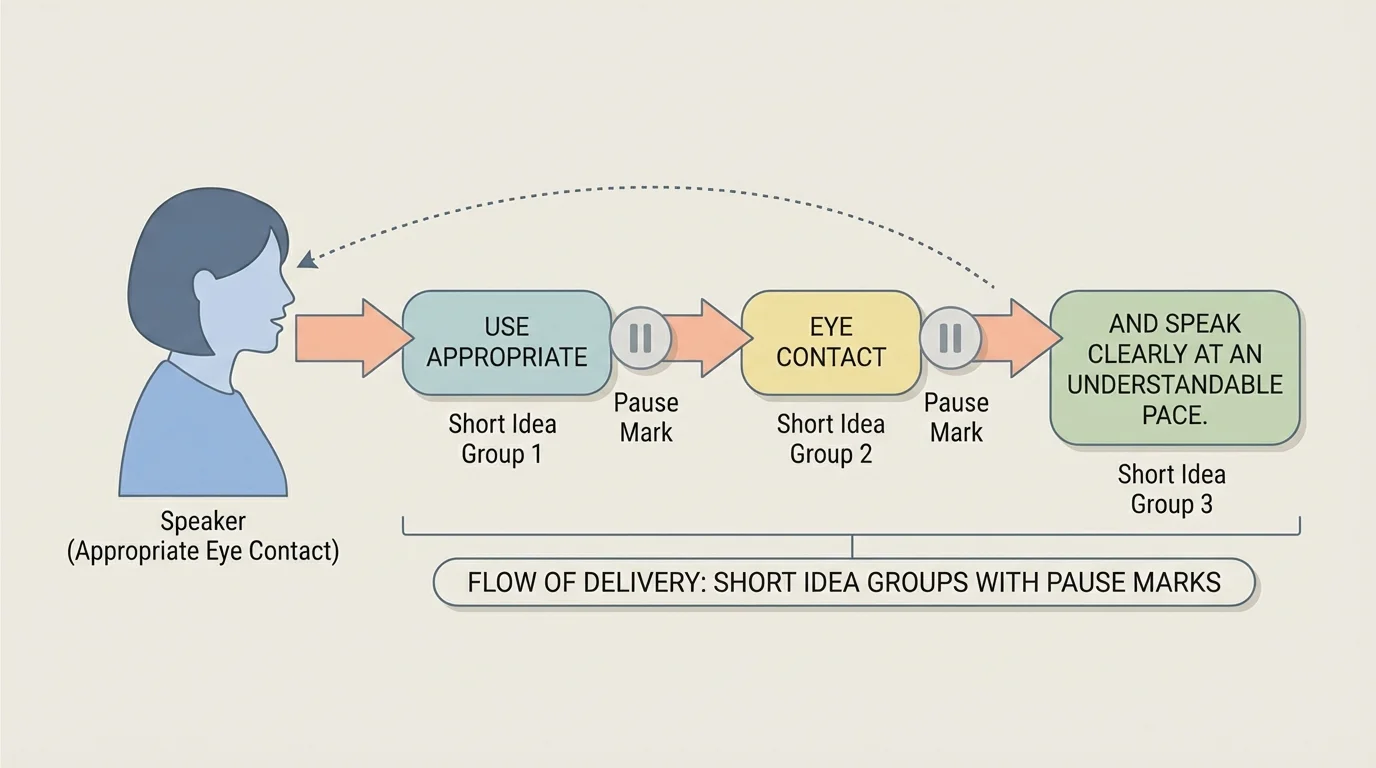
Suppose a speaker says, "Recycling helps save resources reduce waste lower pollution and protect wildlife." That is hard to follow because the ideas run together. A clearer version would be: "Recycling helps save resources. It reduces waste. It can lower pollution and protect wildlife." The ideas are the same, but the pace and pauses make them easier to understand.
Breathing supports pace. If you breathe at natural stopping points, your speech sounds calmer. This also helps you avoid filler words such as "um," "uh," and "like" repeated too often. Filler words are common, but too many can distract listeners from your message.
When a speaker explains information step by step, pacing becomes especially important. As [Figure 2] shows, separating ideas into small groups with pauses helps the audience process one part before moving to the next.
Speaking well does not always sound the same. Your voice should match your purpose. If you are expressing an opinion, your tone should sound thoughtful and confident. If you are persuading, your voice may become more energetic on important reasons. If you are explaining information, your pace may slow slightly so listeners can understand facts and steps.
Persuade means trying to convince someone to think, believe, or do something. When persuading, eye contact matters because it helps your reasons feel direct and believable. A clear voice matters because listeners need to hear each reason and example.
If you are sharing an opinion, it helps to emphasize your main point. For example, a student might say, "I believe recess should be longer because students focus better after movement." The speaker can look at the audience during the words "I believe" and "focus better" to highlight the key message.
If you are explaining a process, pacing is especially important. For example, if you are describing how a seed grows, you might say the steps in order and pause between them: first the seed absorbs water, next it begins to sprout, and then roots and shoots grow. The pauses help listeners organize the information.
Example: One topic, three purposes
Topic: School garden
Step 1: Expressing an opinion
"I think our school garden is one of the best learning spaces on campus." The speaker uses eye contact to connect and a steady pace so the opinion sounds confident.
Step 2: Persuading
"We should add more vegetable beds because students can learn science, responsibility, and healthy habits." The speaker emphasizes the reasons and pauses between them.
Step 3: Explaining
"First, students prepare the soil. Next, they plant seeds. Then they water and observe the plants over time." The speaker slows slightly so each step is clear.
The words change a little, but the speaking skills remain important in each case. Eye contact creates connection, and a clear pace helps the audience follow the message.
One common problem is monotone speech. A monotone voice stays almost the same all the time. It may not rise or fall enough to show important ideas. Listeners can lose interest because everything sounds equally important. A stronger speaker changes tone slightly to match meaning.
Another common problem is reading every word from notes or slides. When that happens, eye contact disappears and pace often becomes unnatural. The speaker may sound like a robot instead of a person sharing ideas. Notes should guide you, not control you.
Mumbling is another issue. Mumbling happens when words are spoken too softly or not clearly enough. Sometimes this happens because a speaker feels shy. Sometimes it happens because the speaker is facing down toward notes instead of facing the audience.
Rushing is probably the most common problem of all. A speaker may feel nervous and want to finish quickly. But fast speaking often creates more mistakes, not fewer. Slowing down a little usually improves clarity right away.
| Problem | What Listeners Notice | Helpful Fix |
|---|---|---|
| Looking down too much | The speaker seems disconnected | Glance at notes, then look back up |
| Speaking too fast | Ideas blur together | Pause between sentences and main points |
| Mumbling | Words are hard to hear | Open your mouth more and face the audience |
| Very soft voice | Only nearby people can hear | Project your voice to the back of the room |
| Monotone voice | Speech sounds flat | Emphasize key words and vary tone naturally |
Table 1. Common speaking problems, how they affect listeners, and simple ways to improve.
A useful way to think about these problems is that most of them are fixable. They are not signs that someone is a "bad speaker." They are signs that a speaker needs more awareness and control.
You already use many speaking skills in everyday life. When you tell a friend about a movie, explain the rules of a game, or answer a question in class, you naturally change your voice and pace. Presenting in front of a group builds on those same skills.
Strong speakers are not always the loudest people in the room. Often, they are the people who help others understand them best.
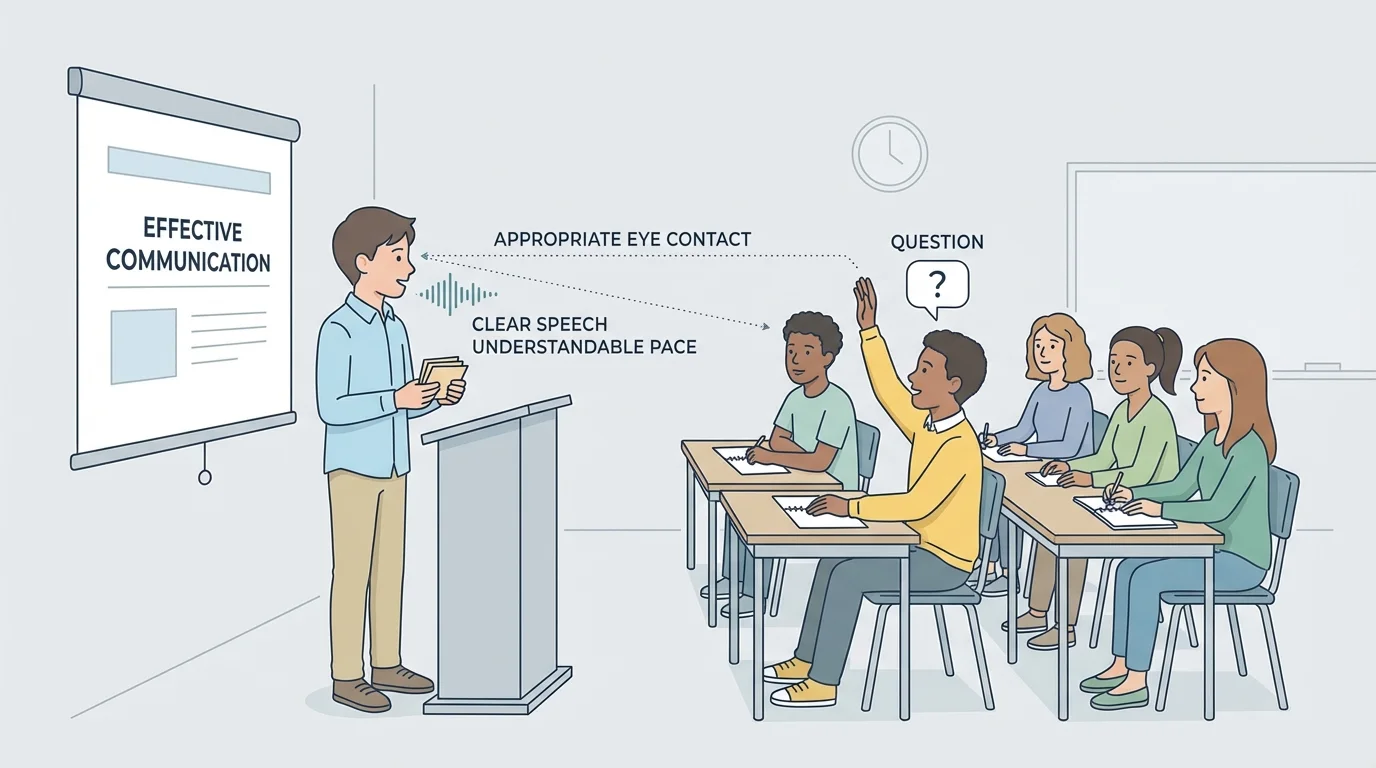
These skills matter during real classroom speaking, as [Figure 3] illustrates. In a presentation, you may need to introduce a topic, explain facts, share an opinion, and answer questions. Eye contact and clear pacing help in every part of that process.
During the beginning of a presentation, look at the audience and say your opening clearly. This helps establish confidence. In the middle, use pauses between important points. At the end, slow down slightly so your conclusion sounds complete rather than rushed.
Question-and-answer moments are especially important. When someone asks a question, listen carefully, look at the person who asked it, and then include the rest of the audience as you answer. This shows respect to the questioner while keeping everyone involved.
Group presentations also require attention. If several students are speaking, each person should still make eye contact and speak clearly. Listeners should not suddenly have to struggle because one speaker drops their voice or rushes through their part.
Even short speaking moments count. Giving a book recommendation, reporting on a science observation, explaining a math strategy, or introducing a guest all call for the same habits. As shown in [Figure 3], speaking to a class is really a series of connected choices: where you look, how clearly you speak, and when you pause.
Preparation supports good eye contact and pacing. When you know your topic well, you are less likely to cling to your notes. When you understand the order of your ideas, you are less likely to rush.
One helpful approach is to organize ideas into clear parts: opening, main points, and closing. If you know what comes next, your speaking sounds more relaxed. Another helpful approach is to choose a few important words to emphasize. That keeps your voice from sounding flat.
Confidence does not mean feeling zero nerves. Many strong speakers still feel nervous. Confidence means using good speaking habits even when you feel those nerves. Looking up, speaking clearly, and pausing between ideas are signs of control.
"It's not enough to know what you want to say. You also have to help others hear it."
A speaker who prepares well can focus on the audience instead of worrying about every word. That makes eye contact more natural and your pacing easier to follow.
Over time, these habits become stronger. The more you understand your message and pay attention to your listeners, the more clearly and confidently you can speak.
