Have you ever noticed that people talk differently when they want different results? A student asking for longer recess does not sound the same as a student explaining how a volcano forms. And neither of those sounds exactly like a student sharing a personal view about school uniforms. Good speakers do more than talk. They adapt their language so it fits their purpose.
When you speak in class, in a group, or in front of an audience, you make choices. You choose your tone, your examples, the amount of detail you include, and even how strongly you say something. These choices help your listeners understand what kind of message you are giving and why it matters.
Purpose means the reason for speaking. If your purpose changes, your language should change too. You would not use the exact same words to convince your class to start a school garden, to explain how a garden helps pollinators, and to tell your opinion about which vegetables should be planted first.
Strong speakers think about two questions before they begin: Why am I speaking? and Who is listening? Those questions help them decide whether to sound more informative, more convincing, or more personal. They also help speakers avoid confusion. If listeners cannot tell your purpose, they may miss your main point.
Adapt language means changing the way you speak so it fits your purpose and audience. This can include changing your word choice, tone, details, examples, and organization. Audience means the people who are listening. Purpose means the reason you are speaking.
Think of language like clothing for ideas. You would not wear swim gear to a snowstorm. In the same way, you should not use playful, unsupported language in a serious explanation, and you should not bury a persuasive speech under too many facts with no clear opinion. Matching language to purpose helps your message work.
[Figure 1] Most classroom speaking tasks fit into three main purposes: to persuade, to explain or provide information, or to express an opinion. One topic can sound very different depending on the purpose, as the comparison shows through three versions of a message about the same subject.
To persuade means you want listeners to think, feel, or do something. To explain or provide information means you want listeners to understand a topic clearly. To express an opinion means you want to share what you think or believe and why you think it.
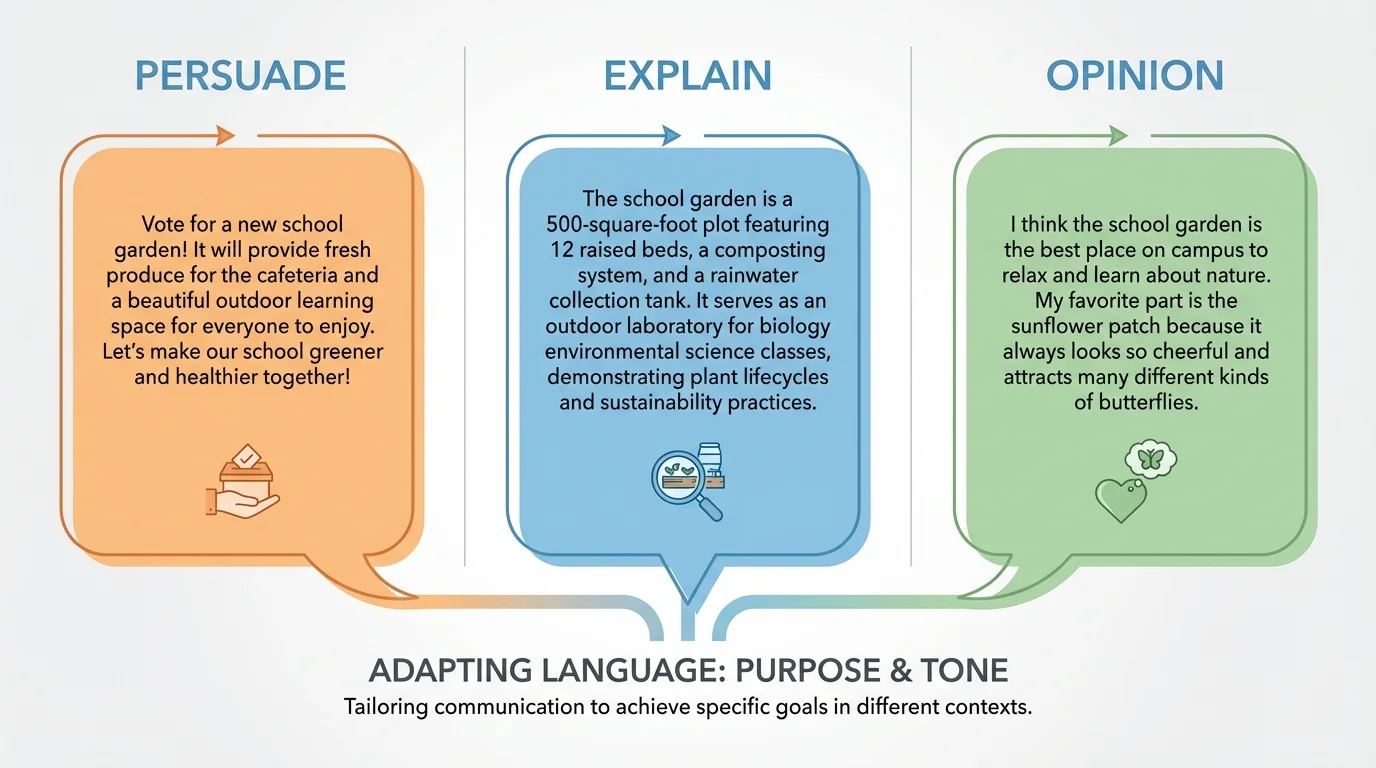
These purposes can overlap, but they are not identical. A speaker giving information may include an opinion for a moment, but the main purpose still matters most. A good listener can often tell the main purpose by noticing the speaker's words. Is the speaker giving facts? Trying to convince? Sharing a personal point of view?
| Purpose | Main Goal | Language Often Used | Example Starter |
|---|---|---|---|
| Persuade | Convince listeners | Strong reasons, evidence, action words | "We should..." |
| Explain/Inform | Help listeners understand | Clear facts, steps, definitions | "First, this happens..." |
| Express an opinion | Share a personal view | Belief words and supporting reasons | "I believe..." |
Table 1. Comparison of the three main speaking purposes and the language often used for each one.
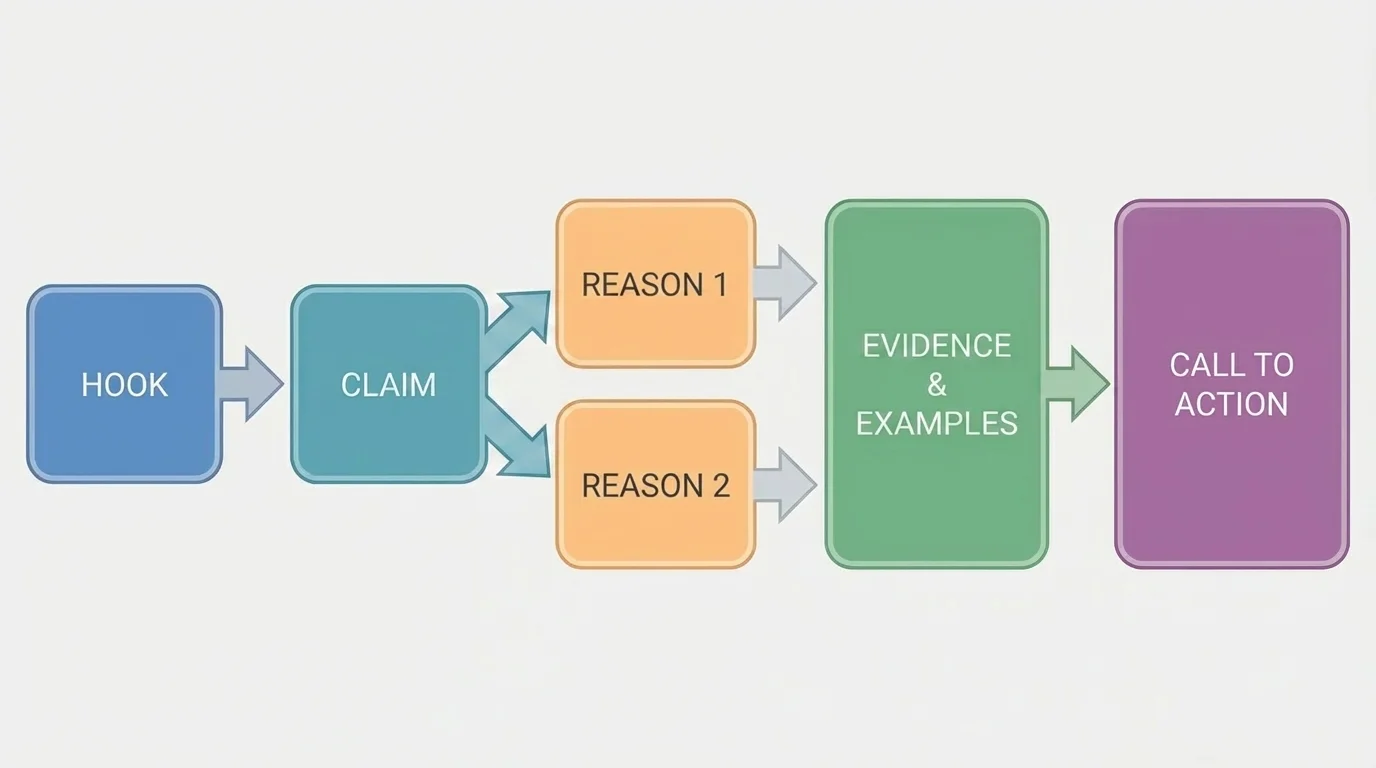
[Figure 2] When you speak to persuade, your goal is to move listeners toward your idea. That means your words should be strong, clear, and respectful. A persuasive presentation often includes a claim, reasons that support the claim, evidence or examples, and a clear ending that tells listeners what they should think or do next.
Your claim is your main point. For example: "Our school should add more recycling bins." That statement is not just a topic. It is a position. After the claim, you need reasons: maybe recycling bins reduce waste, keep classrooms cleaner, and help the environment. Then you need support, such as examples from your school or facts you have learned.
Persuasive language often includes words and phrases such as should, must, would help, for these reasons, and I urge you. These words signal that the speaker wants action or agreement. However, persuasive speaking should not sound rude or bossy. Respect makes persuasion stronger because listeners are more likely to trust a speaker who is thoughtful and fair.
A persuasive talk also often ends with a call to action. This is a sentence or two that tells listeners what to do next. For example: "Vote for the recycling project at Friday's class meeting." That gives the audience a clear next step.
Here is how language changes when persuasion is the goal. Instead of saying, "There are different lunch choices at school," a persuasive speaker might say, "Our school should offer one more healthy lunch choice because many students want fresh food that helps them stay focused." The second version clearly takes a stand and gives a reason.
Persuasive example
Topic: getting a class reading corner
Step 1: State the claim
"Our classroom should create a reading corner."
Step 2: Give reasons
"A reading corner would give students a quiet place to focus, and it would make books easier to reach."
Step 3: Add support
"Many students already enjoy independent reading, and a special space could help more students build strong reading habits."
Step 4: End with action
"Let's work together to design one this month."
Notice that the speaker is not simply talking about books. The speaker is trying to move listeners toward a decision. That is what makes the language persuasive. Later, if the speaker needed to explain how the reading corner would be organized, the language would become more informational than persuasive, connecting back to the shift in purpose shown in [Figure 1].
[Figure 3] When your purpose is to explain or provide information, your main job is clarity. You want listeners to understand a topic, process, event, or idea. Your language should be organized and accurate. Instead of pushing listeners to agree with you, you guide them through the information with a step-by-step explanation.
Informational speaking often uses sequence words such as first, next, then, because, and finally. It may also include definitions, examples, descriptions, and comparisons. These tools help listeners build understanding one piece at a time.
Suppose you are explaining how composting works. You might start by defining compost, then describe what materials can go into a compost bin, then explain how those materials break down over time, and finally describe the benefits. This kind of order helps listeners follow your thinking.
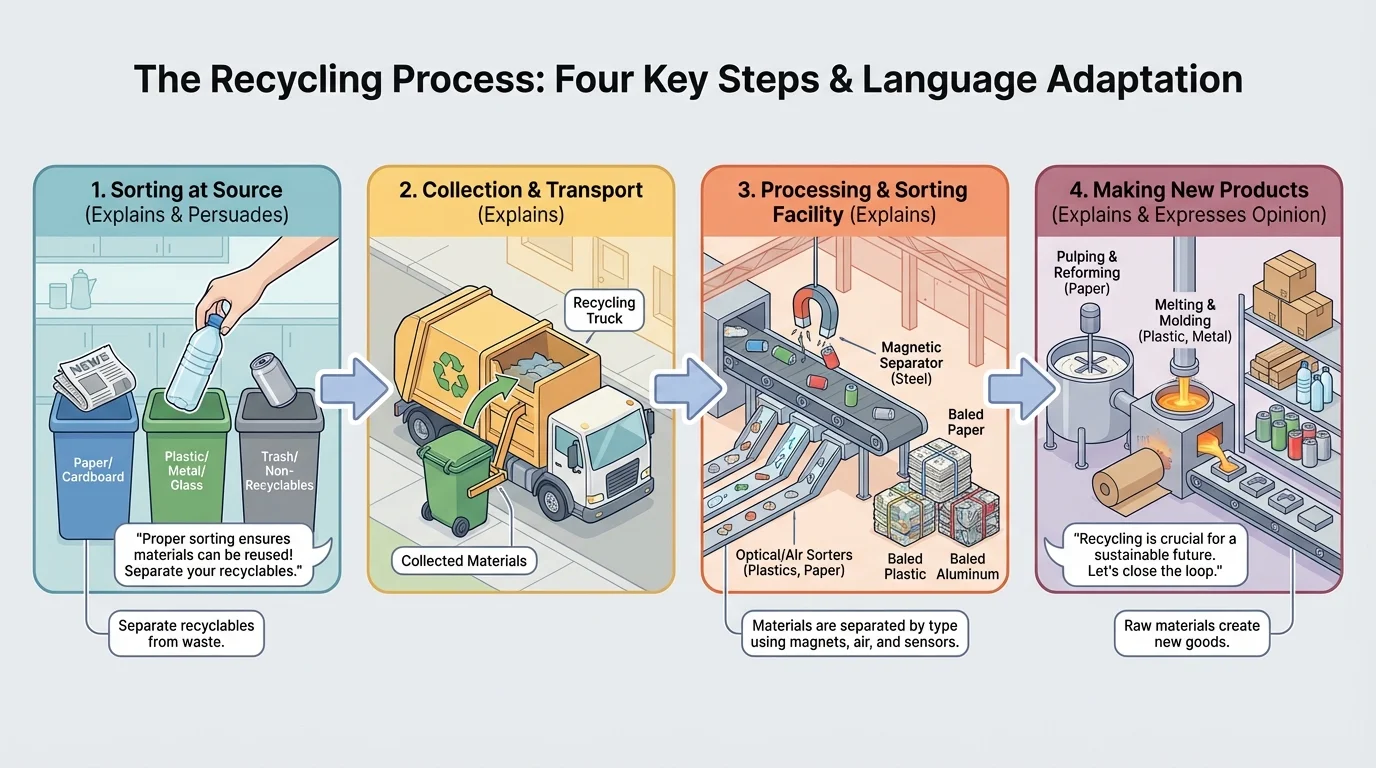
Informational language is usually more neutral than persuasive language. Neutral does not mean boring. It means the focus stays on helping the audience understand. A speaker might say, "Recycling turns used materials into new products. First, people sort items such as paper, plastic, and metal. Next, the materials are collected and sent to a recycling center." This sounds different from a persuasive statement like, "Everyone should recycle every day."
Clear explanations also use examples that fit the audience. If you are speaking to fifth graders, you should choose words they can understand and examples they know. If you are speaking to adults at a community event, you may use more detailed vocabulary and more complex examples.
Clarity comes from order
Many students think explaining means saying everything they know. Actually, good explanation means choosing the right information and putting it in a helpful order. Too many details can confuse listeners. A clear structure helps the audience remember the most important points.
One helpful way to explain is to move from general to specific. Start with the big idea, then add details. For example: "A food chain shows how energy moves through living things. For example, grass is eaten by a rabbit, and a fox may eat the rabbit." This method helps listeners see both the main concept and a real example.
When you express an opinion, you share what you think, feel, or believe about a topic. An opinion is personal, but it should still be supported. Saying "I like it" is not enough for a strong presentation. A speaker should explain why they hold that opinion.
Opinion language often includes phrases such as I think, I believe, in my view, or from my experience. These phrases signal that the speaker is giving a viewpoint. But a strong opinion presentation also adds reasons, examples, or evidence. For instance: "I believe field trips are one of the best ways to learn science because students can observe real plants, animals, or machines instead of only reading about them."
Opinion speaking can be thoughtful and respectful. You can share your own view without pretending it is the only possible view. Good speakers may even recognize another side: "Some people think homework should always be short, but I believe meaningful homework can be useful when it gives students time to practice important skills." This shows fairness and maturity.
Opinion example
Topic: whether students should have assigned seats at lunch
Step 1: State the opinion
"I think students should be allowed to choose their own lunch seats most of the time."
Step 2: Give reasons
"Choosing seats helps students build friendships and practice making responsible choices."
Step 3: Acknowledge another view
"Assigned seats can help if there is a problem, but they do not need to be used every day."
Step 4: End clearly
"For those reasons, I believe student choice is the better everyday plan."
Opinion and persuasion are similar because both often include reasons. The difference is that persuasion pushes harder toward changing the audience's thinking or behavior. Opinion speaking focuses more on sharing and supporting a viewpoint. Sometimes a speech begins as an opinion and becomes more persuasive as the speaker urges action.
[Figure 4] Your audience affects almost every speaking choice you make. The same idea should sound different when you speak to a close friend, your class, your principal, or younger students. Word choice, examples, volume, and tone all shift depending on who is listening.
If you are speaking to younger children, you may need simpler words and shorter sentences. If you are speaking to a teacher or principal, your language may sound more formal and carefully organized. If you are talking with classmates, you can still be respectful while sounding more natural and conversational.
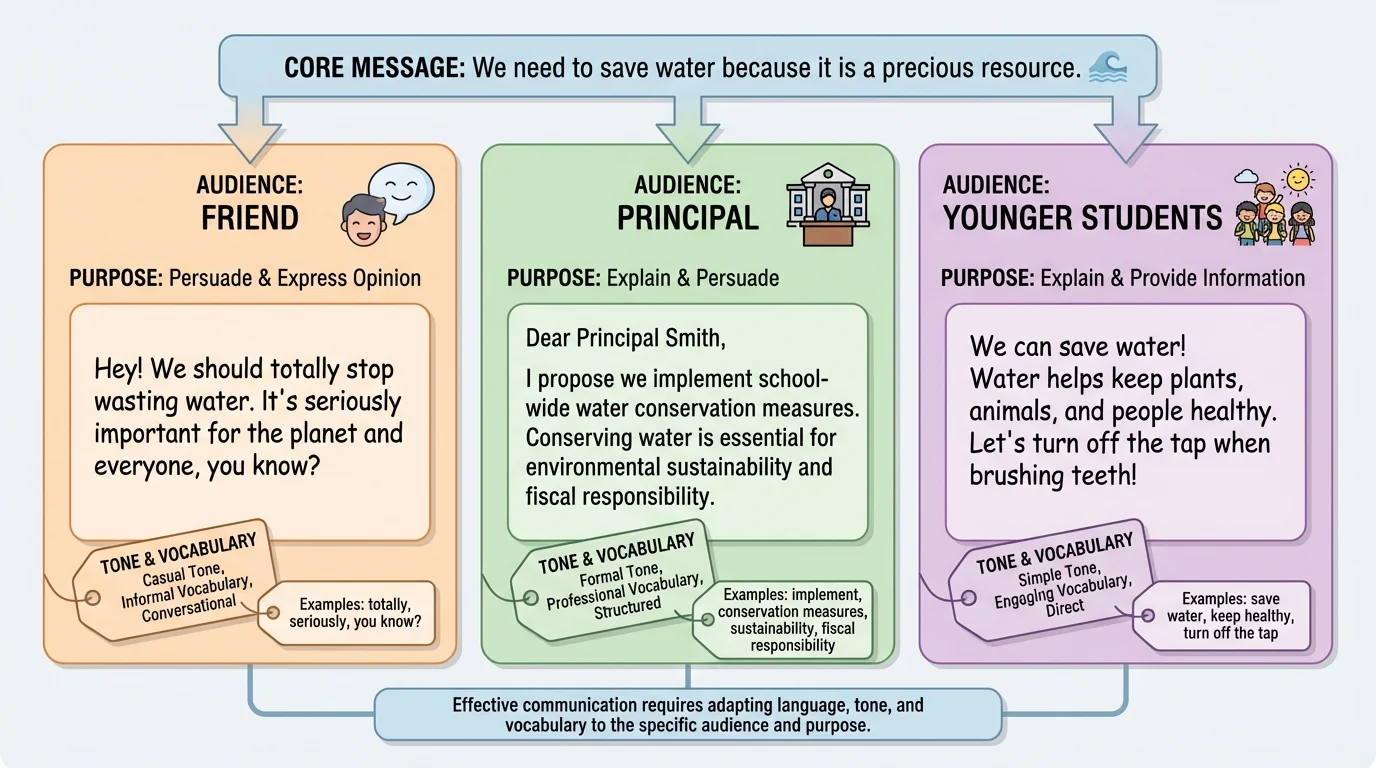
For example, suppose your message is about keeping the playground clean. To younger students, you might say, "Please throw away your trash so the playground stays safe and fun." To the principal, you might say, "I would like to suggest adding more trash cans near the playground because it would help students keep the area cleaner." The purpose may be similar, but the language changes because the audience changes.
Knowing your audience also helps you choose examples. If you want classmates to care about a topic, use examples from school life, sports, lunch, recess, clubs, or technology they use. If you want adults to care, use examples that connect to safety, cost, time, or community impact.
| Audience | Helpful Language Choices | Example |
|---|---|---|
| Classmates | Clear, direct, familiar examples | "This would help us finish group work faster." |
| Teacher or principal | Respectful, organized, more formal | "I would like to propose a solution." |
| Younger students | Simple words, short sentences, concrete examples | "Walk so everyone stays safe." |
Table 2. Examples of how speaking choices change for different audiences.
Tone is the feeling your words create. A tone can be excited, serious, calm, respectful, urgent, or thoughtful. Tone should match purpose. A persuasive speech might sound confident and energetic. An explanation might sound calm and clear. An opinion speech might sound thoughtful and personal.
Word choice matters too. Precise words help listeners understand exactly what you mean. Compare these two sentences: "The project was good" and "The project was successful because students worked together and finished on time." The second sentence is stronger because the words are more specific.
Organization is another important part of adapting language. Most strong oral presentations have three parts: an opening, a middle, and a closing. The opening grabs attention and introduces the topic. The middle gives reasons, facts, or examples. The closing leaves listeners with the main message.
From earlier speaking lessons, remember that listeners need help following your ideas. Signal words such as first, for example, because, on the other hand, and finally act like road signs for your audience.
Transitions are especially useful. In a persuasive talk, transitions such as another reason or most importantly help build the case. In an informational talk, transitions such as next and as a result help explain sequence. In an opinion talk, transitions such as in my view and however help connect personal ideas and reasons.
Good pacing also matters. If you rush, listeners may miss important ideas. If you speak too slowly or repeat too much, listeners may lose interest. The right pace depends on the purpose and the amount of information you are sharing.
Oral expression is not only about talking. It is also about listening. Careful listeners notice purpose. They ask themselves whether the speaker is persuading, explaining, or sharing an opinion. This helps them understand the message better and respond in a useful way.
For example, after an informational presentation, a good response might be a question asking for clarification: "Can you explain the second step again?" After an opinion presentation, a listener might respond, "I understand your view, but I think differently because..." After a persuasive speech, a listener may ask, "What evidence supports that claim?"
Speakers should also watch their audience while talking. If listeners look confused, the speaker may need to explain more clearly. If listeners seem unconvinced, the speaker may need stronger support. If listeners seem interested but unsure, the speaker may need a stronger closing or a clearer call to action, which connects back to the persuasive structure shown in [Figure 2].
Skilled speakers often change their language in the middle of a presentation. If they notice confused faces, they may add an example. If they notice strong interest, they may slow down and give more detail.
This ability to adjust while speaking is a powerful skill. It shows that communication is not one-sided. Speaking and listening work together.
One common mistake is mixing purposes without realizing it. A student may begin by explaining a topic, suddenly switch to a strong opinion, and then end with facts that do not connect clearly. This can confuse listeners. A better choice is to know your main purpose and make sure most of your language supports it.
Another mistake is using language that is too vague. Words like good, bad, stuff, and things do not say enough. Clear speakers choose exact words. Instead of "The assembly was good," say, "The assembly was interesting because the speaker used real examples and spoke with energy."
A third mistake is forgetting the audience. A detailed scientific explanation may be too hard for younger listeners. A very casual speech may sound disrespectful in a formal setting. As we saw earlier in [Figure 4], the same message can be reshaped for different listeners without changing the main idea.
Finally, some speakers give opinions without support. Others try to persuade without evidence. Strong speaking almost always includes reasons, examples, facts, or clear explanation. Support gives your words strength.
These speaking skills are useful far beyond a single classroom assignment. Students persuade when they suggest ideas for a project, ask for a rule change, or encourage others to join a club. They explain when they teach a game, describe a science process, or report on research. They express opinions when they discuss books, current events, or school issues.
Adults use these same skills every day. A coach persuades players to follow a strategy. A meteorologist explains the weather forecast. A community member expresses an opinion at a meeting. The purpose changes, and the language changes with it.
"The right words, spoken for the right purpose, can change what people understand, believe, and do."
Becoming a stronger speaker does not mean sounding fancy. It means being intentional. It means knowing your purpose, knowing your audience, and choosing language that helps your message reach people clearly and effectively. Whether you are trying to inform, convince, or share your view, adapting language is one of the most important tools you can use.
