Have you ever started reading a story and then realized a few pages later that you do not really know what is happening? Strong readers do not just open a book and hope for the best. They get ready first. Before they begin, they think, predict, and connect. These actions are called pre-reading strategies, and they help readers understand literary texts such as stories, poems, plays, myths, and novels.
Reading is a little like going on a hike. If you know where you are going, look at the trail map, and remember what you already know about the area, the trip is much easier. In the same way, when you set a goal, preview the text, ask questions, and connect to your background knowledge, reading becomes clearer and more meaningful.
Pre-reading strategies are actions readers use before and at the very start of reading to prepare their minds for understanding a text. These strategies include setting a purpose, asking questions, previewing the text, and activating prior knowledge.
These strategies are especially helpful with literary texts because literature often includes characters, settings, conflicts, themes, and figurative language. If you prepare before reading, you are more likely to notice important details and understand what the author is trying to show.
Good readers are active, not passive. A passive reader just lets words pass by. An active reader thinks while reading. Pre-reading helps you become active even before the first paragraph begins. It gives your brain a job to do.
When you prepare to read, you make it easier to focus. You are less likely to miss key details. You are also more likely to remember what you read later. This matters in school, but it also matters in everyday life. People use similar strategies when they read game directions, recipes, news articles, or instructions for building something.
Pre-reading does not mean taking a long time before every text. Sometimes it takes less than a minute. A quick look at the title, a question in your mind, and a connection to something you already know can make a big difference.
A purpose for reading is the reason you are reading a text. Knowing your purpose helps you decide what to pay attention to. If your purpose changes, the details you notice may change too.
For example, suppose you are reading a folktale. One purpose might be to learn the lesson or moral. Another purpose might be to compare the main character with a character from another story. A third purpose might be to enjoy the story and notice how the author builds suspense. Each purpose guides your attention in a different way.
Here are some common purposes for reading literary texts:
If you are reading Charlotte's Web, your purpose could be to understand how friendship grows between characters. If you are reading a poem about winter, your purpose could be to notice words that create a cold, quiet mood. If you are reading a myth, your purpose could be to discover how the myth explains nature or human behavior.
Example: setting a purpose
You are about to read a story called The Lost Key.
Step 1: Look at the title.
The title suggests that something important is missing.
Step 2: Decide why you are reading.
Your purpose might be to find out who lost the key and why it matters.
Step 3: Let the purpose guide your attention.
As you read, you pay close attention to clues, character actions, and anything connected to the key.
A clear purpose does not trap you. You can adjust it if the text changes direction. Sometimes a story begins as a mystery but later becomes more about bravery, family, or change. Strong readers stay flexible.
Another powerful strategy is to ask questions before you read and then keep looking for answers while reading. This turns reading into a search for meaning. Instead of waiting for the text to do all the work, you become curious and alert.
A useful question is one that helps you understand the text more deeply. Questions can be about characters, setting, plot, conflict, theme, point of view, or the author's craft. They can begin with words such as who, what, where, when, why, and how.
Before reading, you might ask:
While reading, your questions may become more specific:
Suppose you are reading a poem called Storm Windows. Before reading, you might ask, "Is this poem really about weather, or is it also about feelings?" While reading, you would look for words and images that answer that question. That makes you more attentive to figurative language and mood.
Questions do not always get answered right away. Sometimes a reader carries a question through several pages or even an entire book. That is normal. Good questions keep your mind engaged.
Questions act like flashlights. They shine on important parts of a text. When you ask a question, you tell your brain what to search for. Then, as you read, details stand out more clearly because you are not reading randomly. You are reading with direction.
It also helps to notice when a question changes. For example, your first question may be, "Will the main character succeed?" Later, after a surprising event, your question might become, "What will success now look like?" Literature often becomes richer when your thinking grows and shifts.
Before reading in detail, readers often preview the text. Previewing means taking a quick look at the parts of the text that give clues about what is coming. In literary reading, this may include the title, chapter names, headings, illustrations, captions, bold words, opening lines, or information on the back cover. A strong preview helps readers predict, as [Figure 1] shows, by focusing attention on the text features that matter most.
Previewing is not the same as reading the whole text. It is a short survey. Think of it as looking at the outside and shape of a puzzle box before putting the pieces together. You gather clues first.
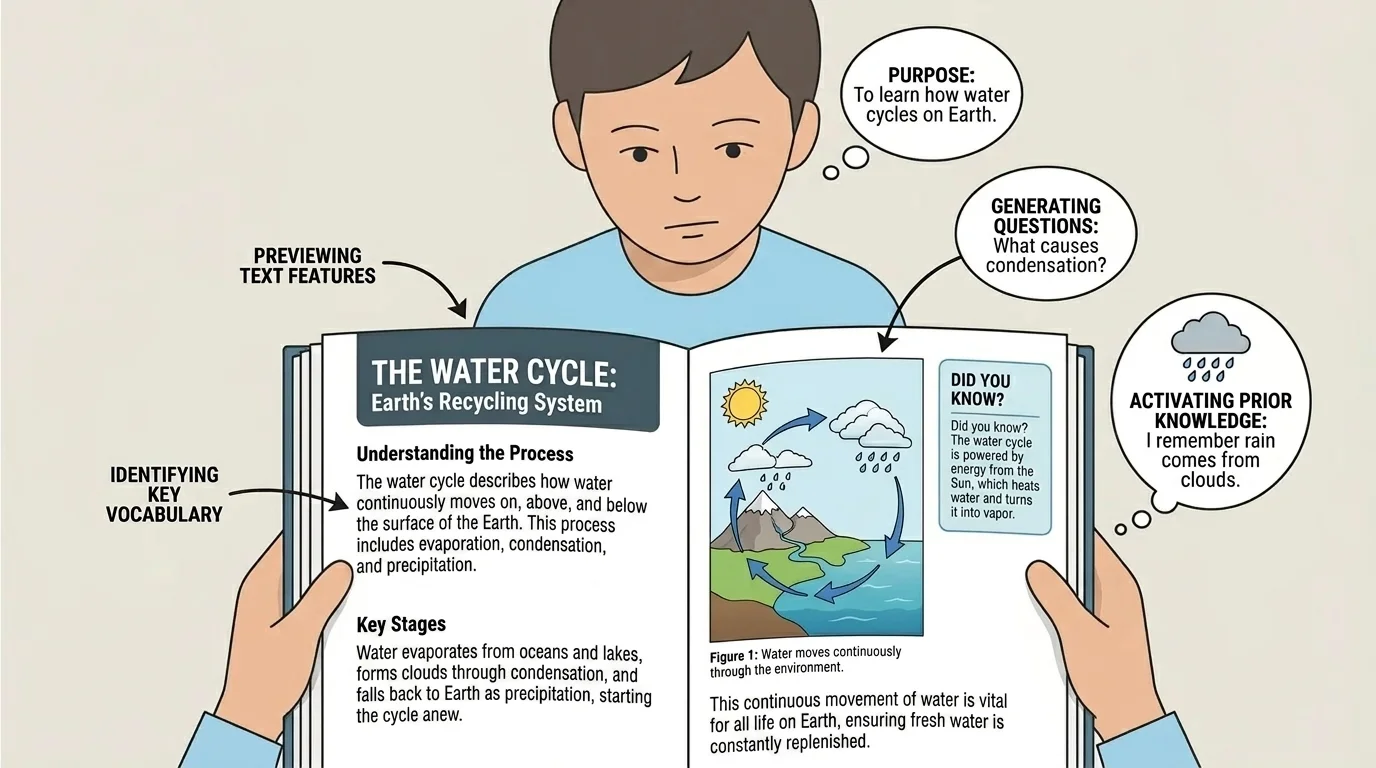
When previewing a story, ask yourself:
Suppose you open a book titled Midnight on Maple Street. Before reading, you notice a dark illustration, a chapter called "The Footsteps," and a back-cover description about a neighborhood secret. From that preview, you can predict that the story may be suspenseful and that the setting will matter a lot.
Previewing also helps with longer texts. If a novel has many chapters, reading chapter titles first can give you a sense of structure. If a play includes a list of characters, you can preview who is involved before the dialogue starts. If a poem is arranged in stanzas with repeated lines, that structure may tell you something about rhythm or emphasis.
Later, when you begin reading carefully, the ideas you noticed during your preview help you stay organized. The text features in [Figure 1] are not decorations. They are clues that guide understanding.
Readers understand new ideas better when they connect them to something they already know. This is called prior knowledge. It includes facts, experiences, memories, and ideas you have learned before. As [Figure 2] illustrates, prior knowledge works like a web that links old ideas to new reading.
If you read a story about moving to a new town, you may think about your own experience of being new somewhere or meeting someone new. If you read a myth about the sun, you may connect it to science lessons about the solar system, even though myths and science explain things in different ways.
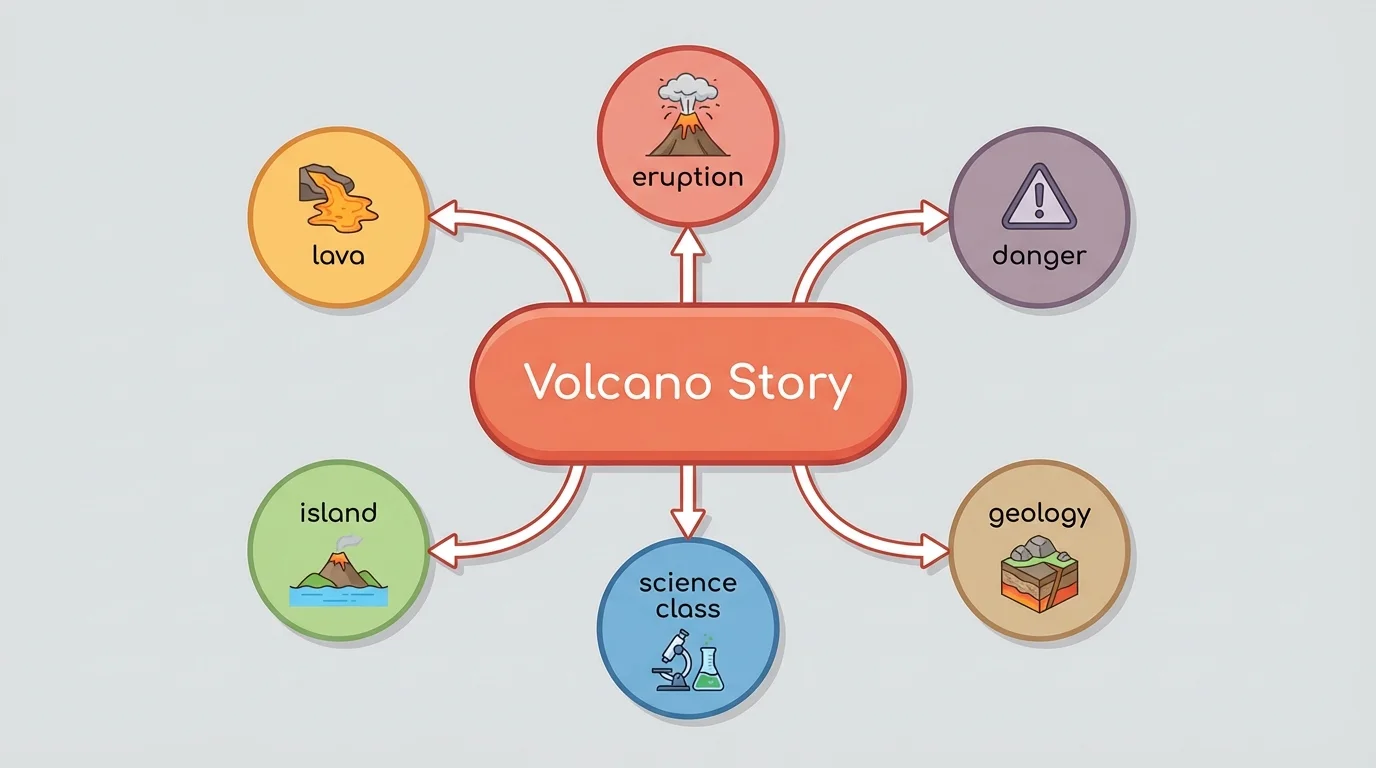
Activating prior knowledge helps because your brain does not start from zero. It attaches new information to ideas already stored in memory. This can improve understanding, prediction, and recall.
But there is an important warning: prior knowledge should support reading, not replace it. Sometimes readers assume too much. They think, "I already know about this," and stop paying close attention. A story may surprise you. Two texts on the same topic can be very different.
Remember: making connections is helpful only when the connections fit the text. Good readers stay open to new details instead of forcing the text to match what they expected.
For example, if you begin a story set near a volcano, you may connect it to what you know about eruptions, danger, smoke, and lava. That helps you picture the setting. But you still need to read carefully, because the story may focus more on family, courage, or tradition than on the volcano itself. The concept web in [Figure 2] shows how one topic can connect to many ideas before reading begins.
These strategies work across many kinds of literary texts, but they may look a little different depending on the genre.
In genres such as realistic fiction, readers often set a purpose related to character problems, relationships, or themes.
In fantasy, readers may preview unusual names, maps, or invented worlds. Their questions may focus on rules of the imaginary setting, such as "What powers exist in this world?" or "What danger is hidden behind this magical object?" Prior knowledge still matters, but readers must also stay open to unfamiliar ideas.
In myths and folktales, readers may set a purpose to find the lesson, explanation, or cultural value in the story. They might ask, "What does this story explain?" or "What trait is being rewarded or punished?" Prior knowledge about heroes, gods, tricksters, or lessons from earlier stories can help.
In poetry, previewing may include noticing the title, line breaks, repeated words, and shape of the poem on the page. Readers may ask, "What feeling does this poem create?" or "Why did the poet choose these images?" Prior knowledge about seasons, emotions, or nature may support understanding.
In drama, readers often preview the cast of characters and scene descriptions. Their purpose may be to understand how dialogue reveals conflict. They may ask, "Who wants what in this scene?" or "How does the character sound through the spoken lines?"
| Type of literary text | Useful purpose for reading | Helpful question | What to preview |
|---|---|---|---|
| Story or novel | Track character change | How does the character respond to problems? | Title, chapters, cover, blurb |
| Myth or folktale | Find the lesson or explanation | What idea about life or nature does this text teach? | Title, illustrations, opening lines |
| Poem | Notice mood and imagery | What feeling do the words create? | Title, line breaks, repeated words |
| Drama | Understand conflict through dialogue | What does each character want? | Character list, scene notes |
Table 1. Examples of how pre-reading strategies can be adjusted for different types of literary texts.
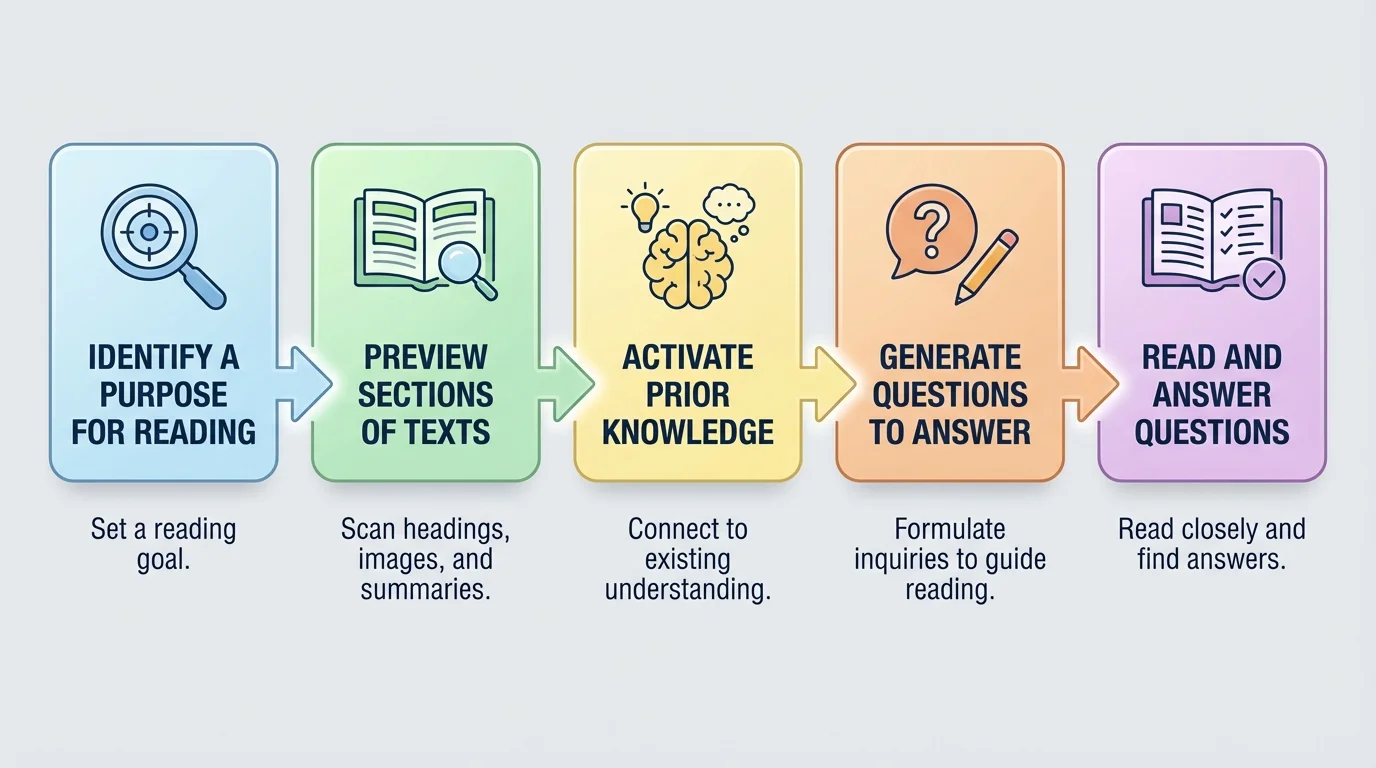
Strong readers often use these strategies in a simple order, as [Figure 3] shows. They set a purpose, preview the text, activate prior knowledge, ask questions, and then begin reading while looking for answers and new clues.
This process does not have to be long or complicated. It can happen quickly in your mind. The important thing is that the reading starts with attention and curiosity, not confusion.
Example: using all the strategies together
You are about to read a short story called The Empty Seat.
Step 1: Set a purpose.
You decide to read to understand why the empty seat matters to the main character.
Step 2: Preview.
You notice the title, a sad-looking illustration, and a first paragraph that mentions the first day of school.
Step 3: Activate prior knowledge.
You think about times when a classroom felt uncomfortable or unfamiliar.
Step 4: Generate questions.
You ask, "Who usually sits there?" and "Why is the seat empty today?"
Step 5: Read and search for answers.
As you read, you notice details about friendship, loss, and the character's feelings.
This example shows that pre-reading is not separate from comprehension. It is the beginning of comprehension. The sequence in [Figure 3] helps organize what skilled readers do almost automatically.
One common mistake is choosing a purpose that is too vague. Saying "I am reading because my teacher said so" does not guide your thinking. A better purpose is specific, such as "I want to understand how the setting creates tension."
Another mistake is asking questions that are too simple to help much, such as "What color is the dog?" unless that detail is important. Better questions dig into meaning, character, or conflict.
A third mistake is previewing too quickly and ignoring text features. Titles, illustrations, and headings often give useful clues. Skilled readers slow down just enough to notice them.
A fourth mistake is using prior knowledge in the wrong way. Sometimes readers decide what a text means before they have read enough. Smart readers use background knowledge as a helper, not as a boss.
Research on reading shows that when readers connect new information to what they already know, they usually remember the text better. That is one reason teachers often ask students to think before reading, not only after reading.
Over time, these strategies become habits. You may begin by using them on purpose, step by step. Later, they feel natural. When that happens, your reading becomes stronger, deeper, and more thoughtful.
