Have you ever heard two people argue about the "best" pizza topping, the "greatest" athlete, or the "most exciting" book? Those arguments can sound strong, but not all statements work the same way. Some can be proved true or false. Others express what someone thinks or feels. Strong readers know the difference, and that skill matters everywhere: in articles, advertisements, websites, and classroom discussions.
When you read informational texts, you are not just collecting words. You are deciding what the author is telling you and how much you should trust it. If a website says, "This backpack weighs only two pounds," that is something you can check. If it says, "This is the most amazing backpack ever made," that is a judgment. Readers who can separate checkable information from personal belief make smarter decisions.
This skill also helps you become a better writer and speaker. If you want to convince someone that recess should be longer or that a certain book deserves an award, you need more than a feeling. You need support. That means reasons, facts, examples, and details that help others understand why your judgment makes sense.
You already know that informational texts teach, explain, or report. They may include articles, biographies, science texts, directions, and websites. These texts often include both facts and opinions, so readers must pay close attention.
Not every opinion is weak, and not every fact is important. A good reader asks, "Can this be proved?" and "What support is given for this judgment?" Those two questions are powerful tools.
A fact is a statement that can be proved true or false by checking a reliable source, using observation, or finding evidence. A opinion is a statement that expresses a belief, feeling, taste, or judgment. The comparison in [Figure 1] shows that facts can be checked, while opinions tell what someone thinks.
For example, "A week has seven days" is a fact. You can check a calendar. "Saturday is the best day of the week" is an opinion. Different people may feel differently, so it cannot be proved true for everyone.
Fact is a statement that can be checked and proved true or false.
Opinion is a statement that shows what someone believes, feels, or judges.
Judgment is a type of opinion in which someone evaluates something, such as saying it is better, worse, important, boring, or valuable.
Facts often include names, dates, numbers, places, and specific details. For example, "The Amazon River is in South America" is a fact. "The Amazon River is the most fascinating river in the world" is an opinion because the word most fascinating expresses a judgment.
Some opinions are simple preferences, like "Chocolate ice cream tastes better than vanilla." Other opinions are more serious judgments, like "Schools should start later in the morning." Serious judgments can be discussed and supported with evidence, even though they are still opinions.
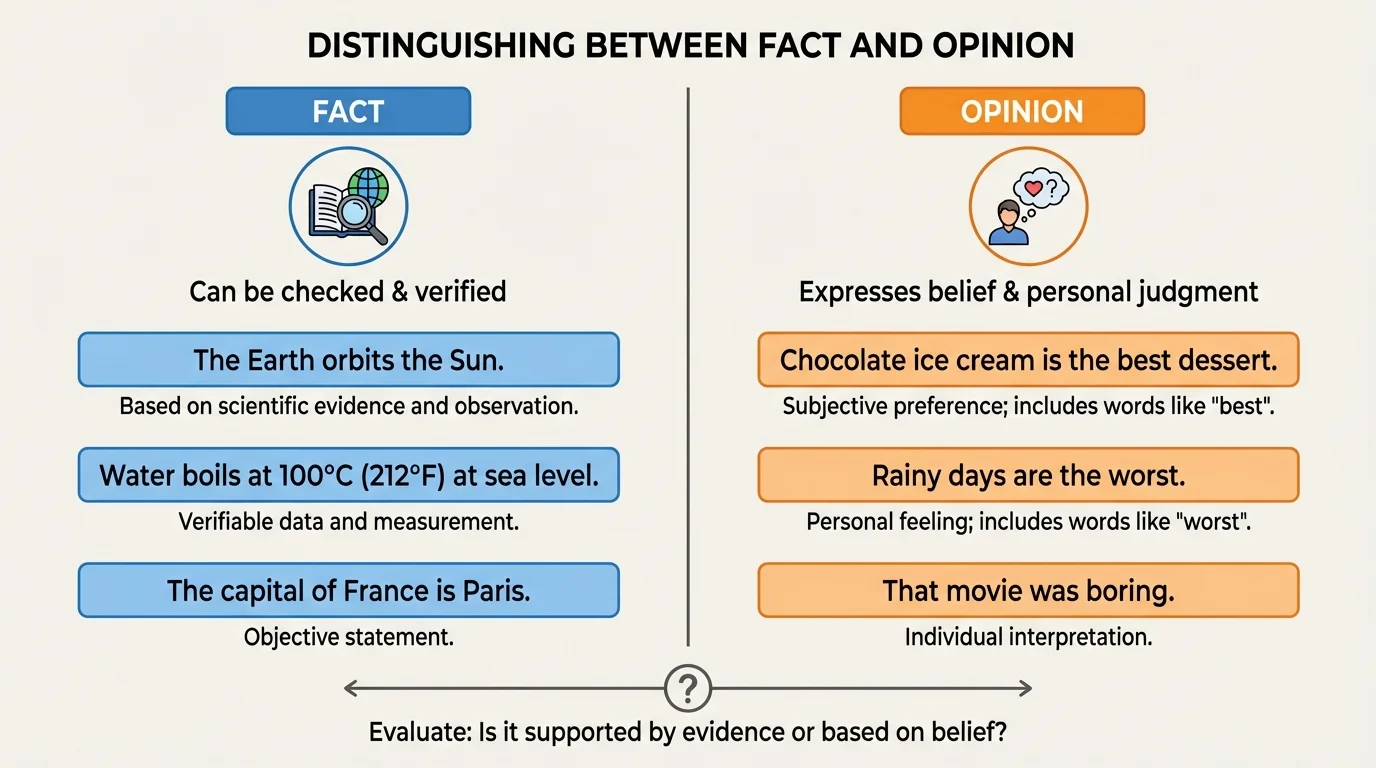
Readers can look for clues in the language of a sentence. Facts usually sound neutral and specific. Opinions often include words that show value or feeling.
Words like best, worst, beautiful, boring, amazing, terrible, important, and should often signal an opinion. For example, "The park has three soccer fields" is factual. "The park should add a skate ramp" is an opinion because it tells what the writer thinks ought to happen.
Still, signal words are only clues, not magic answers. A sentence may sound confident and still be an opinion. "Cats are better pets than dogs" is clearly a judgment even though it does not include the word I. A sentence may also include numbers and still need checking. A statement becomes a fact only if it can truly be verified.
Ask yourself these questions: Can I prove it? Can I check it in a trustworthy source? Does it show a judgment or preference? If the answer to the first two questions is yes, the statement is likely a fact. If the statement mainly expresses a belief or evaluation, it is likely an opinion.
Advertisements often mix facts and opinions on purpose. A cereal box might give factual nutrition information and then add opinion words like delicious or the ultimate breakfast to persuade shoppers.
This is why careful readers do not stop at the first sentence. They notice what kind of claim the author is making and whether it is based on proof or personal judgment.
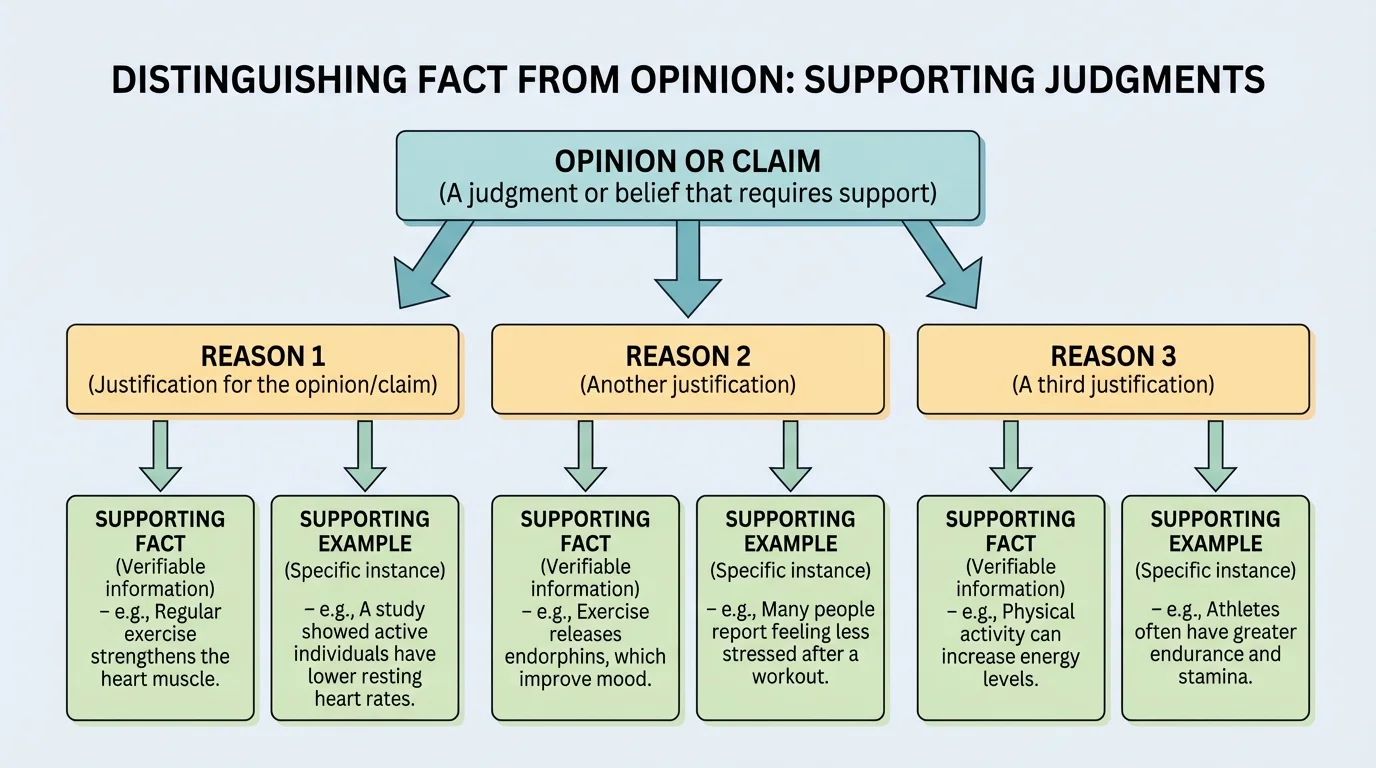
A strong judgment does not stand alone. It is backed by evidence. As [Figure 2] illustrates, a writer begins with a claim, adds reasons, and then supports those reasons with facts, examples, quotes, or details.
Suppose a student says, "Our school library needs more graphic novels." That is an opinion, but it can become a strong, well-supported judgment. The student might explain that many readers enjoy graphic novels, that these books can encourage reluctant readers, and that the current library shelf has very few choices. Those supporting details help the judgment make sense.
Support turns opinion into argument. An unsupported opinion is just a personal statement. A supported opinion includes reasons and evidence that help other people evaluate whether the judgment is sensible, fair, and convincing.
Here is an example of weak support: "The library needs more graphic novels because they are cool." The reason is real, but it is not strong enough for most readers. Here is stronger support: "The library needs more graphic novels because student surveys show high interest, teachers use them in reading groups, and the current collection has only a few titles." The statement is still an opinion, but now it is supported.
A claim is what the writer wants the reader to believe. A reason explains why. Support may include facts, examples, statistics, observations, or statements from experts. The better the support, the stronger the judgment.
Many sentences are not purely one or the other. They may combine factual information with an opinion. This is common in informational texts, especially reviews, editorials, and persuasive articles.
Consider this sentence: "The movie is 95 minutes long and is the funniest film of the year." The first part, "The movie is 95 minutes long," is a fact because it can be checked. The second part, "the funniest film of the year," is an opinion because funniest is a judgment.
Sorting mixed statements
Read the sentence: "The blue whale can grow longer than a school bus and is the most incredible animal in the ocean."
Step 1: Find the part that can be checked.
"The blue whale can grow longer than a school bus" is factual because its length can be measured and compared.
Step 2: Find the part that shows judgment.
"The most incredible animal in the ocean" is an opinion because most incredible depends on personal judgment.
Step 3: Explain why it matters.
One sentence can carry both information and persuasion, so careful readers separate the parts instead of labeling the whole sentence too quickly.
This matters because authors often place a fact next to an opinion to make the opinion sound stronger. Facts can support opinions, but a fact does not automatically turn the opinion into a fact. Readers must still notice which words are checkable and which words are judgments.
As you saw earlier in [Figure 1], the key difference is not whether a sentence sounds serious. The key difference is whether each part can be proved or whether it expresses belief or evaluation.
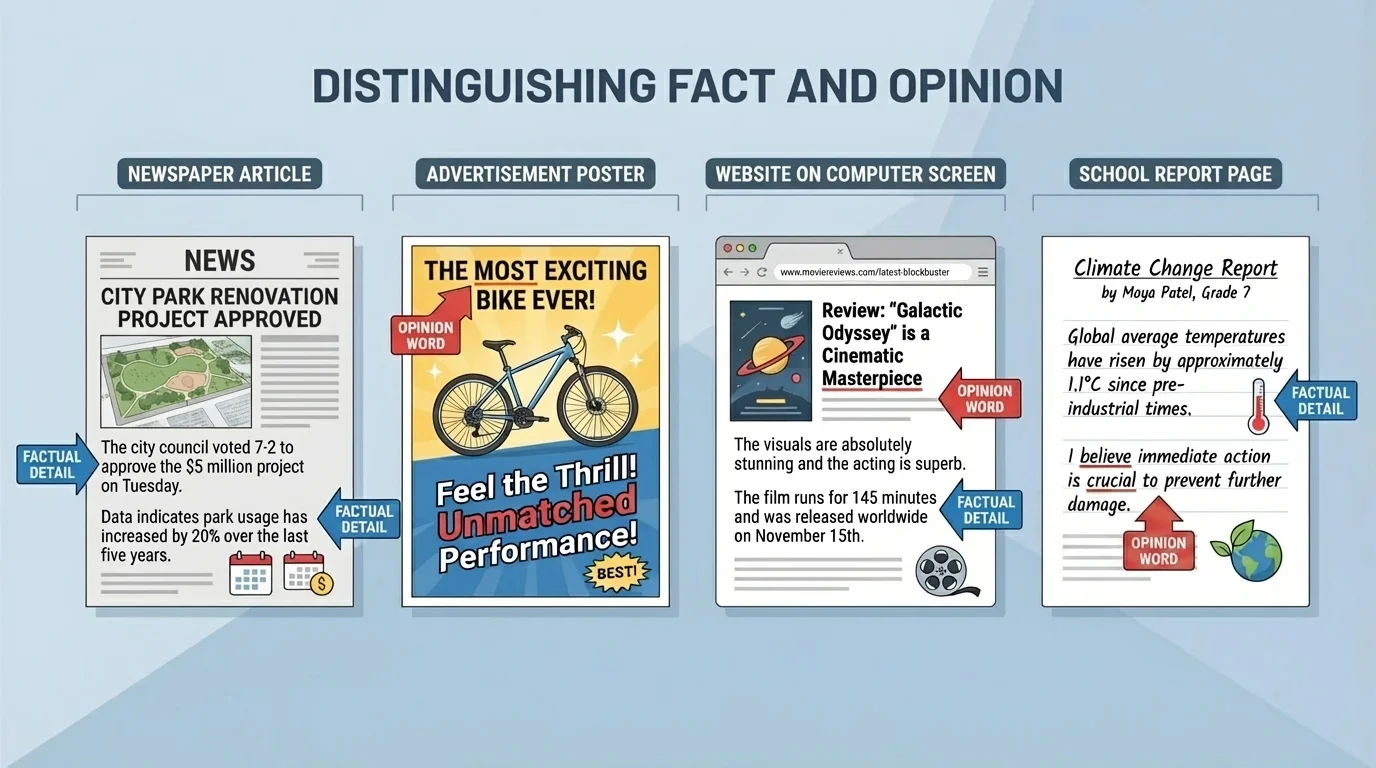
Facts and opinions appear in many kinds of informational texts. [Figure 3] shows that an article, an advertisement, a website, and a school report can all contain both kinds of statements, but they use them in different ways.
In a news article, facts may include names, dates, locations, and quotations. Opinions may appear in quoted speech or in an opinion piece connected to the article. In a science report, facts are often based on observation, research, and data. In an advertisement, facts and opinions are often mixed to persuade the audience to buy something.
Websites need especially careful reading. A site may look professional but still include opinions presented as if they are facts. Good readers check the source, look for evidence, and compare information with other reliable texts.
For example, suppose a website says, "Our town's new sports center opened in March." That is a fact if records confirm it. If the site adds, "It is the most exciting place in town," that is an opinion. If the site explains that the center includes two basketball courts, a pool, and after-school programs, those facts may support the opinion, but the judgment remains a judgment.
When reading charts, captions, and labels, the same rules apply. Data can provide facts, but titles or captions may include opinion language. A chart called "The Best Snacks for Students" already includes a judgment in the title.
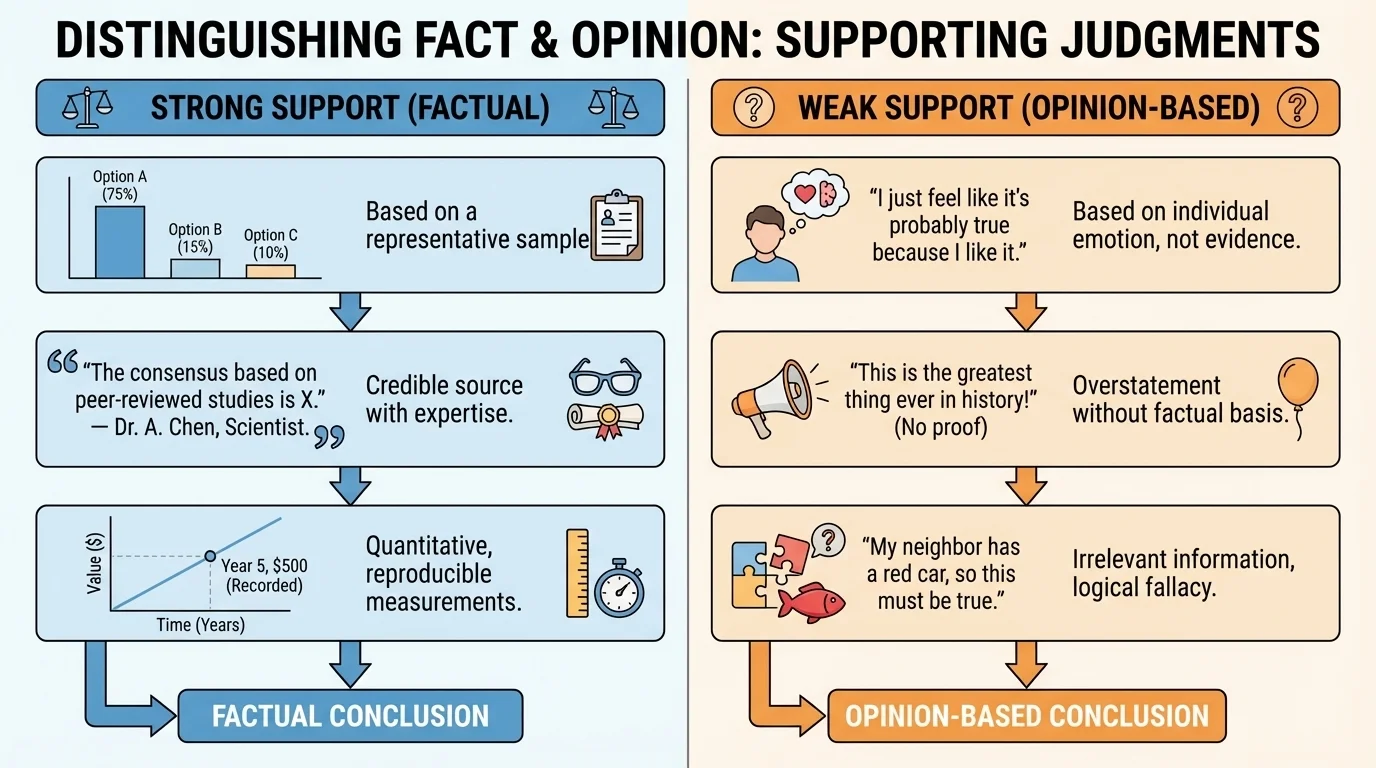
Not all support is equal. As [Figure 4] compares, some evidence strongly supports a judgment, while other support is weak, unrelated, or missing.
Strong support is relevant, clear, and connected to the claim. If someone argues that school lunches should include more fresh fruit, strong support might include nutrition facts, student survey results, or examples from schools where the change worked well.
Weak support may be based only on feelings, exaggeration, or unrelated details. Saying, "School lunches should include more fresh fruit because bananas are cool," is weak support. The idea may be cheerful, but it does not really prove the point. Strong readers ask whether the evidence actually matches the judgment being made.
| Type of support | What it looks like | Example |
|---|---|---|
| Strong support | Specific, checkable, connected to the claim | "A student survey showed that most students wanted more fruit choices." |
| Weak support | Vague, emotional, or not connected well | "Everybody knows fruit is better." |
| No support | Claim with no reason or evidence | "The menu should change." |
Table 1. Comparison of strong, weak, and missing support for judgments.
Reliable sources matter too. A statement from a trained expert, a government report, or direct observation may provide better support than a random comment online. That does not mean experts are always right, but it does mean readers should think carefully about where information comes from.
"A strong opinion is built, not just stated."
Later, when you meet persuasive writing, editorials, reviews, and debates, this skill becomes even more important. You are not just deciding whether you agree. You are deciding whether the author has earned your agreement.
You can use this same skill in your own writing. Start with a clear judgment. Then add reasons. Finally, support those reasons with facts, examples, or details. This makes your thinking easier for others to follow.
Building a supported judgment
Opinion: "Students should have more time for reading choice each week."
Step 1: State the judgment clearly.
The writer makes a claim about what should happen in school.
Step 2: Add reasons.
Choice reading can build reading stamina, increase interest, and help students discover new genres.
Step 3: Add support.
The writer can mention classroom observations, reading logs, student feedback, or examples of students finishing more books when they can choose what they read.
Notice that the final statement is still an opinion. However, it becomes thoughtful and convincing because it is supported. That is what readers and writers do when they provide support for judgments made.
This is also true in everyday life. If you tell a friend, "That game is better," your friend may ask, "Why?" If you answer, "Because it has clearer rules, more teamwork, and shorter waiting time," you are supporting your judgment. Even casual conversations become clearer when opinions are explained.
Just as the structure in [Figure 2] shows, good argument grows from a claim to reasons and then to evidence. Without that structure, a judgment may sound loud, but it does not sound strong.
One common mistake is thinking that if many people agree with something, it becomes a fact. Popularity does not turn opinion into fact. "Most students like pizza" may be support for a decision about lunch, but "Pizza is the best food" is still an opinion.
Another mistake is confusing emotion with evidence. Words like awesome, horrible, or unfair can show strong feelings, but feelings alone are not enough. Strong support needs details that connect clearly to the claim.
A third mistake is accepting every number as truth. Numbers can be powerful, but readers still need to ask where they came from. If a text says, "Nine out of ten kids love this snack," you should ask who counted, how they counted, and whether the source is trustworthy.
Careful readers separate three things: the claim being made, the evidence supporting it, and the author's wording. A sentence may sound convincing because of exciting language, but sound support depends on quality evidence, not flashy words.
When you read closely, you become harder to fool. You notice what is proven, what is believed, and what still needs better support. That is a powerful reading skill for school and for life.
