One tiny word ending can completely change a word's job in a sentence. The word active describes someone or something, but activity names a thing. The word teach is an action, while teacher names a person. Learning to spot these changes is like having a decoder for big words. When you understand how suffixes work, you can unlock meanings even when you have never seen a word before.
A base word is the main part of a word. It carries the core meaning. A suffix is a group of letters added to the end of a base word. Some suffixes only change tense or number, but derivational suffixes often do something more powerful: they create a new word and can change the word's part of speech.
Base word means the main word part that holds the central meaning.
Suffix means letters added to the end of a word.
Derivational suffix means a suffix that makes a new word, often changing the word's meaning or part of speech.
Part of speech means the job a word does in a sentence, such as noun, verb, adjective, or adverb.
For example, in the word kindness, the base word is kind and the suffix is -ness. The word kind is an adjective because it describes a person. The word kindness is a noun because it names a quality. The suffix changed the word's job.
This is called morphology, the study of how word parts work together. When readers use morphology, they look inside a word for clues. Instead of guessing wildly, they ask, "What is the base word? What does the suffix do?"
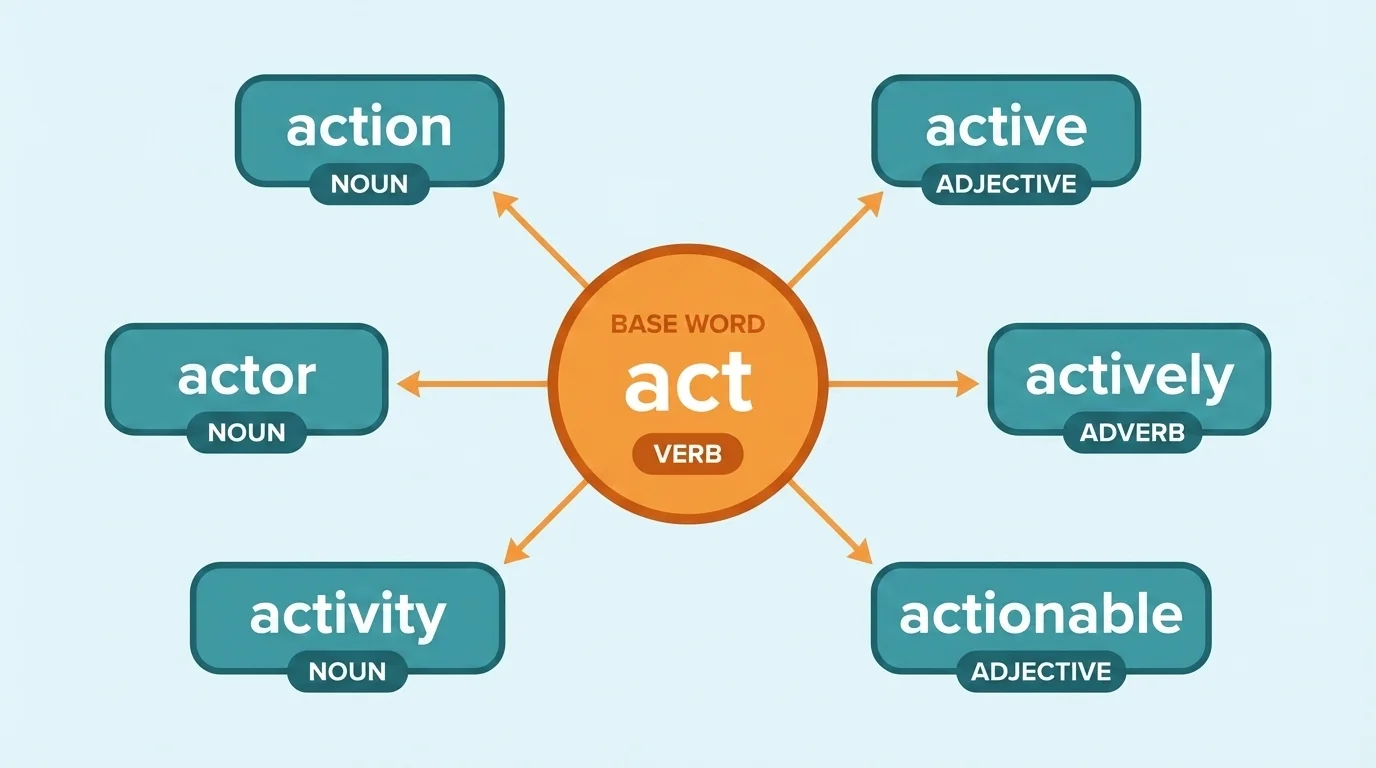
There are four important parts of speech to watch here: a noun names a person, place, thing, or idea; a verb shows action or being; an adjective describes a noun; and an adverb usually describes a verb, adjective, or another adverb. One base word can grow into a whole family of related words, as [Figure 1] shows with the word act.
Look at this set: act, action, active, actively, actor, and activity. These words are connected in meaning, but they do different jobs in sentences. That is why derivational suffixes matter so much when you read.
Here is how the jobs change:
Verb to noun: invent becomes invention. The first word shows an action. The second names a thing or idea.
Adjective to noun: dark becomes darkness. The first describes. The second names a condition.
Noun to adjective: care becomes careful. The first names an idea. The second describes a person, thing, or behavior.
Adjective to adverb: quiet becomes quietly. The first describes a noun. The second tells how something happens.
Watch how sentence meaning changes too. In "The puppy is playful," playful describes the puppy. In "The puppy loves play," play is a noun. In "The puppy plays outside," plays is a verb. Related words may come from the same base, but their jobs can shift in important ways.
Many derivational suffixes follow patterns. If you learn the patterns, you can make smart guesses about unknown words. A pattern chart, as shown in [Figure 2], helps you notice that certain endings usually create certain parts of speech.
These patterns are not perfect every single time, but they are very useful. Readers do not need to memorize every word in the dictionary. They need strong clues, and suffixes provide those clues.
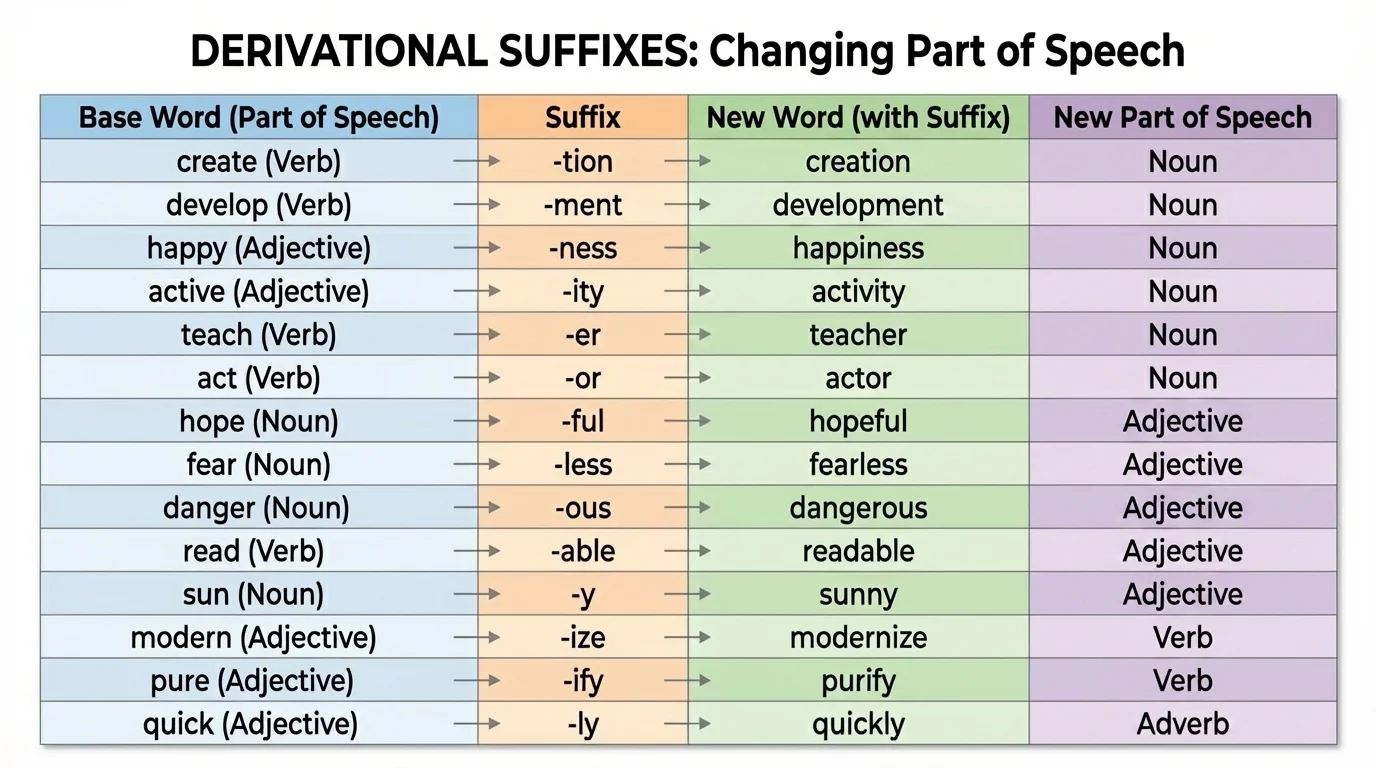
Suffixes that often make nouns include -tion, -sion, -ment, -ness, -ity, -er, and -or.
Examples: celebrate becomes celebration, move becomes movement, happy becomes happiness, active becomes activity, and teach becomes teacher.
Suffixes that often make adjectives include -ful, -less, -ous, -able, -ible, and -y.
Examples: help becomes helpful, hope becomes hopeless, danger becomes dangerous, comfort becomes comfortable, and rain becomes rainy.
Suffixes that often make verbs include -ize and -ify.
Examples: modern becomes modernize, and simple becomes simplify. These new words express actions.
The suffix that often makes adverbs is -ly.
Examples: quick becomes quickly, brave becomes bravely, and final becomes finally.
| Suffix | Usually Makes | Base Word | New Word |
|---|---|---|---|
| -ness | Noun | kind | kindness |
| -ity | Noun | active | activity |
| -ment | Noun | enjoy | enjoyment |
| -er | Noun | run | runner |
| -ful | Adjective | care | careful |
| -less | Adjective | fear | fearless |
| -able | Adjective | wash | washable |
| -ly | Adverb | soft | softly |
Table 1. Common derivational suffixes, the parts of speech they usually create, and sample words.
Notice the word usually. English has patterns, but English also has surprises. That is why readers should use both morphology and context instead of depending on only one clue.
The ending -er often names a person who does something, like writer or runner, but it can also name a thing, like toaster. The suffix still helps form a noun, even though the noun is not always a person.
When you read science, social studies, or even game instructions, these patterns appear everywhere. Words like electricity, careless, movement, and finally become much easier to understand when you notice their parts.
A word family is a group of related words built from the same base. Studying word families helps you see both meaning and grammar. If you know one word well, you can often understand several others connected to it.
[Figure 3] Take the base word act. It can become action, active, actively, activity, and actor. All of these words connect to doing something, but each one fits into sentences differently. The relationships among these words become even clearer when you compare them the way we saw earlier in [Figure 1].
Sometimes adding a suffix changes the spelling too. Readers need to look for the hidden base word, even when it is not perfectly unchanged.
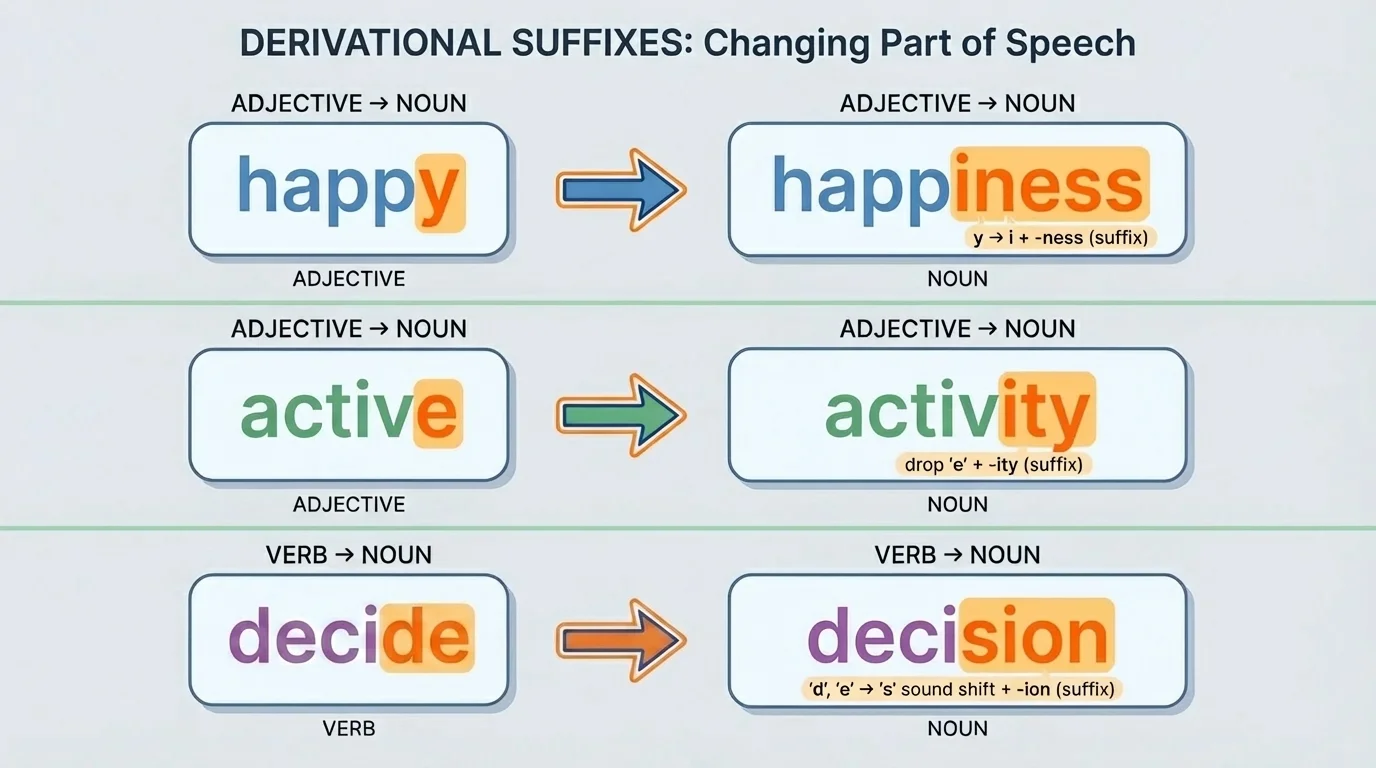
Here are some common spelling changes:
y changes to i: happy becomes happiness. The base word is still there, but one letter changes.
A final e may drop: create becomes creation. The word changes shape a little when the suffix is added.
The sound may shift slightly: decide becomes decision. The spelling and pronunciation do not stay exactly the same.
Here is another strong word family: excite, exciting, excited, and excitement. The word excite is a verb. Exciting and excited are adjectives. Excitement is a noun. If a sentence says, "The roller coaster caused great excitement," the suffix -ment helps you know that excitement names a feeling or state.
Word family example
Look at the base word beauty.
Step 1: Start with the noun.
Beauty names a quality, so it is a noun.
Step 2: Add a suffix to make an adjective.
Beautiful uses -ful and describes something.
Step 3: Add a suffix to make an adverb.
Beautifully uses -ly and tells how something happens.
One base idea can produce several related words with different jobs.
Word families are especially helpful when you meet longer academic words. If you know equal, then equality may be easier to understand. If you know possible, then possibility may make sense too.
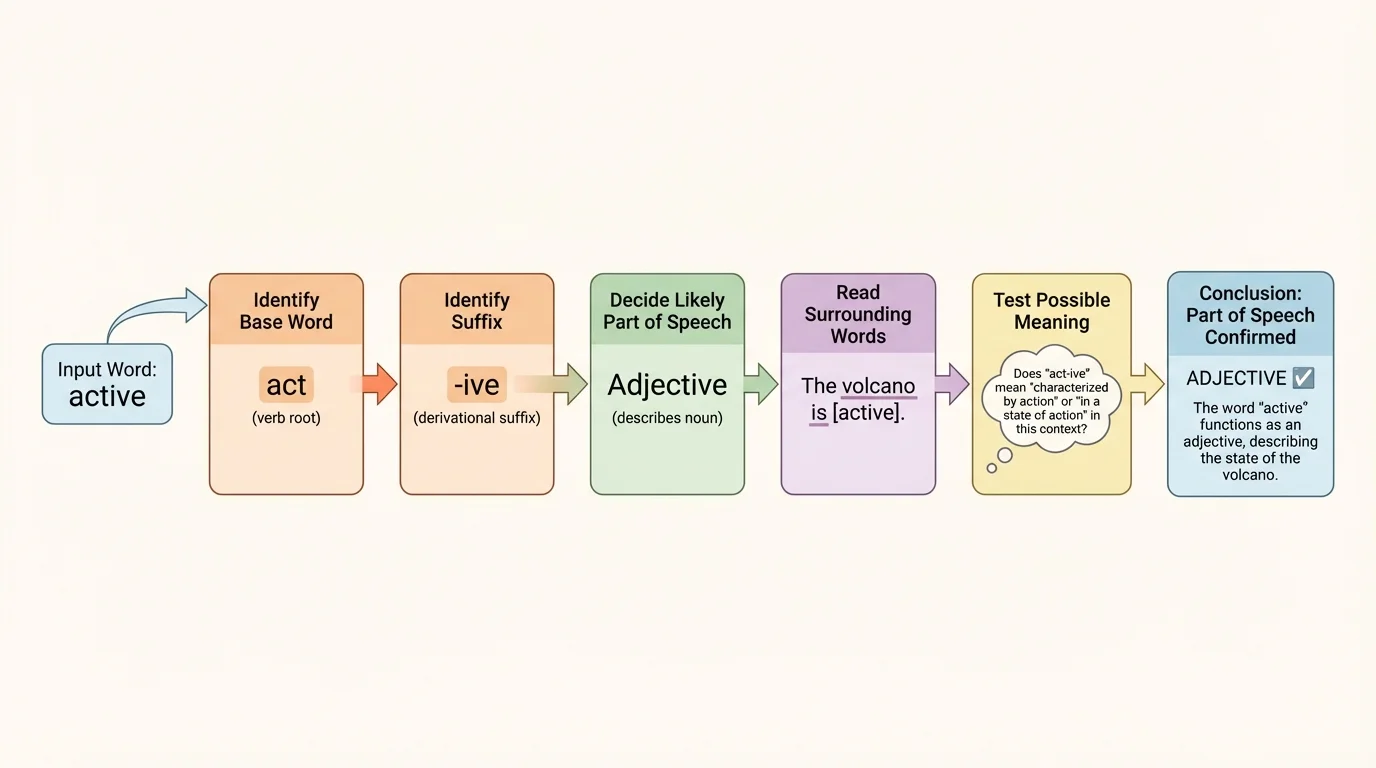
Strong readers do not rely on suffixes alone. They combine suffix clues with context clues, the hints from the rest of the sentence or paragraph. A good strategy follows a clear order, as [Figure 4] shows: find the base word, notice the suffix, guess the part of speech, then test the meaning in the sentence.
This matters because a suffix can point you in the right direction, but the sentence confirms whether your guess makes sense.
Read this sentence: "The city celebrated the artist's creativity." If you know the base word create, you can connect it to making something. The suffix -ivity in creativity helps show that the word is a noun. The sentence tells you it is something the artist has or shows. So creativity means the quality of being able to create new ideas.
Now read this sentence: "The hikers moved cautiously across the icy bridge." The suffix -ly tells you that cautiously is an adverb. It describes how the hikers moved. Even if you were unsure at first, the sentence helps you confirm the meaning: they moved in a careful way.
Consider another example: "Her kindness made the new student feel welcome." The base word kind is an adjective. The suffix -ness turns it into a noun. The sentence shows that this noun names a quality or behavior that helped someone.
Use both inside-the-word clues and outside-the-word clues. Inside the word, look for the base and suffix. Outside the word, read the nearby words and ask what job the word is doing in the sentence. These two kinds of clues work best together.
Suppose you read, "The musician performed skillfully." You may know the noun skill. Adding -ful makes skillful, an adjective. Adding -ly makes skillfully, an adverb. The sentence tells you it describes how the musician performed.
Later, when you meet another long word, this same strategy still works. That is why [Figure 4] remains useful beyond a single example. It gives you a repeatable way to decode unfamiliar words in stories, articles, and textbooks.
Knowing derivational suffixes makes reading faster and smarter. Instead of stopping at every unfamiliar word, you can break the word apart and build a likely meaning. This is especially useful in subjects with many academic terms. Science books use words like activity, movement, and electrical. Social studies texts use words like government and equality. Literature may include words like graceful or sadness.
This knowledge also improves writing. If you want to describe a character, you might choose an adjective such as thoughtful. If you want to name a quality, you might use a noun such as thoughtfulness. If you want to tell how an action happened, you might use an adverb like thoughtfully. Picking the right form helps your sentence say exactly what you mean.
You may already know that prefixes are added to the beginning of words and suffixes are added to the end. This lesson focuses on suffixes that do more than add tense or number. These suffixes often build entirely new words.
Writers often choose between related forms on purpose. Compare these sentences: "Maya is creative." "Maya showed creativity." "Maya created a mural." The words are related, but each sentence needs a different part of speech. Understanding derivational suffixes helps you make those choices clearly.
Not every word ending is derivational, and not every suffix changes the part of speech. For example, plural -s in dogs changes number, not part of speech. Past tense -ed in jumped changes time, not usually the basic job of the word. Derivational suffixes are special because they often create a new word.
Some words can be tricky because English has borrowed words from many languages. That means patterns help a lot, but they are not perfect. A good reader stays flexible.
Also remember that a word can sometimes have more than one related form. From music, you may get musical and musician. From magic, you may get magical. From use, you may get useful and useless, but usually is not actually part of that family even though it looks similar at first glance. That is why meaning matters as much as spelling.
Reading an unfamiliar word
Read the sentence: "The volcano's destructive power changed the landscape."
Step 1: Find the base word.
The base word is destroy, which means to ruin.
Step 2: Notice the suffix.
The ending -ive often creates an adjective.
Step 3: Check the sentence.
Destructive describes power, so it is acting like an adjective.
The word means something like "causing destruction" or "able to destroy."
If you keep practicing this kind of thinking while you read, big words become less scary. You start to see patterns instead of puzzles.
Derivational suffixes are powerful because they connect meaning, grammar, and reading strategy all at once. When you understand how words are built, you become better at unlocking new vocabulary across every subject.
