Have you ever been reading a great story and suddenly hit a word that seems to block the whole sentence? Strong readers do not always stop and reach for a dictionary right away. Instead, they act like word detectives. They look inside the word, around the word, and even think about other meanings the word might have. That is how readers keep moving, stay focused, and understand more of what they read.
Unknown words show up everywhere: in novels, science articles, social studies books, directions for games, and even online posts. If you can figure out what a hard word probably means, you become a more confident reader. You also become better at writing, because the more you understand words, the more carefully you can choose your own.
Sometimes a word is unfamiliar because it is long. Sometimes it is familiar but used in a surprising way. Sometimes it looks like a word you know, but it has extra parts added to it. Readers who can infer meaning do not just memorize definitions. They learn how words work.
To infer means to make a smart guess based on evidence. When you infer the meaning of a word, you are not guessing wildly. You are using clues. Those clues usually come from three main sources: the word's structure, the sentence or paragraph around it, and your knowledge that some words can have more than one meaning.
Structural analysis means examining the parts of a word to help determine its meaning. Context clues are hints in the words and sentences around an unfamiliar word. Multiple-meaning words are words that have more than one definition, and the sentence helps the reader choose the correct one.
These strategies work best together. A word part might suggest one meaning, while the sentence confirms it. Or the sentence might tell you that a common meaning does not fit, so you need to think of a different one.
When readers meet an unknown word, they can ask three useful questions. First, What parts do I recognize inside the word? Second, What clues do the nearby words give me? Third, Does this word have another meaning that fits better here?
For example, read this sentence: "The hikers were exhausted after climbing the steep mountain trail for six hours." Even if you do not know the word exactly, the sentence tells you the hikers climbed for a long time, so they were probably very tired. Here, the context helps you infer the meaning quickly.
Now read this sentence: "The kitten was fearless and would pounce on any moving shoelace." If you know that cats jump suddenly when they play or hunt, you can infer that pounce means to spring or jump quickly. The context gives action clues.
A morpheme is a meaningful part of a word, and good readers look for those parts, as [Figure 1] shows. Many unfamiliar words become less mysterious when you break them apart into a prefix, a base word or root, and a suffix.
A prefix is a word part added to the beginning of a word. A suffix is added to the end. A root or base word is the main part that carries the core meaning. If you know the meanings of common word parts, you can often figure out the meaning of a longer word.
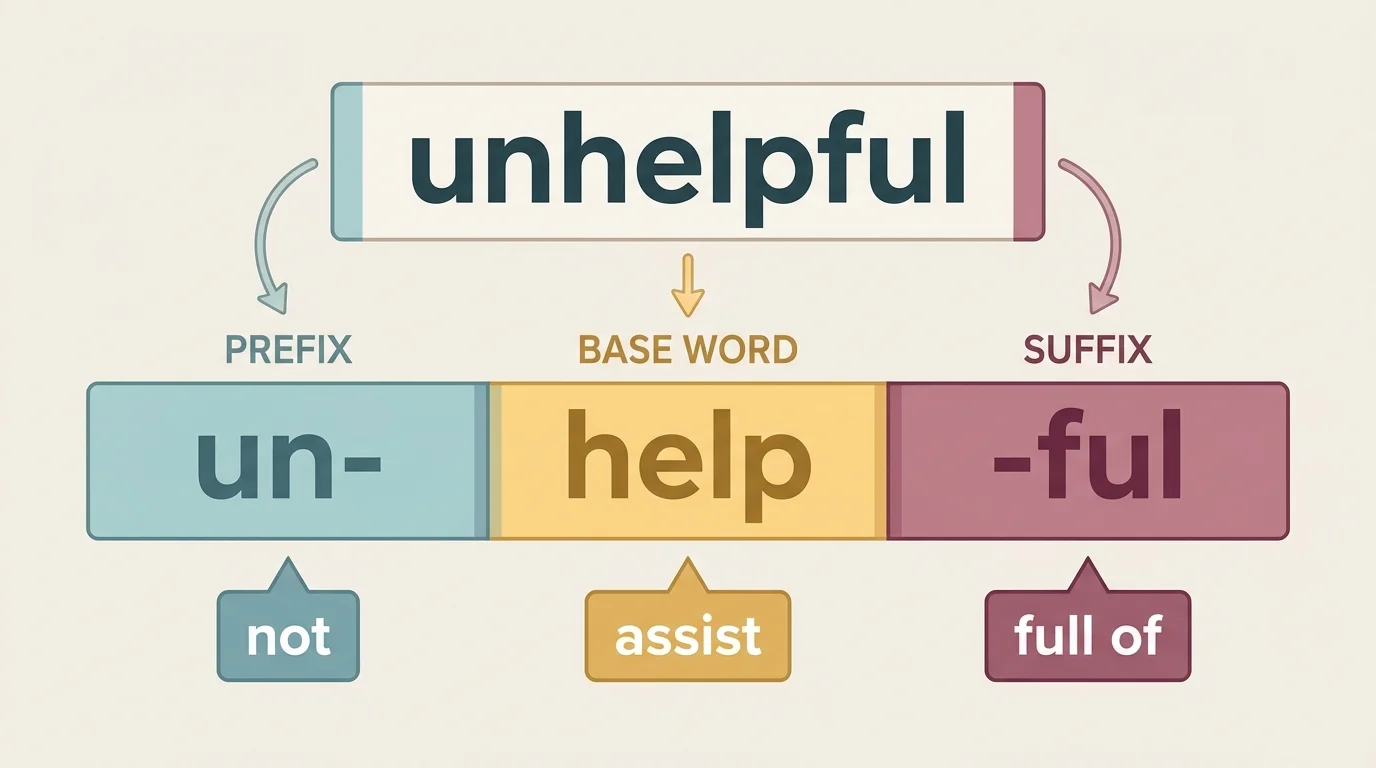
Take the word unfriendly. The prefix un- often means "not." The base word friend is familiar. In this word, -ly is part of friendly, which describes someone as kind or pleasant. Put the parts together, and unfriendly means "not acting in a friendly way."
Now think about careless. The base word is care. The suffix -less means "without." So careless means "without care" or "not being careful."
Sometimes structural analysis helps even when only part of the word is familiar. In the word rebuild, the prefix re- means "again," and build is the base word. So rebuild means "build again."
How word parts help readers
Word parts are like puzzle pieces. One part may not tell the whole meaning, but several parts together can guide your thinking. If you know that pre- means "before," view relates to seeing, and -er can mean "a person or thing," then previewer would likely mean a person or thing that sees something before others do. Even if the exact word is new, the parts point you in the right direction.
As seen earlier in [Figure 1], breaking words into meaningful pieces is especially useful with longer academic words in science and social studies. A word like misbehavior can be split into mis-, meaning "wrongly" or "badly," and behavior, meaning the way someone acts. That leads to the meaning "bad behavior."
You do not need to memorize hundreds of word parts at once. Start with the ones that appear often in grade-level reading. The more you notice them, the faster they become useful.
| Word Part | Kind | Meaning | Example | Meaning of Example |
|---|---|---|---|---|
| un- | Prefix | not | unkind | not kind |
| re- | Prefix | again | retell | tell again |
| pre- | Prefix | before | preview | see before |
| dis- | Prefix | not, opposite of | disagree | not agree |
| -ful | Suffix | full of | joyful | full of joy |
| -less | Suffix | without | hopeless | without hope |
| -er | Suffix | one who, more | teacher | one who teaches |
| -able | Suffix | able to be | washable | able to be washed |
| port | Root | carry | transport | carry across |
| spect | Root | look | inspect | look into carefully |
Table 1. Common prefixes, suffixes, and roots that help readers infer word meanings.
Suppose you read: "The glass dish is breakable, so carry it carefully." If you know -able means "able to be," then breakable means "able to be broken." The rest of the sentence confirms that meaning because it warns you to carry it carefully.
Or read: "The museum guide asked visitors to inspect the fossil closely." If you know the root spect means "look," then inspect probably means "look at carefully."
Sometimes the fastest way to infer meaning is by using context clues. The words around an unfamiliar word act like hints, as [Figure 2] explains. Authors often give clues on purpose because they want readers to understand without stopping every few seconds.
There are several common types of context clues. One type is a definition clue, where the sentence directly explains the word. Another is a synonym clue, where a nearby word means almost the same thing. An antonym clue gives an opposite idea. An example clue gives examples that reveal the meaning. A general sense clue comes from the whole sentence or paragraph.
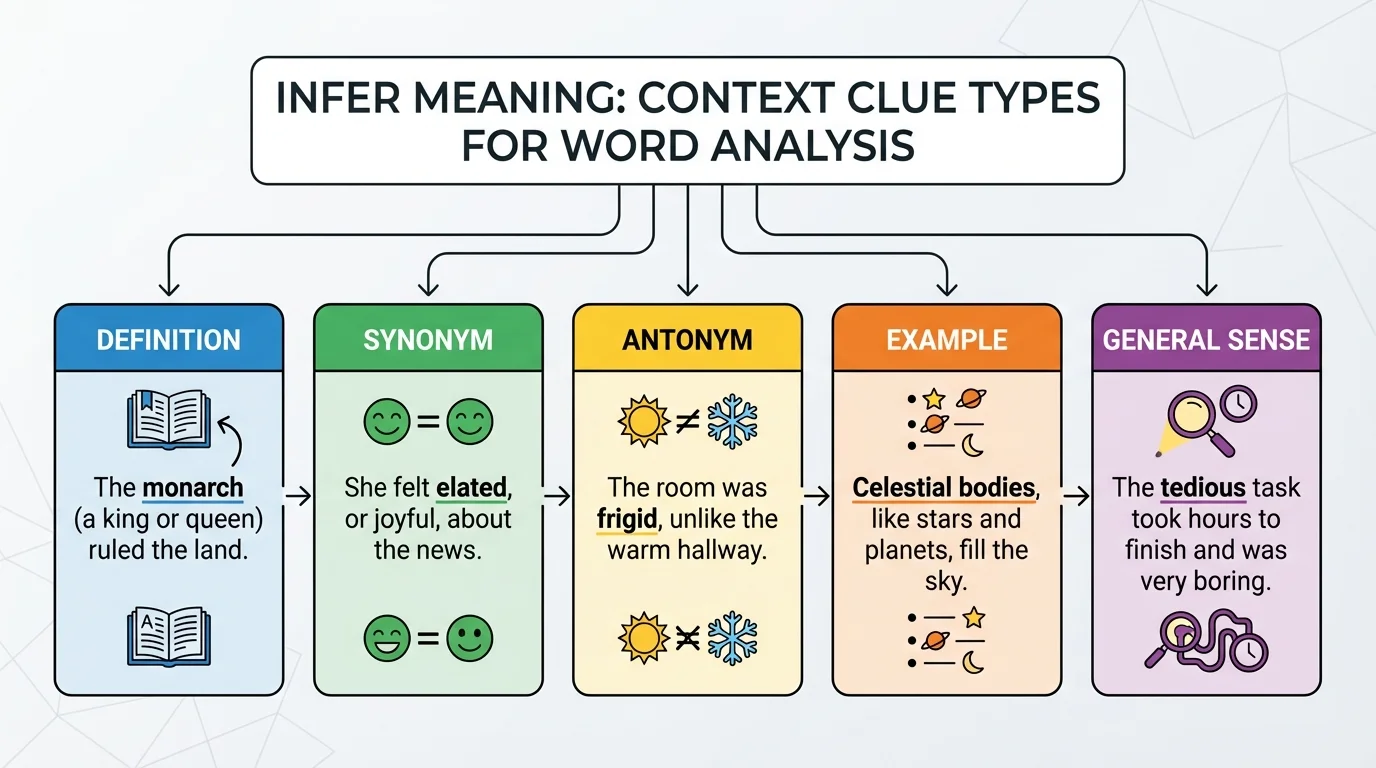
Look at a definition clue: "A habitat, the natural home of a plant or animal, must provide food, water, and shelter." The phrase after the comma defines the word, so habitat means the natural home of a plant or animal.
Now a synonym clue: "The room was silent, completely quiet except for the ticking clock." The words completely quiet help you infer that silent means quiet.
Here is an antonym clue: "Unlike his timid sister, Marcus was bold and eager to speak first." If Marcus is bold, and his sister is the opposite, then timid means shy or not brave.
Here is an example clue: "Celestial objects, such as stars, planets, and moons, can be seen in space." The examples show that celestial relates to space.
A general sense clue works a little differently. Read: "Nina glanced at the dark clouds and quickened her pace. She knew the storm was imminent." Even if no direct definition appears, the whole idea suggests the storm is about to happen soon.
Using context clues in one sentence
Sentence: "After the race, Luis was famished, so he ate two sandwiches, an apple, and a bowl of soup."
Step 1: Notice the clue
The sentence tells what Luis does after the race: he eats a lot of food.
Step 2: Connect the clue to the unknown word
If someone eats that much, the word famished probably means very hungry.
Step 3: Check the meaning in the whole sentence
"After the race, Luis was very hungry" makes sense, so the inferred meaning fits.
Later, when you meet the word again, you will probably remember it more easily because you figured it out from a meaningful situation. As shown in [Figure 2], different context clue types all help readers reach the same goal: understanding the word well enough to keep reading with confidence.
Some multiple-meaning words can trick readers because a familiar word is used in a new way. You may know one meaning very well, but the sentence may require a different meaning.
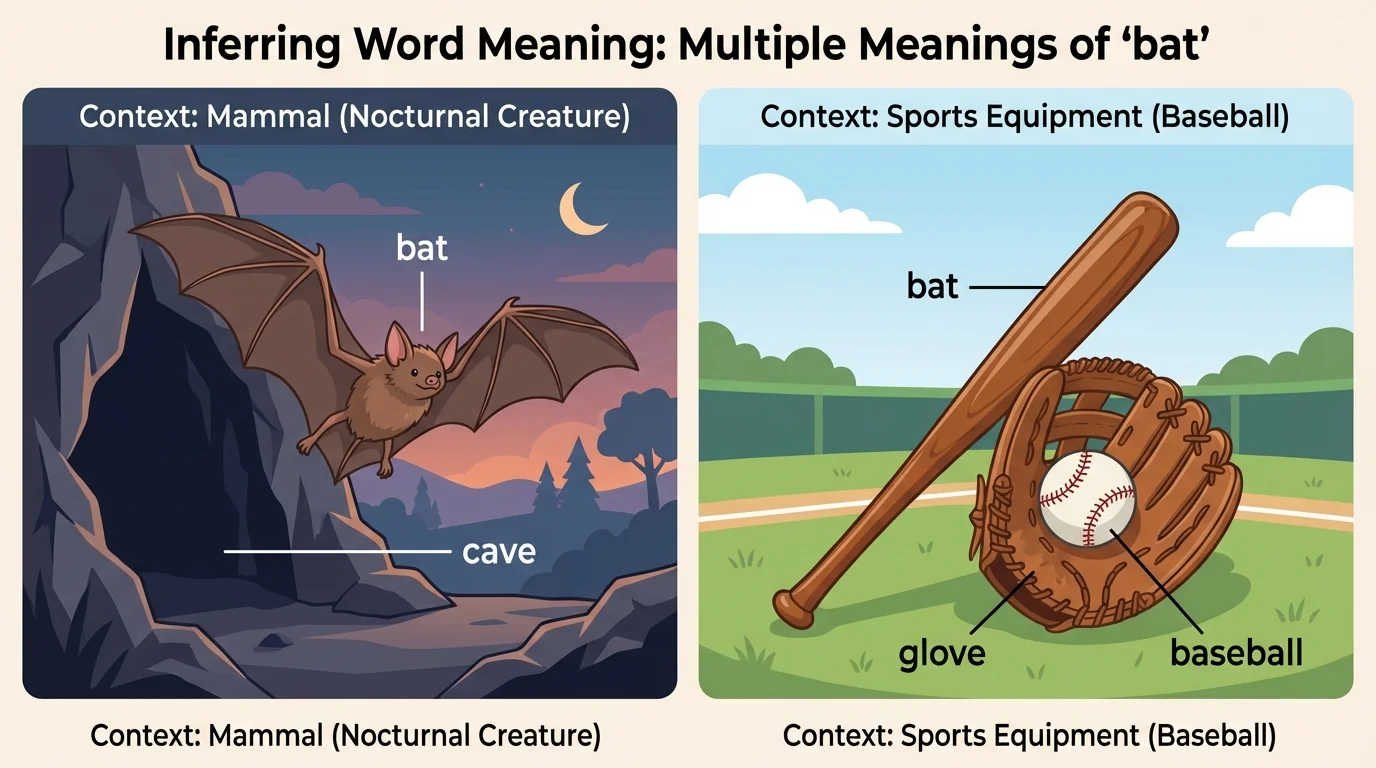
[Figure 3] Think about the word bat. In one sentence, "The bat flew out of the cave at dusk," it means a flying mammal. In another sentence, "Jaden carried his bat to baseball practice," it means sports equipment. The spelling is the same, but the meaning changes.
The word bank is another example. In "We sat on the grassy bank of the river," it means the land beside the river. In "My mother went to the bank to deposit a check," it means a place where money is kept.
The word current can mean happening now, or it can mean moving water or air. In science, "The river's current carried the leaf downstream" uses one meaning. In social studies, "current events" uses another meaning.
This is why readers should not grab the first meaning that comes to mind. They should ask, Does that meaning fit this sentence? If not, they should try another meaning they know. The scenes in [Figure 3] make this clear: the same letters can point to different ideas depending on the situation.
Some of the most common English words have many meanings. The word run can describe moving fast, operating a machine, managing something, and more. That is one reason context is so important in reading.
Writers depend on readers to use context wisely. In a mystery story, a word like case may mean a problem to solve. In a classroom, it may mean a container, such as a pencil case. In grammar, it can even refer to the form of a pronoun. The surrounding words tell you which meaning belongs.
The best readers often use more than one strategy at once. Suppose you read: "The villain's disappearance was sudden, and no one knew where he had gone." You might notice the prefix dis-, but the strongest clue is the rest of the sentence: no one knew where he had gone. That tells you disappearance means the act of going away or no longer being seen.
Now try a longer word in an academic sentence: "The reusable bottle is a practical choice because it can be washed and used again." Structural analysis helps here. The prefix re- means again, and the base idea of use is clear. So reusable means able to be used again. The context about washing and using the bottle confirms it.
Combining structure and context
Sentence: "The desert landscape looked lifeless; no plants swayed, no insects buzzed, and no animals could be seen."
Step 1: Break apart the word
The base word is life. The suffix -less means "without."
Step 2: Build a likely meaning
Lifeless probably means "without life."
Step 3: Use the sentence to confirm
The sentence says there are no visible plants, insects, or animals, so "without life" fits the context.
Sometimes one clue is weak, but two clues together are strong. If a word part gives only a rough idea, the sentence around it may sharpen the meaning. If the context is a little vague, the word parts can narrow the choices.
Inferring a word meaning is helpful, but readers should also test their idea. One good way is to replace the unfamiliar word with your guessed meaning and reread the sentence. If the sentence still makes sense, your inference is probably close.
For example, in the sentence "The fragile vase cracked when it slipped from her hands," you can infer that fragile means easily broken. Replace the word: "The easily broken vase cracked..." That makes sense.
Another check is to read beyond the sentence. A later sentence may confirm or correct your guess. Strong readers stay flexible. They do not cling to a meaning that no longer fits.
Words do not live alone. Earlier reading skills still matter here: noticing main ideas, paying attention to details, and thinking about the topic all support word meaning. A word that appears in a science passage may have a different meaning than the same word in a story.
It also helps to notice the part of speech of the unknown word. Is it acting like a noun, verb, adjective, or adverb? In "The puppy will charge across the yard," charge acts like a verb. In "The store added an extra charge," it acts like a noun. The role of the word changes the meaning.
These strategies are useful far beyond language arts class. In science, students meet words like prediction, transport, and microscopic. Structural analysis can help with all of them. In social studies, words like government, dispute, and historic often become clearer through context.
In everyday life, you may need to infer meanings while reading game rules, recipes, signs, websites, or instructions for a device. If a recipe says to combine ingredients gently, the context tells you not to stir roughly. If a sign says a path is restricted, the structure and context suggest it is limited or not open to everyone.
Word detective skills also make reading more enjoyable. Instead of getting stuck, you stay inside the story or article. You build independence. You learn not only one word, but also a way of thinking that works on many words.
That is the real power of structural analysis, context clues, and multiple meanings. They help readers unlock meaning even when a word is unfamiliar at first glance.
